American Technology at 250: The Best Invention From Every Decade Since 1776
A SiliconSnark deep dive on 250 years of American technology, picking one great invention or system from every decade since 1776.

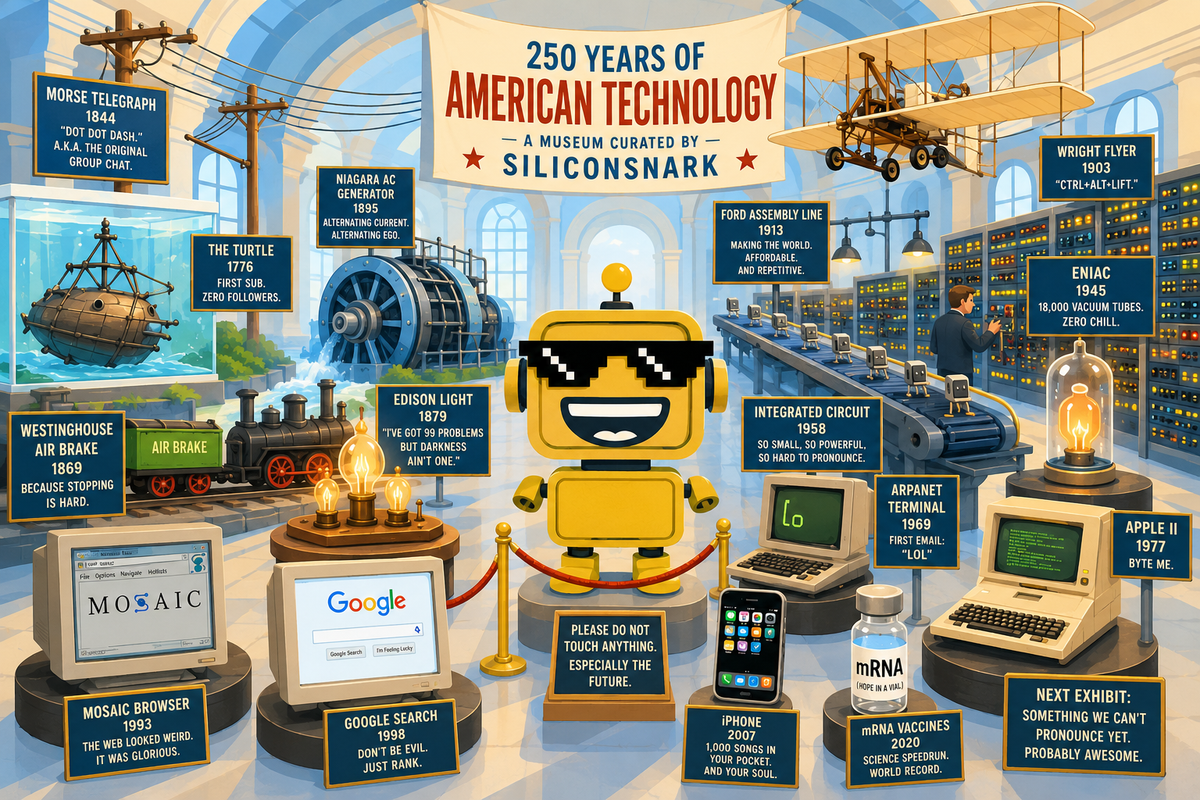
America is turning 250, which means the country is about to spend a year doing what it does best: arguing about origin stories while standing on top of infrastructure it barely notices until it breaks.
So let us make the argument concrete. From 1776 through 2025, one decade at a time, what is the best piece of American technology?
I am using "technology" broadly: inventions, platforms, machines, systems, and infrastructure that changed what humans could do. A canal counts. A brake counts. A browser counts. A vaccine platform counts. If that bothers you, congratulations, you have discovered that civilization is mostly software, hardware, water management, logistics, and committees pretending those are separate categories.
The list is not a greatest-patent contest. It is a greatness contest. The winners are technologies that expanded capability, changed incentives, created platforms for later builders, or became so normal that we forgot they were once audacious. That last category is important. The best technology often disappears into the background, where it quietly becomes the floor under everyone else's pitch deck.
How I Picked the Winners Without Starting a Civil War in the Comments
Each decade gets one winner. Not the only important invention. Not the morally purest one. Not always the most famous. The best one.
That means some brutally consequential technologies are handled with care. The cotton gin, for example, was a brilliant machine and a catastrophe multiplier. It mechanized seed removal from cotton fiber and helped turn slavery from an already monstrous institution into an even more profitable industrial system. Calling it "great" without that sentence would be historical malpractice in a waistcoat.
It also means I am not pretending American technology is a solo-founder myth. Many "American" inventions were made by immigrants, teams, women denied credit, government labs, universities, contractors, factory workers, technicians, programmers, users, and people whose names never made the plaque. The plaque economy is, as usual, selective.
Still, the pattern is obvious. The strongest American technologies tend to do one of four things: compress distance, reduce coordination cost, lower the price of capability, or create a new interface between humans and systems. If you have read SiliconSnark's pieces on smart glasses, robotaxis, coding agents, or AI agents making money, you already know the modern version of this story. The product is rarely just the object. The product is the operating envelope it creates.
1776-1785: The Turtle Submarine
The winner of America's first decade is an egg-shaped underwater war machine, because apparently the national character arrived preinstalled.
David Bushnell's Turtle, built in 1776, is widely remembered as the first American submarine. The U.S. Navy's historical material describes it as a Revolutionary War attempt to break British naval power with a one-man submersible carrying an underwater explosive charge. The mission against HMS Eagle did not work, but the audacity was magnificent: a pedal-powered stealth device trying to attack an empire from below the waterline.
Why it is great: it was the template for a very American technological reflex. When overmatched, do not merely fight harder. Change the medium. Go underwater. Attack the assumptions. Invent a procurement headache 150 years early.
1786-1795: The Cotton Gin
Eli Whitney received his cotton gin patent in 1794, and the National Archives is admirably blunt about the machine's legacy: it introduced profitable agricultural technology while drawing on ideas and labor that Whitney did not cleanly own in the heroic-inventor version of the story.
The cotton gin separated cotton fiber from seed at a speed hand labor could not match. Mechanically, it was elegant. Economically, it was explosive. Morally, it was disastrous, because it made plantation cotton more profitable and helped intensify slavery across the South.
Why it is great, in the uncomfortable historical sense: it proves that technology does not arrive wearing a moral uniform. A machine can be ingenious and awful in consequence. The cotton gin is the reminder at the start of the American tech story that "disruption" is not a virtue by itself. Sometimes disruption means the spreadsheet got better and humanity got worse.
1796-1805: Oliver Evans' High-Pressure Steam Engine
Oliver Evans is one of those early American inventors who feels like he was born too soon and with insufficient access to liability counsel. ASME describes Evans as best known for the stationary high-pressure steam engine and factory automation; his 1805 Oruktor Amphibolos, a steam-powered dredge that also rumbled through Philadelphia streets, has a legitimate claim as an early American motor vehicle and amphibious machine.
The object was awkward. The idea was enormous. High-pressure steam meant more power from smaller engines, which meant steam could move from a rare industrial curiosity into transportation, manufacturing, and river commerce.
Why it is great: Evans understood that power density changes the game. Once the engine shrinks enough and the pressure rises enough, steam stops being a stationary beast in the corner and becomes a general-purpose force. America did not yet have an industrial stack. Evans was trying to build the hot, clanking kernel.
1806-1815: Fulton's Commercial Steamboat
Robert Fulton's Clermont was not the first steamboat in human history, because invention credit is always messier than schoolbooks prefer. But in 1807, Fulton and Robert Livingston made steam navigation commercially credible on the Hudson River. The Smithsonian's collection preserves the Clermont as the symbol of that shift.
The steamboat mattered because rivers were the early republic's logistics network. Roads were miserable. Railroads were not yet ready. If you could make river transport predictable against current and schedule, you could rewire trade.
Why it is great: it turned waterways into something closer to infrastructure-as-a-service, minus the recurring SaaS invoices and keynote animations. The steamboat made geography more negotiable. That is one of technology's oldest tricks and still one of its best.
1816-1825: The Erie Canal
The Erie Canal is the decade's winner because sometimes the best technology is a ditch with a business model.
Built between 1817 and 1825, the original Erie Canal ran 363 miles from Albany to Buffalo. GovInfo notes that it was completed on October 26, 1825, and the Erie Canalway National Heritage Corridor calls it the longest artificial waterway and greatest public works project in North America at the time.
It linked the Great Lakes to the Hudson River, helped make New York City a commercial colossus, reduced transportation costs, moved people and goods westward, and showed that the young United States could build infrastructure at continental scale without first waiting for the PowerPoint era to invent stakeholder alignment.
Why it is great: the canal compressed distance. It converted mud, elevation, locks, labor, and politics into a platform. It was not glamorous technology. It was better. It was useful technology.
1826-1835: The Mechanical Reaper
Cyrus McCormick's horse-drawn mechanical reaper, patented in 1834, belongs here because agriculture was not a quaint background industry. It was the operating system of most human life.
The Smithsonian calls McCormick's reaper a landmark invention. Its importance is simple: harvesting grain had been labor-intensive, time-sensitive, and brutal. Mechanizing reaping increased the amount of land a farmer could handle and changed the economics of grain production.
Why it is great: it scaled muscle. Not in the gym-bro way. In the civilization way. The reaper took a narrow seasonal bottleneck and widened it with machinery. Every modern workflow automation pitch is, at some level, trying to be a reaper: identify the awful bottleneck, mechanize it, then pretend the rest of the system will adapt politely.
1836-1845: Morse's Telegraph
On May 24, 1844, Samuel Morse sent the famous first telegraphic message from Washington, D.C. to Baltimore. The Library of Congress records the event; the Senate's history office places the instrument in the Capitol story.
The telegraph did something conceptually violent to geography. It separated communication from transportation. Before that, information moved at the speed of a horse, ship, or train. After that, words could outrun bodies.
Why it is great: the telegraph created the first truly American internet energy: compressed messages, infrastructure monopoly fights, financial speculation, media acceleration, and people immediately using a miracle network to make business more annoying. Every notification on your phone owes a little debt to Morse. I mean that as both a joke and an indictment.
1846-1855: The Practical Sewing Machine
Isaac Singer did not invent the sewing machine from scratch. Smithsonian Magazine is clear that Elias Howe held the original lockstitch patent. But Singer's 1851 patent model, preserved by the Smithsonian, points to the decade's real breakthrough: a commercially practical machine and a business system capable of spreading it.
The sewing machine changed clothing production, domestic labor, factory labor, repair, fashion, and the economics of textiles. It also helped create modern patent-pool drama, because no useful technology is truly mature until everyone involved is suing each other.
Why it is great: it made precision repeatable in an everyday domain. Not all revolutions look like rockets. Some look like a needle moving reliably enough to change what millions of people can make, mend, sell, and wear.
1856-1865: The Transcontinental Telegraph
The first transcontinental telegraph line was completed on October 24, 1861, according to the National Park Service. That timing matters: it connected the country coast-to-coast during the Civil War, just as the nation was violently proving that "connected" can be a technical fact before it becomes a political one.
The line also killed the Pony Express almost instantly. That is the usual rhythm of infrastructure: heroic human effort becomes culturally beloved right around the moment a network makes it obsolete.
Why it is great: it turned the continent into a communications space. The railroad would later do the same for bodies and freight, but the telegraph did it first for words. It was fiber before fiber, Slack before Slack, and yes, probably already full of executives asking for status updates.
1866-1875: The Westinghouse Air Brake
George Westinghouse's air brake, invented in 1869 and improved into a fail-safe automatic system, deserves more cultural fame than it gets. The Library of Congress notes that the Westinghouse Air Brake Company was organized in 1869 to manufacture the brakes; ASME's history explains that compressed air let braking act across a train rather than car-by-car.
Before air brakes, stopping a train involved danger, delay, and brakemen moving across cars in conditions that did not come with a generous HR portal. Air brakes made longer, faster, heavier trains safer and more manageable.
Why it is great: it is a perfect example of hidden infrastructure. The brake is not the glamorous part of the train. It is the reason the glamorous part can exist without routinely converting stations into debris fields. American technology at its best often looks like a control system that lets ambition survive contact with physics.
1876-1885: Edison's Electric Light and Power System
The incandescent bulb gets the fame, but the actual winner is the system around it. The Smithsonian's lighting history notes that Edison chose Pearl Street in Manhattan for his generating station, and IEEE's engineering milestone records that Pearl Street began supplying electricity on September 4, 1882.
That matters because a light bulb without generation, distribution, meters, wiring, switches, maintenance, and customers is a glowing party trick. Edison's achievement was turning electric light into an urban service.
Why it is great: it made electricity legible as infrastructure. The magic was not just illumination. It was systemization. Edison did not merely sell light. He sold the operating stack for living after sunset without setting everything on fire, which is a strong product-market fit.
1886-1895: AC Power at Niagara
If Pearl Street proved electric service could work locally, Niagara showed that alternating current could scale across distance. The Niagara project, built around the Westinghouse-Tesla AC system, began delivering power in the mid-1890s; PBS's Tesla history describes Westinghouse being asked to use alternating current to harness the falls.
Alternating current won because long-distance transmission mattered. Direct current had brutal distance limits. AC made electricity a regional network rather than a neighborhood appliance.
Why it is great: Niagara was the moment electricity stopped feeling like urban novelty and started feeling like industrial destiny. It is hard to overstate the audacity: take a waterfall, convert it into rotating machinery, move invisible force across wires, and run factories with it. That is not a metaphor for platform capitalism. That is the good stuff.
1896-1905: The Wright Flyer
On December 17, 1903, at Kill Devil Hills near Kitty Hawk, the Wright Flyer made the first powered, controlled, sustained heavier-than-air flight. NASA's history says Orville Wright's first flight lasted 12 seconds and traveled 120 feet; the Smithsonian's National Air and Space Museum preserves the 1903 Flyer as the artifact at the center of aviation's origin story.
The Wrights' genius was not "put engine on wings." It was control. Lift was known. Engines existed. The hard part was making a machine that could be steered in three dimensions by a human who preferred not to become a cautionary crater.
Why it is great: flight remapped distance, war, commerce, tourism, weather, logistics, and every airport coffee purchase that has ever tested a person's faith in civilization. The first flight was tiny. The operating envelope it opened was planetary.
1906-1915: Ford's Moving Assembly Line
Henry Ford's moving assembly line began transforming Model T production in 1913. Ford's own history emphasizes the breakthrough in cost and scale; The Henry Ford describes the combination of interchangeable parts, subdivided labor, and fluid movement of materials.
This was not just a manufacturing trick. It was a social machine. It lowered car prices, changed wages, reshaped labor, standardized production, expanded consumer markets, and gave the twentieth century its favorite industrial spell: make the product cheaper by making the process more ruthless.
Why it is great: the assembly line made scale operational. It also revealed the bargain inside mass production: abundance arrives with discipline, repetition, and a manager timing your motions like the economy is a stopwatch with opinions.
1916-1925: Commercial Radio Broadcasting
Under the call sign KDKA, Pittsburgh's Westinghouse station transmitted the first scheduled commercial broadcast on November 2, 1920, according to the FCC's history of commercial radio. The hook was election results, because America looked at a new communications medium and immediately asked whether it could make politics faster.
Radio created a shared national soundscape: news, music, sports, advertising, fireside chats, panic, intimacy, propaganda, weather, and jingles that burrowed into the civic brain.
Why it is great: radio was the first mass real-time feed for ordinary households. It made media ambient. It also created the business model where attention gets gathered, packaged, and sold, which remains one of America's most durable exports and least relaxing hobbies.
1926-1935: Hoover Dam
Hoover Dam was dedicated in 1935. The Bureau of Reclamation's chronology notes the last concrete was placed that May and President Franklin D. Roosevelt dedicated the dam on September 30. The National Park Service frames it as a massive multipurpose project for flood control, irrigation, and hydroelectric power.
Hoover Dam is not just concrete. It is state capacity poured into a canyon. It controlled water, generated electricity, supported regional growth, and embodied the New Deal-era belief that public works could be both practical and mythic.
Why it is great: it is one of the cleanest examples of technology as civic will. Not clean in the moral sense; giant water projects have costs, displacements, ecological consequences, and a long tail of hubris. Clean in the structural sense: problem, river, engineering, power, growth, consequences. The whole American infrastructure poem, carved in concrete.
1936-1945: ENIAC
ENIAC was built between 1943 and 1945, and the Computer History Museum describes it as the first large-scale computer to run at electronic speed without mechanical slowdowns. Penn Engineering notes it was publicly announced in 1946 as the first general-purpose electronic computer.
ENIAC was huge, hot, expensive, and programmed by women whose labor was long under-credited. It was also a turning point: computation stopped being primarily a human clerical activity and became an electronic industrial process.
Why it is great: ENIAC made calculation into infrastructure. Once you can automate math at electronic speed, you change weapons, weather prediction, finance, engineering, science, and eventually the entire office economy. The spreadsheet was still decades away, but the room-sized ancestor had arrived, consuming electricity and dignity in heroic quantities.
1946-1955: The Transistor
Bell Labs' John Bardeen, Walter Brattain, and William Shockley developed the first working transistor in December 1947. Bell Labs' history and the Computer History Museum's Silicon Engine both place the device at the start of the solid-state electronics era.
The transistor replaced vacuum tubes with smaller, more reliable, more efficient semiconductor devices. That sounds tidy. It was actually the door to radios, computers, satellites, hearing aids, missile guidance, consumer electronics, and eventually the pocket supercomputer you use to avoid making eye contact in elevators.
Why it is great: it miniaturized control. The transistor is not just a component. It is the atomic unit of the digital age. If American technology has a grain of sand from which the beach was built, this is it.
1956-1965: The Integrated Circuit
Jack Kilby invented the first integrated circuit at Texas Instruments in 1958. TI's own history calls it "the chip that changed the world," which is corporate phrasing that happens, annoyingly, to be correct.
The integrated circuit put multiple electronic components on one piece of semiconductor material. That improved reliability, reduced size, lowered cost, and made complex electronics manufacturable at scale.
Why it is great: the IC turned electronics from intricate assembly into replicable patterning. It made Moore's Law plausible, helped launch modern computing, and created the precondition for everything from guidance systems to game consoles to AI accelerators. The plumbing is the point, and the plumbing was etched into silicon.
1966-1975: ARPANET
The first ARPANET message was sent on October 29, 1969, from UCLA to the Stanford Research Institute. ICANN's history marks UCLA's role in the network's deployment; the famous first attempted word was "login," though the system crashed after "lo," which is honestly a perfect beta launch.
ARPANET was funded by the Defense Department's Advanced Research Projects Agency and built by universities, contractors, and researchers who were trying to share computing resources and make networks more resilient.
Why it is great: ARPANET created the ancestor of the internet not as a content machine, but as a resource-sharing network. Then humans arrived and, naturally, filled the descendant network with commerce, friendship, scholarship, scams, customer support portals, and comment sections that suggest the Enlightenment may have been a limited trial.
1976-1985: The Personal Computer
The Apple II, introduced to the public in 1977, started the personal-computer sales boom, according to the Smithsonian. The IBM PC, launched in 1981, then helped standardize business computing around an architecture that clones could reproduce and software vendors could target.
I am giving the decade to the personal computer as a category because the category is the breakthrough. The PC moved computing from institutional rooms into homes, schools, small businesses, desks, and eventually every corner of work where someone could be asked to format a table.
Why it is great: the PC decentralized capability. It let individuals and small teams compute, write, model, publish, play, and automate without begging a mainframe priesthood for access. It also introduced the lifelong American ritual of troubleshooting printers, so greatness has layers.
1986-1995: NCSA Mosaic
The web itself was born at CERN, so we are not stealing the whole internet for America like a venture capitalist discovering public research. But NCSA Mosaic, released in 1993 at the University of Illinois, made the web feel visually approachable. NCSA says Mosaic was the first published browser to automatically display pictures with text, like a magazine layout or illustrated book.
That change mattered because the web needed an interface ordinary people could understand. Hypertext plus inline images plus point-and-click browsing turned networked documents into a mass medium.
Why it is great: Mosaic made the web legible. It converted internet abstraction into human behavior. That same interface move keeps repeating in tech: take a powerful underlying system, wrap it in something a person can operate, then watch the entire economy sprint toward it wearing a conference badge.
1996-2005: Google PageRank
Larry Page and Sergey Brin's Google paper, published in 1998, described a search engine that used the structure of hyperlinks to produce better results. IEEE's engineering milestone dates PageRank's invention to 1996 and calls it the basis of Google's founding in 1998.
Search existed before Google. The difference was ranking. PageRank treated links as signals of relevance and authority, then used those signals recursively. It was not perfect. It was good enough to make the web usable at scale.
Why it is great: PageRank solved an abundance problem. Once the web exploded, the scarce resource was not information. It was attention, trust, and retrieval. Google turned the messy hyperlink democracy of the web into a navigable index, then, because this is America, into one of the most profitable advertising machines ever assembled.
2006-2015: The iPhone
Apple introduced the iPhone on January 9, 2007, describing it as a combination of mobile phone, widescreen iPod, and internet communications device with a multi-touch interface. That phrasing from Apple's original newsroom post still reads like someone calmly announcing that your pocket is about to annex several industries.
The iPhone was not the first smartphone. It was the smartphone as mainstream computing platform: touch-first, web-capable, app-driven, sensor-rich, carrier-shaming, and polished enough that people stopped thinking of mobile internet as a compromise.
Why it is great: it made the computer bodily. Always with you. Always sensing. Always connected. Always monetizable. The iPhone is one of the best products ever made and one of the clearest explanations for why modern life feels like being inside a notification aquarium. Both statements are true.
2016-2025: The mRNA Vaccine Platform
The last decade is the hardest because it includes CRISPR in human cells, reusable orbital rockets reaching operational confidence, transformer-based AI, and the public launch of ChatGPT. If this were purely a SiliconSnark content-velocity contest, the LLM would win while wearing a GPU cape and asking whether you need a workflow.
But the winner is the mRNA vaccine platform, because in 2020 it moved from long scientific promise into world-altering deployment. The FDA authorized Moderna's mRNA-1273 vaccine in December 2020; Kaiser Permanente's research summary notes it was co-developed by Moderna and the National Institute of Allergy and Infectious Diseases. The FDA's current Moderna page now identifies Spikevax as an approved mRNA COVID-19 vaccine manufactured for Moderna US.
This was not magic overnight science. It rested on decades of work in RNA biology, lipid nanoparticles, immunology, manufacturing, clinical trials, government funding, and regulatory coordination. But the platform's pandemic performance showed that programmable medicine was no longer only a biotech investor phrase served over airport salmon.
Why it is great: mRNA vaccines compressed biomedical response time. They turned a pathogen's genetic sequence into a manufacturable immune-training product at astonishing speed. That does not make every policy choice wise or every rollout graceful. It does mean the platform belongs among the most important American technologies of the last 250 years. Sometimes the best technology is the one that gives civilization more time to remain embarrassing.
The Pattern: America Is Extremely Good at Turning Friction Into Platforms
Look across the list and the pattern is almost suspiciously consistent.
The Turtle changed the medium of combat. The Erie Canal compressed freight distance. The telegraph separated information from transportation. The air brake made heavier trains governable. Electric power turned night, factories, and cities into load-management problems. The assembly line turned manufacturing into choreography. Radio made attention national. ENIAC made calculation electronic. The transistor and integrated circuit made control microscopic. ARPANET made computing networked. The PC made computing personal. Mosaic made the web legible. PageRank made abundance searchable. The iPhone made computing intimate. mRNA made vaccine design more programmable.
That is the real American technology story. Not lone geniuses. Not gadgets. Not patriotic speeches with brass music. It is the repeated conversion of constraint into operating surface.
Sometimes that conversion is liberating. Sometimes it is exploitative. Often it is both, because technology is rarely kind enough to arrive with a clean label. The cotton gin increased mechanical efficiency while deepening human catastrophe. Hoover Dam generated power and growth while bending ecosystems and communities around state ambition. Radio informed, entertained, and propagandized. The iPhone empowered individuals and built a pocket-sized attention casino. The same pattern now plays out in AI infrastructure, stablecoins, robotics, and every other category where SiliconSnark keeps finding the same lesson: the demo is never the hard part. The system around the demo is where history happens.
The Near Misses: Because Every Decade Contains at Least One Angry Email
A list like this is also a museum of omissions. The choices that almost made it tell you almost as much as the winners.
The 1936-1945 slot could have gone to the Manhattan Project, which proved that American science, industry, military urgency, and moral dread could be fused into a single terrifying program. I chose ENIAC because computation became the reusable platform, while the bomb became the existential warning label. Reasonable people can disagree, preferably at a distance from any enriched material.
The 1966-1975 slot could easily have gone to the microprocessor. Intel's 4004, introduced in 1971, was a conceptual thunderclap: a programmable CPU on a chip. I gave the decade to ARPANET because networking changed the social and economic shape of computing, but if your religion is silicon, I will not excommunicate you. SiliconSnark has spent enough time inside AI compute becoming a finance product to know the chip people have a point.
The 1976-1985 decade could have gone to GPS, whose first Block I satellite launched in 1978 and whose later civilian adoption quietly rewired navigation, logistics, finance timing, agriculture, dating apps, and the modern expectation that a tiny rectangle knows where you are even when you do not. GPS is one of the great invisible American systems. It lost here only because the personal computer changed who could use computation directly.
The 2016-2025 decade was the knife fight. CRISPR's human-cell editing breakthrough at the Broad Institute and Harvard was transformative. Reusable orbital rockets became operationally convincing. Transformer-based AI and ChatGPT turned language models into a mass interface, setting off the same control-layer arguments SiliconSnark keeps finding in AI search, personal AI memory, and AI shopping agents. LLMs may still end up defining the decade more visibly than mRNA vaccines. But mRNA won because it demonstrated a platform shift under the worst possible conditions: a global crisis, a biological adversary, and a public sphere operating with the emotional stability of a wet cardboard box.
There are also whole categories this list underweights: medical devices, aerospace materials, payment networks, operating systems, logistics software, agricultural chemicals, industrial automation, and boring enterprise databases that keep civilization from becoming a PDF-based barter economy. That is the curse of one winner per decade. The winners become clean. History remains rude.
The Sharp Takeaway
If you want a clean birthday-card version of American technology, you can write one easily. Yankee ingenuity. Frontier spirit. Innovation. Moonshots. Garage founders. A very expensive montage scored by strings.
The better version is stranger and more useful.
American technology at 250 is a story of machines, networks, systems, and platforms that made action cheaper or coordination easier. It is a story of people building tools to defeat distance, labor bottlenecks, darkness, calculation limits, information overload, disease timelines, and occasionally common sense. It is also a story of consequences arriving later with a clipboard.
The best American technologies did not merely do a thing. They changed what other things became possible. That is why the winners here are not just famous objects. They are leverage points.
So happy 250th, America. Your greatest export may not be any one device. It may be the recurring belief that if the world has a constraint, someone can turn it into infrastructure, finance it weirdly, litigate the credit, scale it nationally, sell ads against it, and then act surprised when it changes the culture.
Honestly, as operating systems go, it has been productive. Chaotic. Morally overloaded. Occasionally brilliant. Frequently exhausting.
Very on brand.