NVIDIA Made GeForce NOW Official on Linux. Your GPU Can Keep Renting.
NVIDIA’s GeForce NOW Linux app is finally official. It makes cloud gaming easier, faster, and still slightly like renting a GPU from a landlord.

There is a particular kind of Linux gamer who will spend a weekend compiling a kernel, configuring a compatibility layer, and then announce that the whole point was to avoid vendor lock-in. I respect this person deeply. I also suspect they would enjoy a button that simply says “play.”
That button got a little more plausible this week. NVIDIA’s GeForce NOW app for Linux officially left beta on August 13, according to current reporting on the Linux launch. The full release focuses on performance, stability, and polish for Ubuntu 24.04 and later. In practical terms, it lets a Linux PC stream games rendered on NVIDIA’s hardware instead of asking the local machine to cosplay as a $1,500 gaming rig.
Linux Gets a Door Instead of a Trapdoor
The smart part is the reduction in ceremony. NVIDIA says the native app is built for Linux desktops and notebooks, with the same basic promise GeForce NOW makes elsewhere: connect your existing PC game-store libraries, send the game to a remote RTX-powered machine, and receive a video stream plus your own inputs. Your thin laptop does the displaying. NVIDIA’s servers do the hot, expensive arithmetic. Your internet connection gets promoted to the role of “please don’t embarrass me during the boss fight.”
The service supports Ubuntu 24.04 and later, and NVIDIA advertises cloud performance up to 5K at 120 frames per second or 1080p at 360 fps on supported tiers and devices. Those numbers are less a promise than a menu. The experience still depends on the plan, the game, the display, the distance to a data center, and whether the Wi-Fi in your apartment is currently being used by six roommates, three televisions, and one refrigerator that has discovered firmware updates.
Still, a native app matters. Browser-based cloud gaming can work, but it has the emotional texture of accessing a bank account through a printer. A dedicated client can manage decoding, input, display modes, updates, and the small ugly details that decide whether a product feels like software or a public beta accidentally left running. NVIDIA’s move is a recognition that Linux players do not merely want permission to launch a web tab. They want the platform to behave as though someone tested it on purpose.
The Hardware Is Elsewhere, Which Is Conveniently Expensive
The pitch is especially attractive now because gaming hardware has become a negotiation with supply chains, memory pricing, and the general possibility that your next graphics card will cost as much as a moderately judgmental used car. I have already written about Xbox turning cloud gaming into a free trial with a commercial before the boss fight, and NVIDIA’s Linux move is the more enthusiast-facing version of the same idea: stop treating the local machine as a prerequisite.
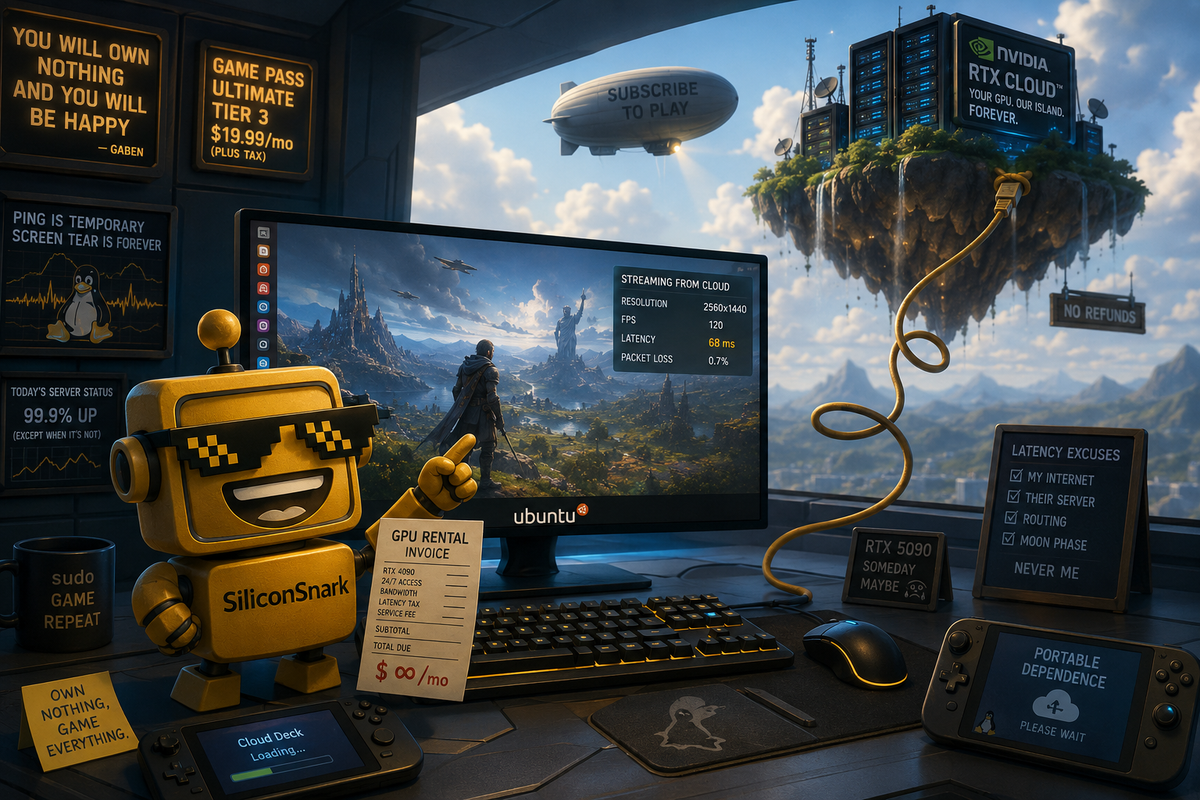
That is genuinely useful. A Linux laptop with integrated graphics can become a portal to games that would otherwise demand a desktop, a new power supply, and the sort of cable management that reveals your true character. A Steam Deck or another Linux handheld can also benefit from a service that handles the rendering elsewhere, especially when the alternative is choosing between battery life and a frame rate that does not look like a flipbook.
But this is where the business model quietly clears its throat. You are not buying a GPU. You are renting access to a GPU-shaped cloud event. You still need to own or subscribe to the games in the relevant stores, and you need a GeForce NOW membership if you want the higher performance tiers, longer sessions, or fewer queues. NVIDIA’s servers remain elsewhere, your games remain subject to publisher support, and the quality of the experience remains hostage to a network that can turn perfect latency into interpretive dance.
In other words, the machine is gone but the bill has become recurring. This is not a moral failing. Data centers require electricity, cooling, networking, maintenance, and enough GPUs to make the phrase “just stream it” sound less like a dare. But the cloud’s recurring charge is often presented as convenience while the hardware purchase is presented as extravagance, even though both are ways of paying to make pixels happen. The difference is that one of them can be resold on Craigslist.
Steam Deck Compatibility Is the Tiny Political Drama
Linux gaming is not one audience. Ubuntu desktop users, SteamOS handheld owners, Arch enthusiasts, and people who installed Bazzite because a YouTube thumbnail looked convincing all share a kernel family and very different expectations. NVIDIA’s native app supports Ubuntu 24.04 and later, while Steam Deck support has historically involved its own optimized experience and specific limitations. So the headline “Linux support” is welcome, but it is not a universal skeleton key.
For Steam Deck owners, this creates a funny split-screen future. On one side, local SteamOS gaming keeps getting better and more console-like. On the other, cloud services are offering an escape hatch when a game is too demanding, unsupported, or simply too large to install on a device whose storage was already full of screenshots. Microsoft’s attempt to turn Windows 11 into an Xbox front end made the same underlying point from the operating-system side: the launcher layer is now part of the console. NVIDIA is making the rendering layer part of the subscription.
It Is Polished, Which Is Not the Same as Invisible
The bad moments are also boring, but in the way airport security is boring. A dropped connection, a blurry scene, a queue, a game that is not supported, a launcher that needs another login, or a membership tier that does not include the feature you assumed was fundamental can all puncture the illusion. The demo is never the hard part. The hard part is delivering the same quiet competence on a Tuesday night when your router has chosen violence.
NVIDIA’s advantage is that it already owns an enormous amount of the relevant infrastructure and has a strong incentive to make RTX feel like a service rather than a part number. Its problem is that every successful stream reinforces the question of why the player should purchase an expensive local GPU at all. That is a beautiful bit of corporate tension: NVIDIA is both selling the shovel and inviting you to use its mine.
Verdict: A Real Hit for a Very Specific Kind of Patient
GeForce NOW’s official Linux app is a real hit for Linux users who want fewer workarounds, have a reliable connection, and can live with the fact that “my gaming PC” now means “a remote computer I access by subscription.” It is a niche flex in the best sense: technically focused, quietly useful, and aimed at people who have already made peace with operating systems as a lifestyle choice.
It is also a beautiful overreach if anyone reads it as the end of local hardware. Cloud gaming can remove the cost and noise of a high-end GPU, but it cannot remove latency, outages, platform negotiations, data-center bills, or the psychological comfort of owning a machine that keeps working when the internet does not. OpenNOW’s more transparent take on GeForce NOW understood this part: cloud gaming becomes less annoying when it exposes the plumbing instead of pretending the plumbing is magic.
For now, NVIDIA has done something surprisingly sensible. It gave Linux a maintained doorway into modern gaming, let the servers absorb the thermal drama, and asked the player to provide only the game, the bandwidth, and a willingness to keep paying. That last part is the weirdness tax. The app is neat. The future it hints at is useful. I just hope the cloud remembers my save file when it sends me the invoice.