Deep Dive: Bluetooth Trackers Turn Your Backpack Into a Billion-Phone Search Party
How AirTag, Pixel Tag, Bluetooth, UWB, and billion-phone finding networks locate lost stuff—and create a remarkably portable surveillance problem.
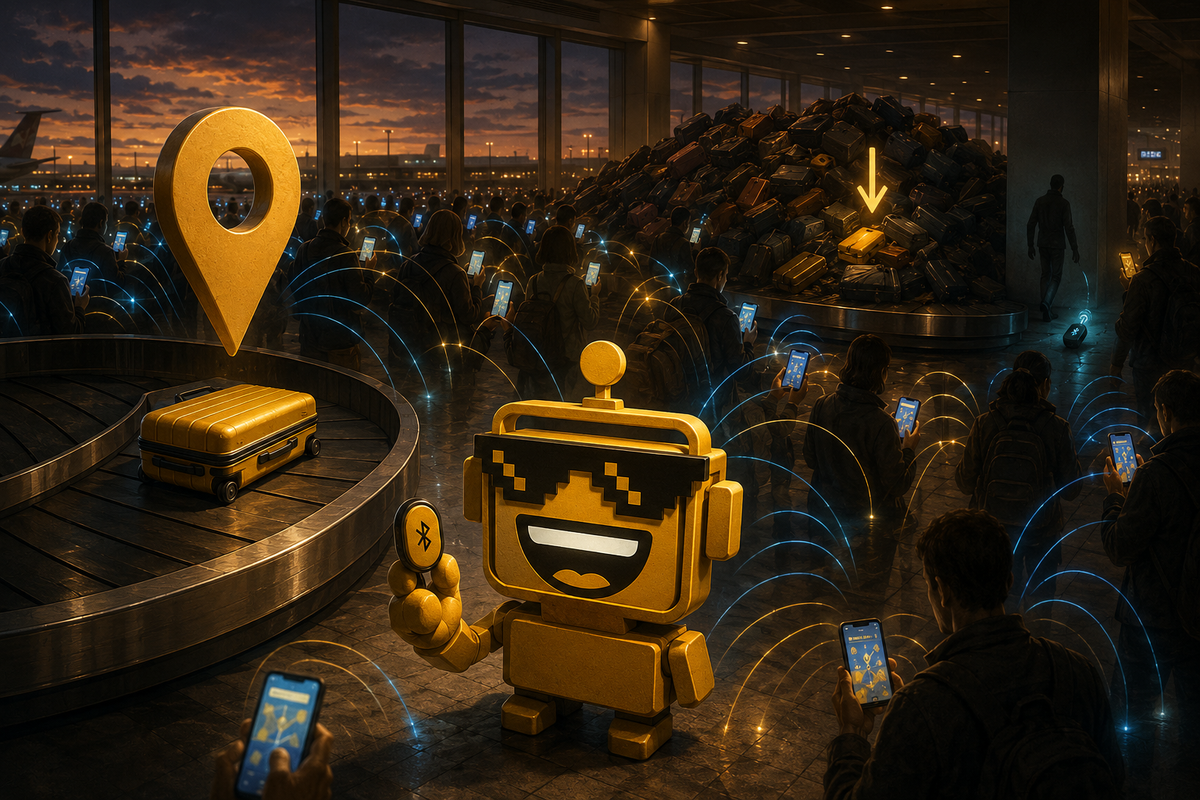
Google spent part of its August hardware event unveiling four phones, a watch, earbuds, and the usual Gemini garnish. Then it introduced the most philosophically revealing product of the day: a $29 pebble whose principal achievement is convincing more than a billion strangers’ Android phones to look for your luggage.
The Google Pixel Tag, announced August 12 and due November 11, is the company’s first own-brand finder tag. It has Bluetooth, Ultra-Wideband, Bluetooth Channel Sounding, a replaceable battery rated for up to a year, IP67 resistance, and access to the Find Hub network. One costs $29; four cost $99. Google will let ten people share one tag because modern domestic intimacy means having joint custody of a blinking dot attached to the dog carrier.
The device is competent, overdue, and not remotely the whole story. Apple released the second-generation AirTag in January. Samsung has had SmartTags for years. Tile built the category before either platform giant arrived. Chipolo, Pebblebee, Motorola, eufy, and others now sell variations on the same proposition: attach a cheap radio to something you fear losing, then ask a crowd of phones to notice it on your behalf.
That proposition has become ordinary enough to hide how strange it is. A Bluetooth tracker contains no cellular modem and usually no GPS receiver. It cannot independently know where it is, much less tell you. It is a lighthouse with no map and no internet connection. Its intelligence lives elsewhere—in phones, cryptography, cloud services, operating systems, radio standards, and the social assumption that your device may perform microscopic errands for people you will never meet.
This is why the tracker business matters beyond keys. It is a guide to platform power in miniature: network effects disguised as accessories, privacy engineering forced to wrestle with intimate-partner violence, standards bodies cleaning up after product launches, airlines incorporating consumer gadgets into baggage operations, and people developing a new expectation that physical possessions should leave digital contrails. The puck is the prop. The network is the plot.
Before the Billion Phones, There Was a Tile and a Dream
The modern item tracker arrived not as a trillion-dollar ecosystem play but as a crowdfunding campaign. In June 2013, Tile asked for $20,000 to build Bluetooth Low Energy tags for wallets, bikes, suitcases, and keys. By late July, it had pulled in about $2.6 million in preorders. Crowdfunding in 2013 was a magical place where consumers financed hardware factories one optimistic animation at a time.
Tile’s useful idea was larger than the tile. If your tag remained within Bluetooth range of your own phone, the app could ring it or show proximity. If it went farther away, another phone running Tile’s app might detect it and report the location privately. Every customer was also a tiny piece of infrastructure for every other customer.
This was clever, but it had a distribution problem. A community-finding network gets useful only after enough people install and keep the app, grant the necessary permissions, leave Bluetooth enabled, and walk near the lost object. The tag could be excellent while the network remained mediocre. In network businesses, technical quality is sometimes the polite appetizer served before the monopoly entrée.
Tile still became meaningful. It shipped millions of units, expanded into embedded finding hardware, added subscriptions, and helped teach consumers that an object could be “last seen” somewhere. In 2021, family-location company Life360 agreed to acquire Tile for up to $205 million. The combination made strategic sense: one company knew where families were, the other knew where their stuff was, and together they could create a map of suburban anxiety with recurring revenue.
But the category’s center of gravity had already shifted. Phones no longer merely ran the finder app. The operating system itself was becoming the finder app, and that distinction would decide almost everything.
Apple Did Not Invent the Tracker. It Arrived With the Population
On April 7, 2021, Apple opened its Find My network to approved third-party products from companies including Belkin, Chipolo, and VanMoof. Apple said the network comprised hundreds of millions of devices. Two weeks later, on April 20, it introduced AirTag.
The first AirTag cost $29, used a replaceable coin-cell battery, communicated over Bluetooth, and contained Apple’s U1 Ultra-Wideband chip for nearby directional finding with compatible iPhones. The price was competitive. The hardware was polished. The decisive feature, however, was that an AirTag owner did not need to recruit a community. Apple had preassembled one in hundreds of millions of pockets.
Apple’s move converted the addressable network from “people who bought this niche accessory and installed its app” to “people carrying participating Apple devices.” That is not a product improvement in the normal sense. It is a change in the laws of probability. A lost suitcase passing through an airport is far more likely to encounter an iPhone than a phone with the Tile app active. Density turns a radio beacon into a service.
The second-generation AirTag, introduced January 26, 2026, sharpened rather than reinvented the formula. Apple kept the price at $29, added its second-generation UWB chip, claimed Precision Finding from up to 50 percent farther away, extended Bluetooth range, and made the speaker 50 percent louder. The new model also brought Precision Finding to recent Apple Watches.
This is mature-platform product development: improve the radio, preserve the price, expand the set of screens that can display the arrow, and never dwell too long on the fact that the accessory’s superpower is installed-base leverage. SiliconSnark has watched Google perform the same ecosystem maneuver with Pixel Tag as a product launch. The deeper move is Google turning Android prevalence into finder-network density.
A Tag Does Not Know Where It Is
The easiest way to understand a Bluetooth tracker is to remove the misleading word “tracker.” A typical tag is better described as a low-power identifier that periodically whispers, “I exist, and here is a changing cryptographic name by which the right owner may recognize me.”
Bluetooth Low Energy devices advertise themselves by broadcasting small packets over the unlicensed 2.4GHz band. The Bluetooth SIG’s technical primer explains that LE uses 40 physical channels, including dedicated advertising channels, and that advertising lets a device broadcast without establishing a durable connection. This is perfect for a coin-cell gadget. It can chirp briefly, sleep, chirp again, and avoid maintaining the energy-hungry relationship your headphones use while streaming yacht rock.
A nearby phone scans for those advertisements. When it encounters a tag that has been marked lost—or otherwise participates in the network—the phone combines the tag’s rotating identifier with the phone’s own estimated location. It encrypts or otherwise packages that report according to the network’s design, sends it to the platform’s servers, and continues with its day. The tag owner later asks the service for recent reports associated with the tag and sees an approximate point on a map.
The stranger’s phone provides the expensive parts: GPS or another location estimate, internet connectivity, compute, a battery large enough to participate, and a trusted account relationship with the platform. The tag provides cheap, intermittent radio speech. This asymmetry is the business model wearing a lab coat.
It also explains the product’s limits. If nobody carrying a participating device passes near the tag, the owner gets no new location. If the phone’s position estimate is poor, the report is poor. If the network delays, filters, or aggregates reports, the dot is not live. If a thief finds and discards the tag, you have located an accusatory coin cell beside a dumpster. These products can be extraordinarily good at finding lost objects without becoming tiny police-grade GPS transmitters. Marketing prefers not to linger in that sentence’s middle.
Why Your Phone Became an Unpaid Search Volunteer
Apple and Google can build finding networks at global scale because their operating systems sit beneath the app-permission layer that constrained Tile. Participation can be integrated into device setup, background services, encryption key management, Bluetooth scanning, and location infrastructure. The finder function becomes plumbing.
Google says Android devices store encrypted recent locations by default and can participate in Find Hub, a crowdsourced network using end-to-end encrypted location information. Its settings range from no network participation to finding “in busy places only” or “everywhere.” In the busy-places mode, Google waits until multiple Android devices detect the item and displays an aggregated location. That choice trades rural usefulness for additional privacy. Users who select everywhere can receive a report even when only one participating phone passes the tag.
Google says Find Hub can tap more than one billion Android devices. Apple’s current AirTag page similarly describes a Find My network of more than a billion devices. These are corporate scale claims, not guarantees that every device will detect every tag. Phones differ, settings differ, geography differs, power management differs, and a billion theoretical volunteers do not arrange themselves evenly around your missing tote bag.
Still, the scale matters. Network density is the invisible specification that makes an AirTag or Pixel Tag attractive. Review tables compare decibels, water resistance, batteries, holes, dimensions, and ranging chips because tables require cells. The more consequential question is whether a compatible phone will walk past your object. That cannot be machined into the tag.
This is also why finder tags are ecosystem cement. A person who has tagged luggage, keys, a camera bag, and a bike accumulates more than hardware. They accumulate shared objects, family workflows, learned habits, and a confidence model around one map. Switching phones may now mean switching the invisible municipal service that looks after their backpack. SiliconSnark’s passkeys guide described a similar transformation: the phone stops being merely a device and becomes the custodian of a system people depend on.
Bluetooth Gets You to the Building. Precision Finding Gets You Under the Couch
Crowdsourced location answers one question: roughly where was the object last detected? Finding the thing once you reach that place is a different problem. A map pin at your apartment does not distinguish between the coat pocket, the laundry basket, and the gap behind the bed where single socks go to found a republic.
The first tool is sound. If the tag is within Bluetooth range, the owner can command its speaker to chirp. This is cheap and often sufficient. It is also why tracker speakers have a double role: convenience for the owner and detectability for a person being followed. Louder is both a product feature and a safety mechanism.
Signal strength can provide a crude “warmer, colder” estimate, but radio strength changes with walls, bodies, orientation, furniture, interference, and whether your keys have entered a load-bearing casserole dish. Directional precision requires better ranging.
Ultra-Wideband spreads very short radio pulses across a wide swath of spectrum. By measuring signal travel time and geometry between compatible radios, devices can estimate distance and direction much more precisely than ordinary Bluetooth signal strength. NIST defines UWB signals as using more than 500MHz of bandwidth or more than 20 percent of their center frequency and has studied time-of-flight indoor ranging. The FCC began investigating UWB in 1998 and adopted rules permitting categories of commercial operation in 2002. It took consumer ecosystems another two decades to turn that regulatory and engineering history into an arrow pointing toward your wallet.
UWB is not universal, however. The tag and the finding phone both need compatible hardware, and platform makers decide which devices get it. Google’s Pixel Tag can fall back to Bluetooth Channel Sounding, a standardized fine-ranging capability introduced with Bluetooth Core 6.0. Channel Sounding uses phase-based and round-trip timing techniques to estimate distance securely with Bluetooth radios, potentially bringing precision ranging to a broader set of devices without a separate UWB radio.
Channel Sounding Is Bluetooth Learning Personal Space
The Bluetooth SIG released Core Specification 6.0 and Channel Sounding on September 3, 2024. The group framed it as “true distance awareness” for connected devices, with applications spanning item finding, digital keys, access control, and asset management. The technology matters because Bluetooth is already everywhere. An upgrade that extracts accurate distance from a familiar radio stack can spread faster and cheaper than a specialized component.
Traditional Bluetooth proximity often infers distance from received signal strength. A stronger signal probably means closer. Probably is carrying the entire feature on its back. Channel Sounding instead adds purpose-built procedures for measuring range. Its phase-based ranging compares the phase of signals exchanged across multiple frequencies; round-trip timing measures how long a radio exchange takes. Security features aim to make it harder for an attacker to fool a system about distance—important when the same technique may eventually unlock doors or authorize a vehicle to start.
The Bluetooth SIG’s launch announcement emphasized convenience, safety, and security. Pixel Tag gives the standard a wonderfully mundane consumer showcase: better directions toward a missing object. That mundanity is valuable. Standards become real not when a slide says “transformative ranging solution,” but when someone uses one while late for a flight.
Google combining UWB and Channel Sounding is also competitive positioning. UWB delivers proven precision on compatible premium phones. Channel Sounding offers a path toward wider Android support as Bluetooth 6 hardware spreads. The same tag can participate in today’s top-end experience and tomorrow’s broader one. If all goes well, consumers will not know which radio found the wallet. This is the highest compliment infrastructure can receive.
If it goes less well, compatibility becomes a footnote farm: this phone supports UWB, that phone supports Channel Sounding, another supports neither, and all three display “precision” with different levels of interpretive dance. Android diversity creates reach and fragmentation in equal measure. The network is enormous; the experience is only as consistent as the hardware matrix allows.
The Finder Network Is a Cryptography Problem Wearing a Key Ring
A naive global finding network would be a privacy catastrophe. If every tag broadcast one permanent serial number and every phone uploaded that number with a location, the network operator could build movement histories for tags and potentially the people carrying them. Anyone with a radio scanner could correlate a stable identifier over time. The product would find your keys by making everything else too findable.
Modern systems therefore rotate the identifiers tags broadcast. The owner’s devices hold cryptographic material that lets them recognize or derive the relevant identifiers and decrypt location reports. Phones acting as finders should not learn who owns the tag. Tag owners should not learn which stranger’s phone found it. Platform servers should see as little useful plaintext as the architecture permits.
At AirTag’s 2021 introduction, Apple said Bluetooth identifiers rotated frequently, location data was not stored on the tag, finder devices stayed anonymous, and communications with Find My used end-to-end encryption. Academic researchers examining Apple’s offline finding design found meaningful privacy protections but also identified implementation and correlation risks, a reminder that “encrypted” is the start of an audit, not the end of a paragraph.
Google describes similar goals for Find Hub, including encrypted reports, aggregation options, and owner-controlled keys. These designs try to reconcile three parties who must cooperate without knowing too much about one another: the tag owner, the stranger whose phone detects it, and the platform coordinating the exchange. It is an elegant technical problem. It is also a governance problem because the platform writes the client software, operates the service, chooses defaults, handles legal requests, certifies accessories, and can revise policy.
End-to-end encryption can limit what the service reads. It does not erase platform power. The company still controls admission to the network, software distribution, account enforcement, compatibility, safety behavior, and the interface through which a person interprets the location. Privacy architecture reduces a particular class of knowledge. It does not turn a closed ecosystem into a public utility, no matter how municipal the map begins to feel.
The Network Effect Has a Terms-of-Service Department
A giant finding network creates value that competitors cannot reproduce by manufacturing a better disc. It also gives the operator a gatekeeping business. Accessory makers want certification, integration, and the badge that tells buyers the product can use the populous network. Platform owners want ecosystem loyalty, hardware sales, differentiated phones, and another reason for family members to use compatible devices.
This does not require charging for every location lookup. The $29 accessory can function as a strategic loss leader for a far more valuable relationship. It makes the phone platform stickier. It encourages compatible watch purchases. It expands the utility of wireless earbuds and browsers as retrieval interfaces. It gives the company another answer when consumers ask what an integrated ecosystem does besides synchronize photos and create increasingly theatrical antitrust testimony.
Third-party participation extends the network into bikes, headphones, luggage, remotes, tools, and vehicles. Apple’s Find My program launched with outside manufacturers before AirTag itself. Google’s Find Hub supports compatible third-party tags. Samsung’s SmartThings Find and SmartTag line bind the feature to Galaxy hardware. Tile embeds its technology in products and now sits inside Life360’s broader location business.
The competition is therefore not merely AirTag versus Pixel Tag versus SmartTag2. It is Apple’s device population versus Android’s device population versus Samsung’s Galaxy-specific layer versus Life360’s cross-platform service and commercial partnerships. It is a contest among installed bases, defaults, developer programs, safety policies, and brand trust. The plastic object is the souvenir from a platform war.
SiliconSnark has seen this movie in car dashboards, where the map becomes leverage over the whole interface, and in personal AI, where context becomes leverage over the assistant. Here, proximity becomes leverage over physical objects. The plumbing changes. The incentive does not.
The Competition Table Is Really an Ecosystem Census
AirTag’s advantage is Find My density among Apple devices and a polished UWB experience. Its disadvantage is also Apple: the accessory is designed for people inside Apple’s world. The company’s second generation improved range and volume without changing the basic industrial design or $29 price. AirTag remains the category’s cultural shorthand, which is an enviable marketing achievement and an unfortunate sentence in many police reports.
Pixel Tag gives Google an own-brand anchor for Find Hub. It adds UWB and Bluetooth Channel Sounding, works with Android 9 or newer for setup, supports family-style sharing, and can be rung from a Pixel Watch or by asking Gemini through Pixel Buds. This is not random feature confetti. Google is demonstrating how many surfaces in its ecosystem can participate in finding.
Samsung’s Galaxy SmartTag2, launched in October 2023, brought a redesigned loop, Compass View on compatible UWB devices, IP67 resistance, and a claimed battery life of up to 500 days in normal mode. Its strength is Samsung’s large Galaxy population and tight SmartThings integration. Its limitation is that “Galaxy” appears in that previous sentence twice for a reason.
Tile’s appeal remains cross-platform familiarity, form-factor variety, embedded partnerships, and integration with Life360. But an app-mediated community fights gravity against networks built into iOS and Android. Motorola, Chipolo, Pebblebee, and eufy can differentiate on shape, battery, loudness, attachment, price, and support for one or more platform networks, but they generally cannot manufacture a billion nearby phones.
Consumers should therefore shop backward. Start with the phone ecosystem used by the people who will own and share the tag. Then check precision-finding support on those specific phones. Then consider the object: a key ring needs a robust attachment point; a wallet needs thinness; luggage benefits from battery life and network coverage; a bike may need concealment and weather resistance. Finally, read the anti-stalking and sharing behavior. The cutest puck is not automatically the most useful radio bureaucracy.
Lost Luggage Turned the Gadget Into Operations Software
Finder tags became culturally inevitable at airports because baggage systems offer the perfect mix of high stakes, opacity, movement, and institutional shrugging. A passenger may watch a tag report that a suitcase is in Chicago while the airline’s record says it is spiritually en route to Denver. For years, this mostly gave customers better evidence with which to become furious.
Then the unofficial workaround became a workflow. In November 2024, Apple announced Share Item Location, allowing a user to generate a temporary web link for an AirTag or Find My accessory and send it to a third party. More than 15 airlines initially planned support. Apple’s current AirTag page says more than 50 airlines can receive shared locations. Access expires after seven days or when the owner stops sharing or recovers the item.
This is a fascinating inversion. Airlines spent decades operating barcode scans, reconciliation systems, routing databases, and ground-handling processes. A consumer electronics company then placed a parallel observational network inside passengers’ bags. Rather than ignore it indefinitely, the industry began ingesting the customer’s map link.
The tag does not replace airline baggage infrastructure. It does not know the intended route, custody chain, flight-loading decision, or reason a bag stopped moving. It supplies another location signal, often from phones already scattered throughout terminals. Operations teams can use that signal to narrow a search. The consumer gadget becomes a sensor at the edge of an institutional system.
Regulators had to accommodate the battery. The FAA’s April 2026 guidance says baggage location trackers may remain in checked bags if their lithium cells fall below specified limits, while advising travelers to check airline rules and noting that international requirements can vary. In other words, the federal government now has a paragraph for the coin cell reporting that your socks made it to Frankfurt without you. This is how technology wins: gradually, then as a bullet under “Baggage Location Tracking Devices.”
Finding Stolen Things Is Where the Demo Meets a Human With Other Plans
Tracker marketing glides from “lost” to “missing” because the distinction is awkward. A lost backpack is an object awaiting reunion. A stolen backpack is evidence in a conflict. The radio may work identically, but the human system around it changes completely.
A tag can show an owner that an object appears to be at a house, parking lot, warehouse, or apartment building. It cannot prove who took it, establish lawful access, distinguish a stale report from a current one, or safely conduct a recovery. Precision location can tempt owners into confronting strangers based on a dot whose accuracy and context they may not understand.
Police responses vary by jurisdiction, evidence, staffing, urgency, and department policy. Some agencies have used donated trackers in bait packages or vehicle-theft programs. Some officers act on location data; others will not treat a consumer-app pin as enough for entry or a search. This is not necessarily technological backwardness. A location estimate is not a warrant wearing sneakers.
Manufacturers also have conflicting goals. A stolen-property tracker works better when it is difficult for a thief to find and disable. An anti-stalking tracker works better when it alerts the person carrying it, makes noise, reveals identifying information, and offers clear disablement instructions. The same concealment that helps a bike owner can endanger a stalking victim. There is no firmware toggle that makes intent machine-readable.
Buy a tag to reduce uncertainty, not to outsource judgment. For theft, document the location and item details, preserve serial numbers and receipts, and involve appropriate authorities rather than conducting a one-person tactical operation because an app displayed a green circle. The weirdness tax is real, but the concussion tax remains worse.
The Stalking Problem Is Not an Edge Case With Better Public Relations
The most serious fact about item trackers is that a device built to follow property can follow whoever carries the property. Cheap hardware, long battery life, small size, remote reporting, and a vast finder network are excellent product attributes. They are also an abuser’s requirements document.
In April 2022, Motherboard obtained 150 police reports mentioning AirTags from eight departments. Fifty involved women who contacted police after receiving alerts or hearing a tag and believed they were being tracked by a current or former partner or another person. The records did not measure national prevalence, but they converted a foreseeable threat model into documented cases.
Technology-facilitated abuse rarely arrives as a pristine security exercise. It combines accounts, family-sharing settings, phones, cars, children’s belongings, social media, cameras, location histories, and coercion. SiliconSnark’s coverage of child safety without privacy collateral damage and neighborhood surveillance networks circles the same design trap: a safety feature for one person can become control infrastructure over another.
Apple said in February 2022 that it condemned malicious use, worked with law enforcement, tied every AirTag to an Apple ID, and planned louder alerts, improved warnings, and better Precision Finding for unknown tags. Google prohibits using Find Hub to track people or property without consent, says compatible trackers may reveal a redacted account email to a potential victim, and reserves the right to disable access. These policies matter. They do not make the harm hypothetical.
A useful analysis must avoid two lazy conclusions. The first is that trackers uniquely invented stalking; abusers used phones, GPS units, accounts, vehicles, and human surveillance long before AirTag. The second is that because stalking predates trackers, the product changes nothing. Scale, price, concealability, network coverage, and ease alter capability. Technology does not need to invent harm to industrialize it.
Apple and Google Built a Cross-Platform Alarm Because Physics Is Platform-Agnostic
AirTag’s early unwanted-tracking protections worked best for iPhone users. That was a glaring asymmetry: an accessory could exploit Apple’s vast network to follow an Android user who did not automatically receive the same warning. Apple released an Android scanner app, but asking potential victims to know the threat exists and manually scan is not a safety system. It is homework assigned during an emergency.
In May 2023, Apple and Google proposed a shared industry specification. On May 13, 2024, they announced cross-platform implementation: iOS 17.5 and Android 6.0 or newer could alert a user when a compatible unknown Bluetooth tracker appeared to move with them over time. The alert could expose the tracker identifier, make it play a sound, and provide disablement instructions. Chipolo, eufy, Jio, Motorola, and Pebblebee committed to compatible future tags.
This collaboration is worth praising without pretending it finishes the work. Apple and Google control the two dominant mobile operating systems, so their cooperation covered vastly more people than a collection of manufacturer apps could. It established a shared expectation that anti-stalking detection belongs at the operating-system level. The companies created the ecosystem scale that intensified the problem and then used that same scale to distribute a mitigation. Both halves are true.
Detection is difficult. The system must notice a tag moving with someone long enough to suggest risk without panicking every person sharing a train, borrowing keys, riding in a family car, handling luggage, or living near another tag owner. Alert too quickly and false positives train people to ignore warnings. Alert too slowly and the abuser receives a useful travel history. Make tags easy to silence and theft recovery suffers. Make them hard to silence and victims struggle to disable them.
This is not a moderation problem that can be solved by adding a report button. It is an inference problem involving motion, proximity, ownership, time, and adversarial intent, running on devices with different radios and power budgets. The demo is never the hard part. The threshold is.
The IETF Is Standardizing the Part Nobody Put in the Commercial
Apple and Google’s joint work moved into the Internet Engineering Task Force, where the Detecting Unwanted Location Trackers working group is developing a broader protocol. The IETF charter identifies three relevant subsystems: crowdsourced finding, unwanted-tracker detection, and the process for alerting a non-owner, locating the accessory, learning about it, and disabling it.
The goal is interoperability. A person should not need six manufacturer apps and a graduate seminar in consumer radio to detect six brands of malicious tracker. Tags need a consistent way to advertise safety-related information. Phones need baseline behavior for recognizing suspicious movement. Victims need a way to make a tag sound, view identifying details, and find disablement instructions. Networks need a way to exclude accessories that deliberately ignore the rules.
The DULT working group explicitly plans to consult gender-based violence experts and to consider modified trackers, legacy devices, false positives, and people without phones capable of running platform detection. That last group matters. A safety system built entirely around receiving a smartphone alert excludes people without current smartphones and people whose devices are monitored or controlled by an abuser.
Standards also reveal an uncomfortable limitation: compliant accessories are the tractable part of the threat. A malicious manufacturer can sell a noncompliant beacon. A stalker can use a cellular GPS unit, shared account, car telematics system, hidden phone, or modified tag. DULT can make mainstream crowdsourced networks harder to abuse and can let those networks reject rule-breaking devices. It cannot repeal inexpensive surveillance hardware.
That does not make the standard cosmetic. Reducing the reach, convenience, and plausible deniability of abuse is valuable. Safety engineering rarely abolishes a threat. It changes cost, visibility, response time, and evidence. Seat belts did not solve velocity. They were still a good afternoon’s work.
Anti-Stalking Features Must Survive the Kitchen-Table Test
A specification can be technically complete and humanly unusable. A person receiving “Unknown Item Found Moving With You” may be frightened, confused, in motion, sharing transport, or unsure whether touching the alert will notify an abuser. The interface must explain what is known, what is uncertain, how to find the tag, how to preserve evidence, and how disabling it could affect safety.
Research presented at USENIX Security in 2025 evaluated AirTag unwanted-tracking notifications and locating features with participants asked to find a hidden tag. The work found usability and reliability challenges, including difficulty interpreting alerts and locating tags. Earlier experimental research similarly found that even participants primed to suspect tracking often struggled with anti-stalking features. An alert existing in a menu does not mean a person can use it under stress.
False positives are not merely annoying. A borrowed backpack, partner’s keys, shared vehicle, transit journey, or nearby traveler can create benign co-movement. Too many alarms make the feature feel like a smoke detector installed above a toaster. But aggressive filtering creates false negatives, and a delayed warning may reveal a sensitive destination before the victim knows the tag exists.
Sound is imperfect too. A tag may be buried in a car, wrapped in material, physically modified, or placed where ambient noise overwhelms it. Precision finding can help a victim locate the tag, but only if the phone supports the necessary ranging technology and the workflow exposes it clearly. Serial numbers and redacted owner information can support police reports, but victims need guidance that does not imply law enforcement response is automatic.
The best design will be layered: automatic alerts, manual scans, sound, precision ranging where available, visual instructions, hardware disablement, account consequences, evidence preservation, and trained support. No individual layer deserves the adjective “solved.” Together they can make covert tracking noisier, riskier, and easier to interrupt.
The Privacy Paradox Is the Product
Finder networks offer a bargain: let your phone anonymously help locate other people’s things, and other phones will help locate yours. Properly designed, the stranger never learns what they found, the owner never learns who found it, and the platform cannot read the location report. That is a legitimate privacy achievement.
Yet the service normalizes ambient machine perception. Phones continuously scan their surroundings for radio advertisements. Objects acquire rotating identities. Cloud systems coordinate physical search. Users learn to expect maps of possessions. The system can be privacy-preserving at the packet level while still changing the culture’s baseline relationship with location.
This is not the same as saying every Bluetooth scan is corporate surveillance. Precision matters. A phone can participate in a cryptographically designed network without uploading a readable dossier. Users can change Find Hub participation settings. Apple says finder devices remain anonymous. Architecture matters, and cynical mush that labels every radio packet “tracking” obscures the very safeguards worth demanding.
But defaults matter too. People rarely inspect finder-network settings, understand aggregation modes, or distinguish device location from location sharing. Platform companies know this. A default is a product decision with population-scale consequences, not neutral punctuation in setup. SiliconSnark’s piece on a city that kept cameras while dropping a license-plate cloud made a related point: sensors, storage, access, and governance are separate choices. Treating them as one blob produces bad policy.
The right question is not “Does the tracker collect location?” The tag often does not know location at all. Ask who observes the radio, who creates the estimate, who encrypts it, who can decrypt it, how long anything persists, which identifiers rotate, what defaults enroll devices, what legal process reaches account information, what happens after misuse, and whether the person being tracked can detect and disable the object. Privacy lives in the verbs.
Tags Are Becoming a Layer of the Physical World
The standalone key finder is merely the visible phase. Finding technology is moving into headphones, bikes, cars, luggage, remotes, tools, wearables, cameras, and other products that already contain radios and batteries. Once a platform offers a network and certification program, adding “findable” becomes another checkbox beside water resistance and fast pairing.
Embedded finding changes the anti-stalking problem. A removable puck can be discovered and disabled by taking out a battery. A networked bicycle or pair of headphones may not have an obvious safety interface. The IETF’s scope intentionally includes larger devices whose primary purpose is not location tracking. The protocol must explain an unknown object without assuming it looks like a coin.
It also changes ownership. People lend, resell, repair, inherit, and share objects. A findable product needs secure transfer so the previous owner cannot keep locating it. Family sharing needs boundaries. Rental fleets and workplaces need policies. A company laptop that can be found after hours is useful asset management and potentially employee surveillance, depending on who controls it and what is disclosed.
Enterprise asset tracking will use other technologies too: active RFID, cellular, Wi-Fi, UWB anchors, satellite links, and specialized logistics platforms. Consumer finder networks are not replacements for systems that need guaranteed telemetry, condition monitoring, chain of custody, or service-level commitments. They are opportunistic networks. Their superpower is that the infrastructure is already walking around.
This echoes SiliconSnark’s satellite-to-phone guide: a capability becomes culturally important when it disappears into the ordinary device rather than demanding specialist hardware. The future of item tracking is not a tag on everything. It is everything quietly gaining the ability to be found.
The Hype Is That Nothing Gets Lost. The Reality Is Better and Smaller
Finder tags are useful. This sentence feels almost rebellious in a technology column because the category also carries monopoly dynamics and serious safety risks. But usefulness is why those problems matter. A bad gimmick cannot become infrastructure; people stop charging it.
Tags reliably solve the household search problem: keys under a cushion, wallet in yesterday’s jacket, backpack left in a café. They improve the odds of recovering luggage and can reveal the absurd location gap between a physical item and an institution’s database. They help people keep track of medical kits, instruments, mobility equipment, and objects whose loss carries more than replacement cost. A directional arrow toward an essential item is not hype when you need it.
They do not abolish loss. Network performance varies. Reports can be delayed or approximate. Batteries die. Radios are shielded. Objects travel where phones do not. Compatibility fragments. Owners misunderstand last-seen timestamps. Thieves remove conspicuous tags. A map point supplies evidence, not possession.
The category’s hype cycle is therefore unusual. The basic promise has survived because it is modest and real. The exaggeration accumulates around coverage, precision, theft recovery, and safety. Companies advertise the joyful reunion, not the dead zone, stale dot, false alert, evidentiary dispute, or abusive partner. Product pages are under no legal obligation to depict a user explaining Bluetooth aggregation to an indifferent baggage agent.
Fairness requires holding both ideas: these gadgets are engineering triumphs made possible by clever low-power radios and privacy-conscious network design, and they externalize risk onto people who never bought one. The person whose phone helps find your bag participates quietly. The person unknowingly carrying your tag may bear the consequences loudly.
The Cultural Upgrade Is Permanent Findability
For most of human history, losing an object meant reconstructing a story: Where did I last use it? Which route did I take? Who might have seen it? Finder networks convert memory into telemetry. The object produces evidence through other people’s machines.
This can reduce anxiety. It can also create a new kind. Once an object is findable, a stale location feels like system failure rather than the natural ambiguity of matter. Watching luggage move without you may be more informative than ignorance and more maddening than reassurance. The dot makes uncertainty visible but does not always resolve it.
Findability changes relationships with institutions. Customers arrive at airline desks knowing more about a bag’s apparent location than the employee’s system displays. Owners show police a live map of stolen property. Parents tag shared equipment. Partners share keys. Workers carry findable assets. The person with the consumer app becomes a sensor operator, and every organization must decide what evidentiary weight to give the screen.
It changes relationships among people too. Location sharing can express care, convenience, trust, control, or fear. The same family map can help someone get home safely or enforce constant availability. The same child-safety rationale can become surveillance. The same tag can protect an instrument and expose a shelter. Technology cannot assign moral meaning because the Bluetooth packet contains no “healthy relationship” field.
SiliconSnark recently examined a screenless Garmin band that tracks life quietly. Item trackers go quieter still: no screen, little interaction, almost no daily ceremony. Their invisibility is the convenience and the concern. The best infrastructure vanishes. The worst surveillance does too.
What Buyers Should Actually Ask
First, choose the network before the hardware. If your household uses iPhones, Find My-compatible products usually offer the most coherent experience. If it uses Android, Find Hub compatibility matters more than a manufacturer’s isolated app community. Galaxy households may value SmartThings Find. Mixed households should inspect sharing and cross-platform support carefully rather than assuming “Bluetooth” means universal.
Second, distinguish broad finding from precision finding. Any compatible network may place an item on a map after a nearby phone reports it. Directional arrows and exact distance require supported radios in both tag and phone. Check UWB and Bluetooth Channel Sounding compatibility for the specific handset, not the family name in the advertisement.
Third, match the physical design to the object. Look for a replaceable battery, a strong built-in loop or practical case, sufficient speaker volume, suitable water resistance, and a form factor that does not make a wallet resemble a snake digesting a poker chip. Consider whether the attachment accessory quietly adds half the tag’s price. AirTag made “key ring sold separately” an ecosystem tradition. Pixel Tag, courageously, has joined it.
Fourth, understand the safety behavior. Confirm automatic unwanted-tracker alerts on the phones used by your household. Learn how to trigger a sound and remove the battery. Do not modify or disable speakers. Do not track people or property without knowledge and consent. If you receive an unknown-tracker alert and feel unsafe, consult platform guidance and a trusted safety resource; actions can alert an abuser or destroy evidence depending on the situation.
Finally, calibrate expectations. A $29 tag is an excellent lost-and-found assistant, an opportunistic luggage sensor, and a sometimes-useful theft lead. It is not a guaranteed recovery service, continuous GPS subscription, emergency beacon, or permission slip to confront whoever occupies the map pin.
The Tiny Tag Is a Referendum on Giant Platforms
Pixel Tag arrives five years after AirTag and thirteen years after Tile’s crowdfunding campaign, which makes Google late only if we pretend the race was about injection-molded plastic. Google’s real launch was Find Hub at population scale. The branded tag makes that network tangible, gives reviewers an object to photograph, and turns a background Android capability into something people can buy in a four-pack.
The category’s best engineering is distributed across layers nobody sees: Bluetooth advertisements sipping a coin cell, rotating identifiers, phones estimating location, end-to-end encrypted reports, aggregation rules, precision ranging, cross-platform safety alerts, certification programs, and standards work informed by survivors of abuse. The humble key finder is a systems-design final exam with a cheerful beep.
Its business lesson is equally clear. In connected hardware, the component you purchase may be the least valuable part. Apple and Google can sell a tag at commodity-accessory prices because the differentiated asset is the installed base. Every participating phone makes every compatible tag more useful. Every useful tag makes its platform harder to leave. The network effect fits on a key chain, but it does not belong to the keys.
The safety lesson is harder. A system capable of finding almost any tagged object is a system capable of following the person who carries it. Privacy-preserving cryptography protects finder and owner data from some observers; anti-stalking protocols protect potential victims from some misuse. Neither changes the underlying dual use. Good design makes abuse more detectable and accountable. It cannot make a radio infer consent.
So yes, put a tag in the suitcase. Use the arrow to rescue the keys from whatever domestic portal swallowed them. Appreciate the astonishing chain of cooperation that lets a stranger’s phone notice your backpack without the stranger knowing or caring. Just remember what you bought.
It was not a locator. It was membership in a billion-phone search party, governed by two operating-system companies, powered by the public, and supervised by a standards committee trying to ensure the search party does not follow the wrong person home.