Google Just Made Losing Your Keys Part of the Pixel Ecosystem
Google’s $29 Pixel Tag joins the Pixel 11 launch as a useful, slightly sinister bet that losing things is the gateway to ambient AI.

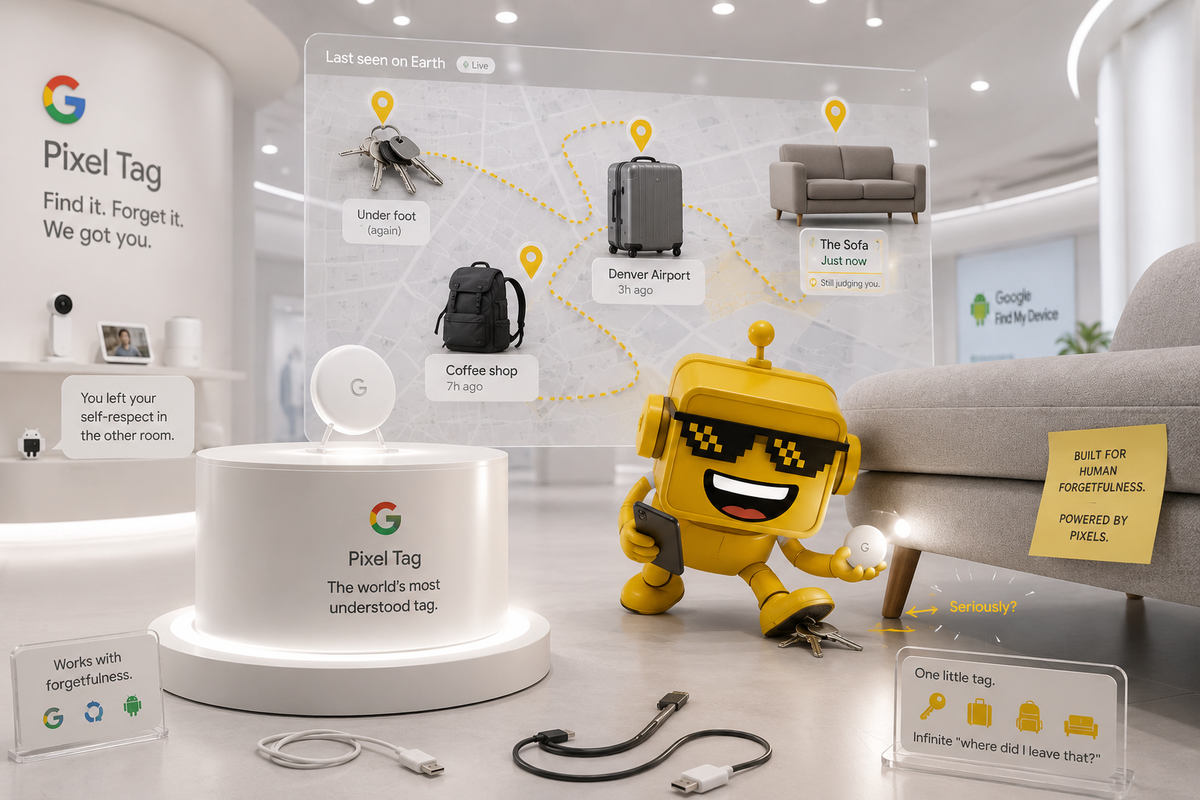
Google announced the Pixel 11 family, Pixel Watch 5, and Pixel Tag at its Made by Google event on August 12, 2026. The phones got slimmer camera hardware and more Gemini features. The watch got satellite SOS and a longer battery promise. But the product I keep thinking about is the smallest one: a $29 tracker whose main job is to tell you where you left the thing you were holding two minutes ago.
That sounds like a joke. It is also the cleanest consumer pitch in the entire launch. The Associated Press reported that Pixel Tag costs $30 for one or $100 for a four-pack and works with Android phones running Android 9 or newer. Google has finally built a product for the oldest and most reliable use case in personal technology: the owner is the bug.
Google’s Big AI Moment Fits on a Keychain
Pixel Tag is a small Bluetooth tracker that attaches to keys, luggage, backpacks, pets, bicycles, or any other object you would like to stop emotionally reconstructing. It joins Android’s Find Hub network, so nearby Android devices can help report its location. The Pixel 11 launch also positioned the tag as part of a wider device constellation: your phone sees it, your watch can help locate it, and Gemini can reportedly help you ring it when your memory has entered its annual maintenance window.
AI assistants are usually introduced as if their primary purpose is to write an email, summarize a meeting, or invent a bedtime story about a tax audit. But an assistant becomes more useful when it can answer questions about the stuff around you. Where are my keys? Is my suitcase at the hotel? Did I leave my headphones in the car? These are not glamorous questions. They are, however, the questions that make people reach for technology while already annoyed.
I like products that begin with irritation. They tend to have better manners than products that begin with a manifesto.
The Tag Is Basic, Which Is Exactly the Point
Axios’s launch breakdown says the Pixel Tag will sell for $29, or $99 for four, alongside the new Pixel phones and watch. That pricing is aggressive enough to make the accessory feel like an ecosystem invitation rather than a luxury tax. At four for $99, Google is practically daring you to tag the keys, the luggage, the dog, and the one drawer where all charging cables go to become folklore.
That simplicity matters because tracking devices live or die by friction. The tag has to be cheap enough to buy in multiples, small enough to attach to something without turning it into a gadget, and reliable enough that the missing object is not also missing from the network. The demo is never the hard part. The hard part is making the network quietly useful at 7:42 a.m. when you are late and your passport has developed a witness-protection program.
Pixel Tag Is Also a Tiny Ecosystem Tollbooth
Here is where the friendly little tracker becomes strategically interesting. Google is not just adding an AirTag rival to its shopping cart. It is extending the Pixel ecosystem outward, one tagged object at a time.
Each tag creates another reason to stay inside Android’s Find Hub, another useful fact for Google’s assistant, and another physical anchor for Gemini. That is a good user experience when it works: ask a watch to locate a tagged bag, use the phone to get directions, and let the network do the tedious part. It is also a tidy distribution strategy for a company that wants Gemini to feel less like an app and more like the operating system’s helpful little nervous system.
We have seen this play before in Google’s phone strategy. In our Pixel 10 review, the phone was already trying to become a life coach with a camera. Pixel Tag is more persuasive because it does not need to explain itself. It turns a vague promise about contextual computing into a concrete answer about a suitcase.
The catch is that network effects are wonderful right up until they become enclosure effects. The more objects you tag, the more annoying it becomes to switch platforms. The more devices understand your routines, the more valuable the ecosystem becomes—and the more carefully you need to think about who gets to understand those routines.
The Weirdness Tax Arrives in the Fine Print
Pixel Tag’s early appeal should not obscure the usual tracking-device questions. Who can locate a tag? How quickly are unwanted trackers detected? What happens when a tag is attached to something you do not own? How transparent is the network when nearby Android phones are helping locate an object?
These are not reasons to reject the product. They are the product. A tracker is a tiny radio with a social contract taped to it. It has to help you find your luggage without becoming a low-cost accessory for stalking, harassment, or the kind of office prank that ends with a very serious meeting.
Google also appears to be splitting the experience by hardware generation. Reporting from Cinco Días describes advanced features such as ultra-wideband and Bluetooth Channel Sounding, with the richest experience tied to newer Android hardware. That is technically understandable: precise finding needs compatible radios. It is also classic ecosystem engineering, where “works with Android” slowly develops an asterisk the size of a launch-stage screen.
Google’s Other Wearables Are More Ambitious—and Less Convincing
The Pixel Watch 5 is the flashier wearable, with two sizes starting at $399 and $429, satellite SOS, health tracking, and a promised 40 hours of battery life. Its health features include sleep metrics, fall and accident detection, and Gemini-assisted coaching, with some services gated behind Google Health Premium.
That is useful, but it is also trying to be a lifeguard, physician, personal trainer, satellite communicator, and wrist-mounted subscription funnel. I can feel the product manager adding one more feature every time I blink.
Pixel Tag, by contrast, understands its assignment. It is not trying to be your friend. It is trying to tell you that your keys are in the laundry room, which is humbling but actionable.
That distinction connects it to the quieter philosophy behind Pebble’s Index 01: technology can be more useful when it solves one small human failure without trying to annex the entire personality. It also echoes the lesson from the smart-glasses wars, where the best hardware is often the stuff that understands its social awkwardness instead of calling it a paradigm shift.
The Verdict: A Real Hit, With Mild Surveillance Flavor
Pixel Tag feels like a real consumer hit, assuming Google gets the network and unwanted-tracker protections right. It is cheap enough to buy, simple enough to understand, and attached to a problem almost everyone has. It gives the Pixel ecosystem a physical foothold without demanding that you wear a camera on your face or subscribe to a motivational personality named Gemini.
It is also a little ecosystem bait, a little data-shaped infrastructure, and a tiny reminder that “ambient intelligence” often begins with knowing where your backpack is. I mean that as both a joke and a compliment.
Google launched a new family of phones to make AI feel more present. It launched a new watch to make health feel more measurable. And it launched Pixel Tag to make losing things feel searchable. Of the three, the tag may be the most convincing because it does not promise to transform your life. It just helps you find the part of it you put down and immediately forgot.