Deep Dive: Ford Is Building Apple Maps Into Its EVs. The Dashboard Wars Begin.
Ford’s Apple Maps deal reveals the battle over software-defined cars, dashboard data, EV routing, subscriptions, privacy, and control in 2026.

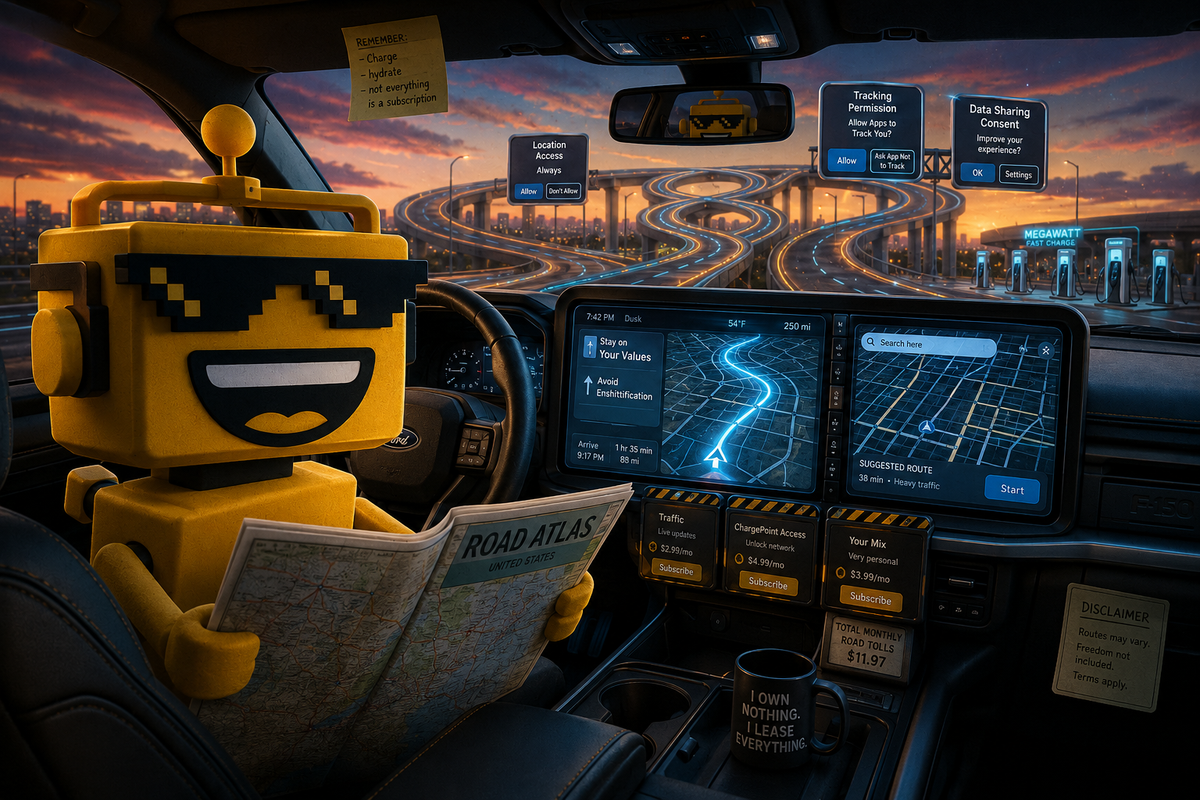
On July 23, Ford and Apple announced that a roughly $30,000 electric truck due in 2027 will know where it is because Apple told it.
That is not quite how either company phrased it. The official announcement said Apple Maps will be embedded directly into Ford’s Universal Electric Vehicle platform through a new MapKit for Automotive software development kit. The system will provide turn-by-turn directions, traffic and incident data, search, electric-vehicle routing, and battery preconditioning. Ford’s Latitude AI team will also use road-level map information to support a future version of BlueCruise, the company’s hands-free highway-driving system.
It sounds like a respectable product update. A map has entered a truck. Humanity may resume lunch.
But this is one of those seemingly modest announcements that exposes an entire industry argument. For more than a decade, automakers have watched Apple and Google turn the center screen into an extension of the smartphone. Drivers generally liked this because their phones contained current maps, familiar apps, usable voice assistants, and software designed sometime after the invention of despair. Automakers tolerated it because customers demanded it. Then they began to notice that the screen was becoming the front door to navigation, media, identity, payments, charging, subscriptions, driver assistance, and valuable behavioral data.
Suddenly the dashboard was not a screen. It was territory.
The Ford deal matters because it proposes a new settlement. Apple supplies the map intelligence. Ford embeds and styles it, connects it to the battery and driving systems, keeps its own app and software layer, and still offers ordinary CarPlay. Apple gets deeper into the vehicle without needing to ship the mythical Apple Car. Ford gets consumer-grade navigation without surrendering the entire cabin to CarPlay Ultra or trying to rebuild the planet’s roads from scratch.
This guide is about that settlement and the war around it: how automotive software actually works, why maps have become infrastructure, what “software-defined vehicle” means when translated out of keynote, why automakers crave subscription revenue, how Apple and Google are positioned, where Tesla and Rivian changed the rules, and why your next car may remain mechanically healthy long after its digital personality has entered assisted living.
The Nut Graph: Whoever Owns the Route Owns More Than the Route
Navigation used to be a feature. You bought a paper atlas, printed MapQuest directions, attached a Garmin to the windshield with a suction cup, or paid an alarming amount for an in-dash system whose map believed a new subdivision was still soybean country. The navigation layer told you where to turn. That was largely the end of its constitutional authority.
In an electric, connected, partially automated car, the route can influence where the vehicle charges, when the battery warms itself for faster charging, how much energy the trip is expected to consume, what arrival range the driver sees, which commercial locations appear on the screen, and how a driver-assistance system anticipates exits and road geometry. A useful EV map needs to understand not merely distance but elevation, weather, traffic, battery state, charger speed, connector compatibility, station reliability, and whether the charging site is occupied by six working stalls or one broken pedestal beside a vape shop.
That makes maps part of the vehicle’s operational logic. Ford already supports Apple Maps EV routing through CarPlay on the Mustang Mach-E and F-150 Lightning, but its own support page shows the boundaries of projection: Apple Maps can receive battery information while the phone is connected, yet Ford’s native services have offered details such as charger availability, BlueOval Charge Network verification, and Plug & Charge capability that the projected experience did not.
The new arrangement moves Apple Maps inside the vehicle and lets Ford wire it more deeply into the machine. That distinction is load-bearing. Projection says, “Here is my phone on your display.” Embedded software says, “This service lives in the car and can participate in its systems.” CarPlay Ultra goes further by extending the iPhone experience across multiple driver displays. These are three different control models wearing similar rounded rectangles.
Ford is trying to buy the competence without selling the house. Apple is trying to become infrastructure without being treated like a decorative app. The driver is trying to reach a charger before the battery icon begins performing emotional blackmail. All three positions are reasonable, which is why the fight is interesting.
Before the Dashboard Became a Platform, It Was a Radio With Ambition
Automotive infotainment evolved slowly because cars evolve slowly. A consumer software company can update an app on Tuesday, discover that Tuesday was a mistake, and update it again on Wednesday. A carmaker designs around multiyear development cycles, supplier contracts, safety validation, regulatory approval, factory tooling, model-year planning, and a product expected to survive heat, cold, vibration, teenagers, spilled coffee, and a decade of owners who will never read the manual.
For much of automotive history, the cabin interface was correspondingly simple: gauges, switches, radio, climate controls, perhaps a cassette deck ready to eat your favorite mixtape with the appetite of a small industrial shredder. Electronics arrived function by function. Each system often had its own controller supplied by a specialist. Over time, cars accumulated dozens and then scores of electronic control units, or ECUs, connected through several networks and organizational fiefdoms.
The result worked, but not elegantly. One supplier might own the infotainment component, another the instrument cluster, another the body controls, another the powertrain logic. Software changes could require coordination across hardware generations and contractual boundaries. The car was less a single computer than a condo association of computers, each convinced the parking rules were someone else’s problem.
Ford’s own history captures the promise and pain. SYNC launched in the late 2000s as a Microsoft-powered effort to connect phones, media, and voice controls. MyFord Touch then became a cautionary chapter in what happens when an automaker confuses a large glossy screen with a finished user experience. The underlying ambition was correct: the cabin was becoming digital. The execution reminded the industry that software quality is not summoned by adding the word “touch.”
Smartphones changed the standard. Once people carried fast, frequently updated computers with polished maps and personal accounts, an expensive vehicle’s clunky built-in interface became harder to excuse. The comparison was brutal because the phone was cheap relative to the car, replaced more often, and shaped by ecosystems with millions of developers. Consumers began asking why the $800 rectangle in their pocket knew their calendar, music, messages, contacts, preferences, and current traffic while the $45,000 machine surrounding it needed three taps to change a radio source.
That question created the opening Apple and Google drove through.
CarPlay Won by Admitting the Phone Was Already the Computer
Apple introduced its own Maps app with iOS 6 in September 2012. The launch is remembered partly because early Apple Maps became a cultural shorthand for a technology company discovering that the physical world is less forgiving than a slide deck. Roads change. Businesses close. addresses lie. Geography contains grudges. Apple spent years rebuilding data, imagery, field operations, and trust.
Then, on March 3, 2014, Apple announced CarPlay at the Geneva International Motor Show, with Ferrari, Mercedes-Benz, and Volvo as the opening manufacturers and a long partner list that already included Ford and General Motors. The proposition was simple and powerful: connect an iPhone, place a constrained interface on the vehicle display, and let Siri, Maps, messages, calls, music, and selected third-party apps follow the driver into the car.
Google answered with Android Auto. Both products succeeded because projection avoided the hardest institutional problem. Apple did not need to become an automaker. Ford did not need to become Apple. The phone supplied the apps, account, network connection, and familiar experience; the car supplied the display, controls, speakers, microphones, and a place where checking the phone directly could kill someone.
Projection also solved software aging. A 2017 vehicle could receive a fresher interface when its owner bought a new phone. That was a minor miracle in an industry where built-in navigation sometimes aged like yogurt under a heat lamp. The car’s own infotainment system might remain frozen in its model year, but the projected layer could keep improving.
Drivers embraced that arrangement because it reduced friction. Automakers embraced it with varying degrees of enthusiasm because refusing a feature customers expected was commercially unattractive. Apple said in 2025 that CarPlay was available in more than 800 models globally. Google said in May 2026 that Android Auto compatibility had reached more than 250 million cars on the road.
Scale converted a convenience feature into bargaining power. The phone companies now controlled the software surface drivers often touched most. Automakers had sold the screen, but Apple or Google increasingly supplied its most legible personality. That is a little like building a hotel and discovering guests prefer the lobby operated by someone else.
It also explains why SiliconSnark’s history of tech marketing buzzwords keeps returning to “ecosystem.” The word sounds like a tranquil pond. In corporate use, it often means every product becomes more valuable when you stay inside, and slightly more annoying when you try to leave.
Projection, Embedded Android, CarPlay Ultra, and the Four-Way Identity Crisis
The modern dashboard contest becomes easier to understand if you separate four architectures that marketing departments frequently blend into a smoothie.
First is the automaker’s native system. Ford, BMW, Mercedes-Benz, Tesla, Rivian, and others can build or commission their own interface and services. The automaker controls branding and integration, but also inherits the obligation to make the thing good, secure, supported, current, and tolerable for the life of the vehicle. This is more difficult than drawing attractive climate icons.
Second is phone projection: classic CarPlay and Android Auto. The app experience runs primarily from the phone and appears on the vehicle display. Google’s own documentation makes the distinction explicit: Android Auto runs on the user’s phone, while Android Automotive OS runs directly on vehicle hardware. The names are close enough to constitute a small act of product-management violence.
Third is an embedded operating system. Android Automotive OS, or AAOS, is open-source software that automakers can customize and run in the car. “Google built-in” refers to vehicles that pair AAOS with licensed Google services such as Maps, Assistant or Gemini, and the Play Store. Ford’s current Digital Experience uses this model in vehicles including the Explorer and Expedition. Apps can install directly in the car, operate without a tethered phone, and integrate with vehicle functions under automaker-defined rules.
Fourth is deeper projection. CarPlay Ultra debuted with Aston Martin in May 2025 and can provide content for the instrument cluster as well as the center display, combining Apple’s design language with automaker branding and vehicle data. It still relies on the driver’s iPhone, while driving functions remain powered by the built-in vehicle system. Hyundai, Kia, and Genesis were named as committed brands at launch.
Ford’s MapKit for Automotive deal is a fifth variation hiding inside the first. Ford embeds a specific Apple service—maps—inside its native experience. The driver does not need to project an iPhone merely to use it. Ford can customize the look and connect road information to EV and assistance functions. Ordinary CarPlay remains available. This is modular procurement presented as ecosystem diplomacy.
It is also potentially smart. Automakers do not need to outsource everything or build everything. They can decide that some layers are strategic, some are commodity, and some are strategic precisely because a partner already operates them at global scale. The difficult part is knowing which is which before a five-year product cycle turns the answer into archaeology.
What “Software-Defined Vehicle” Actually Means, Minus the Conference Badge
“Software-defined vehicle” is one of those phrases that can mean something precise in engineering and almost anything near an investor microphone. At its most useful, it describes a vehicle whose capabilities, behavior, user experience, and continuing improvement depend substantially on software running on a modern electrical architecture—not merely a car that contains software, because cars have contained software for decades.
The architectural shift is from many distributed ECUs toward fewer powerful central computers and zonal controllers. A zonal controller manages inputs and outputs in a physical area of the vehicle, such as the front-left or rear-right, instead of assigning a separate electronic box to every functional domain. Central compute handles more of the high-level software. Fast automotive Ethernet carries data among the pieces. Hardware becomes more standardized. Functions become services that software can call.
A 2026 SAE review describes the transition as moving from distributed controllers to centralized zonal compute platforms, supported by service-oriented software, virtualization, over-the-air updates, digital twins, and high-performance chips. In normal language: instead of wiring a tiny computer to every idea, the car consolidates computing and lets software coordinate more of the machine.
That can reduce wiring, weight, complexity, and cost. It can make updates broader and faster. It can allow features to improve after sale, support shared software across several models, and give engineers a cleaner way to connect navigation, energy management, infotainment, driver assistance, diagnostics, and body controls. Ford says its UEV platform uses a new zonal architecture, while a recent company post claims in-house ownership can deliver significantly more driver-assistance capability at 30 percent lower cost than buying it externally.
The catch is that consolidation also increases the blast radius of mistakes. A bug in a disposable entertainment app is irritating. A bug in a platform coordinating displays, charging, doors, cameras, or driving functions can be operationally serious. The car is becoming easier to update because it is becoming more dependent on updates. That is progress accompanied by a very expensive dependency diagram.
Our CES 2026 automotive preview joked about cars becoming consumer electronics on wheels. The joke is accurate but incomplete. A car is consumer electronics on wheels that must also pass safety rules, survive fifteen winters, stop predictably, and remain supportable after the software team that named the interface has reorganized twice.
The Map Is Now Talking to the Battery
Ford’s Apple Maps integration becomes less trivial when you follow the information through the vehicle.
An EV route planner needs the car’s current state of charge and an estimate of energy use. It considers the route, speed, terrain, weather, traffic, driving style, and climate demand. It then selects charging stops and predicts arrival state of charge. Before the vehicle reaches a fast charger, the thermal-management system may precondition the battery—warming or cooling it toward an efficient temperature for high-power charging.
This is why a phone map with a generic “charging stations nearby” layer is not enough. The vehicle knows the battery. The map knows the road and places. The charging ecosystem knows plugs, networks, power, status, and sometimes price. A good system combines them without requiring the driver to operate three apps in a parking lot while a seven-percent battery indicator quietly becomes a hostage negotiator.
Google is chasing the same integration from enormous scale. In March 2026, it announced EV battery predictions and charging recommendations for more than 350 Android Auto vehicle models. Google built-in goes deeper because Maps runs natively in the car and can receive vehicle data under the manufacturer’s integration.
Tesla demonstrated the strategic value of full-stack routing years ago. Its navigation system connects route planning with Supercharger locations, expected energy use, and charger availability. That tight loop is one reason Tesla made road trips feel more coherent than the early non-Tesla EV ritual of juggling networks and hoping the charger existed in the same physical dimension as its app listing.
Ford has improved its own charging ecosystem and supports Tesla’s North American Charging Standard hardware on relevant vehicles, but it does not own a global consumer map service. Apple does. Google does. Here the build-versus-buy answer is fairly obvious: Ford’s differentiation comes from how the truck uses mapping, not from Ford cartographers personally confirming every roundabout in Portugal.
The important question is whether the partnership produces one coherent route or another stack of overlapping promises. EV drivers do not need Apple’s place data, Ford’s charger network data, and a charging operator’s status data presented as three respectable strangers who have never met. They need the car to say, accurately, “Stop here for eighteen minutes,” and then make that sentence true.
BlueCruise Makes Maps a Safety-Adjacent Component
The Ford announcement goes beyond directions. Road-level Apple Maps information will support development of the next BlueCruise experience, including a smoother on-ramp-to-off-ramp journey. That language needs careful handling: a map does not drive the car, and Ford is not replacing sensors with Apple’s opinion about the highway.
Driver-assistance systems combine cameras, radar where equipped, localization, vehicle sensors, lane understanding, driver monitoring, control software, and mapped information. Maps can provide useful prior knowledge: road shape, exits, merges, curvature, speed limits, and where a hands-free operating zone begins or ends. Sensors still need to observe the road as it exists now, because construction crews have a longstanding policy of not consulting your navigation database before moving cones.
This is adjacent to the mapping problem in SiliconSnark’s robotaxi deep dive, though the automation level is different. A robotaxi may depend on detailed maps within a constrained operating domain. BlueCruise is a driver-assistance product in a consumer vehicle, with the human expected to meet the system’s supervision rules. In both cases, however, software competence depends on turning the road into machine-readable context.
Ford says more than 1.2 million BlueCruise-equipped vehicles are on the road and plans to introduce new in-house hardware and software on the UEV platform starting in 2027. Its 2025 annual report is less poetic and more revealing: Ford warns investors that failures, misuse, regulation, weak subscription demand, or lost consumer trust could prevent it from recouping software investments.
That is the business reality underneath the smooth merge animation. Better map context can make a system more capable and predictable. It also tightens the dependency between Ford and an outside data provider. Apple says MapKit for Automotive follows Apple Maps privacy principles and that it does not collect vehicle-map location activity in a way tied to an individual. Ford still must explain which data moves where, which company is responsible when map information is wrong, how updates are validated, and what happens when the commercial agreement changes.
A road map used for entertainment is content. A road map used as one input to automated behavior begins looking like infrastructure. Infrastructure requires the kind of dull accountability that does not fit neatly inside a product render.
Ford’s Real Product Is the Boundary Around Apple
It would be easy to read this deal as surrender: Ford could not beat Apple at maps, so it invited Cupertino into the truck. That interpretation mistakes vertical integration for strength in every layer.
No automaker manufactures every tire, chip, seat motor, camera, map tile, modem, operating system component, and music catalog. The strategic skill is architecture: choosing which capabilities define the product, which suppliers improve it, where data and control reside, and how replaceable each dependency remains.
Ford’s boundary is visible in the announcement. Apple provides navigation and road-level mapping. Ford controls the vehicle design, UI customization, battery integration, Ford app, connectivity package, BlueCruise development, zonal architecture, and the broader product experience. CarPlay remains as a customer option instead of becoming the native foundation. This is a partnership, but also a carefully drawn fence.
That fence matters because CarPlay Ultra asks for more screen territory. Apple’s developer material says the system can provide content across driver displays and lets automaker apps control vehicle features without leaving CarPlay. It is designed collaboratively and retains automaker branding, but the visible grammar is unmistakably Apple’s. A driver who experiences the car mainly through Apple software may credit Apple when it works and blame the automaker when it does not, which is a spectacularly efficient distribution of brand value.
Ford CEO Jim Farley has publicly expressed caution about handing over the whole interior while remaining supportive of ordinary CarPlay. The MapKit arrangement embodies that position: use Apple where it is excellent, but do not turn the vehicle into an iPhone accessory with cupholders.
This is the same strategic issue that appears across technology. In our deep dive on Apple’s AI positioning, the company’s advantage was not necessarily owning the flashiest standalone model. It was controlling distribution across devices, identity, services, silicon, and user habit. Automotive expansion follows that playbook. Apple does not need to own the vehicle if it can become the trusted service layer drivers expect inside it.
Ford, meanwhile, needs partners without becoming a beige hardware endpoint for partners. The map deal is interesting because both companies appear to understand the danger.
Google Is Already in the Car, and It Brought an App Store
Apple’s Ford announcement is strategically important partly because Google has already built a broad embedded-automotive position.
Android Automotive OS offers automakers a full open-source infotainment foundation. Google Automotive Services can add Maps, Google Play, and voice assistance. In May 2026, Google said cars with Google built-in were available in more than 100 models from 16 brands. Gemini is replacing Google Assistant in supported vehicles, turning the voice layer into another competitive front where navigation, messages, media, vehicle questions, and commerce can converge.
Ford itself uses Google built-in in current models. That makes the Apple Maps choice for the UEV platform less like a corporate conversion and more like portfolio pragmatism. Automakers can use different stacks across programs, price points, regions, and architectures. Customers may experience this as freedom or as the thrilling discovery that two vehicles with the same blue oval have entirely different software constitutions.
Google’s advantage is the breadth of Maps and Android. Its place database, traffic signals, search habits, developer ecosystem, and mobile installed base are enormous. Its embedded system can run without a phone and offer third-party vehicle apps through the Play Store. For an automaker, that can compress years of platform work into a licensable foundation.
The cost is dependence. Google can sit at the center of navigation, voice, identity, app distribution, and user data. Automakers can customize the surface, but the strongest service relationships may belong to Google. The dynamic resembles the smartphone market, where Android enabled vast hardware competition while Google retained crucial platform layers. Car companies noticed how that story ended for handset makers and would prefer not to reenact it with heated seats.
This is why the competition is not Apple Maps versus Google Maps in the familiar consumer sense. It is modular Apple services versus Google’s embedded suite versus automaker-owned platforms versus hybrids of all three. The winner may differ by layer. Google might supply the operating system while an automaker controls the interface. Apple might supply the map while Ford controls the platform. Spotify might own the audio account. A charging network might own the payment relationship. The dashboard becomes a coalition government, and the driver just wants the defroster.
Tesla and Rivian Made Legacy Automakers Learn a New Grammar
Tesla’s most consequential automotive innovation may not have been electric propulsion. It was demonstrating that a car could be designed as a connected computing platform with centralized software, large displays, frequent over-the-air updates, integrated charging, direct customer accounts, and paid digital features.
Not every Tesla interface decision is wise. Moving basic controls into a touchscreen can turn ordinary muscle memory into menu archaeology. Minimalism occasionally behaves like a designer confiscated the buttons to improve morale. But the company established a powerful expectation: the vehicle can change after delivery, and the manufacturer can maintain a direct software relationship with the owner.
Tesla also illustrates the recurring-revenue temptation. Its Premium Connectivity currently costs $9.99 monthly or $99 annually in the United States, adding features including satellite maps, live traffic visualization, streaming, browser access, and certain remote camera views over cellular. Core navigation remains within Standard Connectivity for an initial period on newer vehicles. The point is not that the fee is outrageous. The point is that a map can become a service tier.
Rivian demonstrated another advantage: modern electrical architecture built by a software-native automaker can become licensable strategic capital. Volkswagen and Rivian formed a joint venture in November 2024 to develop zonal architecture and vehicle software. One year later, Volkswagen said the platform was planned for Rivian’s R2, R3, and R3X and future Volkswagen Group vehicles, with powerful central computers controlling vehicle functions and supporting continuous updates. The group says its future SSP platform could reach volumes of up to 30 million vehicles.
That partnership exists because traditional scale did not automatically produce software speed. Volkswagen’s Cariad unit struggled through delays, restructuring, and layoffs before the Rivian alliance offered another path. The lesson was humbling: a company capable of coordinating engines, factories, global logistics, crash structures, dealerships, and forty-seven shades of metallic gray can still be defeated by software integration.
Our GTC 2026 deep dive described NVIDIA’s parallel ambition to supply the compute, simulation, and development stack beneath automated vehicles. That is the larger market: automakers, cloud platforms, phone ecosystems, chip companies, map providers, and specialist vendors all want to own the layer with the best margins and the hardest replacement cost.
Subscriptions: Because Selling You the Car Once Felt Emotionally Incomplete
Automakers have an obvious economic problem. They sell an expensive object, then may not see the customer again for years except through service, financing, parts, insurance, or the dealer relationship. Software promises recurring revenue after the vehicle leaves the lot. Investors enjoy recurring revenue because it is predictable, high-margin, and spiritually incapable of remaining inside a single PowerPoint slide.
Connected navigation, hands-free driving, cellular data, security monitoring, performance upgrades, entertainment, fleet management, charging services, insurance, and convenience features can all become subscriptions or one-time digital purchases. Some are defensible because they carry continuing costs: cellular service, cloud processing, licensed content, live traffic, map updates, or ongoing development. Others feel like the manufacturer installed a capability in hardware and then placed a tiny tollbooth in front of it.
Ford’s current navigation and connectivity offers already use trials and paid packages. Its 2025 filing says growing digital services and subscriptions is part of the business strategy and acknowledges that customers must see continued value. This sentence should be printed in large type above every automotive product-planning meeting. A subscription is not free margin. It is a recurring audition.
The danger is feature fragmentation. Imagine buying a vehicle and separately evaluating whether maps, traffic, music, charging, remote access, driver assistance, security, and the premium voice assistant remain active. The car becomes a streaming bundle that can tow. Nobody wants to open the dashboard and discover the “Your route continues after this brief billing relationship” screen.
Navigation is particularly sensitive because it straddles safety, convenience, and commerce. A map can surface sponsored destinations, prefer partner chargers, bundle real-time data into a paid tier, or steer users toward services that produce revenue. The route appears objective while quietly becoming a marketplace. This does not mean every recommendation is corrupt. It means the incentive structure deserves daylight.
The home-robot guide made a similar point: the hardware sale is often the wedge, while subscriptions, services, accessories, and position inside the household stack are the prize. A connected car is an even richer context engine. It knows where you go, when you travel, how you drive, where you stop, what you listen to, what the battery needs, and which roadside coffee chain can intervene before civilization collapses.
Your Car Knows Where You Sleep, Work, Worship, and Panic-Charge
Connected-car privacy is not an abstract checkbox issue. Location trails can reveal homes, jobs, schools, medical visits, political activity, religious attendance, relationships, and daily routines. Driving data can include speed, acceleration, braking, seatbelt use, diagnostics, camera feeds, voice interactions, contacts, and device identifiers. Combine enough of it and the vehicle becomes an unusually observant roommate with an insurance-industry networking habit.
The regulatory warning is already concrete. In January 2025, the Federal Trade Commission took action against General Motors and OnStar, alleging that they collected and sold precise geolocation and driving-behavior data from millions of vehicles without adequate notice and affirmative consent. The proposed order said GM had shared information with consumer reporting agencies that could affect insurance rates; for some users, precise location was allegedly collected as often as every three seconds.
That case changed the tone. Automakers can no longer treat vehicle data as an exhaust stream waiting for a monetization deck. Consent must be meaningful. Collection should be limited. Drivers need access, deletion, and opt-out controls where appropriate. Secondary uses require far more scrutiny than a dealership enrollment screen designed to move the line along.
The European Data Protection Board’s connected-vehicle guidance describes cars as terminal equipment, like computers or smartphones, and advises designers to keep users in control while preferring local in-vehicle processing where possible. This is a useful principle because cloud convenience has a habit of becoming permanent collection.
Apple’s positioning in the Ford announcement is explicit: it says it does not collect vehicle-map location details in a way tied to the individual. That is valuable, but it does not answer the whole car’s privacy model. Ford, Apple, charging providers, app developers, cellular carriers, insurers, dealers, and service vendors may touch different information for different purposes. Privacy must describe the flow, not merely the nicest participant’s policy.
This connects to SiliconSnark’s guide to digital identity. Once a device knows who you are, what you are allowed to access, and how you move through the world, identity becomes control infrastructure. In the car, that infrastructure can personalize seats and playlists. It can also decide which profile, subscription, payment method, driving permission, or data policy applies. Convenience and governance share the key fob.
The Screen Is Also a Safety Device, Which Ruins Several Fun Ideas
Dashboard software has one design constraint that phone apps can usually avoid: the user may be operating two tons of moving machinery while touching it.
The National Highway Traffic Safety Administration defines distraction broadly, including fiddling with entertainment or navigation systems. It says distracted driving claimed 3,208 lives in the United States in 2024. NHTSA’s visual-manual guidelines encourage automakers to limit tasks that demand too much attention while the vehicle is moving, though the federal guidance is voluntary.
This creates a legitimate reason for restricted app categories, simplified templates, disabled typing while driving, and voice interaction. Apple and Google constrain what CarPlay and Android Auto apps can do because a fully open app platform on the center screen would rapidly become TikTok with lane departure.
It also complicates the industry’s screen obsession. A large display can present maps and camera views well, adapt controls to context, and support software updates. It can also remove physical affordances that drivers operate by feel. A climate knob has one job and can often be found without looking. A glass panel has infinite jobs and no texture. The industry frequently calls this flexibility. Drivers sometimes call it “why am I in a submenu at 65 miles per hour?”
Voice assistants are supposed to resolve the tension. Google is bringing Gemini deeper into cars. Apple has Siri. Automakers are building their own assistants or partnering with model providers. Natural language can reduce manual interaction when it works: “Find a fast charger near dinner, precondition the battery, and avoid the toll road” is a useful command. When it fails, the driver repeats it louder, because humans remain committed to the theory that software gains comprehension through emotional volume.
The fair conclusion is not “screens bad” or “voice good.” It is that the cabin interface must be designed around glances, muscle memory, failure recovery, offline states, and safe degradation. A gorgeous route animation is secondary to the driver understanding the next action quickly. The best dashboard technology should disappear into competence. The worst asks for a login while the windshield is icing over.
Over-the-Air Updates Turn the Recall Into a Download—and the Car Into a Promise
Over-the-air updates are one of the strongest arguments for software-defined vehicles. They can patch vulnerabilities, fix bugs, refine battery management, improve interfaces, add features, and address some safety defects without sending every owner to a dealership. Tesla normalized the expectation. Rivian followed. Traditional automakers now treat update capability as foundational.
But “the car gets better over time” contains a hidden clause: the company must remain willing and able to make it better over time. Software maintenance becomes part of product durability. The vehicle’s useful life may be fifteen years; a consumer software team may think eighteen months is a respectable eternity. Cloud APIs change. cellular networks retire. certificates expire. suppliers merge. licensing deals end. app frameworks move on. The mechanical object persists while its digital dependencies hold a series of corporate funerals.
Standards and regulation are catching up. ISO 24089:2023 specifies organizational and project requirements for road-vehicle software update engineering. UN Regulation No. 156 requires manufacturers in participating type-approval systems to manage software versions, compatibility, integrity, safety effects, owner information, and recovery when an over-the-air update fails. The UNECE framework explicitly requires that an update mechanism protect authenticity and be able to restore function after failure.
Cybersecurity becomes inseparable from maintenance. NHTSA’s modern-vehicle guidance tells the industry to manage risk across the lifecycle, and its research includes firmware update security. A connected dashboard is an attack surface; an embedded app store is an attack surface; a phone bridge is an attack surface; a cloud account is an attack surface. Consolidated architectures can improve security through cleaner design and centralized updates, but they can also give a successful attacker a more valuable target.
This is where the automotive version of “move fast and break things” encounters the awkward fact that the thing has brakes. Updates need testing across configurations, regions, hardware variants, and safety dependencies. Rollbacks matter. Offline behavior matters. Owners need to know which features are guaranteed, which are subscriptions, and how long critical systems will remain supported.
The software-defined car should not mean the perpetually unfinished car. It should mean a vehicle whose digital systems can improve without making the original purchase feel like a hardware preorder for future competence.
What Happens When the Map Company and the Car Company Break Up?
Every embedded partnership creates a lifecycle question that the launch announcement politely leaves in the glovebox.
What happens if Ford and Apple do not renew the mapping agreement? Does the service continue for existing vehicles? For how long? Does Ford maintain an abstraction layer that can swap providers? Can the vehicle fall back to offline maps? Will third-party navigation apps be available? Does the used buyer inherit every capability? Who pays for cellular data and continuous map updates after the trial period? Which functions remain if the owner refuses every optional account?
These are not cynical edge cases. Cars outlive software deals. A 2027 truck may still be commuting in 2042. The owner may have switched from iPhone to Android, Apple may have changed strategy, Ford may have reorganized the platform, and a future product executive may regard MapKit for Automotive with the fond confusion currently reserved for MiniDisc.
Automakers need graceful degradation. Core vehicle controls must work without cloud services. Safety-relevant functions need defined support periods and fallback behavior. Navigation should not become useless because an account server disappeared. Owners should be able to export personal data, reset the system, transfer the vehicle cleanly, and understand what survives resale.
This is also a repair issue. As software coordinates more hardware, independent repairers need diagnostic access, documentation, authorized parts pathways, and clarity about software pairing. Security is real, but it can become a convenient blanket explanation for locking owners and independent shops out of machines they legally possess. The industry must distinguish protecting the vehicle from protecting the revenue model.
The cultural shift is subtle. People once bought a car as a finished durable good. Software-defined products turn some portion of ownership into an ongoing relationship. That relationship can be beneficial when it delivers security fixes, better charging, improved range estimation, and new capability. It becomes coercive when essential functions depend on changing terms, indefinite accounts, or paid permission to use installed hardware.
The weirdness tax is real. Your map may be better than any built-in navigation system from 2010. It may also arrive with a privacy policy, support lifecycle, subscription matrix, dependency tree, and the faint possibility that one corporate divorce will alter the personality of your dashboard.
Hype Versus Reality: The Car Is Not an iPhone, and That Is Good
Software-defined vehicle evangelists often describe cars as smartphones on wheels. The analogy is useful until it becomes a product strategy.
A phone has a short replacement cycle, relatively standardized hardware, strong app ecosystems, and a user who can usually restart it without blocking an intersection. A car has numerous safety-critical systems, long service lives, extreme environmental requirements, many hardware variants, legal obligations, and users who may buy it secondhand long after the original cloud roadmap has been forgotten.
The auto industry should borrow the phone’s good ideas: coherent platforms, secure updates, strong developer tools, responsive interfaces, portable identity, reliable maps, and software that improves. It should resist the bad ones: engineered obsolescence, notification clutter, opaque data collection, arbitrary account dependence, annual feature theater, and the assumption that everything becomes healthier when placed behind a subscription.
Ford’s Apple Maps deal is encouraging precisely because it is narrower than the hype. Ford did not announce that Apple now owns the cockpit, that a giant language model will replace the steering wheel, or that map tiles have achieved sentience. It chose a capable external service for a problem that benefits from global scale and connected it to a new vehicle architecture.
The risk is execution. Map accuracy must be excellent. EV routing must understand the actual charging network. Battery preconditioning must happen reliably. BlueCruise integration must remain clear about the system’s limits. Privacy controls must cover the whole data chain. The embedded system must stay fast after years of updates. Customers must not discover that the best map features migrate into an escalating connectivity package after the honeymoon.
And the vehicle still has to be a good truck. Software cannot rescue an uncomfortable seat, poor efficiency, weak reliability, slow charging, bad visibility, or a bed designed mainly for lifestyle photography. The demo is never the hard part. The hard part is making every layer work together for years while ordinary owners use it in rain, heat, parking garages, rural dead zones, and family road trips where nobody agrees on lunch.
Our defense of CES’s “Worst in Show” gadgets argued that software-defined hardware is not inherently dystopian; it simply needs adult supervision. The same applies here. A better map connected to the battery is genuinely useful. It becomes absurd only when the commercial machinery mistakes usefulness for permanent jurisdiction.
The Dashboard Is Where the Auto Industry Negotiates Its Identity
For a century, car brands built identity through engines, handling, sheet metal, interiors, advertising, motorsport, and the emotional chemistry of machinery. Software does not erase those things. It becomes the layer through which more of them are experienced.
The dashboard now mediates navigation, media, climate, charging, cameras, assistance, diagnostics, communication, settings, purchasing, and increasingly the driver’s relationship with the manufacturer. It is where an automaker can feel modern or immediately old. It is where a premium cabin can be undermined by lag, where a humble vehicle can feel thoughtful, and where one bad update can turn a design language into a support ticket.
That gives Apple and Google cultural leverage. People already trust their phones to carry identity, communication, and personal context. Bringing that familiarity into the car feels natural. Automakers must either integrate those ecosystems gracefully or offer something clearly better. “We would prefer to own the customer” is not, by itself, a feature the customer can use.
Tesla understood that the interface could become part of the brand. Rivian understood it. Chinese automakers have moved aggressively on cabin software, app ecosystems, voice, and connected features. Legacy companies now face a compressed test: preserve what makes a car distinct while matching the software expectations established by consumer platforms that update weekly.
Ford’s answer is pluralism with boundaries. Google can power some current cabins. Apple Maps can live natively in the UEV platform. CarPlay can remain available. Ford can own BlueCruise, its app, vehicle systems, and interface. This may look messy compared with Tesla’s full-stack purity, but modular alliances are how large industries often adapt.
The cultural meaning is not that Apple finally built a car by sneaking through the map. It is that the car has become too computationally important for any one traditional category to contain. Automakers need software companies. Software companies need vehicles. Chip companies need both. Map companies want the route. Charging companies want the stop. Insurers want the behavior. Regulators want everyone to explain what, exactly, they are doing with your location at three-second intervals.
And you want to go home.
The Sharp Takeaway: Buy the Car, Audit the Relationship
Ford embedding Apple Maps is a good idea.
There, I said it. Please allow the satire department a moment to process the paperwork.
Global mapping is difficult, expensive, and improved by scale. EV routing benefits from tight integration with battery state and thermal management. Driver assistance can benefit from road-level context when maps remain one input among sensors and safety logic. Apple has spent fourteen years turning Maps from a launch-night punchline into serious infrastructure. Ford has more important differentiation problems than deciding whether a bakery entrance is seventeen feet east of its pin.
The deal is also a useful model for automotive software. Automakers should own the architecture, safety case, customer experience, durable support obligations, and boundaries around data. They should partner where outside services are genuinely stronger. They should preserve customer choice when possible. They should make essential functions degrade gracefully. And they should stop pretending a recurring bill is innovation merely because it arrives through a modem.
For buyers, the old checklist is no longer enough. Range, price, reliability, safety, comfort, efficiency, and repair cost still matter. Now ask who supplies the operating system and maps; which functions require an account, phone, cellular plan, or subscription; what data leaves the car; how long updates are promised; what survives resale; what works offline; and whether common controls remain usable when the screen is rebooting.
That sounds exhausting because it is. The car has acquired terms of service without becoming cheaper, smaller, or less capable of getting a nail in the tire.
Still, the future on display here is better than either extreme. We do not need automakers wasting billions rebuilding mature consumer services badly. We also do not need Apple or Google absorbing the entire cabin while car companies retreat into contract manufacturing. The productive middle is a vehicle designed as a durable, secure, updateable platform that can use excellent external services without losing accountability or identity.
Ford put Apple Maps in the truck. The map will talk to the battery, help plan charging, feed road context into future BlueCruise development, and appear through an interface Ford still controls. That is not a revolution. It is something rarer in technology: a sensible boundary.
Now Ford and Apple merely have to maintain it until 2042.