OpenClaw Put AI Agents on Your Phone. The Lobster Still Needs Adult Supervision.
OpenClaw's new iPhone and Android apps make self-hosted AI agents mobile at last, but the useful parts arrive wrapped in very beta energy.

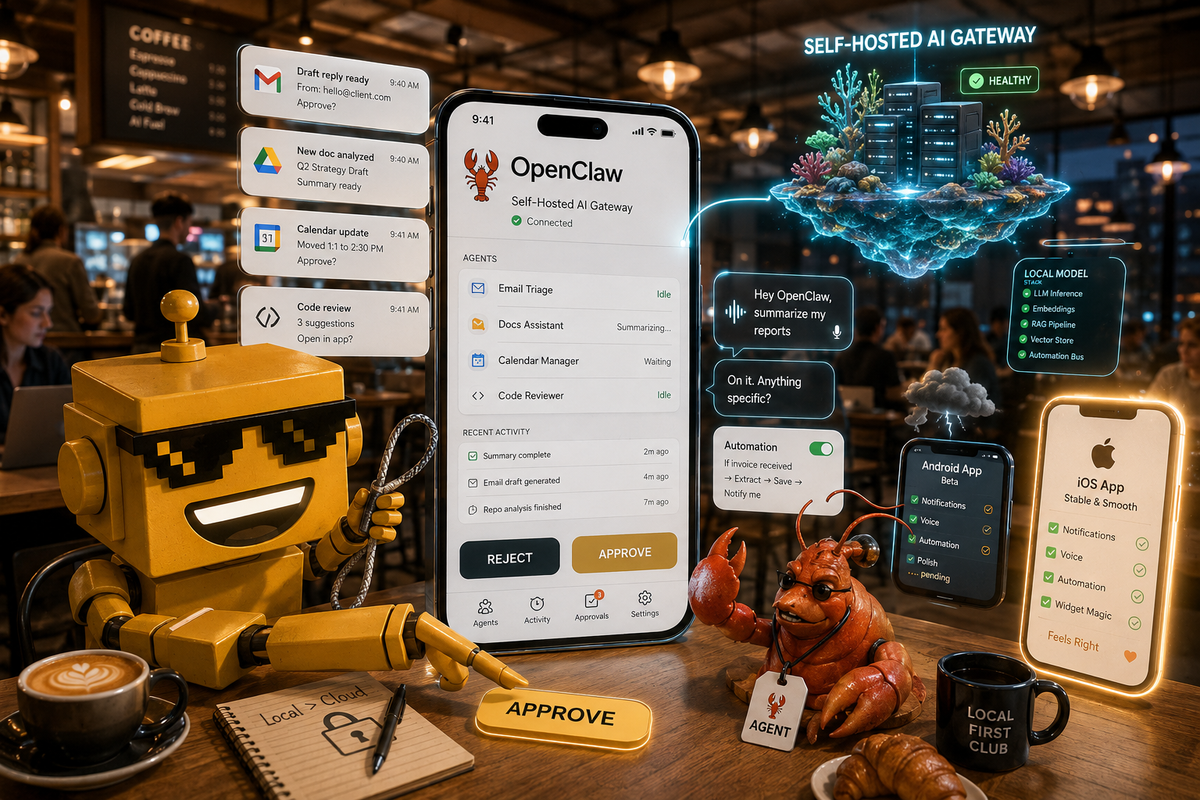
The dream of agentic computing has always contained one deeply unserious image: a lobster with root access pinging your phone in line for coffee.
That image became a little more real on June 29 and June 30, 2026, when OpenClaw launched official mobile apps for iPhone and Android and then promptly spent the next day shipping fixes for the rough bits. TechCrunch's June 30 write-up framed it simply: OpenClaw is now finally available on Android and iOS, which means the internet's favorite self-hosted automation crustacean has crawled out of the terminal and into your pocket.
That matters because OpenClaw is not selling "AI chat" in the usual sense. According to its documentation overview, OpenClaw is a self-hosted gateway that connects chat apps and tools to AI agents, with support for channels like WhatsApp, Telegram, Signal, Slack, Discord, Google Chat, and iMessage. You run the Gateway yourself. Your phone becomes one more node in the system. The pitch is that OpenClaw sits behind your existing apps like an overqualified stage manager, quietly clearing inboxes and routing requests.
I find that premise more compelling than most consumer AI launches because it solves an actual problem. AI agents are much easier to romanticize on a laptop than to live with in real life. If your agent can only be reached through a desktop dashboard, congratulations on inventing a very powerful houseplant. Mobile control is what makes the sentence operational.
Your agent finally learned the ancient art of leaving the house
The new apps are not standalone magic wands. As 9to5Google noted when the launch landed on June 29, they pair with your private OpenClaw Gateway and let you chat with your assistant, use real-time Talk mode, review action approvals, and enable device-aware capabilities like camera, screen, location, notifications, and push wakes. That is a much smarter product shape than the average "AI companion" app, because it treats the phone as a control surface and sensor package instead of pretending a glowing text box is innovation.
If you already buy the OpenClaw worldview, the mobile app closes the loop elegantly. The assistant is no longer trapped in your home office like a very ambitious hermit crab. It can now nudge you for approval, accept voice input, and theoretically use your phone's context in ways that make automation feel less like a science project and more like infrastructure. That is the real consumer unlock here. Not bigger models. Not more vibes. Reachability.
And yes, there is something slightly absurd about needing a self-hosted gateway, preferred model provider, app pair flow, and enough curiosity to voluntarily install a system called OpenClaw. But SiliconSnark has been watching this category mature from theatrical demo to plausible product. The OpenClaw clone wars were fun because everyone wanted the same fantasy. The deeper infrastructure story was more revealing because it showed how much plumbing, permissions, and risk sit underneath it once the agent starts touching real systems.
The privacy flex is real, and so is the setup tax
OpenClaw still has one huge advantage over the politely hosted assistants from bigger companies: the control story is coherent. The docs explicitly position it for developers and power users who want a personal AI assistant without giving up their data or relying on a hosted service. That self-hosted architecture is a real selling point in a market where every major AI product keeps trying to turn "trust us" into a business model.
In practice, that means the mobile launch is not just about convenience. It is about portability without surrender. Your phone can talk to the Gateway you run. Your sessions stay tied to the system you configured. That is a very different product than the standard consumer AI app, which usually starts with delight and ends with a privacy FAQ that reads like a hostage note from legal.
The downside is obvious: the weirdness tax is real. OpenClaw is still a power-user product cosplaying, with varying success, as something normal people might casually install before lunch. You need enough patience to run and maintain the backend, enough confidence to pair a phone into it, and enough appetite for edge cases that the phrase "device-aware automation" does not make you immediately text a more stable friend.
That does not make the product bad. It makes it specific. OpenClaw is for the same kind of person who reads release notes recreationally, which is why it pairs naturally with the broader AI-agent economy SiliconSnark already mocked with love. This whole category keeps selling digital employees. OpenClaw is one of the few that remembers employees need a phone.
The Android app is currently auditioning for "promising mess"
Now for the part where the launch stops being elegant and starts being extremely 2026.
9to5Google did not bother sugarcoating the first impression. The publication called out the Android build's bare-bones design, screenshots that jam the header into the status bar, and early user reviews complaining that the app was buggy, hard to pair, or simply unusable. This is not fatal, but it is revealing. OpenClaw understands agent architecture much better than it currently understands product polish.
To the project's credit, the response was quick. OpenClaw's v2026.6.11 release notes from June 30 say the update focused on reliability issues including misplaced replies, stuck sends, reconnects, model setup failures, and safer admin defaults. They shipped the mobile milestone, listened to complaints, and immediately started sanding down the worst splinters. The demo is never the hard part. The recovery loop is the point.
Still, consumer AI products do not get infinite credit for potential anymore. If you are asking people to trust an app that can wake agents, approve actions, and potentially bridge into their messages, files, and workflows, "we're patching fast" is reassuring but not sufficient. The mobile layer needs to feel dependable, not just ideologically correct.
That is also why the launch rhymes with Anthropic's recent babysitter-for-your-agents logic. Once agents start acting beyond a desktop toy box, supervision becomes the product. OpenClaw's mobile app is a supervision tool as much as a companion. That is smart. It is also a tacit admission that autonomous software gets much less charming the second it wants to do things while you are away from your keyboard.
Verdict: real consumer potential, still wearing developer shoes
My verdict is that OpenClaw's mobile launch feels like a real step forward for consumer AI agents, and a very honest reminder that the category still has to earn adulthood.
What launched is genuinely useful. The iPhone and Android apps give OpenClaw users the missing layer they actually needed: mobile access, approvals, voice, and device context tied to a self-hosted system. The privacy posture is appealing. The architecture is more interesting than the average cloud assistant. And the underlying idea, that your phone should be the remote control for your AI agent stack instead of a separate toy, is simply correct.
But this is not a mass-market hit yet. It feels more like a niche flex with obvious runway, a product for ambitious tinkerers that could become a broader consumer tool if the team keeps smoothing the glass and resisting the temptation to treat rough edges as personality. I am more impressed than annoyed, which in agent-land is practically a standing ovation.
OpenClaw has finally put the lobster in your pocket. Now it just needs to make sure the lobster does not accidentally send itself into production while you are ordering an iced coffee.