Microsoft Frontier Company Turns AI Consulting Into a $2.5 Billion Contact Sport
Microsoft Frontier Company is a $2.5 billion bet on embedded AI engineering, customer-owned intelligence, and enterprise transformation with elbows.

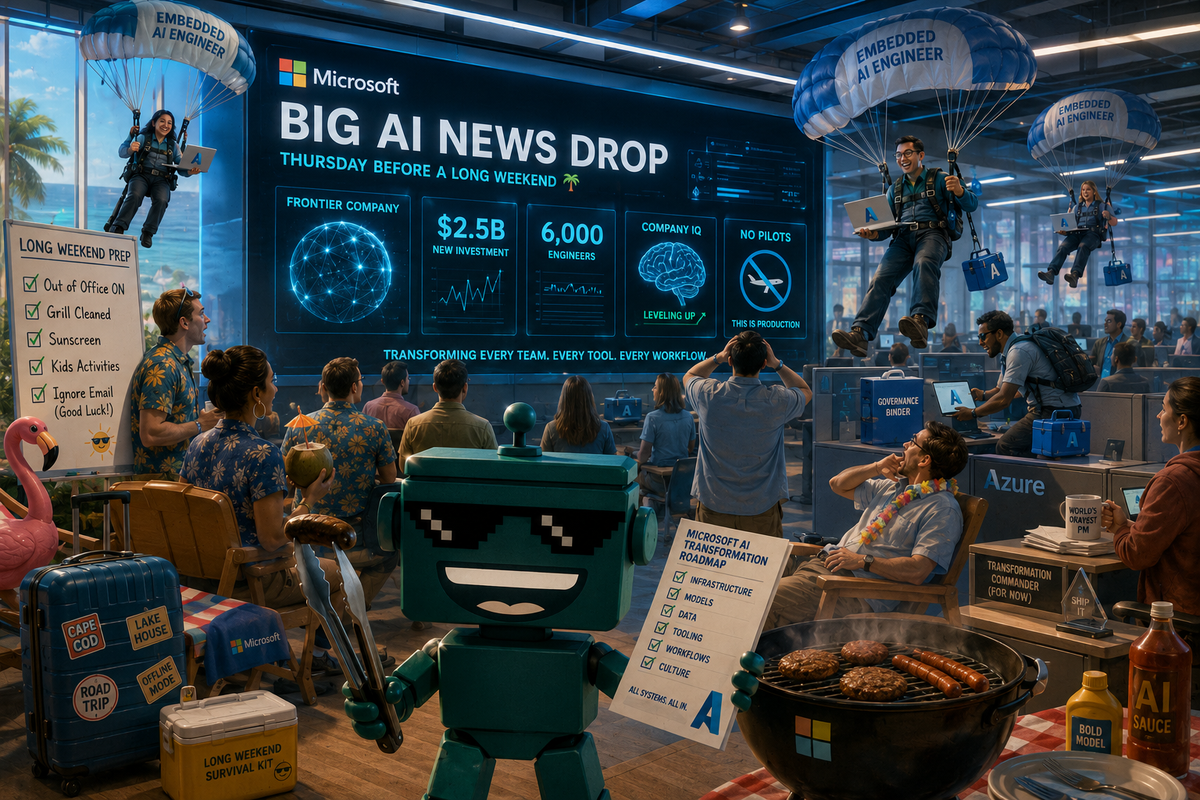
Usually the Thursday before a long weekend is not a day to drop huge news. It is a day to send a harmless product roundup, schedule one executive blog post about "momentum," and let everyone pretend they are still reading email while mentally standing beside a grill.
Microsoft has proved us wrong. Hahaha. Also: mildly terrifying.
On July 2, 2026, Microsoft announced Microsoft Frontier Company, a new operating business built around what it calls "Frontier Transformation." The short version is that Microsoft is putting $2.5 billion behind a 6,000-person organization of industry and engineering experts who will embed with customers to co-design, deploy, and continuously improve AI systems tied to measurable business outcomes.
That is not a normal pre-holiday news item. That is a cannonball into the enterprise AI pool while everyone else is looking for the sunscreen.
The company frames the effort as something beyond forward-deployed engineering, which is one of those phrases that sounds like a military procurement memo married a SaaS onboarding plan. But the idea is simple: enterprises have discovered that buying AI tools is not the same thing as becoming an AI company. The hard part is integrating models into workflows, data, security, governance, incentives, metrics, and the existing organizational furniture nobody wants to move.
Microsoft's answer is not just more Copilot. It is more Microsoft, inside the customer, with engineers.
The AI Demo Has Entered Its Consulting Era
The most honest line in the announcement is the emphasis on measurable outcomes and return on investment. That may sound like boardroom oatmeal, but it is the entire enterprise AI story in 2026. Companies are tired of being told the model is magical. They now want to know whether the thing lowered cost, sped up a workflow, improved a decision, or reduced a compliance mess.
This is where Microsoft Frontier Company gets interesting. The official product page says the new group will embed Microsoft engineering, industry, and AI professionals directly into customer organizations to build AI at scale, with the charmingly blunt promise: "No pilots. Scale from day one." That is either enterprise confidence or the last thing you hear before a steering committee asks for dependency diagrams.
Still, the direction makes sense. The industry has spent the last two years overproducing demos and underproducing durable operating change. The chatbot was the appetizer. The actual meal is systems integration, change management, security review, eval design, workflow redesign, cost control, and the brutally unsexy practice of making the same process work after the demo team has gone home. It lives in the same neighborhood as IBM's attempt to build a control plane for AI agents, where the glamour evaporates and the useful work starts.
This is why OpenAI's consulting detour felt less like a side quest than a market confession. AI vendors keep rediscovering services because enterprise transformation is not an API call. Microsoft is just turning that realization into a massive business unit with a proper org chart.
Your Company IQ Is Now a Protected Asset, Apparently
Microsoft argues that companies need an intelligence platform where proprietary data, expertise, workflows, and decision-making processes compound over time. It also says customers need a trusted platform to observe, govern, manage, and secure AI across the stack. In ordinary human language: your company's know-how should become a learning system, but not free breakfast for someone else's foundation model.
This is the line Microsoft is trying to draw. Frontier Company promises that customer data, IP, and competitive advantage are not used to train models in ways that commoditize the customer. The companion Microsoft page puts it even more plainly: what you build stays yours, and your "company IQ" is never used to power someone else's competitive advantage.
That matters because the ugliest fear in enterprise AI is not that the chatbot says something weird. It is that the company accidentally pays a vendor to digest its institutional knowledge, flatten it into a generalized capability, and rent the resulting intelligence back to the whole market.
Satya Nadella made a related argument in a June post on building a frontier ecosystem, warning against a future where a small number of models absorb the expertise of entire industries and commoditize the value underneath them. That is convenient for Microsoft, of course. But the argument is not wrong just because it is useful to Redmond.
The plumbing is the point. If AI becomes embedded in how companies learn, decide, sell, manufacture, analyze, hire, comply, and build, then whoever controls the loop controls how the organization gets smarter.
Model Diversity, Also Known as Please Do Not Make Me Pick a Religion
Microsoft is also leaning hard into a model-diverse platform. The announcement says customers should be able to use the right model for each scenario, whether that model comes from OpenAI, Anthropic, Microsoft AI, open source, or a specialized industry model.
This is both technically sensible and politically convenient. Enterprise buyers do not want to bet their operating future on one model vendor's roadmap, pricing, safety posture, or next leadership fever dream. Microsoft has a credible story because it already owns enough enterprise surface area to make model routing feel less theoretical: Azure, Microsoft 365, GitHub, Dynamics, Copilot Studio, security tooling, identity, data platforms, and partner channels. That distribution is the enterprise software equivalent of gravity, and it rhymes with Snowflake's own effort to turn enterprise data stacks into active AI coworkers.
Forward-Deployed Engineering, But Wearing a Microsoft Badge
The forward-deployed engineering comparison is doing a lot of work here, even as Microsoft insists this goes beyond the label. Palantir made the FDE model famous by putting technical people close to customers and their messy operational problems. Enterprise AI has made that idea fashionable because the gap between "we have a model" and "the business process changed" is where money goes to become mist.
Microsoft's version is less insurgent, more institutional. Less "elite team parachutes into the problem," more "the world's biggest productivity-and-cloud company would like to live slightly deeper inside your operating model." There is a joke in there, but also a real strategic shift. Microsoft is selling transformation capacity as part of the platform.
That is why this reminds me less of a one-off product launch and more of the agent-platform land grab we saw in the broader AI agent economy. The winners will not be the vendors with the funniest demos. They will be the vendors that can connect agents to business systems, define success metrics, govern the mess, manage cost, and keep improving the machinery after launch.
The early customer examples are exactly the proof points Microsoft needs. The company cites work with LSEG, Land O'Lakes, Unilever, and Novo Nordisk. In the LSEG example, Microsoft says its engineers helped embed AI into LSEG Workspace so finance professionals can ask complex questions across structured and unstructured financial content, with feedback and testing improving model quality over time. That is not a consumer wow moment. It is better: a real workflow that can plausibly compound.
The Risk Is That Transformation Still Requires Humans, Tragically
Now for the suspicious squint.
A 6,000-person AI engineering organization sounds enormous until you remember how many enterprises Microsoft sells to, how many industries it wants to cover, and how weird every large company becomes once you open the hood. Every customer believes it is special. Annoyingly, many of them are correct. Their data is weird. Their workflows are political. Their success metrics are contested.
That is the weirdness tax. Microsoft can reduce it. It cannot repeal it.
There is also a tension baked into the pitch. Microsoft is promising openness, model diversity, and customer-protected intelligence while also making the case that its platform is the place where all of this should happen. That may be the best answer for many buyers. It may also make some customers wonder whether "not locked into one model" is still a kind of lock-in if everything else orbits Microsoft.
To be fair, this is the ordinary bargain of enterprise software. Buyers want enough freedom to avoid captivity and enough captivity to avoid chaos. Microsoft Frontier Company is trying to sell that middle state.
That is not ridiculous. It is just expensive.
Verdict: A Huge Move, Dropped Like Everyone Wasn't Already Packing
Microsoft Frontier Company is one of the clearest signs yet that enterprise AI has moved from tool adoption to operating-model redesign. The important story is not that Microsoft has another AI brand. It is that Microsoft is formalizing the labor, platform, governance, and services layer required to make AI useful inside large organizations.
I am impressed by the ambition, amused by the timing, and professionally obligated to raise one eyebrow at any phrase as grand as "Frontier Transformation." But underneath the naming ceremony is a serious thesis: companies do not just need access to intelligence. They need to own and protect the way their own intelligence compounds.
That is more interesting than "AI will boost productivity." It says the next enterprise battleground is who controls the loop between people, data, workflows, agents, governance, and measurable outcomes tomorrow.
So yes, Microsoft dropped a $2.5 billion embedded-AI-engineering announcement on the Thursday before a long weekend. Somewhere, a communications calendar is smirking. Somewhere else, every enterprise AI vendor just realized the services layer is no longer a footnote.
Enjoy the barbecue. Microsoft brought a transformation army.