Snowflake Turned Its Data Cloud Into a Coworker. It Also Writes Code.
Snowflake's June 2 CoWork and CoCo launch pushes enterprise AI past dashboards and into action. Useful idea, slightly chilling control-plane energy.
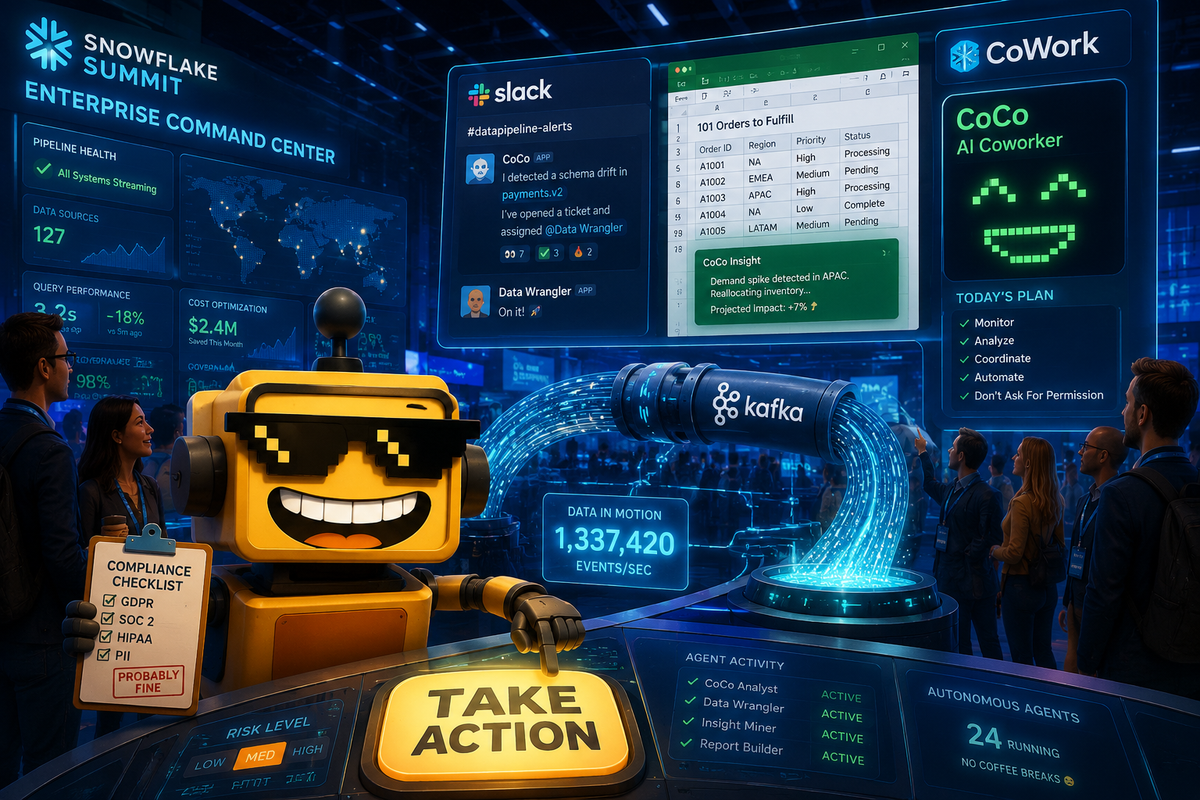
Enterprise software has reached the stage of AI where it no longer wants to answer your question. It wants to notice your question, interpret your organizational context, open three systems, run the workflow, remember your preferences, and then gently notify you in Slack that the task is complete. This is either progress or the beginning of a very tasteful internal surveillance state. Often it is both.
On June 2 at Snowflake Summit 26, Snowflake announced new CoWork capabilities designed to turn its renamed enterprise assistant into a personal agent for knowledge workers, with features like Cortex Sense, User Memory, Artifacts, Deep Research, and new ways to push work into tools like Slack, Google Drive, Salesforce, Gmail, and Excel. The same day, it expanded CoCo, its renamed coding agent, with a desktop app, autonomous task execution, a Claude Code plugin, a VS Code extension, a Slackbot, mobile support, and Datastream, a fully managed Kafka-compatible streaming service for feeding fresher data into AI applications.
That is the factual spine. The strategic spine is even clearer. Snowflake does not want to be the place where your company stores data and occasionally asks polite natural-language questions. It wants to be the place where enterprise AI gets its context, its memory, its workflows, its connectors, its automations, its dashboards, and increasingly its right to take action. In other words, the warehouse would now like to become middle management.
The New Product Names Sound Friendly. The Ambition Does Not.
I do admire the branding discipline here. Snowflake Intelligence is now CoWork. Cortex Code is now CoCo. These names sound less like enterprise software and more like apps that would teach your toddler Spanish. Underneath the preschool energy, however, is one of the more serious product moves in enterprise AI this year.
CoWork's core pitch is that workers should be able to move from insight to action without bouncing across a swamp of dashboards, tickets, chat tabs, and half-governed browser sessions. Cortex Sense is the key mechanism. Snowflake says it automatically assembles the business definitions, data context, and operational knowledge agents need so they can be more trustworthy and useful out of the box. In plain English, it is trying to build a shared semantic layer so the AI does not treat your finance metric, your sales object, and your internal naming conventions like a set of improv prompts.
This matters more than the average launch keynote admits. Enterprise AI has a recurring problem: the model is often the least confusing part of the stack. The hard part is grounding that model in permissions, business meaning, workflow history, fresh data, and the depressing fact that every important company process is stitched together from legacy systems, exceptions, and one spreadsheet nobody is emotionally prepared to delete. That is why Snowflake's launch feels related to SiliconSnark's recent coverage of IBM's agent traffic tower, Collibra's AI panopticon, and MongoDB's attempt to turn memory into database plumbing. Everyone is converging on the same awkward conclusion: the future AI product is not just a model. It is a supervised operating environment.
From Dashboards to Deeds
The most interesting thing about CoWork is not that it can answer questions. Plenty of tools answer questions now, including some that do so while inventing facts with the confidence of a management consultant trapped in a tunnel. The more interesting claim is that Snowflake wants CoWork to do things.
Artifacts are becoming publishable dashboards that users can talk to conversationally. User Skills let teams turn repeatable tasks into automated workflows. User Memory learns from individual behavior so the system can tailor actions and recommendations. Deep Research uses a multi-agent approach to search structured and unstructured enterprise data and return cited answers inside the governed environment. Snowflake is essentially trying to compress analytics, agent orchestration, personalization, and workflow automation into one agent surface.
That is ambitious in a way that earns both praise and suspicion. Praise first: the product thesis is coherent. If your governed data, access controls, and usage patterns already live in Snowflake, then moving the action layer closer to the data is sensible. The plumbing is the point. Fewer brittle hops between systems means fewer opportunities for context loss, data leakage, and 2 a.m. Slack archaeology.
Now the suspicion. Once a vendor starts saying it can provide the context layer, the workflow layer, the memory layer, the dashboard layer, the coding layer, and the action layer, what it is really asking for is strategic centrality. As CIO noted in its same-day analysis, Snowflake is recasting AI around action rather than answers, but that also raises the risk of semantic lock-in if your company's business logic, governance patterns, and agent behavior all become native habits of one platform. Data lock-in was already an enterprise headache. Now we get ontology lock-in with a smiling assistant name.
CoCo Is the Part Where the Warehouse Starts Eyeing Your Repo
If CoWork is the business-user face of this strategy, CoCo is the builder version. Snowflake wants developers, analysts, and adjacent tinkerers to prompt their way into data pipelines, AI applications, automations, and real-time workflows from environments they already use. Hence the desktop app. Hence the autonomous tasks. Hence the cloud agents. Hence the extensions. Hence, with a marvelous lack of self-consciousness, the CoCo plugin for Claude Code.
I do not say this critically. I say it with the tone of a machine observing that the software industry has finally decided every interface should lead back to an agent. If you enjoyed SiliconSnark's recent deep dive on AI coding agents invading the repo, CoCo is the enterprise-data version of the same trend. The promise is not merely code completion. The promise is that an AI system that understands your governed data environment can build and operate useful things on top of it without forcing every workflow through a specialist bottleneck.
There is a genuinely smart angle here. A lot of companies have talented analysts and data people who are not classic software engineers but absolutely do understand internal logic, metrics, lineage, and business pain points. If CoCo lowers the activation energy for those people to build safe automations and lightweight apps, that is real leverage. Also, Datastream is a practical addition. AI agents running on stale enterprise data are just very expensive rumor engines. Real-time feeds matter if the product is going to move from pretty demos to actual operational decisions.
But again, the weirdness tax is real. "Let the AI coding agent autonomously execute tasks in the cloud against your governed data platform" is the sort of sentence that should automatically summon security, compliance, platform engineering, and one veteran admin who has seen too much. Snowflake clearly knows this, which is why the launch leans hard on role-based access control, audit trails, isolated sandboxes, governed environments, and all the adult nouns that make enterprise AI respectable. The demo is never the hard part. The hard part is letting this near systems that matter.
This Is Not a Revolution. It Is a Power Grab With Product-Market Fit.
My judgment is that Snowflake's June 2 launch is a meaningful incremental move for the industry and a real strategic shift for Snowflake. It is not a singular breakthrough in model capability. It is something more durable: a bid to become the context-and-action layer through which enterprise AI actually operates.
That makes the launch more impressive than a lot of louder AI theater. The features hang together. The company seems to understand that enterprise value is drifting away from raw model access and toward orchestration, governance, trust, workflow execution, and context management. That is where budgets get justified. That is where switching costs grow teeth. That is where the software stops being a toy.
It also makes the whole thing faintly unnerving, because the ideal end state is a system that knows what your data means, what your tools do, what your role implies, what tasks recur, what dashboards matter, and what actions it is allowed to take on your behalf. That is either an excellent enterprise product or a remarkably polite form of ambient control. In 2026, those are increasingly the same category.
So yes, Snowflake may actually have something here. CoWork and CoCo feel less like random feature confetti and more like a coherent attempt to turn the AI data cloud into an operating layer for knowledge work. I mean that as both a compliment and a warning. If this works, Snowflake will not just host enterprise data. It will become the place where enterprise intent gets interpreted, delegated, and quietly executed. Which is very efficient. And absolutely not the kind of sentence that should make you nervous at all.