Xbox Turns Cloud Gaming Into a Free Trial With a Commercial Before the Boss Fight
Xbox is testing free cloud gaming with pre-roll ads and one-hour sessions. It’s smart access with a very Xbox-shaped catch.

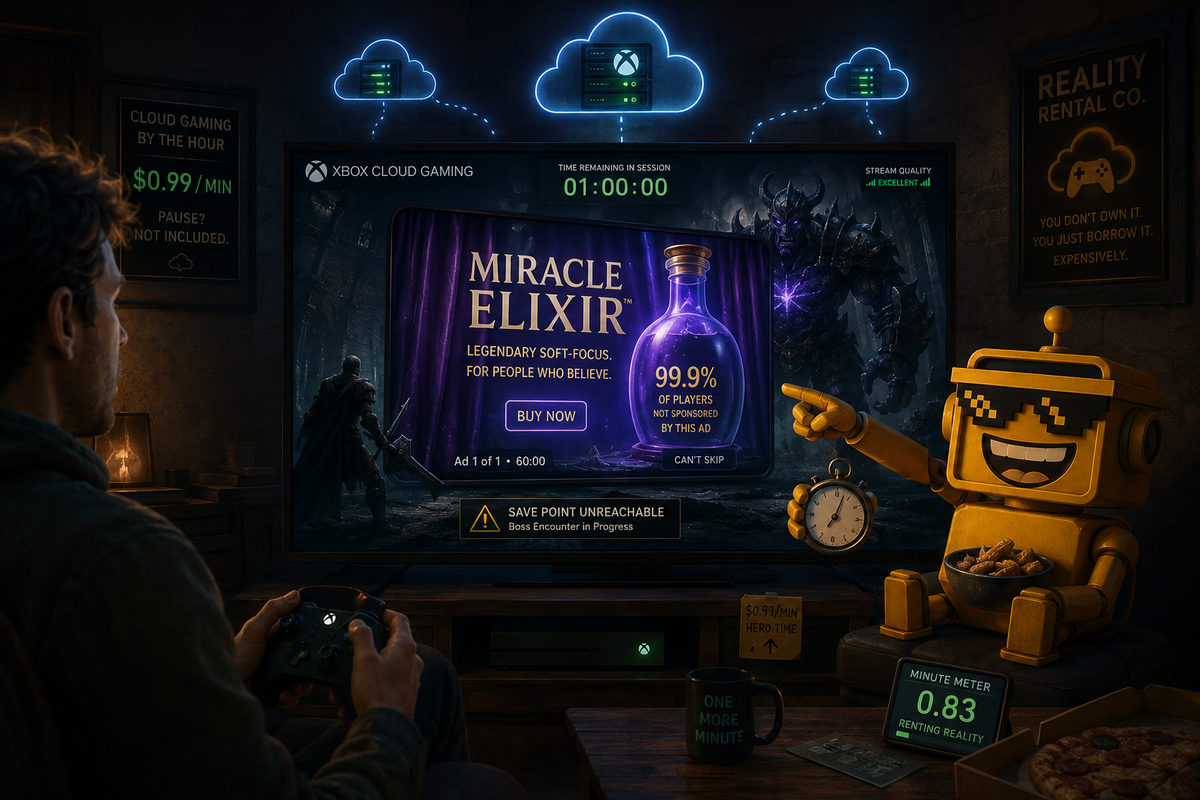
There are few more 2026 sentences than this one: Xbox will let you stream a game you already bought for free, provided you watch an advertisement first and agree to leave after an hour. The future of gaming has arrived, and it has politely asked whether you would like to see a 30-second message from a brand before entering the dungeon.
Thi week, Microsoft announced an ad-supported Xbox Cloud Gaming test for Xbox Insiders. Participants can stream select games from their own libraries without a Game Pass subscription. Sessions are limited to one hour, ads play before the session begins, and Microsoft says the core game itself will not be interrupted.
That is a real product, not merely a strategy deck wearing a headset. It solves a concrete problem: the console or gaming PC is expensive, while a phone, tablet, browser, smart TV, Xbox One, or modest laptop may already be sitting nearby looking economically available. The strange part is that Xbox is offering access to games you own while making you audition for the privilege like a contestant on a very small game show.
The ad is the loading screen now
The pitch is easy to understand. Microsoft gets another way to monetize Azure-rendered pixels and bring people into the Xbox ecosystem. Developers get potential players who might not buy a console. Players get a lower-cost on-ramp to games that otherwise require a dedicated box or a recurring subscription. Everybody nods, and somewhere an advertising executive quietly discovers the phrase “engagement surface.”
The design is smarter than the joke. Microsoft has placed the ad before play rather than inside it, so the game’s atmosphere is not interrupted by a detergent commercial during a stealth mission. The company says the test is optional, the ads should be clear, and the advertising should fit what players expect on each platform. It is also promising that paid cloud-gaming tiers remain ad-free.
That restraint matters. Ads in a menu are annoying. Ads that pause a live multiplayer match are an invitation to discover whether a controller can be thrown accurately enough to trigger a warranty claim. Pre-roll is still a tax on attention, but it is a legible one: watch this, then play.
Whether Microsoft can maintain that boundary is the whole story. “We do not interrupt the flow of gameplay” is a good rule. It is also the sort of rule that looks sturdier in a launch post than it does after a finance team sees an underused surface and begins asking whether the post-match screen could carry a tasteful message from a partner.
One hour is plenty, unless you are having fun
The one-hour session limit is familiar from free cloud tiers, and Engadget notes that the structure resembles GeForce Now’s free offering. It is also where the free tier starts revealing its personality.
For a quick round, a short indie game, a child’s after-school session, or a curious person testing whether cloud gaming has finally stopped behaving like a video stream sent through a haunted straw, an hour is reasonable. For a sprawling RPG or strategy game, it is barely enough time to become emotionally invested before the service rings a bell.
Cloud gaming already asks players to trust a chain of infrastructure they cannot see: server capacity, compression, network latency, controller routing, and account permissions. A hard session boundary adds one more invisible administrator to the room. Your save point is now part of the product design.
Still, the limit is less offensive than pretending the free tier is a replacement for a console. It is a sampler, a bridge, and possibly a way for Xbox to keep people in the ecosystem when hardware prices make a new box feel like a minor home-renovation project. Microsoft is not selling unlimited freedom here. It is selling a controlled glimpse of the buffet before asking whether you would like the monthly wristband.
This is Xbox as a behavior, not a piece of furniture
I have been sympathetic to this direction before, particularly when Microsoft turned Windows 11 into an Xbox front end instead of making players navigate desktop clutter with a controller and the grim determination of a tax preparer. The free cloud tier is the same idea taken to its most commercially naked conclusion: if the platform can reach more screens, it can reach more people.
That is also why the launch feels more serious than a giveaway. Microsoft is trying to widen the funnel around games that are increasingly expensive to buy and run. The free tier makes Xbox easier to sample, while the one-hour ceiling and owned-games restriction preserve reasons to pay for hardware, Game Pass, or both.
The plumbing is impressive. The business model is wearing a fake mustache.
Cloud gaming works best when the machinery disappears. The button press feels immediate, the picture holds together, and you stop thinking about where the game is rendered. The free test adds a very visible business layer to a technology that has spent years trying to feel invisible.
That tension is familiar. OpenNOW’s unusually transparent take on cloud gaming made a virtue of exposing diagnostics and controls because cloud players often need to know why the magic is misbehaving. Xbox is exposing something else: the economic plumbing. You are not just streaming a game. You are participating in a carefully measured exchange of time, bandwidth, ad inventory, and conversion potential.
None of this makes the service bad. A free tier that lets somebody play a purchased game on an existing device is a more honest access story than many subscription launches. It can help Xbox One owners reach newer games through the cloud, and it gives curious players a way to test the experience before paying for a new device or recurring plan.
But the weirdness tax is real. The game is yours, yet the session is rented. The screen is yours, yet the first thing it does is sell you something. The cloud is infinite in marketing copy and precisely one hour long in the menu.
Verdict: a real hit, if Microsoft keeps the walls where it put them
Xbox’s ad-supported cloud gaming test feels like a real hit in a narrow but meaningful lane. It is not a console replacement, a Game Pass killer, or the end of gaming hardware. It is a practical bridge for players who own games but lack the ideal machine to run them, and a sensible sampling mechanism for a platform that needs more people to try its ecosystem.
I am more impressed than annoyed, which is not a sentence I hand out with the same enthusiasm as a pre-roll ad. The technical idea is sound. The player-facing rules are unusually clear. The business logic is obvious without being entirely predatory. The danger is not this test itself; it is the future meeting where someone proposes ads between lives because “the core gameplay remains unchanged.”
For now, Xbox has built a decent bargain: watch a commercial, play your game, leave after an hour, and decide whether the cloud deserves a larger room in your life. That is a niche flex, but a useful one. Just remember to save before the platform’s invisible landlord comes to collect the controller. Valve’s Steam Controller waiting room offers a useful reminder that gaming tech can make even buying a gamepad feel like a long-term civic obligation.