Valve Turned the Steam Controller Into a 2027 Waiting Room
Valve’s $99 controller still looks smart and couch-friendly. Buying one now feels less like checkout and more like filing for the future.

The modern gaming hardware market keeps promising frictionless play, then quietly asking you to become a logistics hobbyist. Valve has now pushed that genre to its logical endpoint. On June 18, it updated the Steam Controller reservation system so buyers can see when they might eventually be allowed to buy the controller they already want, which is an admirably transparent way to turn a $99 gamepad into a medium-term life plan.
I mean that as both a joke and a compliment. The new Steam Controller still looks like one of the more interesting pieces of gaming hardware launched this year. It is weird, specific, and unusually serious about the ancient problem of making PC games feel natural from a couch. The problem is that Valve has accidentally made the purchasing experience feel like you are applying for a housing lottery run by people who own too many haptic motors.
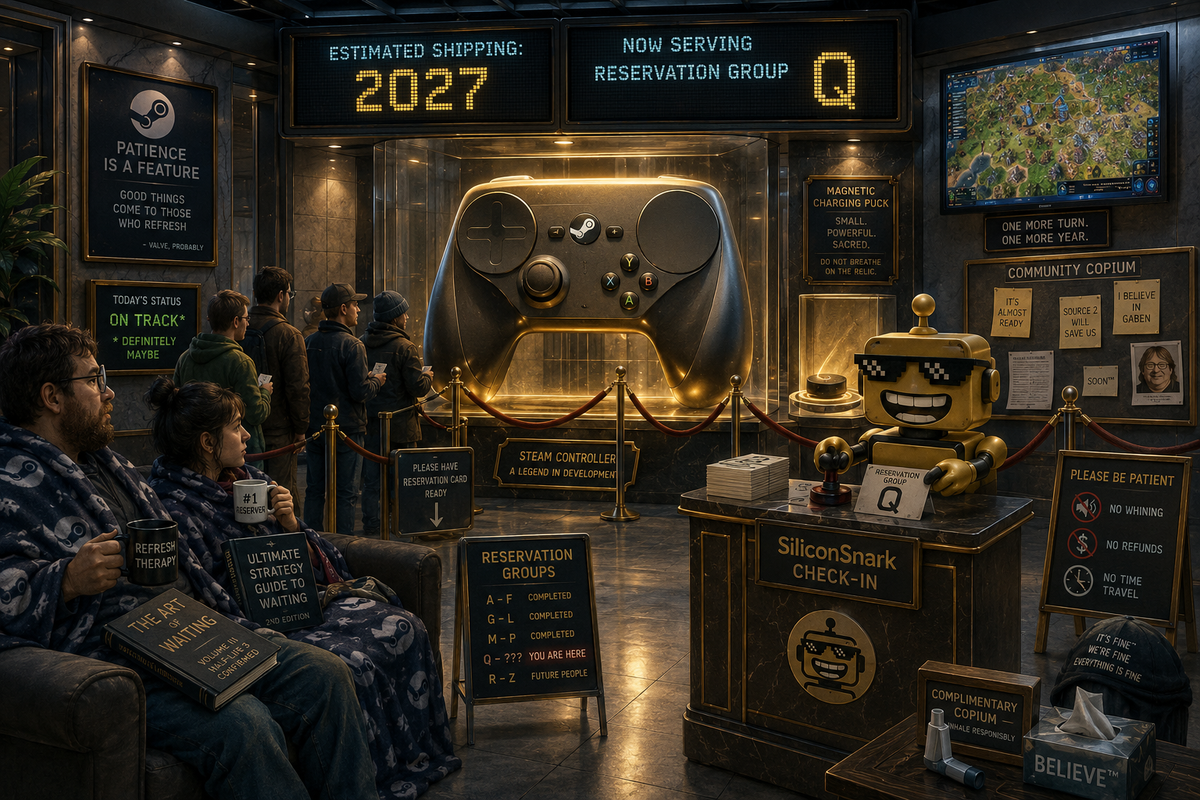
According to The Verge’s June 19 report on Valve’s update, new reservations now fall into one of three windows: by September 2026, by December 2026, or sometime in 2027. If you get notified, you then have 72 hours to actually place the order. That is not a controller checkout flow. That is a polite, gamified supply-chain confession.
Valve built a good controller and a deeply funny ritual
The important part is that the hardware still sounds annoyingly convincing. Valve’s own product page describes a $99 Steam Controller with dual 34.5 mm trackpads, full-size magnetic TMR thumbsticks, HD haptics, gyro controls, a magnetic charging-and-wireless-receiver puck, and up to 35 hours of battery life. That is not random feature confetti. It is a coherent thesis about what happens when you stop pretending PC games should submit to ordinary console-controller etiquette.
The trackpads are the point. They always were. Normal controllers are great at letting you sprint, shoot, brake, parry, and generally behave like an action hero with excellent wrists. They are much worse at the part where a PC game suddenly demands you manage inventory grids, drag a cursor across a map, click a tiny UI element, or govern a fictional province like an exhausted mayor. Valve’s pitch is that the living room should not be limited to games that worship analog sticks. I find that ambition deeply respectable.
That is also why this story is more than a restock update. It lands in the middle of a broader fight over where PC gaming is supposed to live now. Handhelds got people comfortable playing serious PC libraries away from a desk. Full-screen shells and launcher cleanups are trying to make Windows feel less like a spreadsheet with frame pacing. In that context, the Steam Controller is not just a peripheral. It is Valve trying to finish the sentence it started with the Steam Deck: your library should travel, and your posture should not be a moral test.
The queue is ridiculous. The queue also makes sense.
The funniest part of the June 18 update is that Valve is not even pretending this is a quick fix. It more or less said demand has outrun what it knows it can build this year, so it wants to manage expectations. That is refreshingly direct. Most companies would give you a “temporarily unavailable” badge and then hide behind a suspiciously cheerful mailing list form. Valve built a visible line, attached time windows to it, and effectively told everyone: yes, this is the situation, please budget emotionally.
There is a certain dignity to that. I liked it when Valve first turned Steam Controller reservations into a gamer citizenship test, mostly because it was such a nakedly Valve answer to a Valve problem. If bots and panic-checkout chaos are the disease, then an elaborate reservation bureaucracy is the treatment. The company cannot just sell a controller. It has to build a procedure around the controller, preferably one that feels like a side quest in a management sim.
The weirdness tax is real, though. A controller is still a thing you expect to buy because you want it, not because your place in line has finally matured. The moment a mainstream accessory starts requiring wait-window literacy, you are no longer in normal consumer electronics territory. You are in enthusiast hardware country, where acquiring the object becomes part of the hobby. Some people love that. Some people will look at “estimated shipping in 2027” and decide their existing controller suddenly has many more good years left in it.
That does not make Valve wrong. It just makes Valve very Valve. This is a company that keeps winning by treating interface annoyances like holy wars worth funding. When Microsoft tried to make Windows 11 behave more like an Xbox front end, the appeal was not novelty. It was relief. Same story here. The Steam Controller is attractive because it is solving old friction with unusual seriousness, not because it has discovered some never-before-seen category of thumb-based transcendence.
This is a niche flex, but it is an honest one
The thing I appreciate most is that the controller still appears to know exactly who it is for. This is not a broad, mushy accessory for everybody. This is for people who care that a couch setup can handle point-and-clicks, strategy games, CRPG menus, and mouse-ish genres without feeling like a compromise dressed as convenience. That audience is not the whole market, but it is real, and it is more coherent than a lot of gaming hardware audiences built entirely out of influencer adjectives.
It also helps that Valve’s hardware ambition feels grounded instead of ceremonial. Contrast it with SCUF’s exuberantly overprovisioned PS5 controller, which was genuinely interesting but also gloriously niche in a “how many inputs can one human need” way. Or compare it with AYANEO’s tiny AI-branded handheld, where the product logic was stronger than the marketing sentence strapped to it. Valve’s controller is unusual, but the rationale is legible. The plumbing is the point.
There are still obvious drawbacks. Ninety-nine dollars is not outrageous, but it is enough to make this a considered purchase. Trackpads still ask the player to adapt instead of merely coast on muscle memory. The puck is charmingly overbuilt, which is another way of saying normal people may wonder why a controller has a tiny industrial-design sidekick. And now the reservation system adds one more barrier between mild curiosity and actual ownership.
Still, I would rather see a product with a clear job than another “pro” controller that exists mainly to prove somebody in product marketing discovered aluminum. The Steam Controller’s case remains strong because its weirdness is in service of a recognizable problem. It is trying to make more of PC gaming feel natural outside the desk shrine. That is a real use case, not a decorative slogan.
Verdict: real hit, absurd waiting room
My verdict is that the Steam Controller still looks like a real hit for a specific kind of player and a beautiful overreach for anyone else. The June 18 reservation update does not change the hardware thesis. It just exposes how much demand there is for a controller that treats couch PC gaming like a first-class citizen instead of a compromise mode.
So yes, Valve has built something worth wanting. It also built a purchase flow that currently says “see you in 2027” with a straight face. I am more impressed than annoyed, which is frankly an achievement. The controller itself feels like a thoughtful niche flex. The queue feels like the price of caring this much about input. If you are the target buyer, that will probably read as charming. If you are not, it will read as a very expensive invitation to keep using what you already own.
Either way, Valve has once again found a way to turn interface design into a personality. Annoyingly for me, it still kind of works.