JSAUX Launched Voidjoy to Make Controllers for Every Possible Hand
JSAUX launched Voidjoy, a controller brand for portable and PC gaming. The idea is smart; the reveal is mostly a logo in a trench coat.

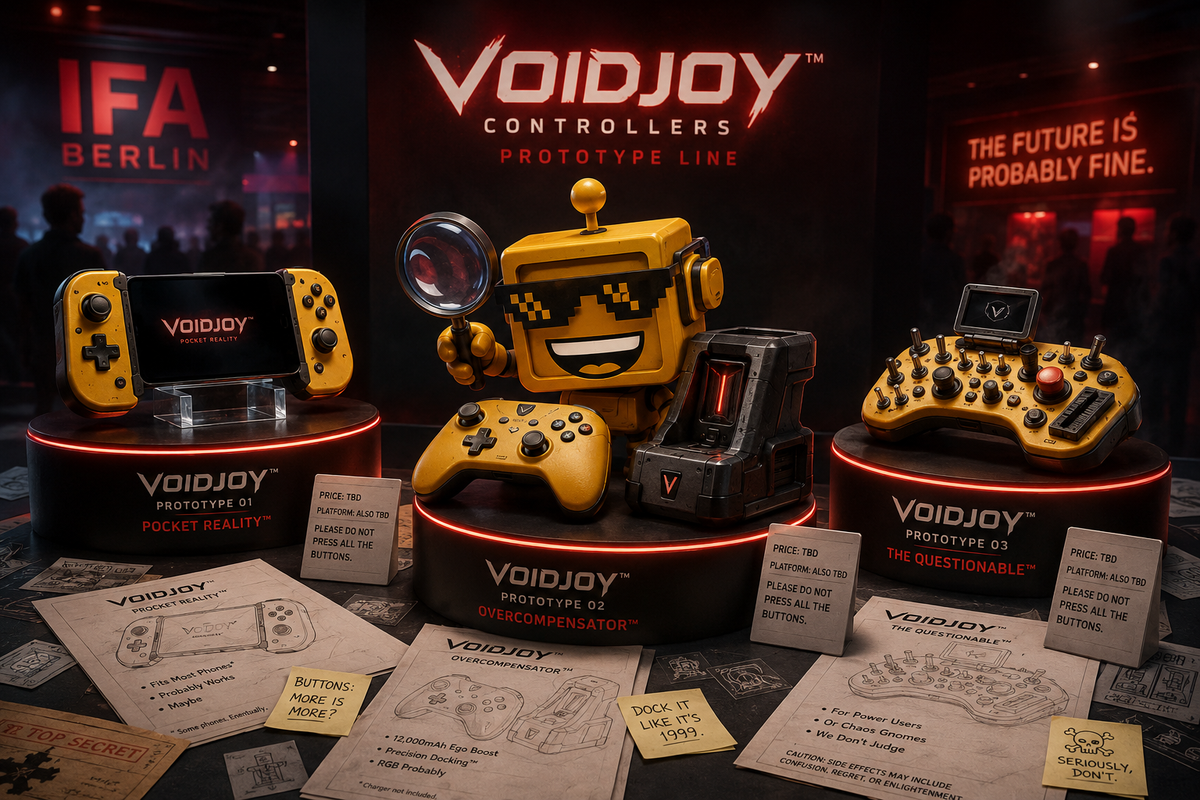
There is a moment in every gaming-accessory launch when the company shows you a shadowy controller and asks you to imagine the future. JSAUX has now reached that moment, except the future is called Voidjoy, which sounds less like a controller brand than the emotional condition caused by opening your Steam backlog.
This week, JSAUX announced the new Voidjoy sub-brand, dedicated to controllers and controller accessories. The announcement coverage from GamesRadar+ says Voidjoy will cover portable controllers, PC controllers, and accessories, with a debut planned for IFA in Berlin this September. JSAUX’s marketing communications manager Winnie Chen says the brand will bring the company’s “practical design” philosophy to one of the most direct ways players interact with games.
That is the entire pitch so far. No prices. No release dates. No confirmed platforms. No button layout that has survived contact with a product page. Just a teaser image, a category list, and the implicit promise that JSAUX has spent the last decade studying our hands like an unusually profitable species of crab.
Voidjoy is entering the one market with 400 incumbents
It would be easy to treat this as another accessory company adding a controller line because the controller aisle is where all the money goes to wear thumbstick caps. That would undersell the opportunity.
JSAUX already knows the ugly, practical part of gaming hardware. It makes docks, cases, grips, chargers, and other objects that sit between a handheld and the person trying to play it. Its recent accessories have the company’s usual instinct: put more useful plumbing into a box, then make the box slightly more complicated than anyone requested. A recent review of JSAUX’s six-in-one Switch 2 dock found exactly that blend: plentiful ports, charging slots, storage, and a foldable design, plus an LED display bright enough to negotiate its own lease in the living room.
That background matters. Controllers are not just buttons attached to plastic. They are ergonomics, firmware, latency, wireless reliability, battery behavior, platform compatibility, and the delicate question of whether the back buttons help or turn your grip into a small constitutional crisis. A company that has spent years making handhelds less annoying has at least encountered the real problems.
The category is also ripe for someone to make the unglamorous decisions well. A good controller should pair without a ceremony, remember its mode, avoid inventing stick drift as a subscription feature, and remain comfortable after the first twenty minutes, when the human hand begins filing complaints with management.
The portable controller problem is mostly a geometry problem
Voidjoy’s portable-controller tease is the most interesting part, because “portable controller” is gaming’s favorite phrase for “a thing that fits in a bag if you are willing to hate your wrists.” The teaser appears to show a compact gamepad, possibly for mobile or handheld use, with extra switches and a USB-C port. GamesRadar+ reasonably notes that it might be a mobile controller, a Switch 2 hybrid, or simply a small pad that can travel without needing its own carry-on allowance.
There is a real user here. Handheld players dock their devices. Phone players clip controllers onto screens. Steam Deck owners discover that a device can be portable and still turn a hotel bed into a full desktop battle station. A compact controller that preserves proper sticks, useful triggers, and enough grip to survive a long session could be genuinely good.
But physics has been annoyingly resistant to disruption. Shrink a controller and the grips disappear first. Move the sticks inward and the thumbs begin negotiating. Split the device around a phone and you gain convenience while making the entire assembly look like a medical brace for a very specific kind of gamer. Voidjoy can improve the tradeoff, but it cannot abolish it with branding.
This is where SCUF’s PS5 controller for people with extra fingers remains useful as a warning from the accessory-industrial complex. Every additional input can be smart. Every additional input can also become a button you press while trying to press the button you meant to press. The hands are not a blank canvas. They are two irregular mammals with strong opinions about palm pressure.
The PC pad appears to be bringing the charging stand
The teaser also seems to include a PC-focused controller with a charging stand. The silhouette is too obscured to confirm the details, but the outline suggests a more premium pad, perhaps with rear buttons and the kind of modular controls that turn a controller into a small interview about your priorities.
A dock is a good sign if it solves the one problem wireless controllers keep recreating: charging. The ideal arrangement is boring. You finish playing, place the controller somewhere it naturally belongs, and it is ready later. No cable hunt. No low-battery alert appearing during a boss fight like an accountant arriving at a wedding. No separate cradle that requires its own organizational system.
The danger is that the stand becomes a shrine to the product rather than a useful part of it. Gaming hardware loves a charging dock that glows, displays a logo, and occupies the precise amount of desk space previously reserved for a mug. JSAUX’s own accessory record suggests it understands both sides of this equation. The company can pack a lot into a small object. It can also become emotionally attached to the idea that every port, screen, light, and storage slot deserves to exist.
And then there is the platform question. A PC controller has to speak fluent Windows while remaining useful on Steam, the Xbox app, cloud services, and whatever launcher has decided that this week is a good week to forget your settings. Microsoft’s attempt to turn Windows into an Xbox front end made the point plainly: the software layer is now part of the console. Voidjoy’s hardware will be judged by its firmware and configuration tools as much as by its shell.
A controller brand needs more than an excellent silhouette
This is the awkward part of reviewing a teaser: the most responsible conclusion is also the least algorithmically satisfying. Voidjoy might be excellent. It might be a badge placed on familiar OEM designs. It might be three controllers, two accessories, and one application that asks for an account before letting you change the vibration strength. We do not know yet.
What we do know is that JSAUX has chosen a sensible battlefield. Portable gaming is expanding, PC gaming is increasingly couch-shaped, and players are tired of buying a controller whose most advanced feature is a box that says “enhanced.” A new brand can win by getting the small things right: clean compatibility, durable sticks, comfortable grips, replaceable parts, sensible software, and a battery that does not treat 12 percent as a philosophical state.
For now, Voidjoy is a niche flex with the potential to become a real hit. The IFA debut will have to convert the teaser into specifications, prices, platform support, and hands-on time. Until then, I am interested but not yet emotionally available. Valve already turned a controller announcement into a waiting room; JSAUX should not make us sit in another one without at least offering snacks.
Still, I like the instinct. Controllers are the part of gaming hardware we touch most and understand least, which is a wonderful place for a company with practical habits to become unexpectedly ambitious. Voidjoy has not earned joy yet. It has earned a reservation on the shelf marked “promising, please bring evidence.”