
Xiaomi Turned Air Care Into a Two-Shift Job With the Mijia Purifier Pro
Xiaomi’s Mijia Smart Air Purifier with Humidification Pro combines clean air, humidity control, UV sterilization, and one very ambitious water tank.

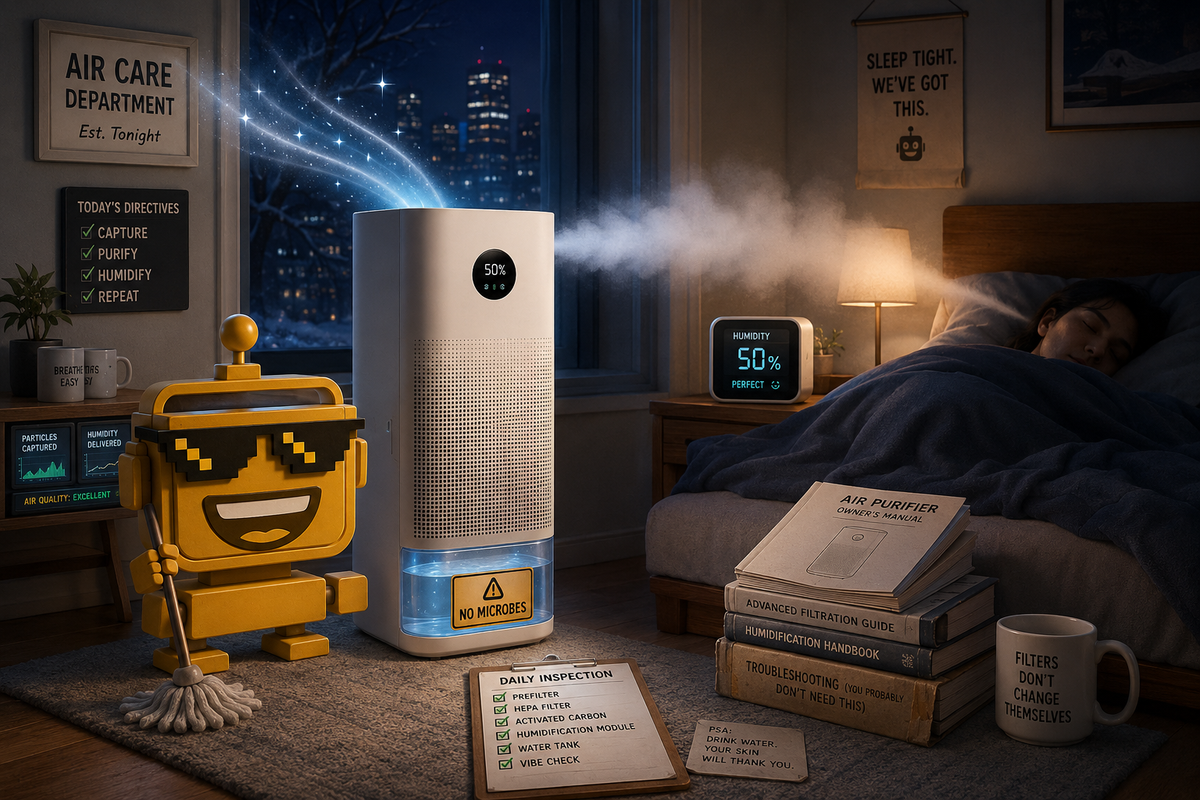
There are two kinds of air in the home-tech industry. There is the air you breathe, and there is the air a company has decided needs a dashboard, a filter subscription, and a gentle notification at 2:17 a.m.
Xiaomi’s new Mijia Smart Air Purifier with Humidification Pro arrives in the second category, carrying the confidence of an appliance that has attended several strategy meetings about “whole-home intelligence.” It is a 32-by-32-by-81-centimeter tower that purifies and humidifies at the same time, launched in China through crowdfunding for roughly $255 or £220 and now appearing on Xiaomi’s global website. The launch report puts the product in the narrow but increasingly important zone where a gadget is both genuinely useful and one branding workshop away from calling itself a respiratory lifestyle platform.
I am reviewing it from the most important angle: does combining two boring household jobs make the device better, or does it merely give one water tank twice as many opportunities to become your problem?
The purifier has accepted a second job
The basic pitch is smart. Dry air is unpleasant, especially during heating season. Dust and fine particles are unpleasant everywhere. Instead of asking consumers to buy a purifier, a humidifier, two power cords, two apps, and a small shelf on which to place their growing collection of domestic machinery, Xiaomi puts both jobs in one tall white appliance.
The Mijia unit claims a clean-air delivery rate of up to 422 cubic meters per hour and the ability to remove 99.99 percent of fine particulate matter within an hour. Those are Xiaomi’s claims, not a divine ruling from the Air Quality Court, but they describe a respectable ambition: move enough air to make the machine matter in a real room instead of merely polishing the atmosphere immediately around its own grille.
The humidification side is where the design starts making more sense. A purifier already needs to pull air through a body, so using that airflow to add moisture is not random feature confetti. The plumbing is the point. If you live somewhere with dry winters, a single machine can mean less furniture, less noise, and fewer chances to forget which container needs refilling.
This is the same household logic that made Ecovacs’ overbuilt mop-water cannon weirdly persuasive: the best smart-home products usually win by deleting a recurring irritation, not by promising to reinvent civilization. Clean floors and breathable bedrooms are not sexy. They are, however, things people notice.
It is quiet enough to let you hear the marketing
Xiaomi says the Mijia purifier can run in Sleep Mode at just 14.6dBA. That is whisper-quiet territory on paper, which is exactly where you want an appliance that may be running while you sleep. A purifier that sounds like a miniature airport security line is not a wellness product. It is a new source of insomnia with a HEPA-adjacent personality.
The low-noise claim is important because the device’s entire value depends on running for long stretches. Nobody needs a purifier that performs heroically for eleven minutes before the household stages a revolt. Quiet operation makes continuous air cleaning plausible, while the combined form factor keeps the bedroom from looking like a consumer-electronics trade show titled “Moisture.”
There is also an integrated UV sterilization system intended to stop standing water from growing bacteria or sending microbes back into the room. This is a thoughtful inclusion. Humidifiers have a deeply unglamorous maintenance problem: water is alive in ways that product photography rarely acknowledges. The machine can be beautiful, quiet, and app-connected, but if the tank becomes a small inland swamp, your wellness strategy has become microbial real estate.
The tank is where the dream meets Tuesday
Every combined appliance has a hidden question: what happens when one function needs maintenance and the other is perfectly fine?
With a standalone purifier and humidifier, the answer is simple. You clean or replace the relevant object. With a two-in-one tower, the answer is probably a more complicated relationship with the water tank, filter, internal channels, and Xiaomi Home app. The machine may save space, but it also concentrates responsibility. One neglected component can turn the entire “healthy home” proposition into an expensive sculpture.
This is why the product’s success will depend less on its air-quality claims than on its cleaning routine. The demo is never the hard part. The hard part is whether a tired person can remove the tank without spilling water on the floor, rinse the right filter without reading a manual written in the dialect of appliance engineers, and find replacement consumables after the product has left the launch window.
Xiaomi has not yet confirmed broad international availability for this exact model. Its appearance on the global website is encouraging, but it is not the same thing as a shipping date, local price, or a guarantee that replacement filters will be easy to buy in your country. “Coming soon” is the smart-home equivalent of a beautifully staged empty room.
It wants to be an ecosystem citizen
The Mijia Pro is also a quiet argument for Xiaomi’s broader home strategy. A purifier is not just a purifier when it can be monitored and scheduled in the same app as your lights, cameras, and appliances.
That ecosystem angle can be genuinely useful. Checking air quality remotely or scheduling sleep mode beats repeatedly pressing buttons like you are negotiating with a vending machine. It is the same appeal behind Google’s more natural home speaker: household technology improves when it handles context without demanding a ceremony.
But the ecosystem adds the usual tax. You are buying into an app, an account, a support cycle, and a brand’s continued interest in maintaining the bridge between hardware and software. That is not a dealbreaker. It is simply the part of the purchase that does not appear in the product photo.
Who needs one appliance to manage the atmosphere?
The target buyer is easy to identify: people in dry climates who already own a humidifier and hate cleaning it; apartment dwellers who want air care without donating another corner to hardware; and smart-home enthusiasts who consider a manual button an invitation to automate.
It is not for someone who wants the cheapest possible purifier, or for anyone who views water tanks as a personal betrayal. It may also be overkill in a naturally humid climate, where the humidification function is less a benefit than an invitation to create a tropical microclimate beside the sofa.
That makes the Mijia Smart Air Purifier with Humidification Pro a niche flex with real consumer logic. It is not trying to be a robot butler, although the home-robot category would clearly like a word about its long-term ambitions. It is a more modest machine: a tower that manages the part of the house nobody thinks about until their throat gets scratchy or the air starts smelling like a closed office.
Verdict: a beautiful overreach with practical lungs
The Mijia Smart Air Purifier with Humidification Pro feels promising because the overreach is attached to a real problem. Combining purification and humidification can save space, simplify routines, and make continuous operation more realistic. The quiet mode, UV water treatment, and meaningful airflow claim suggest a product designed around actual use rather than a pile of decorative “smart” features.
The caveats are equally real. Xiaomi needs to clarify global availability, replacement-filter logistics, maintenance steps, and whether the two-in-one body makes cleaning easier or merely more consequential. A $255-ish launch price is attractive if the machine becomes dependable household infrastructure. It is less attractive if it becomes a tall monument to the week you forgot to scrub the tank.
My verdict: beautiful overreach, leaning toward a real hit for dry-climate apartments and ecosystem-minded households. The Mijia Pro is not going to make anyone feel like they live in the future. That is probably good. The future, as currently marketed, is mostly subscriptions and a robot asking whether you want to optimize your morning.
I would rather have a quiet tower that keeps dust down and humidity reasonable. If it can do that without making me become a part-time water-treatment technician, Xiaomi may have found the rare smart-home upgrade that earns its place in the room by making the room less annoying.