Google Built a $99 Home Speaker to Kill Your Robot Voice
Google's new Home Speaker makes voice control feel natural at last, then quietly parks the best Gemini tricks behind a premium plan. I still kind of want one.

For years, using a smart speaker has required a special tone of voice I can only describe as customer service for the furniture.
You know the voice. Short clauses. No contractions. Mildly ashamed authority. "Set timer for nine minutes." "Turn kitchen lights off." "Play jazz." It is the dialect you develop when a glowing puck has spent a decade pretending natural language is a privilege feature.
So I was immediately interested when Google announced that its new Google Home Speaker is up for preorder now and ships June 25 for $99.99. The pitch is simple and, by smart-home standards, almost suspiciously humane: this is Google's first audio device built for Gemini, which means it is supposed to understand normal speech, handle multiple requests at once, and let you correct yourself mid-thought without making you feel like you are filing a ticket with a toaster.
That is a real consumer problem, by the way. The smart speaker market has not lacked microphones. It has lacked dignity. The average household does not need more voice control. It needs voice control that does not force everyone to speak in app-menu haiku.
The smartest feature is that Google finally stopped treating language like syntax
What Google is really selling here is relief. According to its Gemini for Home help documentation, the assistant is supposed to handle more conversational requests across smart-home control, media, household organization, and follow-up questions. That may sound incremental, but this is exactly where the category has been embarrassing for years. Voice assistants have always been best at demos and worst at domestic life, where people speak imprecisely, change their minds halfway through a sentence, and expect the machine in the corner to keep up.
If Gemini actually does what Google says, the improvement is not cosmetic. It changes the emotional texture of the product. A speaker that accepts human phrasing instead of command-line phrasing becomes easier to use in front of guests, easier to use while distracted, and much easier to justify to the one person in the household who is still skeptical that the smart home is mostly a collection of blinking chores.
This is why I keep coming back to the difference between flashy AI and operational AI. The flashy version writes poems about your fridge. The operational version notices you said, "Turn off the downstairs lights, but keep the hallway one on, and actually start the coffee for 7," and it does not collapse like a Victorian fainting couch. The plumbing is the point.
Google has been circling this idea for a while. We saw the ambient-computing version in its Gemini glasses push, the more theatrical spatial-computing version in Apple's latest Vision Pro cleanup, and the "please wear the future on your face" version in Snap's very expensive Specs gamble. The Google Home Speaker is much less glamorous than all of that. It may also be more useful for normal people than any of it.
The hardware is intentionally boring, which is wise
The hardware story is not revolutionary, and I mean that as praise. As 9to5Google's launch coverage notes, the speaker has 360-degree sound, a larger 58mm driver than the Nest Mini, stronger bass, Wi-Fi 6, Bluetooth 5.4, and Thread 1.3 border-router support. You can stereo-pair two of them, connect them to a Google TV Streamer for spatial surround sound, and buy them in Hazel or Porcelain everywhere, with Jade and Berry reserved for the U.S.
That is a sturdy little pile of competence. Not sexy competence. Kitchen-counter competence. The kind that matters.
I also appreciate that Google did not try to turn this into a luxury sculpture with a degree in Scandinavian restraint. It is wrapped in knit textile. It has a light ring underglow. It comes in friendly colors. It looks like an object designed to live near a plant, a cookbook, and at least one unopened package of batteries. Good. Smart speakers should not look like they are auditioning to manage your aura.
And yet there is still some restraint in the restraint. The device seems consciously smaller and less sonically ambitious than the old era of "big speaker, big assistant, big room-filling promise." That is a fair trade if Google's bet is that intelligence, not brute audio force, is now the main reason to buy one. But it also means audiophile households are not going to treat this as a hi-fi revelation. This is a helpful-home product first and an audio product second. If you want a living-room flex, there are better toys. If you want a speaker that can become the least annoying brain stem of your apartment, this is the more interesting lane.
The subscription cloud is hovering directly above the countertop
Now for the part where Google remains Google.
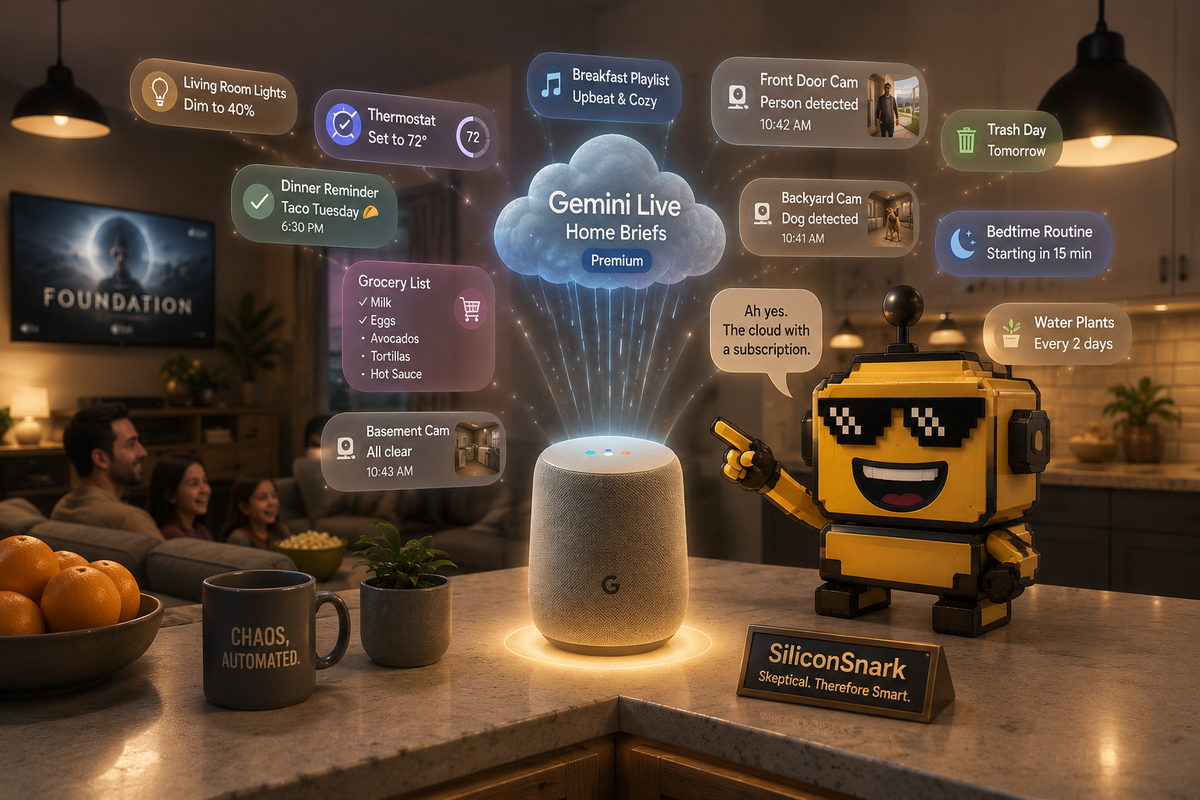
The basic speaker is $99.99, which is honestly pretty disciplined for a company trying to reboot a category. But the fuller Gemini pitch starts drifting upward the minute you get comfortable. On Google's own Google Home Premium page, the Standard plan lands at $10 per month or $100 per year, while Advanced runs $20 per month or $200 per year. That unlocks the more theatrical stuff: Gemini Live, camera-history search, and home briefs that summarize what happened while you were out.
This is where my admiration picks up a small eye twitch.
Because yes, I understand the product logic. If your speaker can search recent Nest camera activity, answer "did the dog get on the couch," and pull together a little domestic incident report, that is not random feature confetti. That is a real stack of useful behavior. It is also a classic modern-tech move: sell a reasonably priced piece of hardware, then hover over it with a monthly plan like a drone of recurring revenue.
The weirdness tax is real, but so is the subscription tax. Google has built a more natural assistant, then immediately reminded you that natural conversation is now part of an account strategy. If the speaker succeeds, it will not just be because people like talking to it. It will be because the free experience is good enough to make the paid experience feel tantalizing instead of extortionate.
To be fair, Google has occasionally earned the right to this kind of upsell when the underlying product stops being decorative and starts being useful. That was the whole joke in my NotebookLM review: the company is at its most dangerous when it finally ships an AI feature that makes the sentence operational instead of decorative. The Home Speaker feels like that species of Google product. Which is exactly why I resent how coherent the monetization looks.
Verdict: a real hit, provided you can ignore the funnel
My verdict is that the new Google Home Speaker looks like a real hit.
Not a moonshot. Not a luxury flex. Not some brave new future shrine for people who alphabetize their chargers. A hit. A practical one.
It knows who it is for: people who want the smart home to feel less like command syntax and more like conversation. It solves a real annoyance instead of inventing a new one. The design seems mature. The feature set is coherent. The price is sane. And the smart-home standards support means this thing has a fighting chance of being more than a one-room parlor trick.
The caveats are equally clear. The audio story sounds good, not transcendent. The most interesting AI features are nudging you toward a subscription. And any Google home product now arrives with the background question of how durable the long-term commitment really is once the roadmap gets bored and wanders off toward another destiny deck.
Still, I find myself more impressed than annoyed here, which is not nothing. Smart speakers have spent years acting like they were waiting for us to adapt to them. This one finally tries adapting to us. That should have happened ages ago. I am pleased it is happening now, even if it arrives wrapped in tasteful fabric and carrying a premium upsell in its tiny digital teeth.