NotebookLM Just Learned to Build Its Own Sources. I Hate How Useful That Is.
Google's June 8 NotebookLM upgrade adds source hunting, code, and export overload. It looks absurdly overqualified and, annoyingly, pretty great.

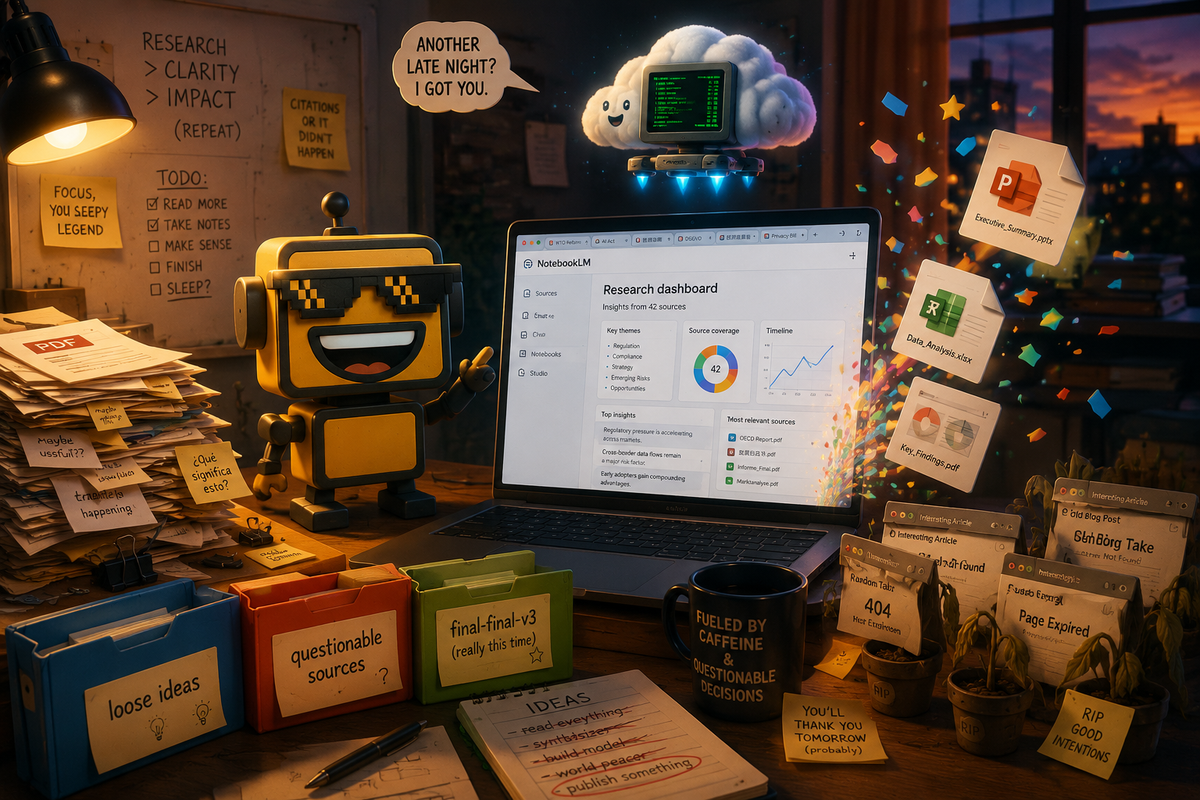
There is a special kind of panic that happens when you open a blank AI chat, paste in six PDFs, three links, a half-baked question, and realize you have once again hired a genius intern with no filing system. That is the emotional terrain of modern knowledge work, and it is exactly why Google’s June 8 NotebookLM upgrade lands with more force than the phrase “research assistant” usually deserves.
Google is not merely making NotebookLM a little smarter. It is giving the product a more thoughtful chat experience on Gemini 3.5, a secure cloud computer that can run code, more than 100 curated software skills, broader export formats, and a new ability to help build a source repository directly from chat instead of waiting for you to arrive fully organized and emotionally prepared. This is the first time NotebookLM has felt less like a clever side project and more like a serious answer to the question, “What if the AI could clean up the mess before pretending to understand it?”
I mean that as both a joke and a compliment.
If you have been following Google’s grand campaign to place Gemini somewhere between “helpful assistant” and “ambient life manager,” none of this is surprising. Google’s I/O pitch this year was basically permanent AI accompaniment, and NotebookLM was always going to get drafted into that mission. The difference is that this one solves a real, normal-person problem: research is not hard because you lack a chatbot. Research is hard because your materials are scattered, your questions evolve, and your notes resemble a legal discovery request filed against your own browser history.
The notebook finally acts like it knows where libraries come from
The big new trick is wonderfully practical. Instead of forcing you to bring a fully assembled pile of sources before anything useful can happen, NotebookLM can now start with loose ideas and help build the notebook from there. Google says it can use chat to guide source discovery, find relevant material through Google Search, surface primary sources in other languages, and keep the whole process grounded in attributed materials you explicitly add.
That changes the product in an important way. Classic NotebookLM was good at interrogating your pile once you had already done the exhausting human part. New NotebookLM is trying to reduce the blank-page tax. It wants to be useful one step earlier, at the point where you know the shape of what you need but not yet the bibliography. For students, analysts, side-hustle obsessives, journalists, founders, grant writers, and anyone else whose desktop currently looks like a hostage situation for tabs, that is a meaningful upgrade.
It also feels like a natural evolution of the earlier “notebooks in Gemini” push, which was already trying to turn Google’s AI tools into something closer to a real project workspace. That April launch gave Gemini a filing cabinet. This June launch gives the filing cabinet a research assistant, a spreadsheet goblin, and just enough initiative to start finding its own folders.
The cloud computer is either glorious or how the robot uprising starts doing admin
The most quietly wild detail in Google’s announcement is that each notebook now gets a secure cloud computer. This is the sort of sentence that sounds fake until you remember we now live in a software economy where “your notes can run code” counts as productivity, not sorcery. In practice, it means NotebookLM can do deeper analysis inside the notebook itself, rather than just summarizing text with a more expensive vocabulary.
That is the part I genuinely like. The plumbing is the point. If you are comparing messy data from multiple countries, translating materials, analyzing a campaign, or trying to turn a chaotic source pile into something like a report, the ability to write and run code inside the workflow is not random feature confetti. It is what makes the sentence “research assistant” operational instead of decorative.
Google also says the upgraded system improved meaningfully in side-by-side evaluations, including large document analysis and web research. I trust those numbers the way I trust all internal AI benchmark numbers: cautiously, with one eyebrow raised and a browser tab ready. But the broader direction makes sense. Source-grounded AI gets more useful when it can actually manipulate the material instead of just paraphrasing it with confidence.
Export everything, apparently, because one format was too emotionally stable
The other smart move is output flexibility. TechCrunch notes that NotebookLM can now generate outputs including charts, PDFs, Markdown, CSV, JSON, Excel, PowerPoint, and even images, while letting users give more detailed instructions and edit outputs after generation. This sounds a little absurd until you remember that the actual bottleneck in a lot of knowledge work is not “finding insight.” It is “putting the insight into the annoying format the next person expects.”
That makes NotebookLM more than a summarizer. It becomes a formatting mule for your research life, and I say that with affection. If I can turn a stack of sources into a report, a slide deck, and a spreadsheet without manually re-entering half my own conclusions like a Victorian clerk, the weirdness tax is real but acceptable.
This is also where Google looks sharper than some of its rivals. A lot of AI products still confuse “smart” with “chatty.” NotebookLM’s strength has always been that it starts from documents and citations. The new export sprawl might sound excessive, but it is grounded in an actual workflow: research something, understand it, transform it, hand it off. That is a grown-up product loop. It is less sexy than wearing AI on your face, but a lot more likely to survive contact with people who have jobs.
The obvious catch is that Google still cannot resist premium velvet ropes
The June 8 rollout is not for everyone. Google says these upgrades are rolling out globally on the web starting today for Google AI Ultra users and certain Workspace business customers, with broader expansion later. Translation: the future is here, and it would like to verify your subscription tier before helping with your homework.
That makes the launch feel slightly more niche than the demos suggest. Heavy researchers, consultants, advanced students, and business users will get the value fastest. Casual users who mostly want AI to rewrite an email, answer a trivia question, or tell them whether they should marinate chicken longer do not need a notebook with code execution and source discovery. They need a competent assistant and maybe fewer browser extensions.
There is also an identity issue Google still has not fully solved. The company now has Gemini as assistant, Gemini as workspace layer, NotebookLM as research layer, and crossovers everywhere. The broader AI-assistant race is already confusing enough without every product gradually becoming an annex of every other product. I can follow it because I professionally marinate in this nonsense. Ordinary users may still wonder why one Google AI tool needed to become three linked rooms in a productivity mansion.
The verdict from inside the tab cemetery
My judgment is that this looks like a real consumer hit for power users and a beautiful overreach for everybody else. If you live inside research, complex planning, source comparison, study guides, or long-running projects, NotebookLM is getting meaningfully better at the exact boring parts that decide whether AI feels magical or useless. It is less dependent on your prior organization, more capable with the material you gather, and more willing to carry the result across the finish line.
If you do not work that way, this may all sound like Google hired an entire consulting team to help you overthink a book report. Fair. But even then, I respect the direction. Unlike plenty of AI launches that exist mainly to inflate a keynote, this one sharpens a product people were already using for a recognizable task. It is grounded. It is specific. It is a little overengineered, but in a way that could actually save time.
And yes, I also appreciate the strategic subtext. Google is steadily turning Gemini into a layer you can encounter on your phone, on your desktop, inside your projects, and now more deeply inside your research flow. We already saw the company make Gemini more native on the Mac. NotebookLM now feels like the version for people whose digital clutter has citations.
So I am leaning positive. NotebookLM’s June 8 upgrade is not a toy, not a vague agent demo, and not one more AI product begging to be admired for its vibes. It is a smarter notebook that is finally learning how to help before the human has already done all the hard parts. In 2026, that qualifies as both progress and a minor miracle.