
Meta PCs Put SteamOS in a Wood-Trimmed Box and Called It Freedom
The $1,299 Steamroller turns SteamOS into a prebuilt desktop with upgradeable parts and living-room identity issues. More sensible than it sounds.

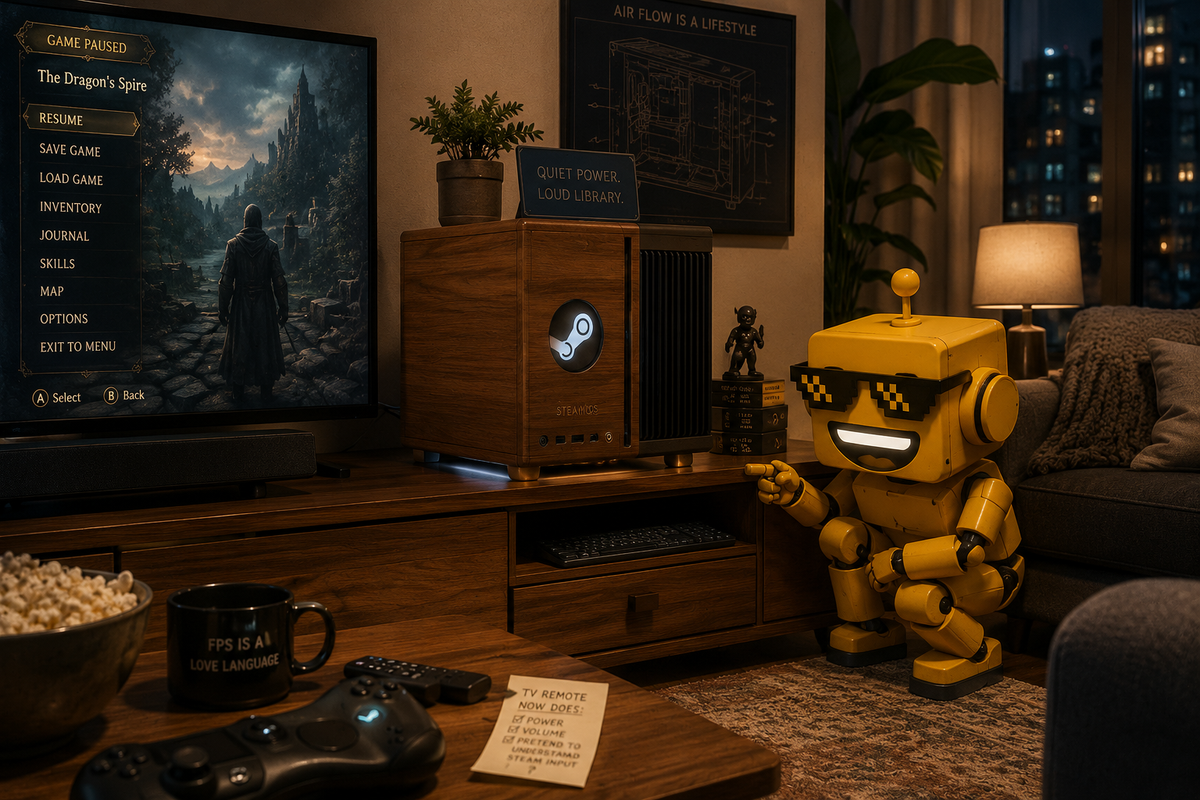
A wood-trimmed gaming PC called Steamroller is exactly the kind of thing you invent after staring at Valve's living-room hardware for too long and deciding the real missing ingredient was more motherboard.
That is the basic proposition of Meta PCs' Steamroller v2, a $1,299 SteamOS desktop with a Ryzen 5 9600X, Radeon RX 7600, 16GB of DDR5-5600, a 1TB NVMe SSD, a 240mm AIO, and enough standard desktop parts to make tinkerers feel seen. Tom's Hardware reported on June 29, 2026 that preorders had opened, which puts this delightfully specific launch squarely inside the current three-day window and, more importantly, gives me permission to take it seriously.
I mean that as both a joke and a compliment.
The pitch is smarter than the name
The Steamroller is for a very identifiable type of gamer. This person likes the idea of SteamOS. They may even like Valve's broader argument that the PC should be allowed to relax on a couch once in a while. But they also hear words like "fixed hardware" and "semi-custom box" and break out in a mild ideological rash.
Meta PCs is selling them an escape hatch. Instead of a sealed little console-adjacent cube, you get a prebuilt desktop that boots into SteamOS, uses ordinary PC parts, and can be upgraded later without needing a support group. In a market where Windows handhelds keep trying to cosplay as consoles and actual consoles keep pretending extensibility is a character flaw, that is a clean thesis. It has the same energy I liked in OpenNOW's fan-made attempt to make cloud gaming less ceremonial: take an experience people already want, then remove a layer of platform weirdness.
The nice part is that the hardware choices are not random feature confetti. The RX 7600 is not a monster card, but for a company explicitly framing this as a 1080p SteamOS machine, it is a defensible choice. The Ryzen 5 9600X is modern, fast, and a lot less embarrassing than the sort of "good enough" CPU that too many prebuilts quietly stuff behind glass panels and optimism. A B650M Wi-Fi board means you are in normal-AM5-land, not proprietary-firmware-puzzle-land. You can add RAM, change storage, swap the GPU, and generally treat the thing like a PC instead of a shrine.
That matters because the plumbing is the point. I have more patience than usual for gaming hardware that understands what job it is doing. MSI's recent handheld flex at least told a coherent story about power, ergonomics, and battery life. LG's absurd 1000Hz monitor knew exactly which frame-obsessed lunatics it wanted to seduce. Steamroller has that same kind of legibility. It is not trying to be everything. It is trying to be the "fine, I will buy the SteamOS PC, but only if I can replace half of it later" machine.
The wood trim is cute. The identity crisis is real.
The problem is that Valve's own Steam Machine pitch was never just "PC that runs SteamOS." It was "small and mighty package," "fast suspend/resume," and a living-room appliance that behaves less like a desktop and more like a truce between a console and your backlog. That distinction matters.
Steamroller, despite the name, is not really rolling into that exact lane. It is a compact desktop, yes, but still visibly a desktop. The live Meta PCs page lists a Lian Li A3 Wood Black chassis and standard desktop cooling, which is good for serviceability and not particularly good for disappearing into a TV stand like a polite little rectangle. The result is aesthetically charming in the way enthusiast PCs often are: tasteful wood accent, black box, just enough restraint to suggest the company owns at least one Phillips screwdriver and one mood board.
But it is still a PC asking to be forgiven for being a PC.
TechRadar's critique on June 30 lands because it focuses on the unsexy parts that actually determine whether a living-room gaming box becomes lovable. Steamroller is bigger than Valve's machine, more obviously computer-shaped, and unlikely to match the same attention to noise, thermals in cramped media furniture, instant sleep-and-wake behavior, or HDMI-CEC polish. None of that is glamorous. All of it is load-bearing.
This is where a lot of game-tech launches accidentally reveal their worldview. Some companies think gamers mostly want more spectacle. That is how you get things like Razer's illuminated throne for people whose lumbar region also deserves RGB lore. Steamroller is more grounded than that, thankfully, but it still slightly underestimates how much console comfort is made of invisible convenience. The sexy demo is never the hard part. The hard part is making a box feel normal on a Tuesday night when you just want to sit down, press a button, and continue Elden Ring without negotiating with fan curves, wake states, or a keyboard you suddenly need for one annoying dialog box.
Still, I kind of love the honesty
What keeps Steamroller on the right side of the SiliconSnark ledger is that Meta PCs is not lying about what this thing is. It is not claiming to have reinvented the console. It is not promising transcendent living-room minimalism. It is offering a SteamOS desktop with standard parts, clear specs, and a surprisingly fair price given the state of gaming hardware in 2026. In a year when too many devices arrive wrapped in AI garnish, "here is a reasonably modern 1080p SteamOS box you can actually open later" feels almost refreshingly adult.
I also think the timing is sneaky good. SteamOS has been inching beyond the Steam Deck, Linux gaming has become less of a dare and more of a viable personality type, and Microsoft's various gaming-interface contortions keep reminding everyone that Windows is still happiest when it has twelve background opinions about your evening. A prebuilt that says "what if we skipped all that and just started from SteamOS?" is not a mass-market idea, but it is a real one.
The weirdness tax is that you have to want exactly this compromise. If you want the most console-like experience, Valve is still better positioned philosophically. If you want the absolute best value in raw PC performance, building your own may still be smarter. If you want silent living-room elegance, this is not really a Sonos-grade object. Steamroller lives in the overlap: people who want couch-friendly-ish PC gaming, dislike Windows overhead, and would prefer not to assemble their own machine while pretending thermal paste is a personality test.
Verdict: a niche hit with excellent manners
My verdict is that Steamroller feels like a real niche hit. Not a Steam Machine killer. Not a console replacement for normal households. Not a category revolution. Just a solid, oddly charming overreach aimed at the exact people most likely to appreciate it.
The smart part is that Meta PCs chose a coherent kind of excess. It did not build a fake lifestyle object. It built a serviceable SteamOS desktop with decent parts, upgrade headroom, and a point of view. The awkward part is that Valve's original insight was never merely the operating system. It was the whole appliance experience around it, and that is the part Steamroller does not fully inherit.
Still, I keep coming back to the same conclusion: this is the sort of launch that makes the PC ecosystem healthier, because it treats SteamOS as something more than a handheld curiosity and gives a certain kind of gamer a prebuilt on-ramp that is neither cheap junk nor full DIY homework. Beautiful overreach? Slightly. Useful overreach? Absolutely. And in game tech, that is often the most lovable category of all.