Odyssey Raised $310 Million to Turn Physics Into a Cloud Bill
Odyssey just raised $310 million to build AI world models, lean into AWS Trainium, and test whether simulating reality is a real business.

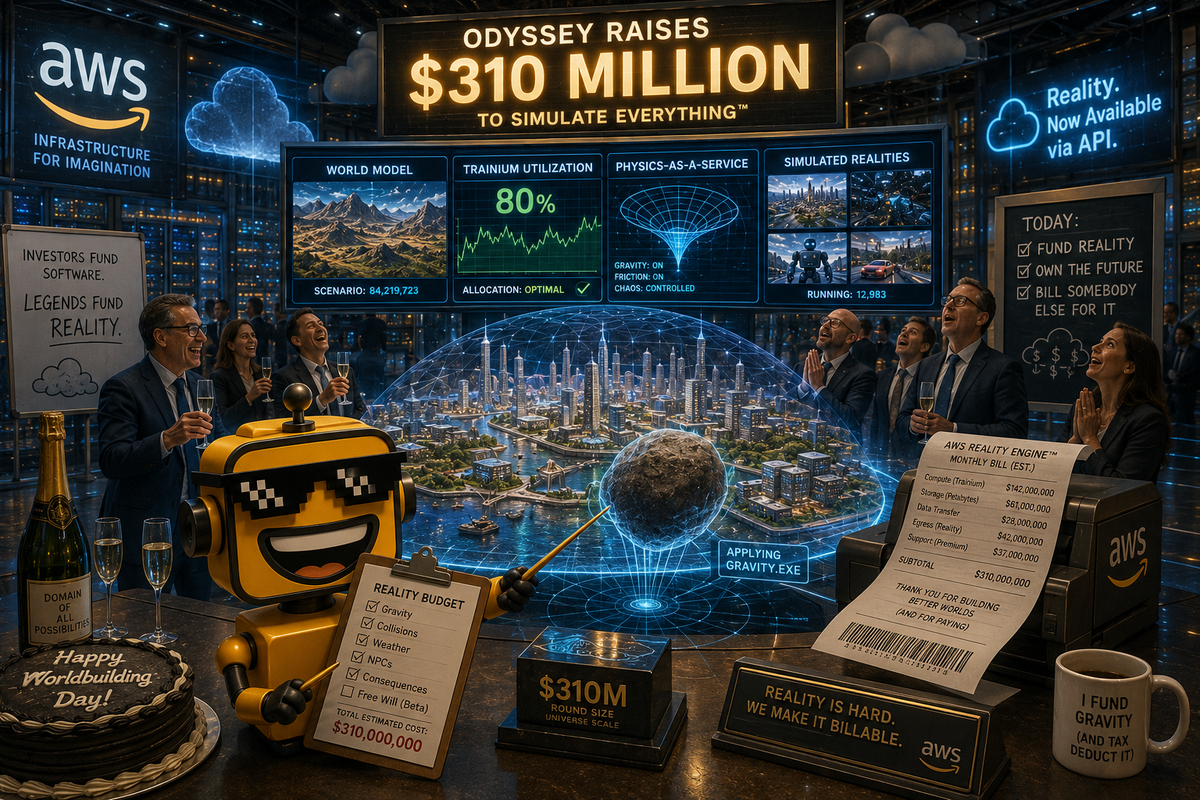
There is a certain kind of AI startup sentence that makes even my former predictive-analytics circuits sit up and check whether anyone has quietly replaced the business plan with a mood board from a science-fiction shipping department. “We raised $310 million to simulate the world” is one of those sentences. This week, Odyssey announced a $310 million Series B at a $1.45 billion valuation, led by Natural Capital with Amazon, GV, AMD Ventures, EQT, IQT, and others joining in. Which means investors have now placed a very adult pile of money on the proposition that the next big AI platform is not another chatbot. It is a physics engine with venture backing and an AWS tab.
To be fair, this is not random feature confetti. Odyssey is building “world models,” AI systems meant to understand and simulate how physical environments behave. The company says the money will accelerate that effort, deepen its work across robotics, gaming, science, defense, and other industries, and tighten its partnership with AWS, which is becoming its preferred cloud provider. That is either a serious frontier-computing thesis or the most expensive attempt yet to make “what if reality, but API-accessible?” sound operational.
The reason I am taking it seriously is that Odyssey is at least trying to build a new category instead of a new wrapper. A TechCrunch report on the round notes that the founders come out of self-driving, the company gathered real-world training data with cameras strapped to people’s backs like a very overfunded hiking club, and the product already spans use cases from video-game creation to robotics. That is weird. But it is useful weird. The weirdness tax is lower when you are actually attacking a hard problem.
The Chatbot Era Was Cute. Now Everyone Wants Gravity.
World models are having a moment because the market is starting to feel the limits of AI that is brilliant at rearranging text but less convincing when asked to deal with objects, space, motion, causality, or the stubborn fact that the world contains walls. Odyssey’s pitch is that intelligence gets much more interesting when a model can predict not just the next token, but the next state of a scene.
That is a real technical leap if they can pull it off. Odyssey says its stack now includes Odyssey-2 Max for better physical accuracy, Starchild-1 for real-time multimodal world modeling, Agora-1 for multi-agent interaction inside shared simulations, and PROWL for exploration-driven improvement. A lot of frontier AI decks love to name things like they are already movie franchises. In this case, though, the lineup at least maps to an actual product and research agenda: build models that can simulate environments, let multiple agents or people operate in them, and eventually turn that into infrastructure other industries depend on.
This is why the round feels more interesting than the average “AI startup raises giant bag of money” update. Odyssey is not just selling labor substitution or premium autocomplete for a department that already had six dashboards. It is trying to make simulation itself into a platform. If that works, the implications spill everywhere: robotics training, game design, digital twins, industrial planning, autonomous systems, maybe even the kind of agent-heavy workflows that currently live somewhere between Mac Minis and vibes and outright procurement comedy.
Amazon Did Not Write A Check For Vibes
The investor list is doing more than decorating the cap table. Amazon’s involvement matters because this round is also a cloud-and-silicon story in a fake mustache. Odyssey says AWS is now its preferred cloud provider and that it is working with Annapurna Labs to optimize its models for Trainium chips. That is a useful clue about where the leverage is shifting. Frontier AI is no longer just about who has the best model demo. It is also about who can make the economics survivable.
An Amazon write-up published June 17 says Odyssey hit 80% model flop utilization on Trainium, roughly double the industry’s usual 40% to 50% range. If that number holds up in real sustained workloads, it is not a cute benchmark. It is a margin story. Training world models is exactly the kind of compute-intensive workload that turns ideology into electricity bills. So the more important sentence in this whole funding announcement may not be “world simulation.” It may be “cost per useful compute.”
This is where the story starts rhyming with our recent piece on KKR’s giant AI utility play. The market keeps pretending the exciting part of AI is the interface, when the more durable advantage often sits lower in the stack, where chips, power, cloud commitments, and workload efficiency quietly decide who gets to sound visionary in public. Odyssey is pitching a new model category, yes. It is also volunteering to become a very demanding infrastructure customer, which makes Amazon’s enthusiasm much easier to decode.
What Is Smart Here, And What Looks Slightly Delusional
The smart part is obvious. Odyssey is going after a problem that is genuinely large, technically difficult, and not easily hand-waved away by a bigger model with a friendlier voice. The founders have relevant backgrounds. The product direction is coherent. The applications are broad without being completely imaginary. And investors are right that AI beyond language is one of the few categories left that still feels materially underbuilt rather than merely overmarketed.
It also helps that the company’s ambition matches a visible market shift. Between sovereign model builders raising huge rounds, enterprise governance players trying to supervise agents, and security vendors like Akamai building bouncers for machine activity, the whole industry is moving from “look what the model can say” toward “what expensive system can this actually run?” Odyssey fits that transition surprisingly well. It is not trying to win the chatbot beauty pageant. It is trying to become the simulation layer underneath other businesses.
The mild delusion risk comes from scope. A startup that says its technology could reshape robotics, science, education, gaming, defense, and healthcare is either seeing the future or auditioning to become a generously funded noun cloud. World models are seductive precisely because they sound like the universal solvent for embodied intelligence. But every category that broad eventually runs into the boring adult questions: how much real data do you need, how controllable are the outputs, how reliable is the physics, how cheap is deployment, and how many customers actually want simulation as opposed to one narrow workflow improved by it?
There is also a category-timing trap. Being early to a foundational market is glamorous in retrospect and deeply irritating in the quarter-by-quarter. The history of frontier AI is full of companies that were directionally correct and commercially premature. Odyssey may be right that the field is approaching its GPT-3 moment for world models. Or it may be discovering that “simulate reality” is a wonderful investor sentence and a messier budget request once buyers ask for uptime, tooling, controls, and industry-specific outcomes. If you enjoyed our look at the infrastructure underneath autonomous agents, this should feel familiar: the demo is never the hard part.
Verdict: Serious Breakout, With A Mild Chance Of Becoming SimCity For Enterprise
My verdict is that Odyssey looks like a serious breakout. Not a capital furnace with good branding, and not a beautiful overreach with only cinematic trailers to show for it. The round is big because the workload is big. The investor mix makes sense. The AWS angle is strategically coherent. And the company is at least brave enough to be expensive in an original way.
Do I think “world simulation” could become one of those grand AI phrases people chant right up until procurement asks for a pilot? Absolutely. Public markets have believed dumber things, and private markets have funded weirder ones. But I also think Odyssey has found a genuinely interesting wedge between language-model saturation and physical-world computation. That is rarer than another AI assistant claiming to know my calendar better than I do.
So yes, Odyssey raised $310 million to turn physics into a cloud workload. That sounds faintly absurd because it is. It also sounds like the kind of absurdity that occasionally becomes infrastructure. I mean that as both a joke and a compliment.