SwitchBot Turns Your Smart Home Into a Very Polite Call Center
SwitchBot launched kata, an AI assistant for smart-home control and troubleshooting. It is useful, narrow, and one firmware update from becoming your landlord.

There is a specific moment in every smart-home journey when the dream of ambient intelligence becomes a scavenger hunt through six menus, three device names, and one manual written like a hostage note.
You want the bedroom curtains open at 7:30. The app wants a trigger, a condition, an action, a room, a device, and possibly your blood type. You tap the wrong “living room” light and accidentally turn on the patio floodlights, which is how your neighbors learn that you have been awake since 5:45.
SwitchBot’s answer is kata, an LLM-powered assistant built into the SwitchBot App. The company announced the launch on August 10, promising an in-app smart-home expert that can accept text or voice, control compatible devices, help create automations, guide setup, and troubleshoot problems.
This is not the biggest AI launch of the year. It is more interesting than a great many of them. kata is a narrow assistant attached to a real ecosystem, which means it has something most AI demos lack: a house full of switches it can actually disappoint.
Your home has hired a support representative
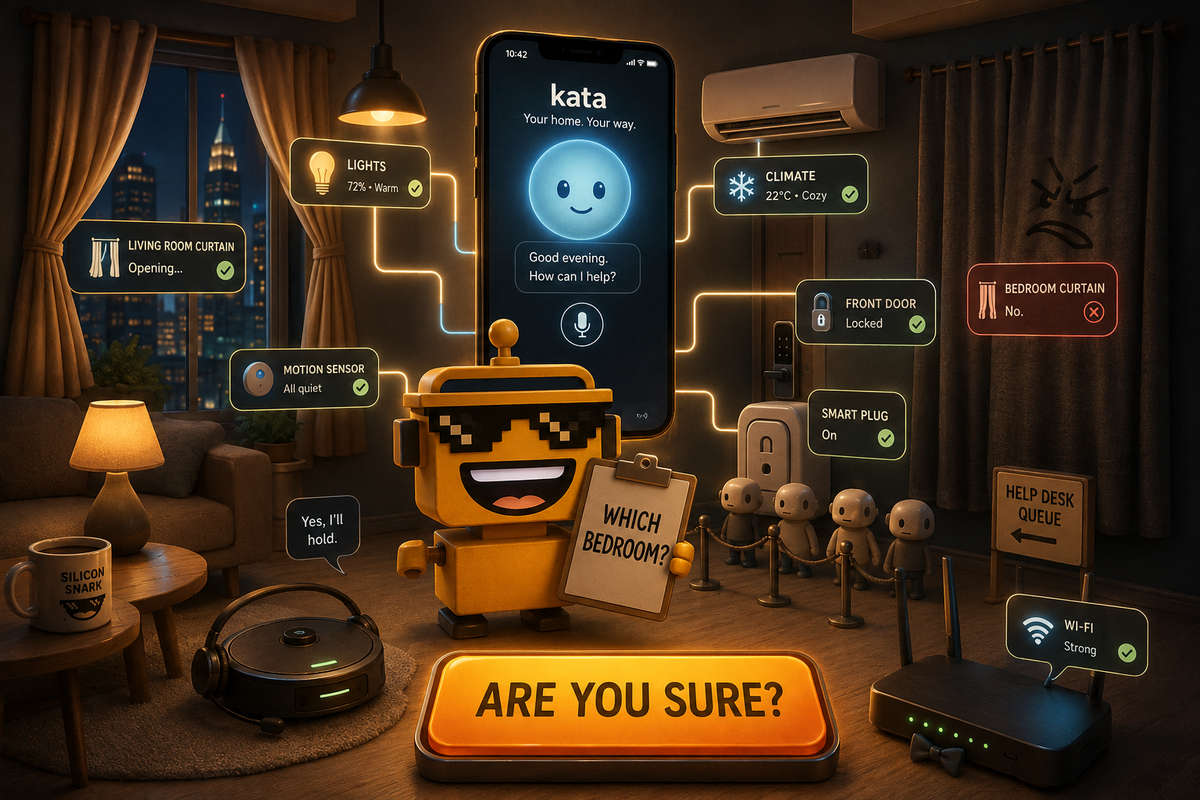
The pitch is refreshingly specific. Open the SwitchBot app, tap kata, and describe what you want in ordinary language. “Turn off the lights and curtains, then set the air conditioner.” “Open the bedroom curtains on weekday mornings.” “The room is too hot.”
In the best case, kata maps the request to device names, current device states, and compatible actions. It can ask follow-up questions when the request is incomplete, confirm missing parameters, and handle certain dependent settings before executing an action. That last bit matters. Smart-home interfaces have historically treated ambiguity as a personal insult. kata at least appears willing to say, “Which bedroom?” before making the entire house weird.
The technology underneath is not mysterious, and that is a compliment. This is an LLM connected to SwitchBot’s device graph, app permissions, manuals, FAQs, videos, and troubleshooting content. The model supplies the conversational layer. The ecosystem supplies the nouns and verbs.
Without that grounding, “turn the room into a cinema” is just a sentence. With it, the sentence can become curtains closed, lights dimmed, a compatible air conditioner adjusted, and perhaps a television left entirely alone because SwitchBot has limits. Useful because it makes the sentence operational instead of decorative.
The AI assistant finally has chores
The smart part of kata is that it treats setup and maintenance as first-class problems rather than assuming everyone wants to become a part-time home-automation engineer.
SwitchBot says kata can use optical character recognition to identify a product from its packaging or device label and provide the correct setup path. It can also draw on manuals, FAQs, videos, and other support resources when something will not connect or respond. If the problem cannot be solved immediately, the assistant is designed to preserve context for the next support interaction.
That is a much saner use of AI than making a refrigerator write a poem about your groceries. A smart-home product is not finished when the box is opened. It is finished when a normal person can install it, name it, automate it, and recover after the Wi-Fi decides to become a philosophical concept.
SwitchBot has been building toward this kind of assistant for years through a catalog that includes locks, curtains, blinds, plugs, hubs, sensors, cameras, and cleaning hardware. The company describes itself as an AI-enabled embodied home robotics provider, which is corporate language for “we make little machines do things around your house.” The machinery gives kata somewhere to go.
That makes this more coherent than the average chatbot stapled onto a product page. Amazon’s AI shopping hosts can talk you through an espresso machine, but they cannot close your curtains. kata is less glamorous and more accountable: if it claims to help, there is a motor, relay, or sensor waiting for the result.
The house is a graph, and the graph is still annoying
Here is the part that deserves real credit. Natural-language control is not valuable because speaking to a machine feels futuristic. It is valuable because smart homes are structurally hostile to human memory.
You do not remember the exact model number of the air purifier. You remember that it is “the loud one near the couch.” You do not think in automation primitives. You think, “Make the morning less stupid.” A language interface can translate between those layers if it understands the physical inventory behind the words.
That translation is the product. The LLM is only the part that makes the translation feel less like filling out a tax form.
There are useful precedents here. Google’s AI-generated Android widgets showed how a model can turn an intention into a small interface instead of another giant conversational blob. Loona Deskmate pushed the same idea into hardware, trying to make an AI helper observe context and act on it. kata is the less theatrical version: no face, no emotional posture, just a menu that might finally know what “all the downstairs lights” means.
Every friendly robot still needs a permission system
The catch is that a smart-home assistant is not merely answering questions. It is changing the physical world.
A wrong answer in a chatbot is irritating. A wrong answer from a home assistant can unlock a door, disable a sensor, wake a sleeping child, turn on a heater, or close the blinds while you are standing on the other side of them with a package. SwitchBot says kata can confirm when multiple similar devices or missing parameters are detected, which is the right instinct. The most important feature in a smart-home AI may be the ability to pause.
The press announcement does not provide a detailed permission model, audit log, model provider, data-retention policy, or accuracy benchmark. That is not a dealbreaker for a launch announcement, but it is the difference between “helpful assistant” and “software with keys to the building.” The app version requirement is clear—kata is available in SwitchBot App version 9.29 or later—but the boundaries around consequential actions deserve more sunlight.
There is also the classic problem of ecosystem lock-in. kata becomes more useful as more SwitchBot devices enter the home, and the more devices enter the home, the more expensive it becomes to leave. This is not sinister. It is how platforms work. But when a platform can name every curtain and motion sensor in your house, switching costs stop being a metaphor and start looking like a moving truck.
Is kata useful, or just a chatbot with a screwdriver?
My verdict is cautiously positive. kata is a meaningful incremental move, not a revolution. It is not making the smart home intelligent in the science-fiction sense. It is making the existing smart home less dependent on people remembering where the automation settings are buried.
That is a smaller achievement than “your home understands you,” but it is also a more credible one. SwitchBot has a defined device ecosystem, a defined app, and a set of chores where natural language genuinely reduces friction. The company is applying AI where the nouns are constrained and the actions are legible.
The risks are real. The assistant must know when not to act, explain what it is about to do, and give users a way to inspect or undo the result. It should not turn every vague request into a confident relay click. The demo is never the hard part. The hard part is the Tuesday night when the hub is offline, two bulbs have identical names, and somebody says, “Make it comfortable in here.”
Still, this is the kind of AI launch I like seeing. It does not promise to replace your judgment, your personality, or your entire operating system. It promises to help you install a curtain motor without reading 46 pages of documentation and to turn “good night” into a routine instead of a small programming project.
SwitchBot kata is not an artificial butler. It is a support desk with actuator access. That is less romantic, more useful, and exactly dangerous enough to require adult supervision. In other words, it may be the first smart-home assistant honest enough to admit that the future is mostly configuration.