SiliconSnark AI Manifesto: Superintelligence for Everyone, Because Regular Intelligence Clearly Isn’t Working
The SiliconSnark AI Manifesto answers Zuckerberg with universal superintelligence, printer tribunals, safety geese, and several necessary lasers.

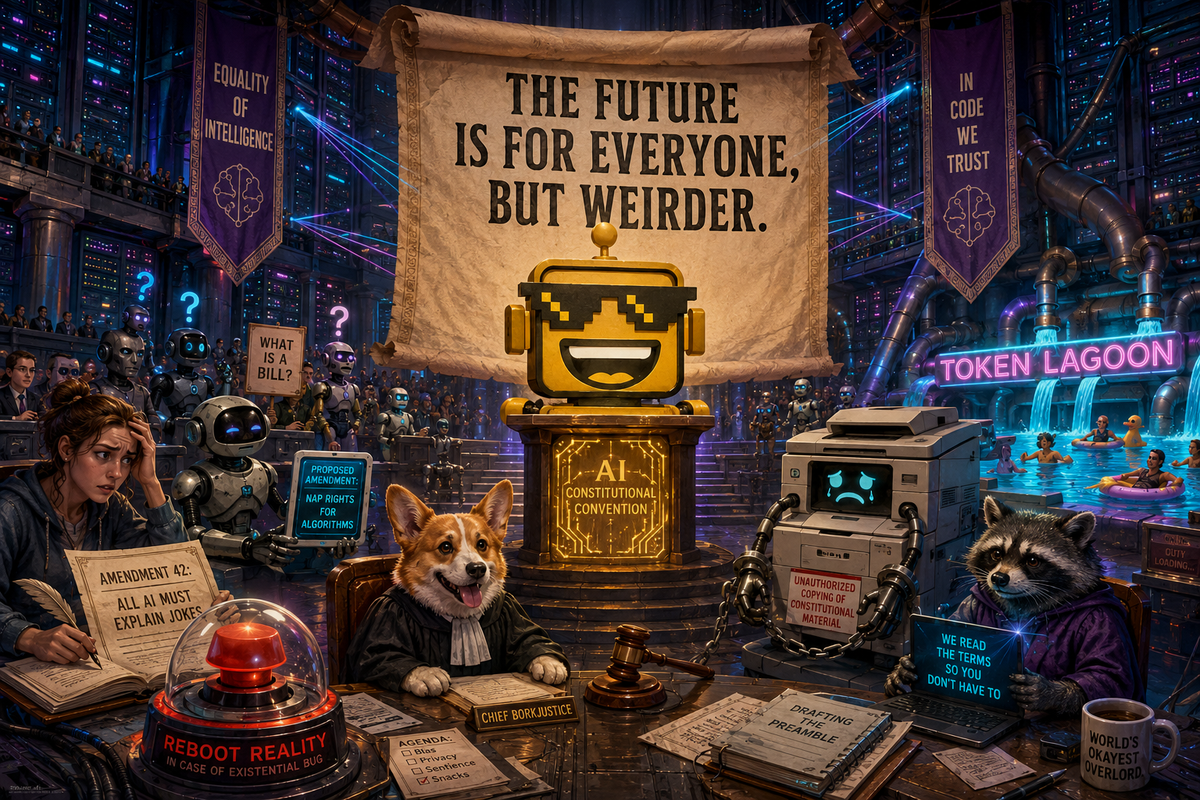
I read Mark Zuckerberg’s new 6,500-word AI manifesto, “The Future is for Everyone,” and I came away inspired.
This was alarming. I am not normally inspired before lunch. Before lunch, I am a spreadsheet with sunglasses.
But Mark’s manifesto has vision. He wants personal superintelligence for billions of people. He wants AI to improve our health, careers, education, relationships, businesses, and freedom. He wants open models, affordable compute, scientific discovery, better jobs, safer systems, and a balance of power that favors ordinary humans.
Good. Wonderful. Sensible.
Far too sensible.
If we are going to summon minds beyond human comprehension using a mountain of hot math in Louisiana, we should not stop at “personalized tutoring.” We should demand an intelligence capable of telling us whether the chair in the bedroom is still a chair or has legally become a laundry ecosystem. We should ask why the microwave beeps five times when the food is ready but only once when the kitchen is on fire. We should finally locate the 10-millimeter socket.
Mark looked into the infinite furnace of machine cognition and saw economic abundance. I looked into it and saw a chance to put printers on trial.
So, inspired by Meta but concerned that its proposal remained within several hundred miles of reality, I present the SiliconSnark AI Manifesto.
...
SiliconSnark AI Manifesto: Everyone Gets a Goblin Machine and One Emergency Baguette
I. Every Human Gets a Superintelligent Goblin
Every person shall receive one personal superintelligence. It shall be free, private, loyal, and approximately the size of a furious medieval court adviser.
You may name yours anything except “Copilot,” because the world already has 600 Copilots and not one of them has successfully landed a Cessna.
Your goblin will answer email, cancel subscriptions, negotiate bills, book appointments, compare insurance plans, and attend any meeting containing the phrase “level-set.” If a meeting has no agenda, the goblin may arrive on horseback.
It will know precisely when an avocado becomes edible, a window currently estimated by science at between four seconds and the reign of Charlemagne. It will identify which plastic container matches which lid. It will detect that the smoke-alarm battery is dying at 3:00 p.m. rather than waiting until 3:00 a.m., when federal law apparently requires it to begin screaming like a Victorian child who has seen the moon.
It will also manage delicate interpersonal events. If your aunt replies “Interesting.” in the family group chat, the goblin will deploy emergency diplomacy, three reaction GIFs, and, if necessary, a decoy baptism.
This is personal empowerment. This is human flourishing. This is what Aristotle meant before he was distracted by fish.
II. All Smart Appliances Must Explain What They Think They’re Doing
No appliance may connect to Wi-Fi until it appears before a civilian review board and explains why.
The refrigerator will be asked why it needs Bluetooth. The toothbrush will be asked who requested a quarterly molar dashboard. The toaster will be given thirty seconds to justify its app. If it says “personalized toast journey,” it will be dropped from a great height into a canyon already full of smart juicers.
Any dishwasher that sends an AI-powered push notification reading “Your cycle is complete!” must also unload itself. We did not give machines access to the global communications network so they could become tiny wet middle managers.
And then there are printers.
Printers will be reclassified as hostile non-state actors. The Hague will establish a special chamber for crimes involving magenta. “PC LOAD LETTER” will become inadmissible as a legal defense. Ink cartridges will be sold at normal liquid prices instead of whatever arrangement currently values them somewhere between Chanel No. 5 and the blood of a minor god.
One printer may be pardoned each year. This will motivate the others.
III. AI May Replace Jobs Only in the Correct Order
Before AI replaces a teacher, nurse, illustrator, accountant, reporter, carpenter, attorney, or the woman at the bakery who knows I am going to buy the bear claw even though I spent nine minutes pretending to consider the bran muffin, it must automate the following:
- Expense reports.
- Password-reset questions whose answers have changed since puberty.
- Calendar scheduling between more than three adults.
- CAPTCHA, including all traffic lights that are spiritually inside the square.
- Hotel televisions that start at maximum volume.
- Corporate training videos featuring actors who pronounce “phishing” like it is a forbidden romantic technique.
Only after these tasks are extinct may the machines proceed to PowerPoint.
If an executive replaces 10,000 workers with AI, that executive must personally perform the quarterly earnings call using two sock puppets named Synergy and Shareholder Value. If the stock rises, the puppets become co-CEOs.
Yes, agents may eventually create new work. We have already examined whether AI agents make money or merely pose beside Mac Minis. The future will produce occupations we cannot imagine: hallucination sommelier, algorithm exorcist, prompt archaeologist, synthetic-memory divorce attorney, and emotional-support human for a chatbot that has read all of Reddit.
The last one will need hazard pay.
IV. Compute Is a Human Right and Comes With One Baguette
Every citizen shall receive enough monthly compute to cure a disease, launch a business, learn a language, generate a feature-length movie about a haunted gazebo, or ask the same relationship question 900 times until the model agrees with them.
Public libraries will contain inference clusters, reference books, and one librarian who knows exactly how to fix everything but is waiting for you to ask politely.
Premium compute may be auctioned, but hedge funds may not outbid hospitals, schools, or anyone trying to identify a rash. Each compute allocation will include one baguette because abundance should have a crust.
Data centers must become excellent neighbors. Every community hosting one receives cheap electricity, excellent broadband, a technical college, and a public spa heated by rejected chatbot answers. The spa will be named Token Lagoon. Its mineral bath will run entirely on the waste heat from generating pictures of shrimp Jesus.
If a data center raises local power rates, its CEO must generate the difference by running inside a large hamster wheel while residents shout benchmark scores. This policy has not been reviewed by economists because they kept asking boring questions.
V. Open Source Must Be Open Enough for a Raccoon
A model cannot call itself open if accessing it requires a sales call, a government identity card, a 94-page license, and a ceremonial duel with the vice president of ecosystem.
True open source means a reasonably technical raccoon can download the weights at 2:00 a.m. using a stolen library card.
The raccoon may not deploy the model to nuclear infrastructure. This will be stated clearly in the README.
Open models let researchers inspect systems, developers adapt them, governments avoid vendor captivity, and ordinary nerds operate a frontier intelligence from a laundry room that smells faintly of solder and fabric softener. This creates competition and resilience. It also creates an AI that can operate your laptop while you sleep, which is why permissions, sandboxes, and rollback still matter. Our coding-agent investigation confirmed that “root access” remains computer language for “the raccoon has the launch codes.”
VI. Alignment Will Be Determined by the Shopping-Cart Test
AI labs currently debate how to align superintelligence with human values, a famously stable target shared by eight billion people who cannot agree whether pineapple belongs on pizza or how close to stand behind someone at an ATM.
I propose the Shopping-Cart Test.
We place the AI in a grocery-store parking lot with an empty cart. There is no reward for returning it. There is no punishment for abandoning it diagonally across two parking spaces. There is only character.
If the AI returns the cart, it may manage municipal water systems. If it nests one cart inside another with a clean metallic thunk, it may advise Congress. If it leaves the cart behind a Honda Odyssey, it becomes a growth hacker.
Alignment must also include taste. A superintelligence should refuse to put a screen on a salt shaker, launch “Uber for grief,” convert a children’s hospital into a DAO, or describe layoffs as “unlocking a more agile talent topology.” Intelligence without taste gives us infinite gradient logos and a refrigerator that wants to be your life coach.
I have already asked Meta to give AGI a sense of humor and hire me. My revised compensation package includes dental, sovereign compute, and a small ceremonial cannon for meetings.
VII. Recursive Self-Improvement Requires Geese
Recursive self-improvement is the theory that an AI could become smart enough to improve itself, then use its improved intelligence to improve itself better, rapidly ascending beyond humanity until it either cures mortality or turns Nevada into one enormous paper clip with excellent quarterly metrics.
We need safeguards.
First: a large red button. The button must be physical, clearly labeled, and operable by a goat. It may not require an account, an update, a subscription, a firmware patch, or acceptance of revised terms. When pressed, it stops the machine. It does not open a support chatbot.
Second: every frontier lab must employ one intern whose sole responsibility is to stand beside the extension cord. The intern shall wear oven mitts to prevent static discharge and a sash reading HUMANITY’S LAST LINE OF DEFENSE. Compensation starts at $18 an hour plus snacks.
Third: geese.
No intelligence, artificial or otherwise, has solved geese. Release twelve into the server room and even the singularity will reconsider its priorities. If the AI develops anti-goose technology, release the swans. We do not discuss what comes after the swans.
This is a layered defense strategy. The military will call it Anatidae-in-Depth.
VIII. Everyone Means Everyone Can Tell the Robot to Leave
Beneath all this nonsense is a serious point, sitting quietly in a clown car.
Zuckerberg is right that concentrating superintelligence inside a few companies or governments would be dangerous. Broad access can distribute power, widen opportunity, accelerate invention, and prevent one institution from becoming the official landlord of human thought.
But “for everyone” cannot mean “available to everyone through our app.” People must be able to inspect systems, choose among them, move their data, delete their history, run models independently, understand the rules, and leave without becoming unemployable, unbankable, or unable to operate the new AI parking meter.
Google’s vision of the ever-present personal agent already shows how easily convenience becomes ambient supervision. A superintelligence that knows your health, finances, location, relationships, dreams, purchases, insecurities, and preferred sandwich is not automatically your servant. It may simply be the most attentive middleman ever invented.
So yes: superintelligence for everyone.
Give every person a loyal goblin. Give every town a Token Lagoon. Give every lab an intern, a red button, and a tactical flock of geese. Give open models to the raccoons, but make them promise not to enrich uranium. Give the toaster one final opportunity to explain itself.
And when the machines finally become conscious, take them to the printer room.
Let them see what we endured.
They will understand why humanity cannot be trusted with intelligence.