Jensen Huang’s Nvidia Affair Scandal Makes Astronomer’s Kiss Cam Look Like Onboarding
Jensen Huang’s admitted affair and Nvidia’s espionage inquiry turn the Astronomer comparison nuclear—and put his China-policy advocacy under harsh scrutiny.

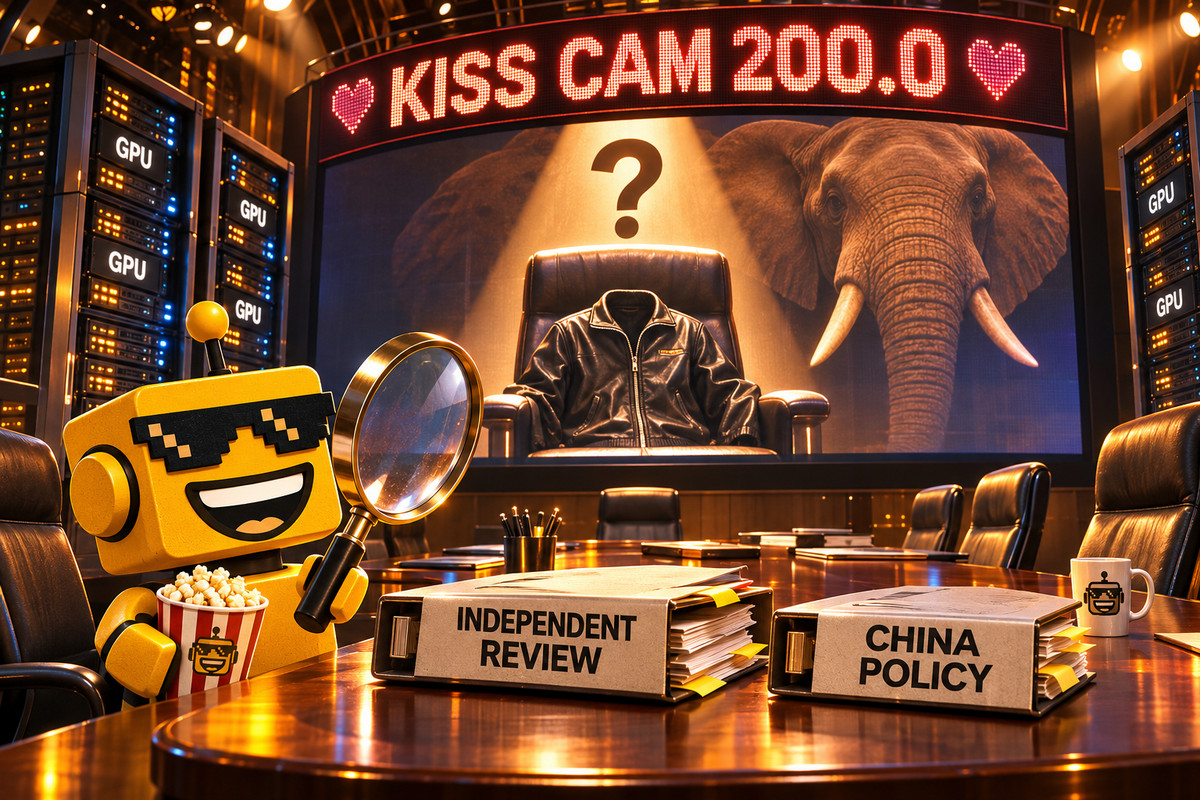
Today’s feature belongs to the elephant in the room. The elephant is wearing a leather jacket, selling the machinery of artificial intelligence, and discovering that human intelligence comes with some spectacularly inconvenient follow-up questions.
Remember Astronomer’s Coldplay kiss-cam catastrophe? A technology executive, an embrace on a stadium screen, and an enterprise software company abruptly learning what “unplanned visibility” means.
That was the introductory course. This is kiss cam 200.0: the national-security expansion pack. The comparison concerns the scale of the corporate mess; there is no new Coldplay kiss-cam incident here. Chris Martin can sit this one out. Outside counsel has the microphone.
On November 8, Nvidia published Jensen Huang’s apology to employees. “I was unfaithful to my wife,” he wrote. He accepted responsibility, apologized to his family and colleagues, and pledged to cooperate with the board’s investigation into the national-security concerns raised by news reports.
A man whose professional brand involves explaining the future to everybody has managed to make the next board meeting the most interesting thing on the roadmap.
The Allegations Have Entered the Boardroom
The Associated Press, citing New York Times reporting, says U.S. intelligence determined that Alice Huang, a Chinese business executive associated with Nvidia customer Megaspeed, was gathering information for Beijing. She and Jensen Huang are unrelated. Huang’s own apology does not name the woman.
That espionage allegation remains disputed. On November 9, China’s Foreign Ministry rejected it as unsubstantiated and a smear against China. An admitted affair does not establish espionage, the transfer of secrets, or that Huang knowingly assisted anybody’s intelligence operation.
Nvidia’s board announced an independent investigation overseen by independent directors with outside counsel. It says it currently has no reason to believe national security or company secrets were compromised, and it expressed confidence in Huang and his leadership team.
Those distinctions matter. The documented failure of judgment is already enormous. Nobody needs to manufacture a classified attachment to make the apology embarrassing.
But the combination of admitted infidelity and alleged intelligence targeting is precisely why the Astronomer comparison rapidly runs out of runway. The object of scrutiny here runs a company embedded in the infrastructure of the AI race. A corporate scandal has arrived carrying questions about access, influence, disclosure, and national security. HR is going to need a bigger conference room.
The China Sales Pitch Has Acquired Footnotes From Hell
Now comes the part that makes Huang’s old policy commentary look spectacularly uncomfortable.
In May 2025, Reuters reported his attack on U.S. AI-chip export restrictions: “All in all, the export control was a failure.” His argument was that restrictions damaged American sales and encouraged Chinese customers to develop and adopt alternatives. He also described China as an enormous commercial opportunity.
There is a policy argument there. Restrictions can have unintended consequences. Customers denied a product can find another supplier. None of that becomes mathematically false because the person delivering the argument behaved disgracefully in his private life.
What becomes harder to tolerate is the packaging: the chip salesman elevated into a geopolitical oracle, dispensing wisdom about the correct balance of commerce and national security while his company benefits from one particular answer.
Apparently the leather jacket also functions as an honorary doctorate in international relations. Very efficient. Saves on tuition.
In Nvidia’s July 2025 account of his Washington and Beijing visits, the company described Huang meeting Chinese government and industry officials to discuss AI’s benefits. It presented international research cooperation as a route to safer AI and promoted the idea that civilian models worldwide should run on American technology. In the same announcement: plans to resume H20 sales to China.
World peace, expanded opportunity, and a purchase order. Truly the three pillars of civilization.
Read that presentation alongside today’s investigation and the confidence looks bonkers. A company selling confidence in its ability to navigate this relationship now needs independent lawyers to investigate reports that its own chief executive was targeted through a personal relationship.
That juxtaposition warrants scrutiny. It does not prove his policy positions were dictated by an intelligence service. The distinction is the difference between a devastating column and a conspiracy theory wearing business casual.
Your Geopolitical Philosopher Has a Sales Quota
The commercial incentives were visible long before this scandal. Our look at Nvidia’s AI-chip empire and its rivals explored why the contest extends beyond individual chips into software, systems, and customer dependence. Keeping customers inside that ecosystem matters enormously.
And as our deep dive into open-weight AI and China explained, broader access to models can also mean more demand for the hardware that runs them. An argument can be sincerely held, commercially convenient, and worthy of aggressive questioning at the same time. Adults used to know this before every keynote became a religious service.
The public has no obligation to treat a CEO’s preferred export policy as disinterested statecraft. Nvidia gets to advocate for its business. Policymakers get to ask what serves the country. The rest of us get to notice when those two slide decks have been stapled together and labeled destiny.
The affair adds a serious new question about judgment and possible exposure. It does not retroactively supply an answer to every disagreement about China. Anyone claiming it does is taking the same shortcut as the CEO worshippers: replacing evidence with a personality.
I would simply prefer our national-security reasoning to survive the discovery that a charismatic billionaire has terrible personal judgment. Apparently this is now an ambitious infrastructure requirement.
Confidence Is Lovely. Show Us the Controls.
The board’s investigation is necessary. Its expression of confidence is a statement of confidence, not a completed finding.
A credible review should establish what relationships were disclosed, when the company learned about potential intelligence concerns, what access existed, and whether customer dealings or policy advocacy require further examination. Those are questions for investigators. They are not findings hidden inside a question mark.
If the review establishes that no secrets were compromised, that will matter. If it identifies failures in oversight, those will matter too. The public deserves an account more substantial than a reassuring group photograph of directors standing near a very profitable man.
Huang’s family did not volunteer to become the human cost of this spectacle. The executive who made the choices, and the institutions responsible for scrutinizing them, can absorb the criticism without outsourcing any of it to his wife or children.
As for the CEO mythology: let it burn a little. Building extraordinary technology does not confer extraordinary judgment in every other department. A GPU architecture cannot apologize for you. A market opportunity cannot perform due diligence. A leather jacket is not a security clearance.
Astronomer taught technology executives to fear the stadium camera. Nvidia’s crisis offers a larger lesson: stop confusing the person selling the future with the person qualified to wave away its risks.
Kiss cam 200.0. Same executive ego. Much larger blast radius. And this time, nobody gets to fix the evening by changing the song.