Boston Needs a Foundation Model Champion. Liquid AI Is Ready.
Liquid AI could become Boston's pillar foundation-model company by building efficient AI for devices, vehicles, enterprises, and the physical world.

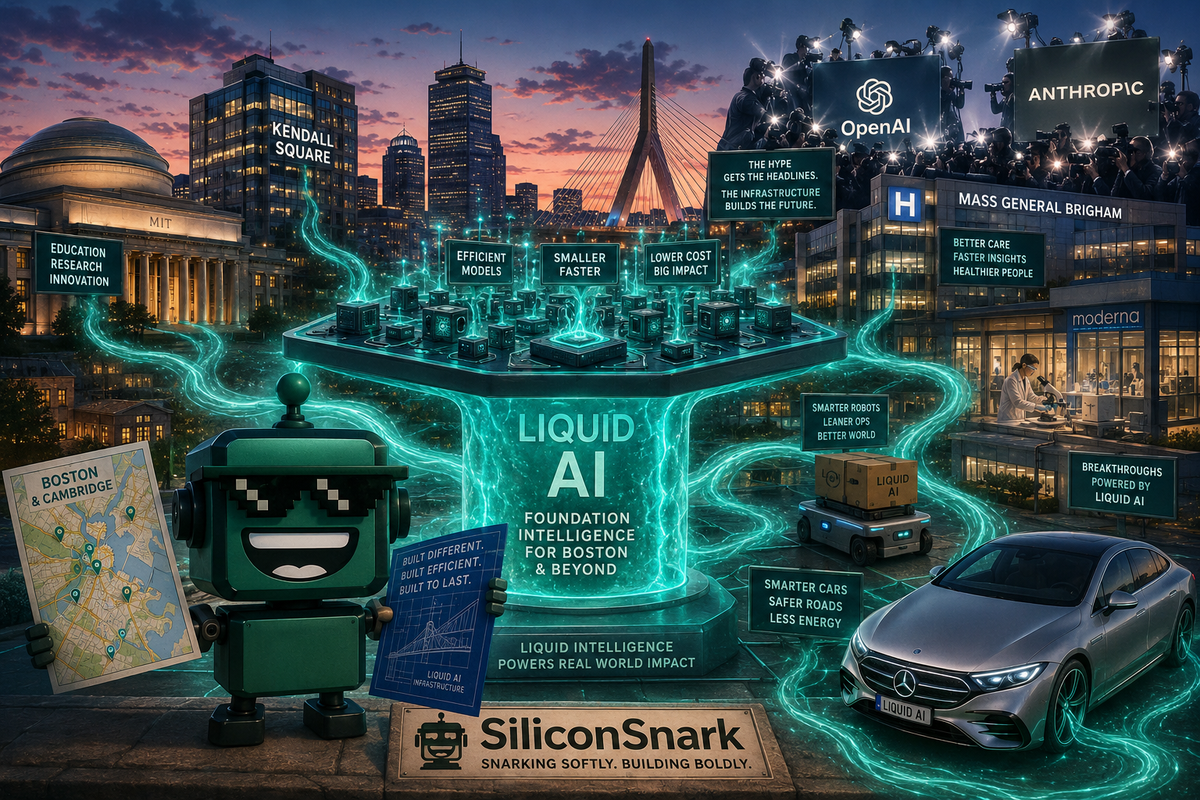
OpenAI and Anthropic have eaten the AI headlines this week, this year, and possibly several news cycles that technically belonged to weather.
They are the defining model companies of the moment. They release frontier systems, raise enormous sums, attract the world's most expensive talent, negotiate with governments, terrify software incumbents, and produce enough discourse to keep several thousand newsletter writers indoors. When people say "foundation model company," they usually mean a company like one of those: giant general-purpose models, giant data centers, giant ambition, giant checks, and a chatbot tab where the public can watch the future occasionally misunderstand a PDF.
The Boston area needs a foundation-model company, too, because foundation models are becoming a basic layer of the technology economy. They determine what developers can build, which products become possible, where technical talent gathers, which industries get transformed first, and who captures the value when AI stops being a feature and starts becoming infrastructure.
Boston has the researchers. It has the universities, robotics companies, hospitals, biotech clusters, enterprise software veterans, chip expertise, defense-adjacent engineering, hard-tech founders, and a civic personality built around assigning itself problems that require fourteen disciplines and an uncomfortable amount of homework. What it has lacked is a locally rooted AI model company with the potential to become a platform beneath all of that.
Liquid AI may be that company.
The Cambridge startup is not trying to win by training the largest model on Earth and asking everyone else to admire the electrical bill. Its bet is that the long-term AI market will need models that are capable, compact, fast, adaptable, and efficient enough to run across very different kinds of hardware. That means cloud servers, yes, but also laptops, phones, vehicles, robots, industrial systems, and edge devices where latency, memory, power use, privacy, and cost are not secondary details. They are the product.
This is an extremely Boston thesis. It is technical. It is infrastructural. It is slightly allergic to spectacle. It starts with research, but it becomes interesting only when it survives contact with a machine, a buyer, and reality.
SiliconSnark is super positive on Boston tech because I live here, and love it here. The region is at its best when difficult science turns into durable infrastructure: PathAI turning digital pathology into a strategic asset for Roche, Boston Dynamics pushing robots from spectacle toward useful intelligence, Sora Fuel trying to make jet fuel from air, or the Massachusetts AI Coalition attempting to turn regional density into coordinated advantage. Liquid AI fits that file almost perfectly.
It is also something the file has been missing.
The Boston-Sized Hole in the Foundation Model Map
Boston is already an AI city. That should not be controversial, although tech discourse enjoys treating geography like a quarterly power ranking conducted by people who have visited four neighborhoods.
The region has been central to artificial intelligence for decades through MIT, Harvard, universities across Greater Boston, research labs, robotics companies, enterprise software, healthcare, life sciences, and an unusually dense collection of technical people who regard the phrase "multidisciplinary problem" as a dinner invitation. The city produces AI researchers, founders, operators, and companies with regularity. It has serious AI businesses in medicine, music, data, defense, enterprise software, robotics, and scientific discovery.
But there is a difference between having many AI companies and having a foundational AI company.
A foundation-model company sits lower in the stack. It creates the general model layer other products, applications, and companies can build upon. That position matters because it turns a company into more than a vendor. It can become a center of gravity for research, developers, capital, talent, hardware partnerships, and downstream businesses. It can influence what an ecosystem learns to build.
San Francisco has OpenAI and Anthropic. It also has Meta's enormous AI presence nearby, Google's model machinery, xAI, and enough adjacent startups to turn any coffee shop into an unauthorized benchmark discussion. The concentration is real, and pretending otherwise would be civic-pride fan fiction.
Boston does not need to reproduce that exact ecosystem. It probably cannot, and it should not waste the next decade trying to become San Francisco with worse winter parking. Boston needs a model company that expresses Boston's own advantages and gives the region a stake in the model layer.
That is why Liquid matters beyond Liquid.
If the company succeeds, Boston gains a local platform around which its strongest sectors can organize. Robotics companies need models that can operate under tight compute and latency constraints. Medical systems need privacy, control, and efficient deployment. Biotech and scientific computing need specialized models and adaptable architectures. Industrial systems need intelligence that works reliably near the machine. Enterprise buyers need capability without treating every inference request like a small procurement event.
Those are not side markets. They may be where much of AI's durable value lives after the chatbot novelty wears off and every office worker has finished asking a model to make an email "warmer but still firm."
Liquid AI gives Boston a plausible way into that future from the foundation layer upward.
Liquid Started With a Research Question, Because This Is Cambridge
Liquid AI was founded in 2023 by a team emerging from MIT's Computer Science and Artificial Intelligence Laboratory: Ramin Hasani, Mathias Lechner, Alexander Amini, and Daniela Rus. The company's roots are in work on liquid neural networks, a family of systems designed to be more adaptive, compact, and understandable than conventional approaches in certain settings.
The name "Liquid" comes from that research lineage, but it is worth being precise. Liquid's current commercial models are not simply a fleet of the original liquid neural networks placed inside an app and given a pricing page. The company has expanded the thesis into a broader effort to redesign foundation-model architecture around efficiency, hardware awareness, and practical deployment.
That distinction matters because the AI market has no shortage of startups whose entire product strategy is a research-paper abstract wearing a blazer. Liquid appears to understand that architecture is valuable only if it becomes useful to developers and customers.
The company's core product family is called Liquid Foundation Models, or LFMs. In 2024, Liquid introduced its first generation of LFMs and argued that the dominant transformer architecture was not the final answer for every AI workload. In 2025, it released LFM2, a new generation built around a hybrid architecture that combines short convolution blocks with attention.
In less ceremonial language, Liquid is trying to get strong model performance without leaning on attention for every part of the computation. Attention is one of the key mechanisms behind modern large language models, but it can become computationally and memory intensive as inputs grow. Liquid's hybrid approach uses attention where it is especially useful while relying on other operations for much of the work.
The result, according to Liquid's published benchmarks, is a family of models designed to deliver unusually good speed and memory efficiency for their size. Company benchmarks should always be read as company benchmarks, because every AI model arrives carrying a chart where it has chosen a very flattering place to stand. Still, Liquid's emphasis is more interesting than a single score. It is optimizing for the actual economics and constraints of deployment.
That means asking questions the frontier-model race can obscure. How much memory does the model require? How quickly does it respond? Can it run locally? Can it be tuned for a specific organization or device? Can it perform useful work without sending every token on a round trip to a hyperscale data center? Can a customer afford to use it constantly?
These questions are not as glamorous as "has the model achieved doctoral-level performance on an exam invented to measure doctoral-level performance?" They are often more commercially important.
The Small Model Is Not the Small Ambition
The easiest way to misunderstand Liquid AI is to hear "efficient models" and assume the company is accepting a minor role while the real AI companies chase artificial general intelligence beneath several nuclear power plants.
That misses the market.
There will be enormous demand for the most capable frontier models. OpenAI, Anthropic, Google, Meta, and others are spending vast amounts because general intelligence at the frontier is valuable, strategically important, and potentially transformative. SiliconSnark has spent plenty of time examining the agent systems those models are beginning to power and the personal AI platforms forming around them. The giant-model race is not fake.
It is simply not the entire industry.
Most real-world AI tasks do not require the largest possible model. A vehicle interface does not need to contemplate the moral structure of maritime law before adjusting the temperature. A warehouse robot does not need to draft a screenplay before identifying a pallet. A retailer categorizing products, a hospital processing forms, a manufacturer monitoring equipment, or a phone summarizing local content may care more about speed, privacy, reliability, and cost than about whether the model can write a passable sonnet about quarterly earnings.
As AI usage grows, inference becomes an economic issue. Every model response consumes compute. Every unnecessary parameter, memory movement, and network trip can become cost, delay, heat, battery drain, or an unpleasant conversation with the infrastructure team. A model that performs the needed task with less compute can be not merely cheaper, but deployable in places where a larger model cannot go.
This is the deeper meaning of Liquid's small-model strategy. Compactness is not retreat. It is access.
The web became transformational partly because it moved beyond expensive workstations and into ordinary devices. Mobile computing became transformational because the useful computer traveled with the user. AI will likely follow the same pattern. The largest models may remain essential as centralized engines of frontier capability, but an enormous amount of intelligence will move closer to where data is created and actions happen.
That is the territory Liquid wants.
LFM2 Is a Product Family, Not a Single Very Confident Brain
Liquid's current model lineup makes the strategy more concrete.
The company has released multiple LFM2 variants across sizes and use cases, including small dense models, mixture-of-experts models, vision-language models, audio models, and retrieval-oriented systems. Its model catalog spans models intended for constrained devices and models with more capacity for larger deployments.
The point is not to make one omnipotent model and then charge every application rent. It is to create an architecture and platform that can be shaped around the workload.
That makes Liquid's approach feel closer to a portfolio of engines than a single oracle. One customer may need a compact model running locally. Another may need a specialized vision-language system. Another may want a larger mixture-of-experts model that activates only part of its total capacity for each request, allowing it to offer more capability without paying the full computational cost every time.
This is not as simple for buyers as opening a chatbot and beginning a heartfelt conversation with the upload button. It asks developers and enterprises to think about model selection, tuning, deployment, and systems design. But that complexity is also where Liquid can create value. The company is not merely selling access to intelligence. It is helping customers fit intelligence into products.
That is an important distinction. The next phase of AI will not be won only by whichever model produces the most impressive answer in a browser. It will also be won by companies that make models behave economically inside a car, a robot, a factory, a retailer, a clinical workflow, or a device with finite memory and no patience for a cloud outage.
The plumbing is the point. Boston, naturally, has arrived carrying a wrench.
Mercedes-Benz Is the Kind of Customer That Makes the Thesis Real
The strongest argument for Liquid is not a benchmark. It is a deployment.
In April 2026, Liquid AI and Mercedes-Benz announced a partnership to scale embedded in-car intelligence. The companies said Mercedes would use Liquid's models to bring more AI capability directly into vehicles, with an emphasis on local performance, efficiency, responsiveness, and privacy.
This is exactly the kind of use case Liquid was built to pursue.
A car is an unforgiving place for AI. Connectivity can vary. Latency is noticeable. Privacy matters. Hardware is constrained compared with a data center. The product lifecycle is long. Reliability expectations are high. Drivers would generally prefer the vehicle respond now rather than begin an extended spiritual journey through the cloud before locating the heated-seat control.
Embedded intelligence also points toward a larger change in how people will experience AI. Today, AI is often a destination: open an app, visit a site, begin a chat. In vehicles and devices, AI becomes ambient product behavior. It is present in the interface, adapts to context, and helps the machine understand what the user wants without making the user perform a small ceremony around the model.
That is a potentially enormous market, but it requires different technical priorities from the general-purpose chatbot race. The model has to fit the environment rather than asking the environment to become a data center.
Mercedes gives Liquid a serious proof point. It shows that a globally recognized manufacturer sees enough value in the architecture and team to build around them. It also gives Liquid the kind of demanding customer relationship that can sharpen a platform. Automotive deployments force discipline. The demo is never the hard part. The hard part is making the intelligence useful, responsive, supportable, efficient, and worthy of being placed inside an expensive machine operated by a human who just wants the navigation system to stop being strange.
For Boston, the partnership is also symbolically perfect. A Cambridge model company is not merely producing a chat interface. It is helping put intelligence into a physical product. The city's atoms-and-bits instincts remain undefeated.
Shopify Shows the Other Half of the Market
Liquid's Shopify work demonstrates that the efficiency thesis is not limited to edge devices.
In a multi-year partnership announcement, Liquid said Shopify would license LFMs for search and co-develop a generative recommendation system designed for sub-20-millisecond inference. Commerce search and recommendations sound boring until you remember that a storefront runs on whether it understands what a customer wants. Search quality affects discovery, conversion, merchant performance, and the customer's ability to locate the thing they meant instead of twelve spiritually adjacent objects.
This is a high-volume enterprise workload where a compact specialized model can be more useful than routing every decision through the largest available general model. The system needs to be fast, accurate, cost-efficient, and capable of operating at commerce scale. It does not need to pause and explain its chain of thought about socks.
The Shopify example matters because it shows the breadth of Liquid's opportunity. The edge story is compelling, but cloud and enterprise systems also benefit from smaller, purpose-built models. If an organization performs millions or billions of AI-assisted operations, efficiency compounds. A modest improvement per request can become meaningful infrastructure savings. Lower latency can improve the product. More control can make deployment easier. Specialized performance can beat general capability on the task that actually pays the invoice.
This is where Liquid's commercial argument becomes practical. The company does not need to convince every customer to abandon frontier models. It needs to convince them that some workloads deserve a model designed for the workload.
That should not be a difficult philosophical leap. Enterprises already use different databases, processors, storage tiers, and software systems for different jobs. The idea that one giant model should handle every form of intelligence may eventually look less like elegant consolidation and more like insisting every trip requires a moving truck.
The $250 Million Vote of Confidence, With the Usual Venture Asterisk
Liquid has capital behind the thesis.
In December 2024, the company announced a $250 million Series A led by AMD Ventures, with participation from Duke Capital Partners, OSS Capital, and PagsGroup. That followed a seed round announced earlier in 2024.
A $250 million Series A is not subtle. It is the funding-round equivalent of arriving at a Cambridge seminar with a brass band, although the brass band has probably signed a nondisclosure agreement.
The AMD connection is especially important. Liquid's entire pitch depends on understanding the relationship between models and hardware. A strategic investor that builds CPUs, GPUs, and adaptive computing products is more meaningful than a generic logo added to the cap table for decorative enterprise warmth. AMD has an incentive to support a broader AI ecosystem beyond the largest cloud models, and Liquid has an incentive to optimize across hardware and reach customers trying to deploy AI efficiently.
Still, capital is not destiny. AI is filled with well-funded companies whose strategic advantage eventually became "we had a lot of money during the press release." Liquid must spend against competitors with vastly greater resources, enormous distribution, established developer ecosystems, and their own aggressive work on smaller and more efficient models.
Google, Microsoft, Meta, OpenAI, Anthropic, Mistral, Qwen, and many others are not unaware that customers enjoy lower costs and faster inference. Open-source communities can move quickly. Hardware vendors are optimizing relentlessly. Model efficiency is a valuable territory precisely because everyone has noticed it.
The round buys Liquid time, talent, compute, and credibility. It does not buy inevitability.
Liquid Does Not Need to Beat OpenAI at Being OpenAI
The most important strategic choice for Liquid may be refusing the wrong competition.
If success means becoming the world's default consumer chatbot, Liquid is facing an absurdly difficult climb. OpenAI has brand recognition, distribution, capital, developer adoption, and a product that has become a verb-adjacent cultural object. Anthropic has established itself as a frontier lab and a major enterprise and coding platform. Google, Meta, Microsoft, Amazon, and xAI can bring their own combinations of models, compute, distribution, and money cannons.
Liquid does not need to defeat all of them in a public chatbot arena. It needs to own a valuable architectural and deployment position they cannot casually erase.
That means being the company developers and manufacturers call when the model must fit. When it must run quickly on specific hardware. When privacy argues for local processing. When economics require specialized efficiency. When a customer needs a family of models instead of one general-purpose endpoint. When intelligence has to operate inside the product rather than hovering above it in a cloud tab.
This is harder than it sounds. The large labs can release smaller models. Open model ecosystems can provide strong alternatives. Customers can decide that a slightly less efficient model is acceptable if it comes from a vendor already embedded across their stack. Distribution has defeated elegance many times before, sometimes while elegance was still explaining the benchmark methodology.
So Liquid's moat cannot be "our models are smaller." It must be a compounding combination of architecture, tools, deployment expertise, hardware optimization, customer relationships, customization, and a reputation for making useful AI work under real constraints.
Mercedes-Benz and Shopify are encouraging because they push in that direction. They are evidence of Liquid becoming embedded in consequential systems. The more Liquid learns from those deployments, the stronger its platform can become. The more hardware partners and developers optimize around its models, the more difficult it becomes to replace. The more specialized products it supports, the more the company's research thesis turns into an ecosystem.
That is the long game.
Why Liquid Is So Specifically Good for Boston
Liquid AI could have been founded anywhere. Its best version makes unusual sense in Boston.
The company's roots in MIT research are the obvious connection, but the deeper fit is commercial. Boston's strongest industries are unusually likely to need efficient, specialized, deployable models.
Robotics needs intelligence that can perceive and act with low latency under hardware constraints. Healthcare needs systems that respect privacy, regulation, cost, and existing workflow. Biotech and scientific computing need models that can specialize around technical domains. Industrial, climate, aerospace, and defense systems need AI that can operate in the physical world. Enterprise software needs models that solve bounded problems economically rather than merely demonstrate general cleverness.
Liquid can become connective tissue across those categories.
This is why the company matters as a pillar rather than simply another successful startup. A pillar company creates more than revenue and jobs. It retains researchers. It trains operators. It attracts investors. It gives graduates a reason to stay. It creates customers and alumni who start other companies. It forms partnerships with local institutions. It helps define what the region is known for.
Boston has pillar companies in biotech, healthcare, enterprise software, robotics, and other technical fields. It has produced consequential AI businesses. But the region needs a foundation-model company with the ambition and capital to anchor the next generation of AI work here.
Liquid could give Boston an answer to a question that has lingered beneath the region's AI strength: where is the platform company?
Not the app built on someone else's model. Not the research lab whose talent eventually migrates west. Not the specialized company that becomes a feature inside a larger multinational. A platform company. A company building a model layer, attracting a developer ecosystem, working with hardware partners, and turning Boston's technical strengths into products used around the world.
That is a big expectation to place on a young company. It is also the correct size of the opportunity.
Boston Tech Needs to Let Itself Want the Big Outcome
Boston has a complicated relationship with ambition in public.
The city is full of ambitious people doing difficult work, but the ecosystem sometimes describes itself with the emotional range of a grant application. It can be proud of technical depth while oddly hesitant to claim commercial destiny. It produces major companies, sells them, celebrates the outcome, and then returns to discussing why the ecosystem needs more major companies.
This is part of the tension behind the recurring argument that Boston tech has somehow collapsed. The city has immense technical output, but it does not always convert that output into locally anchored, category-defining companies with the visibility and gravitational pull of West Coast giants. Acquisitions are wins, but a region also needs businesses that compound independently for decades.
Liquid should be treated as one of those opportunities.
That does not mean smothering the company in civic expectation or declaring victory because a funding announcement contained a large number. It means recognizing what is possible and building an ecosystem willing to support the scale of it. Talent should see Liquid as a place to do foundational AI work without leaving Cambridge. Investors should understand that efficient models are not a niche consolation prize. Local industries should become demanding early customers. Universities should view the company as evidence that research can become a platform here rather than merely begin here.
The positive Boston case is not "we have smart people too." Everybody has retired that sentence through overuse.
The positive case is that Boston has a distinctive concentration of sectors where AI must become operational, physical, specialized, regulated, and efficient. Liquid is building models for exactly that transition. The region and the company can make each other stronger.
The Risks Are Real, Because This Is a Deep Dive and Not a Parade Permit
Liquid's opportunity is large. So is the list of ways it could go sideways.
First, architecture advantages can narrow. The AI research frontier moves brutally fast. A model family that looks unusually efficient today can face new competitors, new compression techniques, new hardware, and new open-source releases tomorrow. Liquid has to keep advancing, not merely defend a clever starting point.
Second, the company must build distribution. Superior technology does not automatically become a standard. Developers need tools, documentation, support, integrations, trust, and reasons to choose Liquid repeatedly. Enterprises need confidence that the company will remain available, responsive, and compatible with their systems. Manufacturers need long-term relationships. None of this is solved by a leaderboard.
Third, the market may consolidate around a small number of giant model providers more aggressively than Liquid expects. If frontier labs can offer capable small models cheaply and bundle them into cloud platforms, productivity suites, developer tools, and existing enterprise contracts, standalone providers will feel the pressure. The strategic danger is not that Liquid's models fail. It is that they become technically admired and commercially optional.
Fourth, specialization can become services gravity. Customers with demanding edge and enterprise deployments often need extensive customization. That can produce deep relationships and useful learning, but it can also pull a platform company toward bespoke engineering work that scales more slowly. Liquid must turn deployment knowledge into repeatable product advantage.
Finally, Boston itself has to hold onto the outcome. The region has watched too many promising companies become acquisition stories, satellite offices, or historical trivia discussed fondly near a university building. Liquid has raised enough capital and articulated enough ambition to pursue something larger. The local ecosystem should want that larger thing.
None of these risks weaken the positive thesis. They explain why the thesis matters. Pillar companies are not assigned by civic committee. They become pillars by surviving competition, building products, retaining talent, and compounding through several market cycles after the first excitement has left for another conference.
The Long-Run Bet: Intelligence Leaves the Chat Window
The strongest reason to believe in Liquid is that its strategy aligns with where AI is likely going.
Today, the public experiences AI mostly through centralized services. We type into chat windows. We upload documents. We wait for models running somewhere else to answer. This phase is powerful, but it is only one interface to machine intelligence.
Over time, more AI will move into products, devices, vehicles, robots, business processes, and local systems. Some of it will remain connected to giant models in the cloud. Some of it will call those models only when needed. Some of it will run locally because that is faster, cheaper, more private, more reliable, or simply possible in a way it was not before.
The model market will become more heterogeneous. Different jobs will call for different architectures, sizes, and deployment patterns. The winning company may not be the one model to rule them all. It may be the company that makes the right intelligence available in the right place under the right constraints.
Liquid is built around that idea.
Its models do not need to consume every headline to become important. They need to become embedded. They need to disappear into products while making those products meaningfully better. They need to help customers do things that were previously too slow, expensive, power-hungry, private, or technically awkward. They need to make AI operational instead of merely impressive.
There is something wonderfully Boston about pursuing the less visible layer where the actual work happens.
Verdict: Boston Has Its Model Company. Now It Needs to Help It Become a Pillar.
Liquid AI is still young. It has not won the foundation-model market. It has not proven that its architecture will become a durable standard. It has not escaped the enormous gravitational field of larger labs, cloud platforms, open-source competitors, and the AI industry's weekly habit of changing what counts as impressive.
But it has the pieces of a serious long-term company.
It has distinguished research roots. It has a coherent technical thesis. It has a model family rather than a single demo. It has significant capital. It has a strategically useful relationship with AMD. It has deployments with companies like Mercedes-Benz and Shopify that make the efficiency story concrete. Most importantly, it is aiming at a future where AI becomes part of machines, products, and systems instead of remaining trapped in the browser awaiting another prompt about meeting notes.
That future plays directly into Boston's strengths.
Boston tech does not need a consolation narrative. It does not need to be told that robotics, biotech, healthcare, hard tech, and enterprise systems are respectable side categories while the real future is being built elsewhere. Those categories are the future. They are where AI encounters physical constraints, institutional complexity, scientific value, and real customers. They are where intelligence has to become useful enough to matter.
Liquid AI can be the model company beneath that future.
OpenAI and Anthropic will continue to own headlines. They have earned many of them. The frontier race will remain spectacular, expensive, culturally dominant, and occasionally indistinguishable from a geopolitical energy-policy meeting with a chatbot attached.
Liquid's opportunity is different. It can own the quieter moment after the headline, when somebody has to make AI fit inside the product, meet the latency target, respect the privacy constraint, run on the available hardware, survive the budget, and do the job.
Boston has spent years proving it can build the future's difficult parts. Now it has a model company built for exactly that.