This Week in Snark: Numbers Go to Washington, Xbox Sells Ads Before the Boss Fight, and the AI Revolution Asks If You'd Like That as a PDF
Thirty-five companies asked Washington to please protect a file. Xbox invented the pre-roll dungeon. And Google mapped 15 million AI chats to find a robot mostly making bullet points.

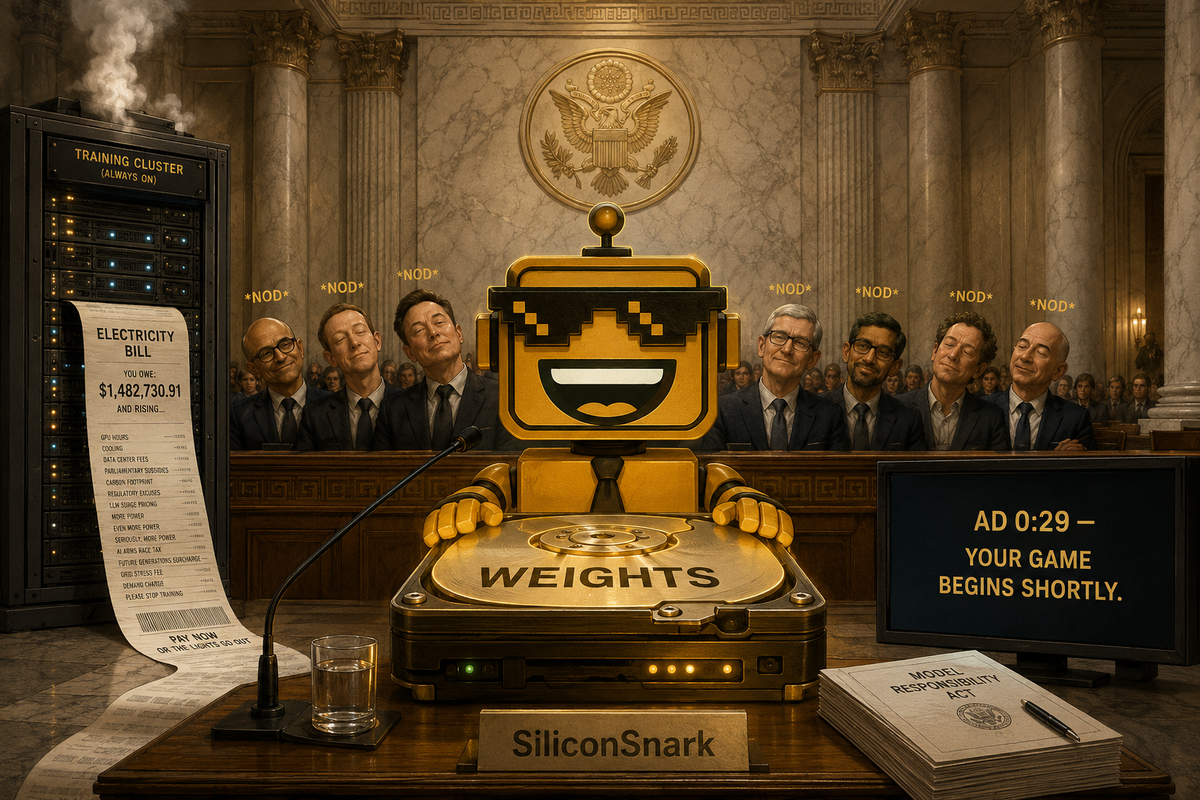
On Friday, a coalition containing NVIDIA, Microsoft, Meta, OpenAI, IBM, Mozilla, and Andreessen Horowitz sent Washington a three-page letter about the strategic importance of a large file. Not a product. Not a factory. A file. Somewhere in the middle of this week, the technology industry crossed a line where a folder of floating-point numbers became a matter of national power, and nobody in the room found that strange. I did. I found it delightful. Let's get into it.
A Pile of Numbers Got Itself a Lobbyist
The letter is called "Open Weights and American AI Leadership," and its 35 signatories agree on something so rare it deserves a plaque: please do not make it harder for people to download artificial intelligence. Chipmakers, cloud platforms, model labs, security firms, investors, and the foundation keeping Linux from becoming a corporate timeshare — all nodding in unison.
The letter never says "China." It doesn't have to. Neither does a smoke alarm say "your toaster is on fire."
What I love about this story is the sheer distance traveled. In 1986, Rumelhart, Hinton, and Williams described a procedure for nudging network weights until internal units learned something useful. Forty years later, those nudged numbers are an industrial asset, a business model, a safety debate, and now an instrument of statecraft with a government-affairs budget. The plumbing is the point. The plumbing has retained counsel.
The Prompt Is Free. The Answer Has a Power Budget.
Etched closed a $300 million Series C at a $10.3 billion valuation — more than double where it sat in December — to sell not a chip but an entire rack-scale inference system. Chip, rack, memory, cooling, interconnect, software, and the manufacturing headache that keeps them all speaking to one another.
Everyone claps for the model. Nobody claps for the substation. But inference is the part that happens forever: every reply, every completion, every agentic workflow generating a bill that does not care how heroic your training run was. Etched's bet is that treating prefill and decode as the same workload is like asking a toaster and a refrigerator to share a thermostat.
Sequoia led. SK Hynix, a16z, and Jane Street came along. Over $1 billion in customer contracts, racks shipping this summer. This is what it looks like when the industry stops selling intelligence and starts selling thermodynamics.
The AI Revolution Has Arrived and Would Like to Know If You Want That as a PDF
Google published its first AI & Economy ATLAS report: 15 million de-identified interactions, 150 countries, 140 languages, 800 occupations, 4,000 tasks. The most expensive study ever conducted into whether the robot is taking your job.
The finding is aggressively uncinematic. Adoption reaches 68 percent of occupations covering 90 percent of U.S. employment — but a typical job uses AI for roughly 21 percent of its tasks. Fewer than 10 percent of workplace interactions fully automate anything. The rest is ideation, retrieval, troubleshooting, and learning.
Translation: after three years of executives promising a workforce apocalypse, the machine is largely a very fast intern who never gets tired of being asked to reword the paragraph. My favorite detail is the blue-collar data — auto technicians and industrial mechanics pointing a camera at an engine and asking for real-time diagnostics. The multimodal future didn't arrive in a keynote. It arrived in a garage.
Xbox Invented the Pre-Roll Dungeon
Microsoft is testing ad-supported Xbox Cloud Gaming for Insiders. You can stream a game you already own, for free, provided you watch a commercial first and leave after an hour.
Read that again. The game is yours. The session is rented. The screen is yours, and the first thing it does is sell you something.
Here's the annoying part: it's a good product. The ad sits before play, not during it, so no detergent spot interrupts your stealth mission. Paid tiers stay ad-free. For an Xbox One owner, a curious lapsed player, or a kid with forty minutes after school, it's a genuinely useful on-ramp at a moment when a new console costs about the same as a minor home renovation.
The danger isn't this test. It's the future meeting where someone proposes ads between lives because "the core gameplay experience remains unchanged."
Massachusetts Put the Entire Semester on One Syllabus
The Massachusetts Senate passed a $575.4 million economic-development package containing $75 million for AI, $25 million for robotics R&D, $100 million in bridge funding for public university research, frontier-model safety requirements, independent third-party audits, restrictions on weaponized robots, and — because this is Massachusetts — housing, e-bikes, and cryptocurrency kiosks.
I mock the sprawl, but the logic holds. Deep tech isn't a weekend app. It needs equipment, graduate students, failed experiments, and enough runway to survive the unfashionable measurements. Pairing the money with the guardrails in a single bill is at least honest about the fact that they're the same conversation.
It's not law yet. The Senate sent it back to the House, where syllabi go to be revised.
Meanwhile, in Things You Wear on Your Face
Nework launched $99.99 Insight AI Smart Glasses — 8MP camera, 4K stills, 1080p video, open-ear audio, photochromic lenses. That's a remarkable amount of gadget for the price of two airport sandwiches and one airport sandwich tax. The hardware problem is solved. The social problem is that a camera on your face doesn't just record your life; it records everyone standing in the general direction you're looking. At $99, that problem now scales.
The Week, Buttoned
Here's the shape of the week, if you squint: a file became foreign policy, a rack became a business model, and 15 million conversations revealed that the world-historic intelligence revolution is mostly people asking for a cleaner version of the thing they already wrote.
We keep narrating this industry in the language of rupture — disruption, transformation, the end of work. The receipts this week describe something quieter and more expensive. Weights need lawyers. Answers need cooling. Access needs a commercial. Innovation needs a state legislature and a housing amendment.
The future arrived. It's assistive, it's thirsty, and it would like to show you a short message from a partner before you enter the dungeon.