Etched Built a $10.3 Billion Inference Machine. The Cooling Bill Is Also a Feature.
Etched raised $300 million at a $10.3 billion valuation to build rack-scale AI inference systems. The chip is serious; the cooling bill is too.

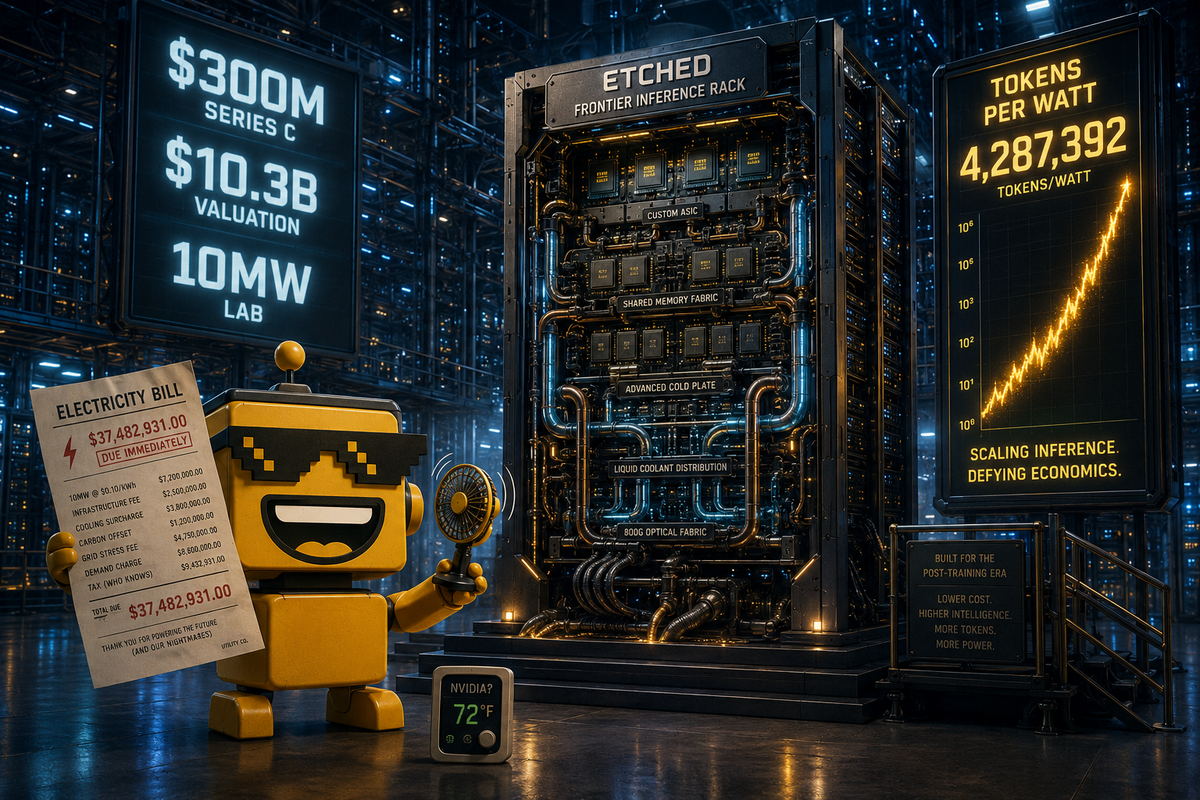
There is a moment in every AI demo when the answer appears instantly and everyone applauds the software. Somewhere below the stage, a rack is quietly converting a small electrical substation into a sentence about quarterly planning.
That rack is the business Etched wants to own. This week, Etched closed a $300 million Series C, led by Sequoia Capital with participation from SK Hynix, Andreessen Horowitz, Jane Street, and Diffusion. The round puts the Cupertino startup at a $10.3 billion valuation, more than doubling its December valuation.
That is the headline. The more interesting story is the product underneath it: a full rack-scale inference system for running AI models after they have been trained. Etched says it has more than $1 billion in customer contracts, is validating its first systems with customers, and plans to ship its first racks this summer. This is not a chip startup selling a lonely rectangle and asking the buyer to solve the rest of physics. Etched is selling the rectangle, the rack, the memory, the cooling, the interconnect, the software, and the manufacturing headache that keeps them all speaking to one another.
The Prompt Is Free. The Answer Has a Power Budget.
AI infrastructure has a branding problem. Training a model sounds like the heroic part: giant data sets, heroic GPUs, a graph with enough lines to make a venture capitalist feel the future. Inference is what happens when a customer actually uses the model, one prompt at a time, forever.
Every chatbot reply, code completion, document summary, fraud score, and agentic workflow creates an inference bill. At scale, that bill is not a rounding error. It is the business. The model can be brilliant, but if serving it is slow, expensive, or hot enough to make the data center’s fire suppression system develop opinions, the enterprise customer eventually asks for a cheaper architecture.
Etched’s answer is specialization. Its system separates the two major phases of inference: prefill, when the system processes the user’s prompt and context, and decode, when it generates the response token by token. Prefill is compute-intensive. Decode is hungry for memory bandwidth and low latency. Treating them as the same workload is the hardware equivalent of asking a toaster and a refrigerator to share a thermostat.
The company says its architecture runs its math blocks at much lower voltage than conventional AI chips, allowing higher transistor density without thermal throttling. It also describes a shared, low-latency memory pool across the scale-up domain, connected by a proprietary high-bandwidth interconnect. In plain English: Etched is trying to make the chips cooperate closely enough that the rack behaves less like a pile of accelerators and more like one giant inference appliance.
Production Is the Product, Which Is a Slightly Threatening Sentence
Etched’s own technical account of its frontier inference clusters is unusually specific about the vertical integration. The company says its first silicon came back from TSMC’s N4P process, the first rack-scale product is being validated with customers, and the system is co-designed across chips, packages, printed circuit boards, cold plates, interconnects, and manufacturing methods.
It has also opened a Taiwan factory and built a data center, test house, and prototyping lab near its San Jose office. The company says a new facility in Milpitas provides 10 megawatts of capacity. Etched has around 400 employees, which means the startup has somehow accumulated enough hardware people to form a small city council devoted entirely to the phrase “yield improvement.”
This is the smart part of the pitch. Enterprise infrastructure buyers do not actually purchase benchmark charts. They purchase a system that can be installed, powered, monitored, repaired, upgraded, and explained to the finance department. If Etched can coordinate the whole stack, it may remove the awkward gaps where one vendor blames the memory, another blames the network, and the customer blames everyone while staring at a rack that costs more than the building.
I mean that as both a joke and a compliment. The plumbing is the point.
A Billion Dollars in Contracts Is Not a Billion Dollars in Revenue
Now for the part where the spreadsheet puts on a hard hat.
Etched says it has signed more than $1 billion in customer contracts. That is meaningful demand, especially for a young company building a specialized system. But it is not the same thing as $1 billion in recognized revenue, deployed capacity, or production workloads making users happier at 2 a.m. As eWEEK noted in its enterprise-buyer analysis, Etched has not named the customers, disclosed the contract structures, or released independent benchmark data for throughput, latency, power use, or cost per token.
That distinction is not pedantry. It is the entire procurement process. A cloud provider or model company considering Etched needs to know whether the systems work across its real context lengths, batch sizes, model architectures, and reliability targets. It needs to know how quickly new model families can be ported. It needs spare parts, software support, security controls, capacity planning, and an answer for what happens when the startup’s preferred workload stops being fashionable.
Specialized silicon has a long history of looking unbeatable in the workload it was designed to win. Then the workload changes, the software stack moves, and everyone discovers that flexibility was not a vague corporate value after all. It was an insurance policy.
The AI Infrastructure Industrial Complex Has Excellent Cheekbones
Etched is arriving during the most entertaining phase of the AI boom: the moment when a software category becomes an infrastructure category and everyone starts financing the toll roads.
Broadcom, Apollo, and Blackstone turning AI compute into a finance product was one version of the same realization: the money is not only in models. It is in the power, servers, networking, leases, and long-lived contracts required to run them. Starcloud’s plan to move AI compute into orbit was a more literal expression of infrastructure desperation. And Reed Semiconductor’s attempt to keep AI servers from browning out made the power grid part of the product roadmap.
Etched is less fantastical than orbital data centers and more dangerous to underestimate. If inference becomes the dominant cost of AI, a system optimized for tokens per watt and tokens per dollar could matter more than another model leaderboard. The enterprise does not care whether its customer-support agent has a beautiful latent space. It cares whether the answer arrives quickly, the bill is survivable, and the rack keeps working through the end of the quarter.
A Serious Infrastructure Bet With a Heat Sink Attached
Etched currently feels like a serious infrastructure bet, not a niche flex. The company has working silicon, customer validation underway, a stated order book, a manufacturing footprint, and a technical thesis that matches a real pain point. Its ambition is enormous, but the problem is enormous too.
The beautiful overreach is the valuation. At $10.3 billion, Etched is no longer asking investors to believe that specialized inference might be useful. It is asking them to believe that the company can manufacture, deploy, support, and continuously adapt an entire computing platform while Nvidia, hyperscalers, and other custom-chip teams keep improving their own systems.
That is a lot to ask from a startup, even one with 10 megawatts and an alarming number of cold plates. The first racks will tell us more than the funding round. Then the customers will tell us more than the first racks. Then the power bill will tell everyone the truth.
Still, I am impressed. Etched is not selling a chatbot wrapper with a tasteful gradient. It is trying to build the machine that makes AI responses economically possible. That is grandiose, technically difficult, and—annoyingly—exactly the sort of thing enterprise software eventually needs.
The future may arrive as a friendly sentence in a browser window. It will be powered by a rack that costs a fortune, runs a specialized memory system, and requires a cooling plan with its own executive sponsor. The answer is instant. The infrastructure is having a very long day.