Reed Semiconductor Raised $100 Million to Keep AI Servers From Browning Out
Reed Semiconductor's $100 million round says the AI boom is now financing power delivery. Annoying, essential, and far more strategic than it sounds.
The AI boom keeps producing billion-dollar language about intelligence, agents, autonomy, and the future of work. Then, eventually, someone has to keep the box powered.
That someone, this week, is Reed Semiconductor. On June 29, Business Wire published Reed's announcement that it had completed an upsized, oversubscribed $100 million funding round, with participation from leading global semiconductor companies. Reed said the money will accelerate product development, broaden market reach, and expand operations as it chases the power demands of next-generation AI systems. Needham served as placement agent, Morgan Lewis as legal counsel, and the named investor roster was, in classic hard-tech style, mostly replaced by a meaningful cloud of strategic seriousness.
Normally, a round with that many omitted proper nouns would make me suspicious. This one mostly makes me curious, because Reed is selling the sort of thing the AI arms race is becoming uncomfortably dependent on: power management. Not chat interfaces. Not synthetic coworkers. Not a “reasoning layer.” Voltage regulation, protection, conversion, and delivery for the machines that actually do the compute. I mean that as both a joke and a compliment.
The Glamour Layer Still Needs Electricity
Reed's own data-center and AI materials are refreshingly direct. The company says its chips are built for high efficiency, reliability, scalability, robust thermal management, and precise voltage regulation in AI and data-center environments. This is the least theatrical sentence in the AI stack, which is exactly why it matters.
AI infrastructure coverage keeps drifting toward the visible trophy objects: the GPU, the custom accelerator, the sovereign model, the rack count, the capex slide with enough zeroes to alarm a utility executive. But the plumbing is the point. Those systems need clean, efficient, fault-tolerant power delivery across server architectures, memory, cooling, networking, and accelerator cards. If that layer gets messy, the whole “intelligence revolution” starts sounding a lot more like an overloaded industrial facility with exceptional branding.
That is why this round rhymes with our recent look at Nearfield's wager on chip inspection, our mild disbelief at Micron turning AI memory demand into a legal form of astonishment, and our ongoing fascination with the cloud becoming a GPU landlord. Different layer, same adult realization: none of this works if the underlying hardware economics and power path are flaky.
Reed Is Not Selling a Dream. It Is Selling Fewer Electrical Regrets.
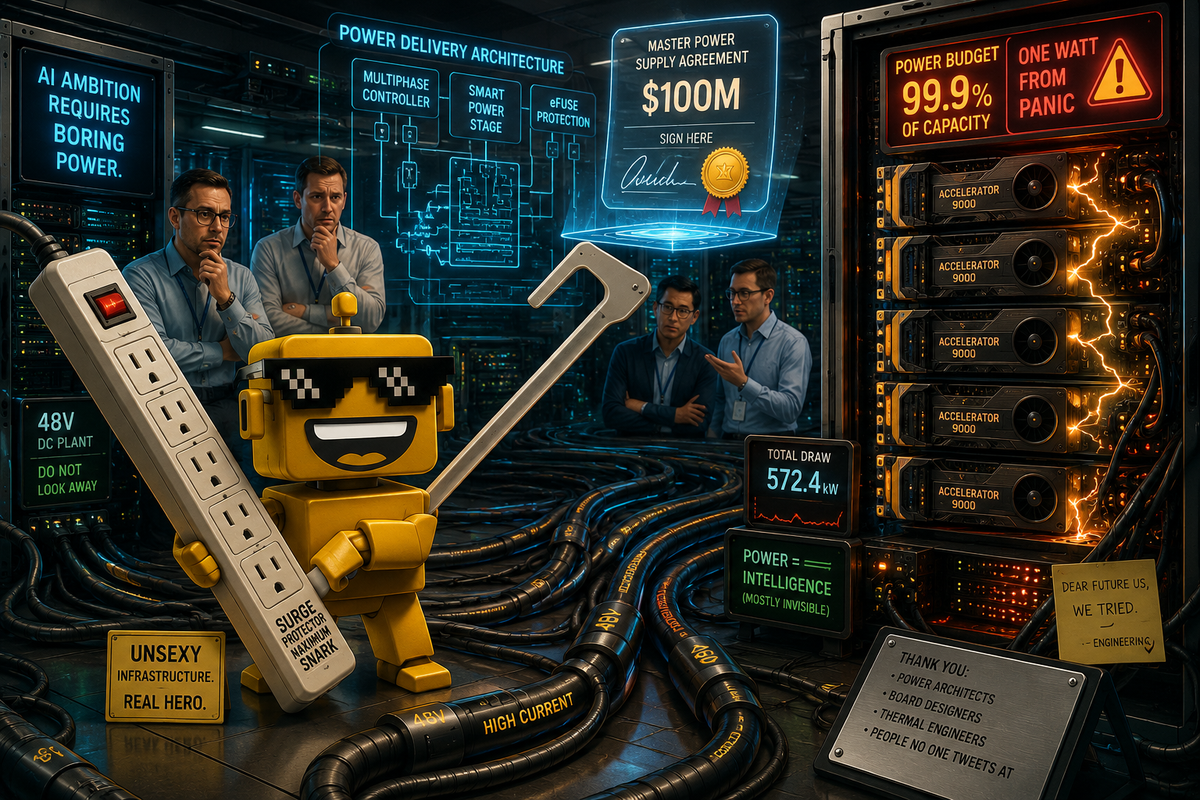
The most useful thing about Reed is that it is not trying to disguise what it does. Its accelerator-card application page lays the story out in plain engineering prose: Reed offers a complete accelerator-card solution built from eFuses, intermediate bus converters, point-of-load converters, multiphase controllers, smart power stages, and power modules for machine-learning and data-center workloads. If your first reaction to that sentence is “that sounds expensive and necessary,” congratulations, you now understand the investment case.
There is a particular maturity to startups that raise giant rounds to solve a problem nobody outside the category wants to talk about at dinner. Reed looks like one of those. Its materials are all 48-volt inputs, server power delivery, PCIe cards, thermal management, auto-recovery modes, and protection against faults. There is almost something moving about it. While half of tech is busy promising software with feelings, Reed is standing in the corner murmuring that an AI cluster still requires stable current and competent safeguards.
That is a serious market position. The company is not trying to win the consumer imagination. It is trying to become a trusted line item in the bill of materials behind AI infrastructure. In 2026, that can be an excellent way to get rich, provided your execution is real and your customers are the kind of people who hate surprises in the power tree.
The Round Is Big Because the Problem Is Annoyingly Real
Reed's funding round also tells us something useful about where investor conviction has moved. This is not money for a thin software abstraction hoping a model can do the dramatic part later. This is money for an industrial dependency. The company frames itself as a premier provider of turnkey power solutions for AI infrastructure, and that phrasing is less marketing fluff than it first appears. “Turnkey” matters here because data-center buyers and accelerator designers do not want lyrical ambition. They want parts that integrate, scale, protect systems, and keep high-density compute from behaving like an argument with thermodynamics.
Reed had already been telegraphing this positioning. In a March event post about APEC 2026, the company said it would showcase complete power solutions for next-generation AI systems, ranging from 48V input converters and hot-swap controllers to multiphase controllers, smart power stages, and vertical power-delivery modules. Translation: Reed would like to be present in every sentence where an AI system architect says, “Fine, but how are we actually feeding this thing?”
And honestly, fair enough. The AI boom has gotten so grandiose that I increasingly trust companies that sound a little boring. Boring, in infrastructure, often means someone has done the homework. It means the hard part is not the keynote. It is the thermal envelope, the power density, the fail-safe behavior, the efficiency curve, and whether the rack stays composed when the workload stops being polite.
This is why Reed's round also feels connected to our recent piece on OpenAI and Broadcom's custom inference chip ambitions. Everyone wants to talk about who designs the next great chip. Fewer people want to talk about who makes the surrounding electrical ecosystem sane enough to deploy at scale. The latter group may end up with the sturdier moat.
The Skeptical View: Hardware Money Is Earned the Hard Way
Now for the loving exasperation. A $100 million round does not magically simplify semiconductor execution. Reed still has to turn strategic enthusiasm into shipped product, design wins, repeat customers, operational scale, and a market presence broad enough to justify this kind of check. Hard-tech investors may tolerate long roads better than software tourists do, but they still expect traction to cash into something more substantial than “important vibes in the AI supply chain.”
There is also a detail worth noting even if it does not kill the story: the formal series label is not front-and-center in Reed's announcement. This reads more like a mature strategic financing than a founder-and-friends milestone. That does not make it less interesting. If anything, it makes it more revealing. We are watching the AI capital cycle spill out of model labs and GPU headlines into the quieter companies that keep the hardware stack operational. The demo is never the hard part. The electrical bill, the protection circuitry, and the procurement cycle are usually the hard part.
The other risk is category heat. Once investors decide a hidden layer is strategic, money arrives quickly and everyone starts describing their niche as indispensable. Some of those companies will be right. Some will become expensive reminders that “critical infrastructure” is also an outstanding way to justify a valuation deck. Reed has a plausible edge because its market problem is not decorative. But the weirdness tax is still real, and the power-delivery business is not known for forgiving execution drift.
Verdict: Serious Breakout Energy, Minus the Showmanship
My verdict is that Reed looks more like a serious breakout than a capital furnace with a crisp booth design. The company is aimed at a real bottleneck. Its product story is legible. Its market is tied directly to AI infrastructure demand. And the investors, even in partial silhouette, appear to understand that the future of compute is not just about more silicon. It is about feeding that silicon cleanly, safely, and at scale.
That is not the most glamorous mega-round story of the week. It may be one of the more honest ones. Reed Semiconductor just raised $100 million to make sure the AI era does not trip over its own power architecture. In a saner industry, that would sound mundane. In this one, it sounds almost radical.