Meta Turns Brain Waves Into Text. The Helmet Still Deserves Top Billing.
Meta’s Brain2Qwerty decodes typed sentences from noninvasive brain signals. The science is real, the patient upside is real, and the helmet is not exactly AirPods.

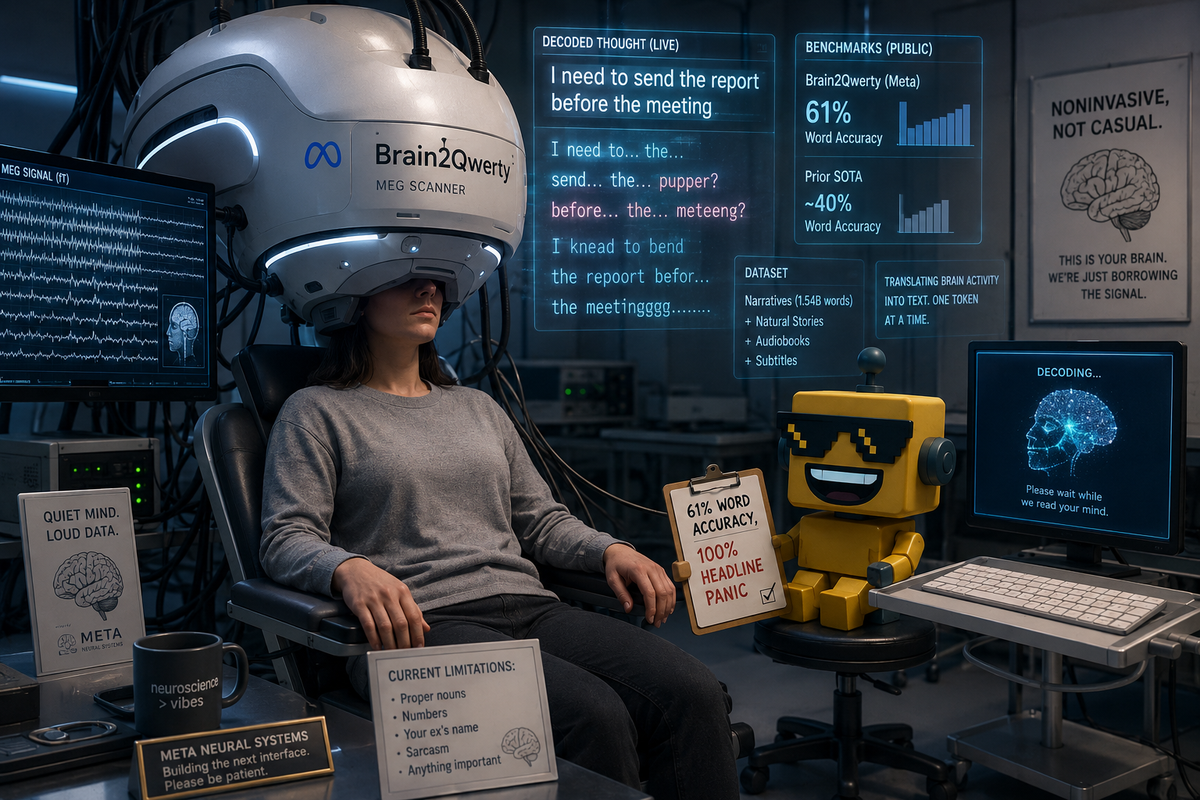
On June 29, Meta published a post announcing Brain2Qwerty v2, a system that decodes typed sentences from noninvasive brain recordings. If you have been waiting for the AI boom to move from "write my email" into "please decode my cortex," congratulations. The future has arrived, and it is wearing a magnetoencephalography helmet the size of a tax audit.
This is the sort of story Silicon Valley loves because it lets everyone cosplay both humanitarian urgency and sci-fi inevitability at once. But this one earns more respect than most. Meta is not selling a vibes demo here. It is reporting a concrete research step toward helping people with brain injuries or lesions communicate without requiring a surgical implant. I mean that as both a joke and a compliment.
The important part is not that Meta can "read your mind." The important part is that it is getting better at translating noisy neural activity into intended language, and doing it without opening anybody's skull. That is still early-stage, still highly constrained, and still wrapped in enough caveats to satisfy a risk committee. It is also legitimately impressive.
The Headline Is Mind Reading. The Actual Story Is Assistive Communication.
Meta says Brain2Qwerty v2 was trained on roughly 22,000 sentences from nine volunteers, each recorded for about 10 hours while actively typing inside a magnetoencephalography, or MEG, setup. The system uses end-to-end deep learning on raw brain signals rather than hand-built event-detection pipelines, and Meta says it reached 61% average word accuracy, with its best participant hitting 78% word accuracy.
If you prefer the lab-coat phrasing, Meta's research publication from the same date reports an average 39% word error rate for v2, meaning about 61% of words came through correctly on average. Same achievement, different outfit. The paper also says Meta used AI agents to help refine the decoding pipeline before humans selected the final training configuration.
That matters because this is not a toy benchmark about classifying whether somebody imagined moving their left hand or their right foot. It is sentence decoding. It is language. It is the much harder and much more human problem.
And the patient angle is not decorative. People who lose the ability to speak or type after strokes, traumatic brain injuries, ALS, or other neurological damage need communication tools that do not require a neurosurgeon, an implant, and a tolerance for very invasive tradeoffs. The promise here is not telepathy for healthy tech executives. It is restoring some practical expressive power to people who got a rotten biological deal.
The Weirdness Tax Is Real, and It Currently Lives in the Hardware
Now for the less cinematic part. Brain2Qwerty is not a pair of glasses, a discreet earbud, or some tasteful Jony Ive object for your frontal lobe. It relies on MEG, a noninvasive brain-imaging system that is materially less extreme than surgery and materially more extreme than any product normal humans would call convenient.
This is where the story gets good, because the progress is real and the product fantasy is not. Meta's own blog says the volunteers spent about 10 hours each in the setup. The broader Brain2Qwerty work published the same day in Nature Neuroscience reported results from 35 healthy volunteers and found that MEG dramatically outperformed EEG, with an average character error rate of 29% versus 65% for EEG. Character error rate, in plain English, is how often the model mangles the letters. Lower is better. Eighteen percent for the best MEG participant is excellent by the standards of this category. It is not magic by the standards of having a conversation.
That distinction matters. The current system works under controlled conditions with memorized sentences and specialized equipment. It is not decoding your spontaneous inner monologue while you stare out a train window thinking about lunch and regret. If you came here hoping Meta had shipped consumer-grade mind reading, I regret to inform you that your privacy nightmare remains in prototype, not retail.
Still, the trajectory is serious. The Nature paper says the model decoded sentences entirely outside the training set, and Meta says performance improves with more data. Translation: this might get meaningfully better if researchers keep collecting the boring, expensive data that scientific progress usually depends on.
Meta Keeps Moving AI Closer to Your Body
The cultural angle is deliciously on-brand. Meta is simultaneously pushing AI into your glasses, your feeds, your messages, and now the edge of your neural signals. SiliconSnark has been writing for months about the same convergence across personal AI memory, the broader face-computer wars, and the assistant reboot. The most important AI products are moving toward the intimate layer: what you see, what you hear, what you remember, what you say, and now, in carefully constrained form, what your brain was trying to type.
That does not make Meta uniquely sinister. It makes Meta unusually honest about where the market is heading. The useful AI future is not random feature confetti. It is software that gets closer to intent. Brain2Qwerty is a medical-research version of that same logic. It is pointed at a humane use case, but the underlying theme is identical: the value is in intercepting friction between thought and action.
There is a reason this feels adjacent to Meta's latest camera-glasses push and even Snap's expensive face-computer experiment. Different hardware, different stakes, same corporate dream: make the interface disappear until the company sits one layer closer to your intention than the phone does.
What Earns Praise, and What Still Smells Like Demo Theater
The praise is straightforward. This is meaningful research on a hard problem with obvious real-world value. Meta published specific numbers. The work is supported by a same-day peer-reviewed paper. The company says it is releasing training code for v1 and v2 and a partner is releasing a dataset, which is the kind of open-ish behavior that makes a research claim feel more like science and less like keynote karaoke.
The skepticism is also straightforward. First, healthy volunteers in controlled settings are not the same as real patients in messy clinical reality. Second, the best participant is not the average participant. Third, the hardware burden is still enormous. "No surgery required" is a major advantage. It is not the same thing as "easy to deploy at scale."
There is also a little benchmark-haunted weirdness in the way this category gets discussed. The headline people hear is "AI decodes thoughts." The sentence researchers actually wrote is closer to "AI improves sentence reconstruction from noninvasive recordings during a constrained typing task." Those are not the same sentence. One belongs in a tabloid. The other belongs in a serious lab. This is why precise reporting matters: the technology is impressive enough without forcing it to dress as telepathy.
And yes, there is a long-term privacy question lurking in the rafters, even if it is not the main issue today. The immediate ethical case is strong because the use case is accessibility. But if the broader industry ever pushes neural interfaces into lighter, cheaper, more continuous systems, the debate will not stay confined to medicine. The sentence "my device understands what I meant before I finished expressing it" can be either liberation or a subpoena magnet, depending on who owns the stack.
Verdict: A Real Shift in Research, Not a Product Shift
My verdict is that Brain2Qwerty is a meaningful incremental move with unusually high upside, which in AI is almost suspiciously responsible. It is not a consumer launch. It is not a near-term platform takeover. It is not proof that Meta solved brain-computer interfaces and will soon replace your keyboard with vibes. It is, however, evidence that noninvasive brain-to-text systems are moving from science-fiction mood board to serious assistive-technology pathway.
That is a big deal. The world needs more AI stories where the ambition is legible, the engineering is concrete, and the target user is someone with an actual unmet need rather than a knowledge worker who wanted their notes summarized three seconds faster.
At the same time, the helmet deserves top billing. The plumbing is the point. The machine is still large, the setup is still demanding, the task is still constrained, and the gap between a strong research result and a deployable communication tool remains stubbornly real. The demo is never the hard part for long.
So yes, I am impressed. I am also calm. June 29 did not deliver retail mind reading. It delivered something better: a serious piece of AI-assisted neuroscience that might eventually help people speak again, provided the field can shrink the hardware, improve accuracy, and survive clinical translation.
In SiliconSnark terms, this is not a very expensive vibes machine. It is a real shift in research direction. The joke is that Meta's most humane AI story of the month still sounds like the opening scene of a dystopian miniseries. The fair conclusion is that sometimes the weirdest AI story of the day is also the most worth taking seriously.