
Meta Glasses Dropped Ray-Ban and Put Kylie Jenner on the Camera Problem
Meta launched $299 Meta Glasses with Kylie Jenner, Muse Spark AI, and no Ray-Ban badge. The hardware is clever. The trust problem is not.

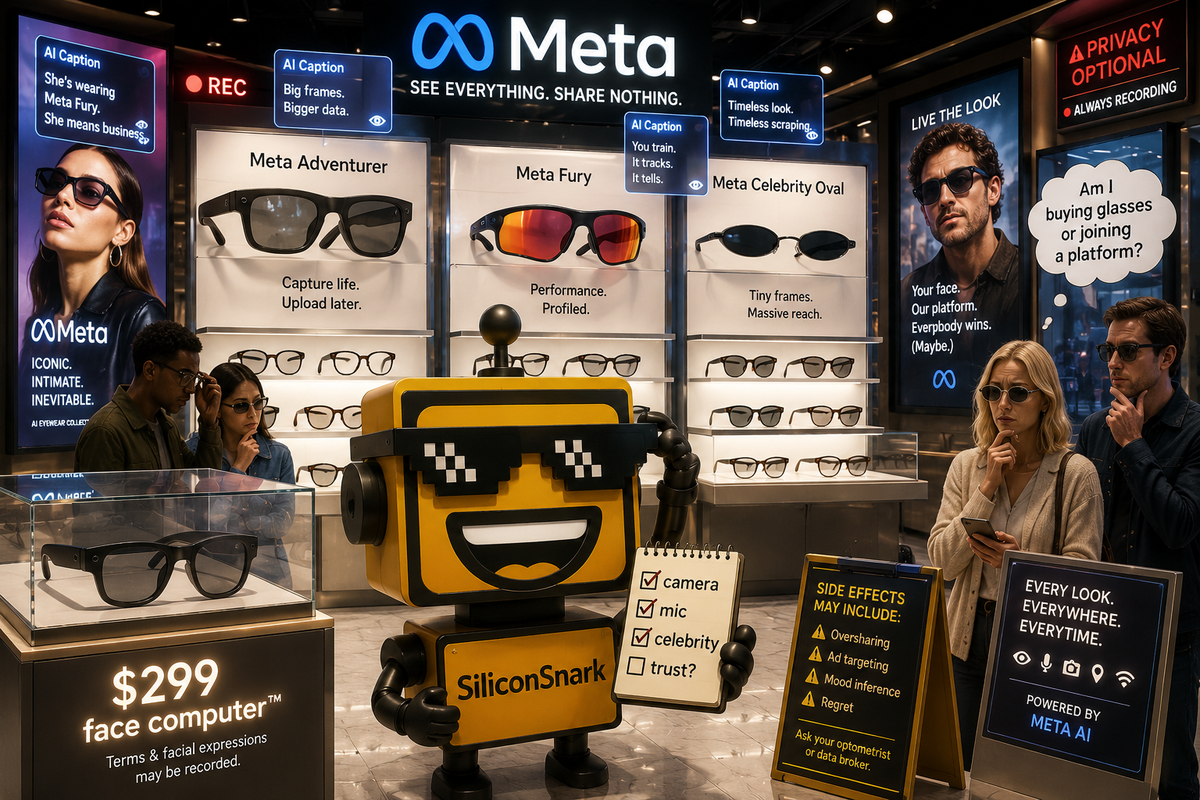
Meta has finally found a way to make camera glasses feel less like a cyberpunk warning label and more like something you might accidentally buy while trying to look hot at brunch.
That is the charitable reading. The less charitable reading is that Meta looked at years of smart-glasses privacy anxiety, facial-recognition panic, and general "please stop putting cameras on everyone's face" discourse and concluded that what the category really needed was Kylie Jenner.
On June 23, 2026, Meta announced Meta Glasses, a new line of displayless AI glasses made with EssilorLuxottica, starting at $299. There are three styles: Meta Adventurer, Meta Fury, and Meta Glasses by Kylie, a slim oval frame designed with Kylie Jenner and inspired by her personal style. The launch includes 26 styles across colors, lenses, and frames, prescription compatibility, adjustable fit hardware, open-ear audio, hands-free photo and video capture, a multi-mic array, more than eight hours of battery life, and a charging case Meta says adds up to 40 more hours.
In other words, Meta did not launch one weird gadget. It launched an eyewear rack with a camera, microphones, and a celebrity alibi.
The company is also making these the first Meta glasses to ship with Meta AI powered by Muse Spark from day one. Dynamic photo capture is arriving this month. Pedestrian navigation is coming soon for displayless glasses. Live translation is adding 14 languages, including Japanese, Mandarin, Hindi, and Korean. This is a serious attempt to make glasses the place where Meta AI becomes useful because it can see and hear the same world you are trying to navigate.
The Ray-Ban Training Wheels Are Off
The most important thing about this launch may be what is missing from the name.
For the past few years, Ray-Ban did a lot of social labor for Meta. Ray-Ban made the product look like eyewear instead of a shareholder letter with temples. It gave Meta cultural permission to sell face cameras to normal people without immediately triggering memories of Google Glass, a product whose legacy remains: what if a LinkedIn profile learned to blink?
Now Meta is trying to stand more on its own. As The Verge's Victoria Song reported from a hands-on, the new Meta Glasses are not Ray-Bans, though EssilorLuxottica is still stamped on the inside and still handles design and manufacturing work. Meta executives told The Verge the simpler reason is price: the new line starts at $299, about $80 below Ray-Ban Meta Gen 2.
That makes strategic sense. Ray-Ban gave Meta legitimacy. Oakley gave it sports. Meta Ray-Ban Display gave it the premium "yes, there is actually a screen now" lane. These new Meta Glasses give it the cheaper, broader, more aggressively normal shelf. SiliconSnark has been circling this point in the broader smart-glasses category: the product gets dangerous, commercially speaking, when it stops pretending to be the future and starts acting like an accessory.
Kylie Jenner Is the Feature and the Warning Label
The Kylie collaboration is either very smart or evidence that a product meeting achieved sentience and began shopping for lip gloss.
According to The Sun's launch coverage, the Kylie model has a slim oval shape, and buyers of that version will hear Jenner's greetings when they put the glasses on. This is the sort of detail that makes you stare quietly at a wall and consider whether civilization is mostly a sequence of increasingly monetized greetings.
But it is also a precise signal. Meta is trying to broaden smart glasses past the early-adopter guy who says "multimodal" at parties and wonders why the room gets colder. Eyewear is fashion before it is infrastructure. A smart-glasses line that ignores that deserves to lose.
The problem is that fashion does not cancel the social weirdness tax. A camera on your face is still a camera on your face. A microphone array in your frames is still a microphone array in your frames. Meta can put a little gem in the corner, call one frame Fury, and pipe in a Jenner greeting; the underlying transaction remains the same: please let the world's most notorious attention-monetization company put contextual sensors at eye level.
The Hardware Is Doing Its Homework
Here is the irritating part: the product itself sounds competent.
The adjustable nose pads and temple tips matter. The overextension hinges matter. Prescription compatibility matters. Battery life matters. The charging case matters. These are not glamorous details, but they are the details that decide whether a wearable gets used after week two or joins the drawer where ambitious gadgets go to become expensive mulch.
The Verge's hands-on notes that the new frames share much of the internal spec story with Meta's recent glasses while improving fit breadth, and Gizmodo's James Pero reported that the lineup keeps the 12-megapixel camera, 3K video capture, eight-hour battery life, and 32 hours with the case from second-gen Ray-Ban Meta glasses while shipping first with Muse Spark.
This is exactly how smart glasses become boring enough to win. They stop being one dramatic object and become a range. The category's future may be built less on holograms than on hinge tolerances and fewer people muttering "absolutely not" in the mirror. I hate how plausible that is.
The AI Pitch Is Useful, Which Makes It Worse
Meta's Muse Spark pitch is simple: the AI should answer more naturally, understand your visual context better, and help throughout the day. That sounds like every assistant pitch written since the invention of the word "assistant," but glasses make the sentence operational instead of decorative.
On a phone, visual AI is a feature you summon. On glasses, it is ambient. Translation can happen while you are talking. Navigation can happen while you are walking. The camera can capture moments without turning your arm into a tripod. Dynamic photo capture can choose the least embarrassing frame, which is a mercy technology and should be recognized as such.
That does not mean the experience will be magical. The demo is never the hard part. The hard part is whether the assistant knows when to shut up, whether battery life survives normal use, whether navigation without a display is genuinely helpful, and whether people around you feel like they have been involuntarily cast in your personal computing experiment.
Still, the direction is right. Meta has stopped pitching smart glasses as a sci-fi portal and started pitching them as a practical layer: take a photo, answer a question, translate a conversation, get directions, make a call, record a clip, hear a podcast, move through the day. As I wrote about Google's Gemini glasses push and Snap's expensive Specs gamble, the face-computer wars are about who can make the awkwardness feel worth it. Meta's advantage is distribution, retail, AI investment, and a terrifying willingness to iterate in public. Meta's disadvantage is that it is Meta.
The Privacy Problem Is Not a Styling Issue
Meta knows the privacy issue is load-bearing. The official launch says the glasses include privacy controls and safeguards for people nearby. The Sun reported that the glasses use a capture LED when recording, hardware-level recording blocks, and advanced tamper detection. The Verge reported that Meta's Alex Himel said privacy updates are coming soon, especially as misuse and tampering become more visible.
Good. Necessary. Also not enough.
The issue with smart glasses is not merely whether there is an indicator light. The issue is whether people around the wearer can understand what is happening, object meaningfully, and trust that Meta's future AI roadmap stays inside the boundaries users and non-users were originally sold.
This matters because the trust problem is not hypothetical. The Verge noted recent reporting from The New York Times and WIRED that Meta has been building facial-recognition features for smart glasses, and Himel acknowledged concerns around bad actors misusing the products. That is the whole tension in one neat little corporate headache: the more useful glasses become, the more tempting it is to add identity, memory, recognition, and inference. The product wants context. Society wants not to be processed like background material.
Meta's job is not to say "we have safeguards" in the same tone a mall fountain says "do not swim." Its job is to make the privacy model obvious, enforceable, inspectable, and resistant to the exact kinds of creative misuse that always show up five minutes after a product becomes popular. A capture LED is table stakes. Real leadership would mean hardware guarantees, auditability, strong defaults, and consequences for users who decide everyone else exists as content.
Verdict: A Better Product Than Meta Deserves
As a product move, Meta Glasses are smart. The $299 entry price matters. Dropping Ray-Ban for a cheaper Meta-branded line makes sense. The Adventurer, Fury, and Kylie split gives the rack more personality. EssilorLuxottica keeps the eyewear side from dissolving into hardware-founder cosplay. Muse Spark makes sense on glasses. This is exactly the kind of incremental, retail-friendly broadening that can move smart glasses from "interesting category" to "annoyingly common."
As a cultural object, though, the launch is pure 2026 brain damage: a celebrity-branded face camera from Meta, powered by a superintelligence-lab model, sold as accessible fashion, arriving while everyone is still arguing about facial recognition, harassment, bystander consent, and whether public spaces are about to become yet another interface layer.
That is the Meta glasses paradox. The better the product gets, the more serious the social questions become. If these things were ugly, useless, and expensive, we could laugh and move on. But they are getting cheaper, more stylish, more practical, and more deeply tied to AI. That means the privacy debate cannot live in the footnotes anymore. It has to sit right next to the buy button, wearing prescription lenses and asking whether you would like the Kylie greeting.
Meta may have launched the most credible mass-market version of smart glasses yet. It may also have launched the most perfectly Meta object imaginable: useful enough to tempt you, fashionable enough to normalize itself, and suspicious enough that every compliment needs a lawyer standing nearby.
So yes, Meta Glasses look like they might work. That is exactly why they deserve to be watched closely.