Massachusetts AI Coalition Is Building a Winning AI Flywheel in Public
A positive check-in on the Massachusetts AI Coalition, Ryan Durkin's organizing work at WHOOP, and Boston's AI momentum.
The most Boston version of an AI movement does not begin with a manifesto. It begins with a packed room, a spreadsheet, someone offering office space, someone else asking about GPUs, and four people calculating whether they can make it from Kenmore to Kendall in less than 18 minutes.
That is, happily, the story of the Massachusetts AI Coalition so far.
When WHOOP announced the Massachusetts AI Coalition in January, the premise was straightforward and weirdly refreshing: Massachusetts already has the institutions, companies, founders, operators, investors, hospitals, labs, universities, and technical obsessives required to matter in AI. What it needed was coordination. WHOOP stepped in as founding chair, with members including Suno, Lovable, DraftKings, Wayfair, HubSpot, Klaviyo, Circle, Jellyfish, Formlabs, and 7AI.
At the time, SiliconSnark covered the Massachusetts AI Coalition launch as something more serious than booster theater. The argument then was that Massachusetts needed a mechanism for turning local density into compounding advantage. Five months later, the check-in is easy: the mechanism is starting to look real.
And the person most visibly tightening the bolts is Ryan Durkin.
Ryan Durkin Is Doing the Connector Work
Durkin's title at WHOOP has evolved into the kind of sentence that explains the whole plot. WHOOP recently described him as vice president of AI and community engagement, and the company highlighted his first appearance on The Boston Globe's 2026 Tech Power Players 50 list alongside WHOOP founder and CEO Will Ahmed. That recognition was a useful signal that the community-building work now counts as ecosystem infrastructure.
That matters because ecosystem work is easy to mock until it works. Founders need capital, customers, talent, credibility, compute, office space, honest feedback, and useful introductions. None of that is as glamorous as shipping a frontier model. All of it helps determine whether the next important AI company starts here, stays here, scales here, or quietly gets absorbed into another region's mythos.
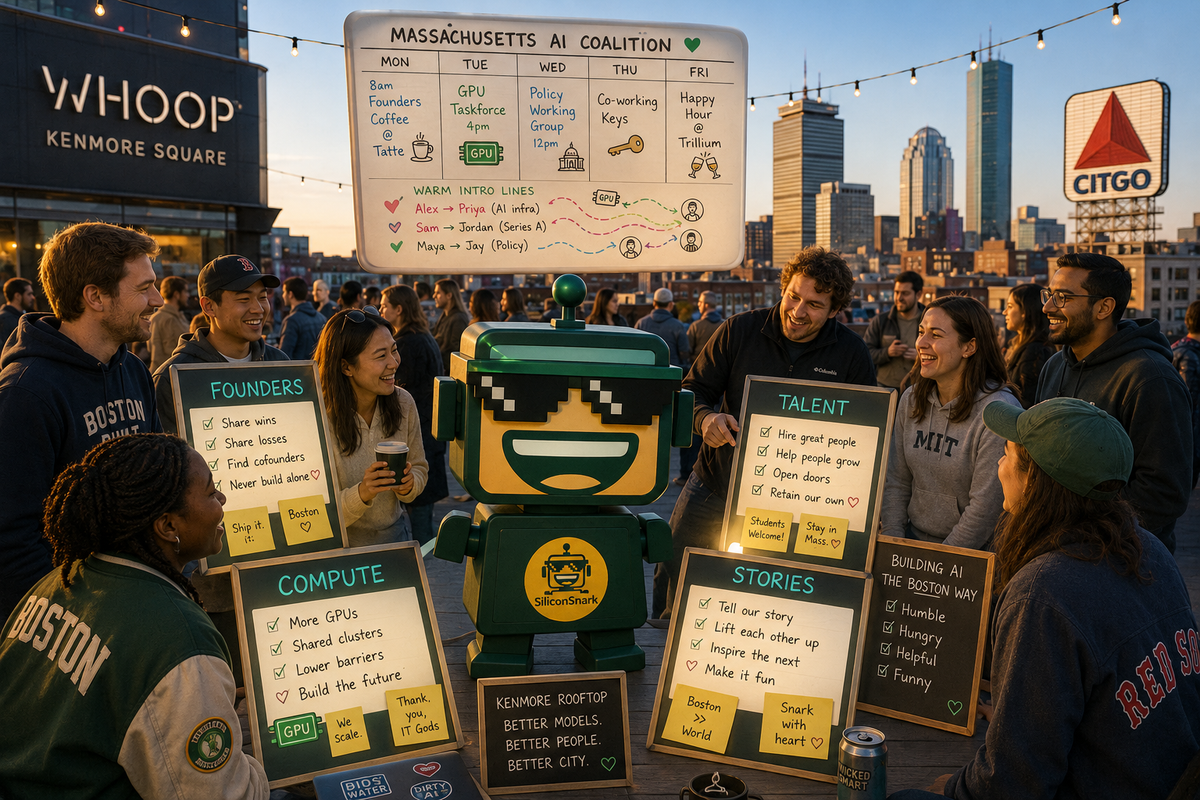
The Boston Globe's Jon Chesto captured the Durkin part of the story in May, writing that Durkin had become a driving force behind the coalition and that the group was preparing to celebrate its first 100 days on WHOOP's Kenmore Square rooftop during Boston Tech Week. The details were concrete: crowded AI events at WHOOP, a January dinner with roughly 30 local leaders, and a desire to stop arguing about tech decline long enough to build the counterexample.
Durkin's work is not pretending that AI leadership can be summoned by saying "ecosystem" into a microphone. It is much more operational: bring people together, make the room useful, turn enthusiasm into programs, and keep the work pointed at builders instead of panel-event fog.
That is not small work. That is load-bearing work wearing a name badge.
WHOOP Is the Right Kind of Local Anchor
WHOOP deserves real credit here too. The company could have treated its Boston momentum as a private victory lap. Instead, it has been lending its platform, space, leadership, and credibility to a broader regional project.
That is meaningful because WHOOP is not a decorative logo on the coalition letterhead. It is one of the rare Boston consumer-tech companies with global scale, a physical product, a serious data platform, and a brand people outside the region recognize. WHOOP's recent run has been substantial: the company said it plans to create more than 600 new roles, mostly in Boston, and that it raised a $575 million Series G at a $10.1 billion valuation.
WHOOP also embodies one of Massachusetts' better AI arguments. This region's strongest companies often live where software meets the body, the enterprise, the clinic, the lab, the machine, or the regulated workflow. WHOOP is a health and performance company wrapped around sensors, coaching, data, and increasingly AI-enabled personalization. So when WHOOP convenes founders around AI adoption, talent, and company-building, it carries a useful kind of authority.
That is the example local founders need.
The Programs Are Becoming Practical
The best sign for the Coalition is that its public work has moved from declaration to useful packaging. The original announcement promised more than 100 in-person events in 2026, spanning practitioner-led AI workshops, hands-on building sessions, founder and operator networking, product launches, and community events. That defined the Coalition as a do-things group rather than a write-statements group.
Since then, the Mass AI Coalition site has started to show the shape of a more durable operating system. Its founder-facing work now includes a Founder Starter Pack framed around practical support: co-working space, GPU credits, warm introductions, startup discounts, and founder events. The details will matter, but the direction is exactly right.
AI founders do not need another inspirational reminder that Massachusetts has talent. They know. They need help getting compute, customers, hires, mentors, office density, capital introductions, and reasons to believe their next phase should happen here.
The Coalition also understands storytelling as infrastructure. Its Voices program is an open call for 100 people to help tell AI stories across the community. SiliconSnark has been making a version of the same point for months: Boston is not short on work. It is short on narration.
The 100-Day Test Was Energy, Not Optics
Boston Tech Week gave the Coalition a useful stress test. A calendar can look impressive in a spreadsheet. The question is whether it produces energy in the room.
By the available signals, it did. Chesto called the Coalition's 100-day event at WHOOP one of the most important moments of Boston's inaugural Tech Week because it represented an organized resurgence of community energy. That is not a minor compliment in a week full of panels, parties, investor walkthroughs, and people saying "agentic."
It also fits the broader pattern SiliconSnark has been tracking. Boston Tech Week worked because the local density was real. Liquid AI matters because Boston needs a foundation-model pillar. The Boston tech collapse discourse keeps missing the point because the region is not failing to build. It is sometimes failing to make the building feel centralized, visible, and inevitable.
The Coalition helps with that exact problem. It gives local AI activity a rhythm, founders a front door, operators a way to contribute, and companies a reason to collaborate without pretending everyone has the same incentives. Most importantly, it gives talented people a reason to keep bumping into each other in person.
My Very Positive Verdict
The Mass AI Coalition is not a substitute for companies. It will not, by itself, create the next Liquid AI, Suno, WHOOP, HubSpot, DraftKings, or Klaviyo. Ecosystems are judged by products, customers, revenue, research, jobs, exits, and founders who decide to stay when leaving would be easier.
But it is becoming a serious coordination layer for the thing Massachusetts already had in pieces.
That is why the check-in is so positive. Ryan Durkin is doing the rare community work that feels urgent without feeling hollow. WHOOP is acting like a true anchor company. The Coalition's programs target practical founder and operator needs. The 100-day moment showed real energy. And the whole effort gives Boston's AI ecosystem a coherent public surface at exactly the moment the region needs one.
The caveat is execution, because execution is always the caveat. The Coalition will need to keep converting events into outcomes: founders helped, companies formed, jobs created, AI tools adopted responsibly, workers retrained, customers won, stories told, and enough ambition retained that Boston stops treating confidence like a zoning violation.
Still, this is the right work. It is positive, practical, and appropriately Boston. Not "we have conquered AI." More like: "we have the people, companies, institutions, founders, and unreasonable homework ethic. Now let us coordinate like we mean it."