Deep Dive: AI Text Watermarking Is Here. Will Anyone Still Use the AI Chatbots?
AI text watermarks can reveal machine-generated writing—but not perfectly. Here is how they work, why they matter, and whether users will flee.

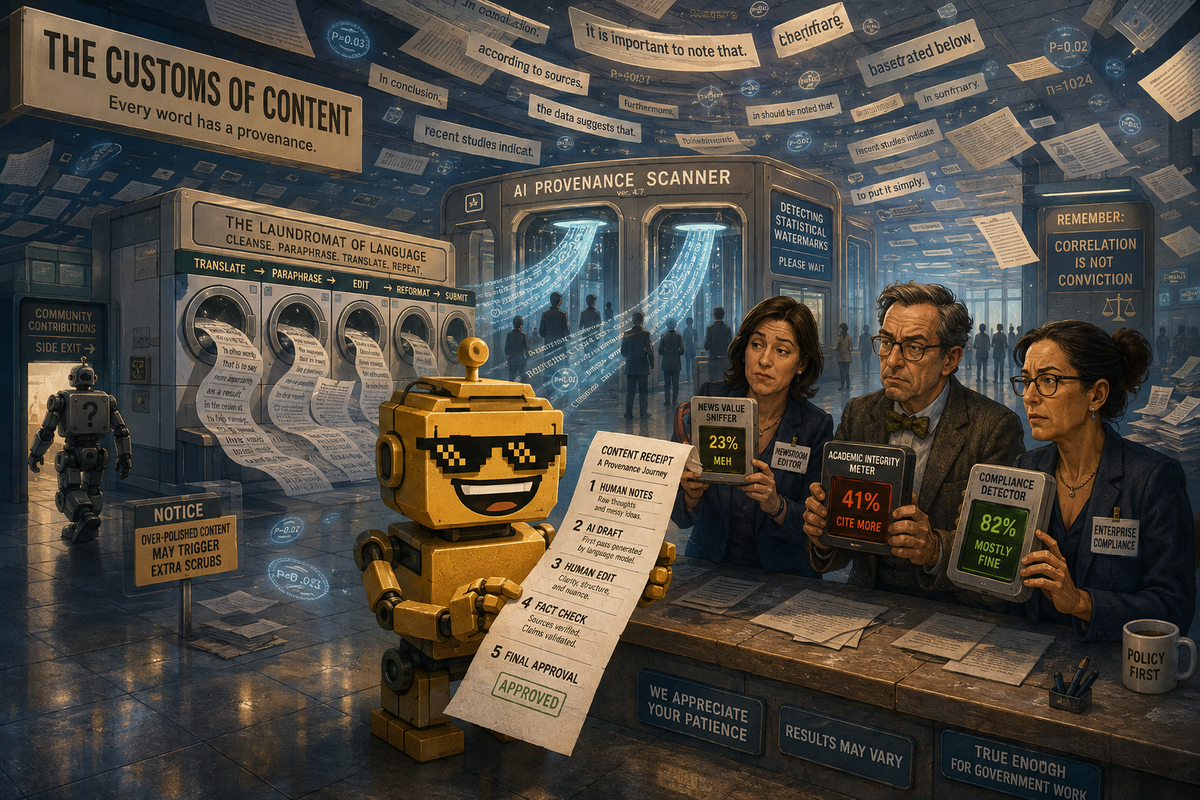
Somewhere, right now, a person is staring at an email drafted by a chatbot and wondering whether the adjectives are carrying a tiny wire.
The email looks normal. There is no robot stamp in the footer. No animated paper clip leans into frame and whispers, “This paragraph was assembled by statistical inference.” The message can be copied into Slack, pasted into a résumé, dropped into a report, or sent to a professor who has already spent three years developing a nervous tic around the phrase it is important to note.
But the word choices may contain a pattern. Not a secret Unicode character or an invisible pixel. A statistical signature created while the model selected one token after another—a preference, spread across the prose, for certain plausible words over other equally plausible words. With the right detector and enough text, that pattern can suggest that a particular AI system generated or processed the passage.
This used to be an academic proposal. It is now product infrastructure. Google DeepMind has deployed SynthID-Text in Gemini at production scale. In August 2026, Anthropic said supported Claude models would add machine-readable marks to generated text, a move we covered when Claude’s prose acquired an invisible passport. The European Union’s AI transparency rules now require providers to make synthetic content identifiable in machine-readable form, while China already has its own labeling regime. The watermark has escaped the research paper and entered the compliance department, which is how every technology knows it has truly grown up.
The immediate reaction has been predictable. Students think every pasted sentence will testify against them. Writers worry that using AI to tighten a paragraph will cause their work to glow under an institutional black light. Employers imagine a dashboard showing which employees asked a model to draft the quarterly update. AI companies worry that customers will leave for tools that do not tag the merchandise. People who have never read a watermarking paper are confidently explaining that changing one comma will defeat the whole thing.
So let us answer the large question early.
No, people are not going to stop using AI because its text is watermarked. Some will switch tools. Some will avoid it for work they intend to misrepresent. Some legitimate users will hesitate because institutions are very good at turning probabilistic signals into disciplinary weapons. But the broad adoption of AI is being driven by convenience, cost, integration, and the fact that the chatbot is rapidly disappearing inside ordinary software. A hidden mark will not make millions of people rediscover a passionate love of writing meeting summaries.
What watermarking will do is force a much harder argument about authorship. Is a paragraph “AI-generated” if a human outlined it, the model drafted it, the human replaced half the sentences, Grammarly polished the result, and an editor signed off? What if AI supplied one metaphor? What if it translated a human draft? What if it wrote the first version of code that a developer tested, refactored, and deployed? Our tools want a binary answer from a creative process that increasingly resembles a casserole.
The watermark is not the end of AI writing. It is the beginning of the provenance era: a period in which origin, editing history, responsibility, and disclosure become separate questions instead of one giant moral panic wearing a detector score.
First, Stop Calling Every Detector a Watermark
The public conversation has bundled several different technologies into one beige compliance smoothie. This is not helpful, because each technique answers a different question and fails in a different way.
A post-hoc AI detector receives a finished passage and guesses whether it resembles machine-generated writing. It might examine predictability, sentence variation, vocabulary patterns, or signals learned from examples of human and AI prose. The detector was not present when the text was created. It is doing forensic profiling after the fact.
A generative text watermark is inserted during generation. The model subtly changes how it selects among plausible next tokens according to a secret or controlled pattern. A detector later checks whether the passage contains more of the favored pattern than chance would predict. It is the difference between guessing that a suitcase came from an airline and finding the airline’s luggage tag—although this luggage tag can fade, be copied, or be deliberately forged, because apparently even metaphors need threat models now.
Metadata and Content Credentials attach information about origin and edits to a file or structured asset. The C2PA standard describes cryptographically signed provenance records that can say what tool created an asset, what operations changed it, and whether the record remains intact. This is powerful for images, video, audio, PDFs, documents, and increasingly structured text formats. But ordinary text copied into a web form is not a stable file. It is linguistic oatmeal. The container disappears the moment you paste it somewhere else.
Then there are visible labels: “AI-generated,” “AI-assisted,” “digitally altered,” or the more honest “A robot was involved and legal made us tell you.” A label is a communication layer, not an origin-detection method. It might be supplied by the creator, added automatically because a watermark was detected, or slapped on by a platform after a classifier became suspicious.
These systems can work together. Metadata can carry a detailed production history. An invisible watermark can help recover provenance after metadata is stripped. A platform can display a visible label. A classifier can flag unmarked material for review. Logging can establish which model account generated which output. The architecture is layered because no single method survives every transformation, covers every model, and answers every policy question.
This distinction matters most in education. OpenAI retired its original AI-text classifier in 2023 after reporting that it identified only 26 percent of AI-written text in one evaluation while incorrectly labeling human text 9 percent of the time. Its current guidance to educators says detectors are not reliable enough for high-consequence judgments. That warning concerns classifiers trying to infer origin from prose. A watermark placed by the generating model is a stronger form of evidence, but “stronger” is not the same as “proof beyond appeal.”
If your school, employer, publisher, or government cannot explain which of these technologies it is using, what the signal means, and how a person can challenge a result, it does not have a provenance policy. It has purchased an accusation vending machine.
How to Hide a Signal Inside a Sentence Without Making It Talk Weird
A language model writes by repeatedly predicting what token might come next. A token can be a word, part of a word, punctuation, or another unit in the model’s vocabulary. Given “The meeting has been moved to,” the model may assign high probabilities to “Tuesday,” “Friday,” and “next week,” while assigning a lower probability to “eggplant.” The final output depends on how the system samples from those probabilities.
Early influential watermarking work proposed splitting possible next tokens into randomized “green” and “red” groups based on the preceding context and a secret key. The generator softly boosts the green tokens. Each choice still has to make sense; the model is not forced to put “eggplant” in the budget memo merely because cryptography developed a produce fixation. Across a long enough passage, however, green selections accumulate more often than chance would predict. The detector reconstructs the groups, counts the pattern, and calculates how surprising the result is.
Google’s SynthID-Text uses a more sophisticated tournament-style sampling system rather than one simple green list. The important product insight is the same: the watermark lives in the selection process, not in a visible character attached afterward. DeepMind says the technique can be configured to preserve the model’s underlying output distribution while still producing a detectable signal. In a live test covering nearly 20 million watermarked and unwatermarked Gemini responses, researchers found no statistically significant difference in users’ thumbs-up or thumbs-down feedback. The computational overhead was also negligible.
That is a serious result. The industry’s first objection to watermarking was that it might make the writing worse or slow generation. Google demonstrated that a large consumer system could add a mark without users noticing a quality penalty. The mark did not force Gemini to end every response with “In conclusion,” because the model was already perfectly capable of that on its own.
But detectability depends on room to maneuver. A creative essay offers many plausible phrasings, giving the generator abundant choices through which to encode a pattern. A short factual answer has less entropy—less uncertainty among possible next tokens. There are only so many elegant ways to say that Paris is the capital of France before the watermarking system begins looking around the sentence for loose change. Code can be even more constrained: rename the wrong symbol or prefer an unusual construct and you may affect correctness, style rules, or compatibility.
Length matters too. A statistical signal needs observations. One sentence may not contain enough evidence. A thousand-word essay provides far more. A detector may abstain when confidence is low, which is responsible engineering but disappointing to anyone hoping for a red “CHEATER” button that works on a six-word discussion-board reply.
This is why a watermark result should be phrased as evidence that a mark is present, with a documented confidence threshold and known source. It should not become an all-purpose claim that a machine “wrote” the work in the ordinary human sense. The detector sees a statistical pattern. It cannot see the student thinking, the employee editing, the journalist checking sources, or the middle manager adding “strategic” to a sentence because the quarter was emotionally difficult.
The Three Things a Watermark Can Prove, Suggest, and Absolutely Not Know
When a watermark detector works as designed, it can provide stronger evidence than a style classifier that a compatible model generated or processed a passage. If separate providers use distinct keys or schemes, it may also support attribution to a model family or service. With more complex multi-bit systems, a provider could theoretically encode additional information such as a version, deployment channel, or user identifier.
That last possibility is where the privacy meeting should begin immediately.
A model-origin mark says, in effect, “This text appears to have passed through Claude” or “This output carries a Gemini signal.” A user-level trace says, “This came from account 4817 at 2:13 p.m.” Those are profoundly different systems. The first can support ecosystem transparency. The second can support abuse investigations, copyright enforcement, leak tracing, employee surveillance, whistleblower identification, or authoritarian policing, depending on who holds the detector and whether the governance was written by adults.
Watermark capacity is not infinite, and many deployed systems appear focused on provenance rather than identity. Still, the public deserves explicit answers: What information is encoded? Who can detect it? Are detections logged? Can a provider connect the result to an account? How long is that mapping retained? Can governments compel access? Can a journalist or dissident obtain untraceable assistance? “Machine-readable” is a technical property, not a privacy policy.
A watermark also cannot tell whether the text is true. It can mark a beautifully sourced explanation and an immaculate hallucination with equal professionalism. C2PA’s own guidance is careful on this point: provenance records can verify that signed information is intact and associated with an asset, but they do not declare the content good, accurate, ethical, or wise. A verified origin is context for judgment, not a substitute for it.
Nor can a watermark determine authorship as law, academia, and culture understand it. If I ask a model for ten headline ideas, reject nine, rewrite the tenth, report the story, interview sources, reorganize the argument, and accept responsibility for every sentence, the presence of an AI-origin signal does not settle who authored the article. It records one part of the process. This is the same distinction behind SiliconSnark’s deliberately non-forensic AI Slop Detector: quality and origin overlap sometimes, but they are not the same category.
Finally, absence of a watermark is not proof of human creation. The text may come from an unwatermarked model, an older model, a local open-weight system, a service outside the detection network, or a watermarked model whose signal was degraded. “No mark found” must never be translated into “certified organic human.” The cleanest-looking carton in the supermarket may simply be the one that escaped labeling.
The Watermark Laundry Is Open 24 Hours
The most obvious attack on a text watermark is to rewrite the text.
A user can paraphrase manually, translate the passage into another language and back, ask a second model to restyle it, summarize it, expand it, reorder sentences, swap synonyms, or combine it with human prose. Each transformation can dilute the token-level pattern. The attacker does not need to understand the watermark. They only need access to language, which is unfortunately available in several regions.
Research is divided not on whether attacks exist, but on how much work they require and how much signal survives. The original watermarking team led by John Kirchenbauer found that marks could remain detectable after human or machine paraphrasing when enough text was available. Other researchers have shown that repeated paraphrasing can substantially reduce detection while preserving reasonable quality. A 2025 EMNLP paper introduced a “smoothing” attack tested against ten watermark schemes, selectively rewriting text to erase signals while trying to retain utility.
This does not make watermarking useless. Security tools are allowed to raise the cost of abuse without defeating every motivated attacker. Door locks remain popular despite the existence of windows. A robust mark can catch bulk spam, lazy academic misconduct, automated influence operations, undisclosed content farms, and accidental reuse. Many bad actors optimize for volume, not elegance. Adding a laundering step consumes compute, time, money, and quality.
But the limits destroy the fantasy of universal detection. If the policy requires every harmful AI sentence to remain identifiable after an adversary repeatedly rewrites it, text watermarking will fail. Natural language is too transformable. The meaning can survive while the surface pattern changes, and most current watermarks live primarily in that surface selection.
Then comes spoofing. An attacker may try to make human-written or malicious text appear watermarked, framing a provider or author. Researchers demonstrated watermark stealing attacks that could scrub or spoof leading schemes after querying a watermarked model, reporting average success rates above 80 percent in their experiments for under $50. A 2026 EACL paper called DITTO showed how knowledge distillation could reproduce a victim model’s watermark signal in another model’s outputs.
This is the provenance equivalent of stealing a police badge and then acting surprised that people ask for a second form of ID.
Newer defenses are being designed against paraphrasing and spoofing, including dual-stream, semantic, and adaptive watermarks. The research race will continue. But any institution treating watermark detection as conclusive attribution should understand the asymmetry: a false negative may let misconduct pass; a false positive or successful spoof may punish an innocent person. The second harm is often more concentrated, personal, and difficult to reverse.
Detection systems therefore need conservative thresholds, abstention, corroborating evidence, transparent error rates, access controls, audit logs, and an appeal process. If that sounds less exciting than “AI detector catches cheater,” congratulations. You have discovered governance.
Open-Weight Models Are the Emergency Exit and the Structural Problem
Watermarking works best when the entity serving the model controls generation and agrees to mark the output. That describes Gemini, Claude, and other hosted systems. It does not describe the entire AI ecosystem.
Open-weight models can run locally, inside a company’s cloud account, on a developer workstation, or through a provider that has modified the generation stack. Even if the original release includes watermarking, an operator may remove or change the sampling component. A malicious user can choose a model without a mark. A privacy-conscious journalist can do the same. The technology cannot tell the difference between evasion and a legitimate need to avoid centralized tracking.
This creates a two-tier system. Compliant commercial providers mark their outputs and become easier to audit. Less accountable services remain invisible. The safest vendors may appear responsible for more synthetic content simply because their products leave evidence, while the sketchiest systems receive the informational equivalent of diplomatic immunity.
Our deep dive on open-weight AI traced how downloadable models became a competitive, geopolitical, and technical force rather than a hobbyist subplot. That same openness limits any universal watermark mandate. Regulators can impose duties on providers placing systems on a market. They cannot make a model already sitting on a laptop remember a compliance meeting it never attended.
The answer is not to ban open models in the name of provenance. That would sacrifice privacy, research, competition, customization, and local deployment while determined abusers found another distribution channel before the press conference ended. It would also centralize speech infrastructure inside a handful of companies with the power to trace outputs, revoke access, and define acceptable generation. A perfectly marked information ecosystem can still be a deeply unhealthy one.
Instead, we should be honest about coverage. Watermarks can identify participating systems. They cannot certify the origin of all text. Platforms can require disclosure in sensitive contexts, preserve provenance when available, and use behavior-based controls against spam or coordinated manipulation. High-stakes institutions can demand process records from the people submitting work. None of these steps requires pretending that every unmarked paragraph was lovingly typed by a mammal.
The open-model gap also changes provider incentives. If one company adds a robust watermark while rivals do not, users who value concealment can leave. In 2024, reporting on OpenAI’s internal debate said nearly 30 percent of surveyed ChatGPT users indicated they would use the product less if text were watermarked. OpenAI publicly emphasized separate concerns about circumvention and disproportionate effects on some groups. The company has since expanded provenance for images, but broad text watermarking remained a harder commercial choice.
Every company likes collective responsibility. Unilateral responsibility has churn metrics.
Europe Has Turned the Research Question Into a Product Deadline
The commercial stalemate is why regulation matters. If every major provider faces comparable duties, watermarking becomes less of a self-imposed disadvantage and more like the privacy banner: imperfect, widely resented, and eventually part of the furniture.
Article 50 of the European Union’s AI Act applies transparency rules from August 2, 2026. The European Commission says providers must design systems so synthetic content can be identified and must apply machine-readable marks unless the tool merely performs standard assistive editing or does not substantially alter the user’s input or its meaning. Deployers face separate visible-disclosure duties for deepfakes and for AI-generated or manipulated text published to inform the public on matters of public interest, subject to exceptions including human review and editorial responsibility.
That distinction is surprisingly sane. The provider builds technical identifiability into the system. The publisher or deployer decides when the audience needs a clear label. A hidden mark serves machines; a disclosure serves people. One is not a substitute for the other.
The Commission’s current Article 50 summary lists watermarks, metadata, cryptographic techniques, logs, and fingerprints as available methods rather than treating one technology as the holy font of provenance. It also provides a grace period until December 2026 for the marking obligation on generative systems placed on the market before August 2. Potential fines can reach €15 million or 3 percent of worldwide annual turnover for companies, subject to the regulation’s enforcement structure and proportionality rules.
The details will matter ferociously. What counts as “substantially” altered text? Does a rewrite qualify while a grammar correction does not? How should an API provider mark output that a customer’s application immediately transforms? What detector access must be public? How durable must the signal remain after editing? What happens when a model generates code, structured data, or a translation rather than prose? Europe has correctly identified the plumbing. It has not abolished plumbing problems.
China’s March 2025 rules on labeling AI-generated and synthetic content took another major step, requiring explicit and implicit labels across text, images, audio, video, and virtual scenes when the measures entered force that September. The policy places duties across generators, distribution platforms, and app stores, including the preservation and detection of labels. This is more than a technical standard. It is information control infrastructure with both consumer-protection and state-governance implications, depending on the content and the authority using it.
The United States remains more fragmented, with sector-specific proposals, state rules around election material and deceptive synthetic media, voluntary company practices, and standards work from bodies such as NIST. The NIST synthetic-content report treats watermarking, provenance, detection, authentication, testing, and auditing as complementary approaches. This is the correct frame. America’s favorite alternative—let fifty states define “AI-generated” in fifty subtly incompatible ways—would at least create jobs for counsel.
Regulation will accelerate watermark deployment because it aligns incentives among the large providers. It will not create universal coverage. Compliance boundaries, older systems, open models, foreign services, and adversarial rewriting will remain. The law can make provenance normal. It cannot repeal paraphrasing.
Will People Stop Using AI? The Honest Answer Is “Some, for Specific Things”
The 30 percent survey figure has become the campfire story of text watermarking: add the mark, lose nearly a third of the users, watch the GPU cluster shiver alone in the night.
Take it seriously, but not literally.
Survey answers describe intention under a hypothetical. They do not perfectly predict behavior after a market-wide change, especially when the product saves time. If every major hosted assistant adds comparable provenance, the switching opportunity shrinks. If the detector remains inconvenient or limited, many users will barely notice. If schools and employers punish any detectable AI involvement regardless of policy, users will seek unmarked alternatives or launder text. The adoption effect depends less on the existence of the watermark than on the consequence attached to it.
People use AI text systems for radically different jobs. A person brainstorming dinner ideas does not care whether the recipe carries a statistical signature. A developer asking for a test case may care only if the company’s compliance scanner treats marked code as a licensing risk. An executive summarizing a meeting may welcome provenance because the organization wants an audit trail. A student submitting an essay under a no-AI rule has an obvious incentive to avoid detection. A dissident using a model to draft a statement may have a legitimate safety reason to avoid traceability. “Will users leave?” is not one question. It is a crowded train station.
The broad trend still favors adoption. AI is embedded in search, office suites, customer service, coding environments, browsers, phones, design software, and enterprise workflows. The SiliconSnark field guide to the major AI systems is now less a chatbot directory than a map of operating layers: tools that retrieve, write, code, plan, generate media, and act across applications. Users will not always make a deliberate choice to “use AI.” They will click Rewrite, Summarize, Draft Reply, Build, or Fix. The model will be one component behind a normal button, like spellcheck after several funding rounds and a small power-grid emergency.
Watermarking may reduce one category of use: undetected substitution, where the entire value proposition is passing machine output off as unaided human work. That includes some academic cheating, content-farm publishing, fake reviews, undisclosed ghostwriting, and automated propaganda. Reducing those uses is not a product failure. It is the point.
It may also chill legitimate assistance if institutions use marks crudely. A non-native English speaker might ask a model to improve clarity. A person with dyslexia might use it to structure prose. A junior employee might polish a memo because corporate writing is a dialect taught primarily through suffering. If every detected signal becomes evidence of dishonesty, people with the greatest benefit from assistance face the greatest stigma.
Studies of AI disclosure already show context-dependent trust penalties. Readers sometimes rate identical content less favorably when told AI was involved, although effects vary by task, label design, and audience. One recent systematic review of AI bylines and disclosure in journalism found mixed results rather than a universal collapse in trust. That is encouraging and inconvenient. Humans remain complicated enough to resist the dashboard.
The likely market outcome is segmentation. Enterprise systems will adopt stronger provenance because customers, insurers, auditors, and regulators value control. Mainstream consumer assistants will comply where required and design labels to minimize stigma. Open and local models will attract privacy-sensitive users, tinkerers, and evaders. “Humanizer” services will promise to wash marks out of prose with all the dignity of a late-night carpet-cleaning commercial. Some providers may offer user-controlled provenance for legitimate publishing, while reserving traceable modes for high-risk generation or abuse investigations.
People will continue using AI. They will become more strategic about where the output goes and what record follows it.
The Student Cheating Debate Is About Assessment, Not Tokens
Education is where watermarking becomes both most tempting and most dangerous.
A reliable model-specific mark could give teachers better evidence than today’s style detectors. It could identify a long, minimally edited essay generated by a participating system. That might deter the lowest-effort substitution: prompt, copy, paste, submit, hope the phrase “a tapestry of perspectives” does not set off a smoke alarm.
But even a strong watermark does not answer the academic question by itself. Was AI prohibited? Was brainstorming allowed? Did the student disclose its use? Was the model used for translation or accessibility? Did it generate the final prose or help revise a human draft? Did the assignment assess factual understanding, writing craft, source evaluation, or the ability to operate modern tools? Detection is evidence about process. Misconduct depends on the rule.
The worst policy would be an automatic sanction triggered by a detector score. Research has shown that post-hoc GPT detectors can disproportionately misclassify writing by non-native English authors. Watermark detectors avoid some of that specific style bias because they search for an inserted signal, but they introduce other failure modes: spoofing, mixed authorship, unknown edits, unsupported models, short-text uncertainty, and institutional confusion over what a positive result means.
Schools need a process that begins before submission. Assignments should state permitted and prohibited uses. Students should preserve notes, sources, version history, and relevant AI conversations. Instructors should evaluate intermediate work, oral understanding, and the ability to explain choices. A watermark result can trigger a conversation or further review; it should not impersonate a verdict.
The deeper problem is that many traditional take-home assignments were designed for an information environment that no longer exists. If a model can produce a competent generic essay in seconds, asking thirty students for the same generic essay and then policing the adjectives is an increasingly expensive ritual. Assessment will move toward process, local context, personal synthesis, live defense, project work, and verifiable source use. Some classes will intentionally teach AI collaboration. Others will create protected spaces for unaided practice, just as calculators are allowed in one lesson and prohibited in another.
Watermarking can support that transition by making undisclosed full-generation riskier. It cannot save an assignment whose entire intellectual challenge can be outsourced without the student understanding anything. The demo is never the hard part. The rubric is.
At Work, the Mark Becomes an Audit Trail—and Possibly an Ankle Monitor
Enterprises will view AI provenance with much less romance. They have confidential data, regulated decisions, contractual commitments, quality systems, and a historic affection for logs no employee will read until something catches fire.
A company may want to know whether customer-facing copy was generated, whether a legal filing passed through an approved model, whether support answers came from an agent, or whether code originated in a system covered by specific terms. Provenance can help enforce policies and reconstruct incidents. It can also distinguish sanctioned tools from unauthorized “shadow AI,” although a missing mark does not prove that an approved human wrote the material by candlelight.
The value rises as models become agents. In our deep dive on coding agents entering repositories, the central issue was not merely whether AI could write code. It was what the surrounding system allowed the agent to read, change, authenticate into, and ship. The same applies to computer-use agents operating the rest of the machine. When AI produces a memo, approves a refund, edits a database, and emails the customer, origin records become part of operational accountability.
But an employee-facing detector can easily become surveillance. Imagine a dashboard ranking workers by the percentage of marked text in their email, code, reports, and chat. The metric will look precise, management will invent a target, and by lunch someone will be rewarded for typing boilerplate manually. It would measure tool traces without measuring judgment, productivity, correctness, or responsibility.
Smart organizations will track outcomes and decision ownership, not purity. They will define where AI is permitted, where disclosure is required, which models are approved, what data may be entered, and what level of human review is expected. Provenance can verify parts of that workflow. It should not become a Protestant work ethic for keystrokes.
There is also a trade-secret angle. If a client can detect that a consulting deliverable was heavily generated, will it question the fee? If a law firm uses AI to produce a first draft, does the mark reveal a confidential method or merely an obvious fact about 2026? Service businesses sell expertise, accountability, relationships, and execution—not a sacred quantity of manual typing. Watermarks will pressure them to explain the human value in the loop. Some will discover that the loop was a decorative oval in the sales deck.
Newsrooms Need Provenance, but “AI-Made” Is Not the Same as “False”
Journalism is a natural home for provenance because origin matters. A newsroom needs to know whether a source document is authentic, whether an image was altered, whether a quote came from a real recording, and whether a tip was generated at industrial scale by people whose profile photos all feature slightly incompatible ears.
Text watermarks can help platforms and editors identify synthetic submissions, coordinated campaigns, fake comments, or undisclosed machine-written public-interest material. File-level Content Credentials can record how documents and media moved through production. Visible disclosures can tell readers when AI performed a meaningful role.
Yet the label must describe process, not insinuate truth. A fully human article can be false. An AI-assisted data analysis can be correct. A chatbot can summarize an authentic filing accurately, while a person can fabricate a quote using the ancient generative technology known as lying. If platforms teach users that unmarked means real and marked means suspicious, they create an “implied authenticity” problem around everything that lacks a label.
This is why the best newsroom disclosure is specific: “AI transcribed the interview; a reporter checked the transcript,” or “A model helped analyze records; journalists verified the findings.” Specificity gives the audience something operational. A generic “contains AI” badge groups spellcheck, translation, synthetic witnesses, and fully generated articles into one flashing bucket.
Watermarking also changes source protection. A mark that only identifies a model may be harmless. A mark that can be linked to an account, prompt, or organization could expose a confidential source who used AI to draft or translate a message. Newsrooms will need safe, local, or privacy-preserving tools for sensitive work. Provenance systems designed for public accountability should not quietly become attribution systems for people who require anonymity.
The healthy norm is provenance where it helps evaluate evidence, disclosure where AI materially shaped what the audience receives, and editorial responsibility everywhere. The EU’s exception for public-interest text that has undergone human review and has an accountable editor points in this direction. A publisher should not escape responsibility by announcing that the robot did it. Nor should a publication need to label every sentence that encountered an autocomplete function on the way to press.
The Internet Wants a Nutrition Label. It Is Getting a Supply Chain.
For images, audio, and video, the industry increasingly describes Content Credentials as a nutrition label. The metaphor is friendly, visual, and mildly deceptive. A modern provenance system is closer to a supply-chain record: who created the asset, which tools touched it, what was changed, who signed each stage, and whether the history still matches the file.
C2PA’s architecture uses cryptographic signatures and content bindings to make records tamper-evident. The latest specification added an AI disclosure assertion and support for structured text formats such as source code, Markdown, YAML, and AsciiDoc. A credential can be embedded in the asset or stored elsewhere and recovered through a “soft binding” such as a watermark or fingerprint.
This layered design exists because metadata is fragile. Social networks, converters, screenshots, exports, and publishing systems frequently strip it. The Content Authenticity Initiative has documented that problem while promoting “durable” credentials that combine signed manifests with watermarks and fingerprints. The metadata carries rich history; the watermark helps find it again.
The philosophical move resembles the one behind passkeys replacing password guesswork with cryptographic proof. Instead of asking whether an asset looks authentic, verify a signed relationship when one exists. The analogy has limits—sentences are much easier to remix than login credentials—but the direction is the same: less vibe inspection, more evidence.
Plain text remains the awkward relative. Copying a paragraph out of a document discards its container. Editing changes the content hash. Quoting one section inside a larger article complicates lineage. A token-level watermark may survive some of this movement, but it carries far less detail than a signed manifest. The future of text provenance will therefore combine several layers: generation marks, structured-document credentials, platform logs, revision history, publisher disclosures, and human accountability.
We can see the same logic in other media. SiliconSnark recently examined how Suno paired AI-music watermarking with fingerprinting and distribution controls. The mark identifies. The fingerprint matches. The platform policy governs behavior. The download limit changes economics. None works alone.
This is also why provenance should not focus exclusively on marking synthetic content. There is value in positively proving that a photograph came from a trusted camera, a document came from a known newsroom, or a statement was signed by an accountable organization. In a world where unmarked AI will always exist, authenticating reliable sources may be more tractable than detecting every fake. We may end up trusting the content with a verifiable history, not because everything else is false, but because provenance is evidence and absence is ambiguity.
The internet spent decades treating context as optional metadata. It is now attempting to reinstall context as security infrastructure. Public markets have believed dumber things.
Watermarks May Save the Models From Eating Their Own Beige Soup
Humans are not the only audience for AI provenance. Future AI systems need to know what they are training on.
As synthetic text floods the web, model developers risk collecting generated material into future training sets. Synthetic data can be useful when deliberately created, filtered, and mixed with high-quality originals. Indiscriminate recursive training is another matter. A 2024 Nature study found that models trained repeatedly on generated data can lose information about the tails of the original distribution, a degenerative process the researchers called model collapse.
The cartoon version is that AI reads AI until language becomes a smooth paste. The real result is more nuanced: rare patterns disappear, errors compound, diversity narrows, and the learned distribution drifts. Preserving original human data and carefully managing synthetic material can mitigate the problem. Provenance makes that management possible.
A crawler that can identify marked model output can exclude it, down-weight it, categorize it, or retain it for a specific synthetic-data purpose. Benchmark publishers can watermark evaluation questions and later test whether a model absorbed them during training. Model providers can look for “radioactivity”—watermark patterns inherited after training on marked data—to investigate distillation or unauthorized use.
This may become one of watermarking’s most important applications, and ordinary users may never see it. The mark becomes a sanitation label for the data supply chain. It helps researchers distinguish observations of the world from prior models’ summaries of observations of the world. The plumbing is the point.
It also creates new conflicts. Publishers may watermark text to prove that a model trained on it. AI companies may watermark outputs to show that competitors distilled their systems. Attackers may spoof those marks to fabricate evidence. Researchers will need statistical standards, independent replication, chain-of-custody practices, and caution before turning model radioactivity into a press release accusing a foreign lab of theft.
Still, incentive alignment is better here than in consumer anticheating. Model developers directly benefit from cleaner datasets, uncontaminated benchmarks, and evidence of model extraction. Users do not have to accept a public scarlet letter. Watermarks that protect infrastructure may spread faster than watermarks sold as a morality detector.
The Bias Problem Does Not Disappear Just Because the Math Improved
Post-hoc detectors have a documented fairness problem. A Stanford-led study of GPT detectors found that several popular systems consistently misclassified essays by non-native English writers more often than those by native speakers. Predictable, formulaic language—the exact clarity many language learners are taught to produce—can resemble model output to a classifier.
Generative watermarking does not rely on that same stereotype. It searches for a signal deliberately embedded by a participating model. That is an important improvement. But social bias can enter one layer later, through how the mark is interpreted.
People who use AI for translation, accessibility, grammar, tone adjustment, or professional fluency may generate more marked text than people who can afford human editors or already command the dominant dialect. If an employer treats marked prose as laziness, a university treats it as cheating, or a publisher treats it as inauthentic, the burden lands unevenly even when the detector is technically accurate.
There is also language performance. A watermark tested across common languages may work differently on low-resource languages, short passages, highly constrained formats, or scripts with different tokenization patterns. Regulators asking for “robust” marking should demand public performance by language and task, not one global accuracy number produced from English essays and corporate optimism.
The label design matters. “AI-generated” implies the machine made the work. “AI-assisted” covers an enormous range. “Processed by Claude” is technically narrower but may alarm readers who do not understand whether that means a full draft or one edit. A good system should preserve granular provenance and display only the context appropriate to the decision. A hiring manager does not need a candidate’s entire prompt history. A professor investigating misconduct may need more than a binary badge.
Most importantly, institutions should punish rule violations and harmful outcomes, not tool contact. If AI use is permitted, a watermark should be boring. If disclosure is required, the response to a mark should be “Was this disclosed accurately?” If AI is prohibited for a specific exercise, detection can support a fair investigation. The same signal should not carry an ambient presumption of moral weakness.
Technology will gladly encode our categories. It will not tell us whether the categories are stupid.
The Future Is Not AI Versus Human. It Is a Receipt
The binary label is already breaking.
A modern document may begin with human notes, use AI for an outline, pull facts from search, generate a draft, pass through a grammar model, receive comments from colleagues, use AI again for a summary, and end with a human accepting legal responsibility. A software change may include model-generated code, human-written tests, an automated security fix, and a maintainer’s review. A video may combine captured footage, synthetic translation, generated B-roll, color correction, and a real person whose face has been adjusted so their eye line matches the camera.
Calling all of that “AI-generated” is technically efficient and descriptively impoverished.
The useful future looks more like a receipt. It records meaningful ingredients and transformations: generated draft, translated section, synthetic image, human edit, source verification, editorial approval. Different contexts can set different thresholds for visible disclosure. A casual email needs less ceremony than medical guidance, election information, a court filing, or a scientific paper.
This approach keeps responsibility attached to people and organizations. A corporation cannot shrug at a false claim because a model wrote the first draft. A journalist cannot outsource verification to provenance. A student cannot cite “the watermark was weak” as evidence of understanding. The receipt explains the process; the accountable party owns the outcome.
Tools will adapt. Word processors may show provenance history alongside tracked changes. Publishing systems may preserve C2PA records. Learning platforms may accept AI conversation logs when an assignment permits assistance. Code hosts may record generated patches and reviewer approvals. Browsers and social networks may expose credentials when relevant rather than placing a radioactive-looking badge on every touched pixel. Enterprise policy engines may enforce approved AI routes without leaking employee identity to every recipient.
We also need a right to meaningful uncertainty. Detectors should say when a passage is too short, too edited, or outside the supported domain. Interfaces should distinguish “mark detected” from “likely AI-written” and “credential verified.” Absence should remain absence, not innocence. Presence should remain provenance, not guilt.
This will feel frustrating to anyone who wants a universal authenticity score. Authenticity is not a scalar. It is a relationship among origin, truth, intent, context, and responsibility. We tried reducing social value to a blue checkmark once. Results were mixed.
So, Should You Care If Your AI Text Is Watermarked?
If you use AI privately for brainstorming, learning, planning, summarizing your own notes, or drafting routine material you are allowed to draft, watermarking changes very little. The text does not become public merely because it carries a statistical pattern. A model-origin mark is not automatically a broadcast beacon, and providers should state clearly whether any account-level traceability exists.
If you publish, submit, or sell the output, you should care about the rules of that context. Does your school permit AI editing? Does your employer require disclosure? Does a client contract promise original human work? Are you producing public-interest information subject to labeling law? The honest risk is not that the watermark makes good work bad. It is that it makes an undisclosed process easier to question.
If you are an organization deploying AI, ask vendors five questions:
- What exactly is marked: every output, only long-form text, supported languages, files, or specific models?
- What can the detector establish, at what error rates, and how does performance change after editing?
- Does the mark encode only provider or model origin, or can it be linked to an account, tenant, prompt, or individual?
- Who can access detection, what is logged, and what appeal process exists when the result affects a person?
- How do provenance records survive APIs, copying, exports, format changes, and downstream platforms?
If the answers arrive as a white paper containing twelve uses of “trustworthy ecosystem” and no thresholds, keep asking.
For creators, the safest practice is process evidence. Keep sources, notes, drafts, revision history, and disclosures appropriate to the work. Do not rely on defeating or preserving a hidden mark to establish authorship. If your contribution matters, document it. If the AI contribution matters, describe it. This is less glamorous than an undetectable-text hack and far more durable.
For institutions, ban automated punishment. A watermark can be a useful signal. Combine it with policy, context, and human review. Make the standard known in advance. Provide a route to challenge errors. Do not force people to prove they are human by performing a worse version of themselves.
The Verdict: The Bots Will Be Fine. Our Definition of Authorship Will Not.
AI text watermarking is neither a silver bullet nor useless theater. It is a practical provenance technique with real deployments, meaningful limitations, and enough policy momentum to become ordinary infrastructure.
It can help identify output from participating models. It can deter low-effort deception, support platform moderation, improve enterprise audit trails, protect benchmarks, manage synthetic training data, and make disclosure more operational. Google has shown that watermarking can run at enormous scale without a detectable quality penalty in user feedback. Europe has given providers a reason to deploy it. Anthropic’s move suggests that the era of optional research demos is ending.
It can also be weakened by rewriting, excluded from open or noncompliant systems, stolen, spoofed, misinterpreted, and weaponized by institutions that crave certainty. It cannot verify truth. It cannot measure human contribution. It cannot decide whether assistance was ethical. It cannot rescue lazy assessment, replace editorial responsibility, or make the unmarked internet authentic.
Will some people stop using watermarked AI? Yes. Users whose goal depends on concealment will seek other tools. Privacy-sensitive people may prefer local models. Legitimate writers who fear stigma may hesitate. Providers will feel competitive pressure if compliance is uneven.
Will people stop using AI? No. The capability is too useful, the integration too deep, and the category too broad. People did not stop using cameras when photographs gained metadata. They did not stop buying software when files gained revision history. They will not abandon AI because prose can carry provenance. They will learn which workflows are visible, which disclosures are expected, and which institutions can be trusted not to turn a signal into a witch trial.
The more consequential future is that “I wrote this” will stop meaning “every token originated directly under my fingers.” It will mean something closer to “I directed this process, made the material choices, checked the result, disclosed what the context requires, and accept responsibility.” That is not a lower standard. In many workplaces, it would be a thrilling upgrade.
AI text now has the beginnings of a paper trail. The trail is incomplete, erasable in places, forgeable in others, and governed by people who will occasionally mistake the map for the territory. Still, it is better than pretending origin does not matter—or that a detector can settle what authorship means.
The bots will keep writing. The humans will keep editing, hiding, disclosing, arguing, and billing by the hour. The watermark will sit inside the sentence, quietly keeping score for a game whose rules we have not finished writing.