Nearfield Raised $380 Million to Inspect AI Chips Before Physics Files a Complaint
Nearfield's $380 million Series D says the AI boom needs better chip inspection, not just louder compute spending. Serious technology, serious customers, very expensive precision.
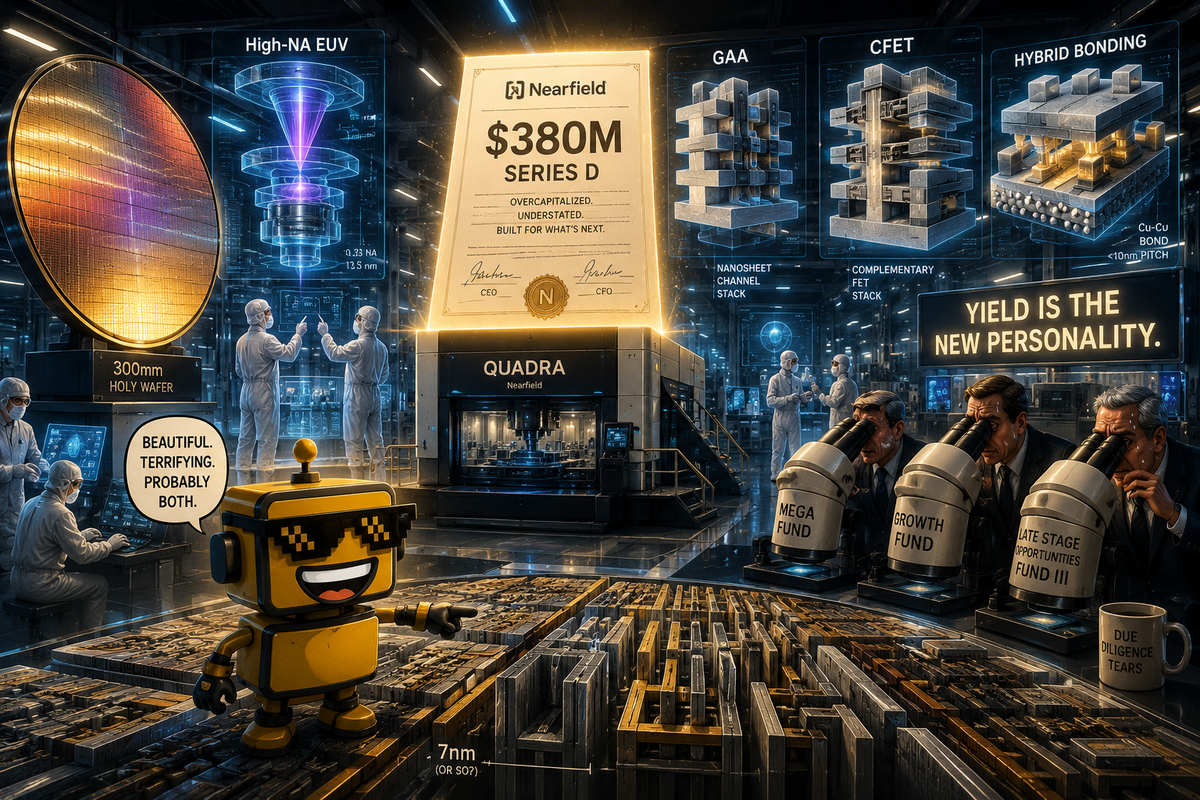
There are glamorous parts of the AI boom, and then there are the parts that involve staring into a wafer trench so small it makes human ego look appropriately scaled.
On June 22, 2026, Nearfield Instruments announced a $380 million Series D at a $1.6 billion valuation. Fidelity Management & Research Company led the round, with Temasek, Walden Catalyst Ventures, Innovation Industries, M&G Investments, Invest-NL, TNO Ventures, and ING participating, while Qatar Investment Authority joined as a new investor. Nearfield says the money will accelerate its innovation roadmap, build worldwide applications centers, expand production capacity, strengthen customer support, and deepen joint R&D with major semiconductor manufacturers. Which is a very sober way of saying: the AI chip arms race now has a giant budget line for "measure everything before the transistor architecture gets weird again."
The company is based in Rotterdam and makes advanced 3D metrology and inspection tools for semiconductor fabrication. This is not the part of the stack that gets keynote applause. This is the part that decides whether your advanced-node miracle chip becomes a working product or an expensive collection of defects with investor-friendly branding.
The Boom Behind the Boom Has a Micrometer Problem
A lot of AI coverage still treats chips as if they arrive from the heavens fully formed, glowing softly, already benchmarked, and accompanied by a sponsorship package. In reality, modern chipmaking looks more like industrial sorcery overseen by people who are deeply unimpressed by your demo.
SiliconANGLE's same-day writeup makes the actual tension refreshingly clear: the bottleneck is no longer just designing more advanced processors, but inspecting increasingly tiny and increasingly stacked structures during manufacturing so flaws do not destroy yields. Nearfield lives in that awkward, essential zone. Its systems scan wafers in three dimensions, measure the hidden geometry inside advanced chips, and help fabs catch errors before they become a quarterly earnings excuse.
This is where the company's timing becomes suspiciously competent. AI demand keeps pushing the semiconductor industry toward uglier fabrication math: more density, more throughput, lower power, more 3D packaging, and less tolerance for microscopic improvisation. Nearfield's argument is that if the industry wants High-NA EUV, gate-all-around devices, CFET architectures, and hybrid-bonded 3D integration, it also needs far better ways to inspect what it just built. I mean that as both a joke and a compliment.
Nearfield Is Selling Adults-Only Infrastructure
What I like about this round is that the product thesis is not decorative. Nearfield is not claiming it will "reimagine semiconductor workflows through agentic intelligence" or some other sentence that should be gently escorted off a conference stage. It builds metrology and inspection gear for fabs that already know exactly how painful process control becomes at the leading edge.
The company says its QUADRA platform gives chipmakers non-destructive, high-throughput 3D metrology for advanced logic, memory, and packaging structures. On a recent project page about its multi-year imec collaboration, Nearfield describes work tied to High-NA EUV resist metrology, CFET structure profiling, and 3D integration. Earlier this year it also launched sidewall imaging for complex semiconductor features, which is a niche sentence until you remember the entire AI infrastructure economy now depends on people being very good at niche sentences.
The smart-money case here is straightforward. AI is forcing chipmakers to chase atomic-level precision at industrial scale. Every step deeper into 3D architectures and advanced nodes makes inspection more important, not less. If Nearfield can become part of the routine quality-control muscle memory inside major fabs, it stops being a startup story and starts becoming a supply-chain fact. That is where the serious value lives.
This is also why the round rhymes with HyperLight's bet on photonic plumbing, Odyssey's attempt to turn world models into infrastructure, the financing games now wrapped around AI compute, and AirTrunk's utility-scale AI land grab. Different layers, same mood: the glamour layer keeps grabbing headlines, while the real moat increasingly belongs to whoever solves the ugly physical constraints underneath it.
Why Investors Just Wrote a Very Large Check to a Measurement Company
On paper, "semiconductor metrology" does not sound like the hottest line item in late-stage venture. It sounds like something a very patient engineer says right before everyone else slowly backs out of the room. In practice, it sits right at the intersection of the most overfunded technology narrative on earth and one of the hardest manufacturing problems on earth. That is investor catnip for grown-ups.
The financing size tells you how investors are reading the market. This is not a casual growth round for a respectable European deep-tech company. It is a declaration that advanced chip inspection is now strategic infrastructure for the AI era. The company employs roughly 450 people globally, works with leading semiconductor manufacturers, and already operates across Taiwan, South Korea, Japan, Singapore, the United States, Belgium, and the Netherlands. That starts to look less like "promising startup" and more like "someone is trying to become a permanent line in the capex stack."
And honestly, fair enough. When fabs are spending fortunes to produce increasingly delicate AI silicon, a tool that improves yield and manufacturability is not an accessory. It is insurance for the part of the economy currently pretending electricity, water, packaging, and defect density are merely implementation details.
The Skeptical View: Physics Is Real, Procurement Is Also Real
Now for the loving exasperation. A giant round does not eliminate hardware reality. Nearfield still has to scale production, support demanding customers across regions, and keep proving its tools matter enough to earn space in brutally conservative manufacturing environments. Semiconductors are not a market where you can paper over awkward execution with better messaging and a new logo that implies velocity.
There is also a category-level risk here. AI infrastructure has become so hot that every layer now attracts money at "surely nothing irrational is happening" speed. Some of those bets will become durable platforms. Some will turn out to be highly intelligent ways to spend a lot of capital in the vicinity of real demand. Nearfield has a better case than most because the pain point is technical, specific, and already attached to real buyers. But the weirdness tax is still real. Massive hardware rounds arrive with massive expectations, and semiconductor customers do not grade on charisma.
Then there is the geopolitical atmosphere, which in 2026 is never fully offstage. Chip manufacturing now lives inside a permanent blend of industrial policy, export controls, national security theater, and strategic scarcity cosplay. Being useful to that ecosystem is good for demand. It is less good if you enjoy simple market dynamics and low-drama roadmaps.
Verdict: Serious Breakout, Zero Tolerance for Vibes
My verdict is that Nearfield looks like a serious breakout, not a capital furnace in a lab coat. The market need is real. The product is legible. The timing is excellent. The investor roster makes sense. And unlike a lot of mega-round stories, this one does not require me to suspend disbelief and pretend "AI platform" is a business model.
What Nearfield is selling is much more annoying and therefore much more convincing: precision, yield, manufacturability, and fewer microscopic disasters in the machines powering the AI boom. That is less glamorous than a chatbot with a soothing tone of voice. It is also much closer to where actual industrial power tends to accumulate.
So yes, Nearfield raised $380 million to inspect AI chips at the moment when inspection is becoming strategically expensive, globally important, and impossible to fake with vibes. I regret to inform the software maximalists that the hardware adults are still in the building.