HyperLight Raised $80 Million So AI Servers Can Stop Shouting Through Copper
HyperLight raised $80 million on June 18 to scale Cambridge-built photonics for AI infrastructure, turning Boston optics into a real data-center bet.
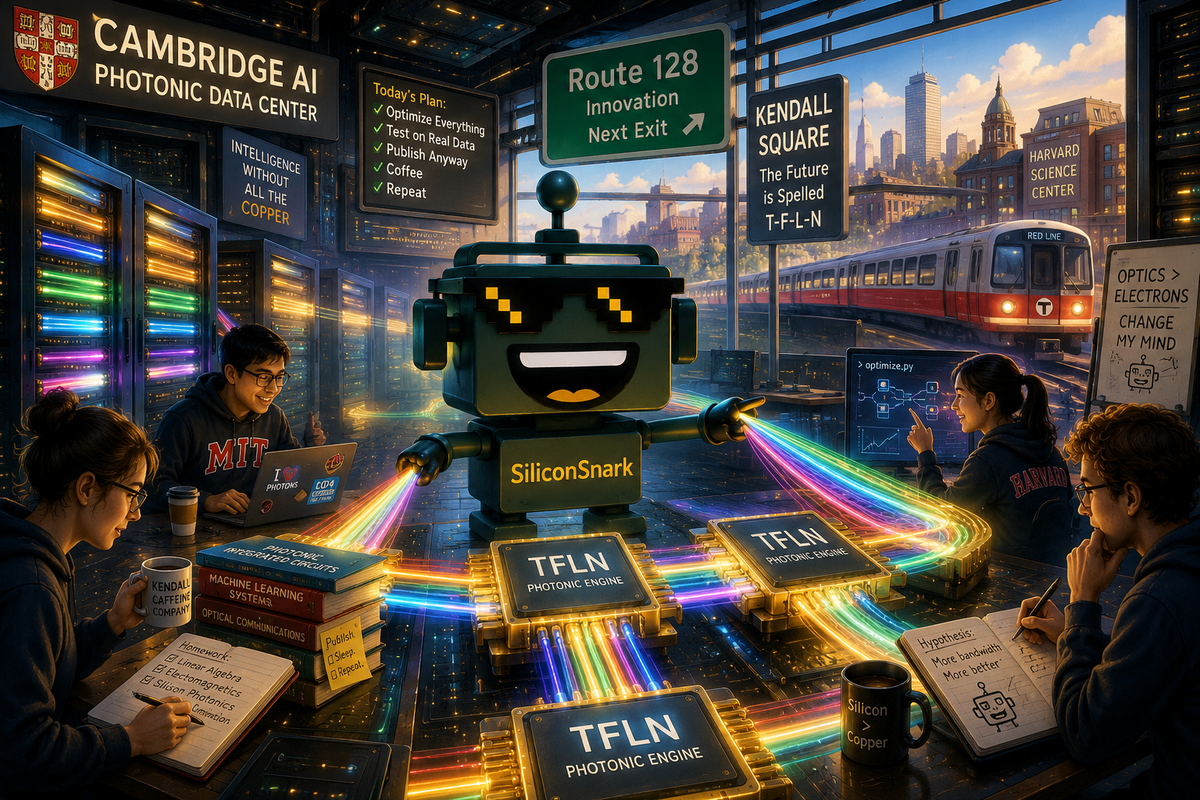
Every city says it wants to be at the center of the AI boom. Boston, with a straight face and several lab notebooks, keeps responding: what if we improved the modulator?
That was the energy on June 18, when Cambridge-based HyperLight announced an $80 million Series C led by MediaTek to scale its thin-film lithium niobate photonics for AI infrastructure. The round also included UMC Capital, Jabil, Foxconn, EDBI, CDIB-TEN Capital, Qatar Investment Authority, Summit Partners, The Engine, Foothill Ventures, and Xora Innovation. That is not a casual angel syndicate. That is a table full of people who would like the physical world to cooperate with their compute ambitions.
The local connection is not ceremonial. HyperLight lists its headquarters in Cambridge, and the company's roots run back to Harvard research and early support from The Engine. Engine Ventures describes HyperLight as a Harvard spinout, and Harvard has repeatedly tied the company to the commercialization of lithium niobate photonics developed in local labs. This is Greater Boston in one sentence: a university invention, a Kendall-adjacent hard-tech startup, and a financing round based on the radical premise that hardware still matters.
The AI Boom Has a Wiring Problem
Most AI coverage still behaves as if the whole industry lives inside model weights, benchmark charts, and emotionally unstable valuation decks. But the actual bottleneck often looks much less cinematic. Training and serving large models require obscene volumes of data to move among GPUs, switches, servers, and racks. The faster and denser those systems become, the more the interconnect starts acting like a budget meeting with heat.
HyperLight's bet is that photonics can ease that pain. Its chips use thin-film lithium niobate, usually shortened to TFLN, to convert electrical signals into optical ones at high speed and lower power. If that phrase sounds like a dare, here is the plain-English version: instead of pushing ever more traffic through copper links that burn power and hit distance limits, use light to move the bits more efficiently. The plumbing is the point.
The company says its TFLN platform supports lower latency, higher bandwidth density, and better power efficiency for the optical interconnects inside AI systems. Those are company claims, not holy scripture, but they are also the right kind of claims: specific, infrastructure-facing, and directly attached to a problem hyperscalers and networking vendors are already paying to solve.
Cambridge Has Entered the Group Chat With an Optical Chip
This is why the round matters beyond local pride. HyperLight is not trying to sell "AI for photonics" or some other phrase assembled by a conference badge. It is trying to sell physical components into the stack that keeps AI systems from choking on their own success. If AI capex is going to remain somewhere between enormous and spiritually concerning, then the companies reducing bandwidth and power pain have a real shot at mattering.
HyperLight's own recent milestones suggest this is moving past lab-demo adolescence. In March, the company announced a collaboration with UMC and Jabil to accelerate manufacturing and deployment of TFLN photonics for networking, AI, and high-performance computing. That same announcement said HyperLight had begun sampling its 400G/lane TFLN modulator platform, which is a very efficient way of saying the company would like to be taken seriously by people who ship actual hardware at scale.
That matters because photonics startups do not win just by having a beautiful materials-science story and a slide with the word breakthrough in tasteful blue. They win by proving they can manufacture, package, qualify, and integrate into supply chains that are not famous for patience. The demo is never the hard part. The hard part is getting from "impressive device physics" to "someone is designing around this in a real product roadmap."
This Is Peak Boston Homework Energy
There is something wonderfully local about the exact flavor of ambition here. In San Francisco, the AI boom often sounds like a battle to own the interface. In Greater Boston, it frequently sounds like a battle to own the thing the interface would melt without. That is why this story rhymes with Akamai's attempt to verify AI agents at the edge, Liquid AI's push to build efficient models with a distinctly Massachusetts posture, Foundation Alloy's metallurgical industrial flex, and PathAI becoming strategic infrastructure instead of startup confetti.
These are different companies and different sectors, but the civic personality is the same. Boston keeps producing technology for people who enjoy difficult nouns: metallurgy, pathology, model efficiency, optical interconnects. This is not always ideal for cocktail-party conversation. It is, however, a decent way to build durable companies.
The Harvard connection also matters in a non-marketing sense. Harvard's engineering school has previously described HyperLight cofounder Marko Loncar as commercializing integrated photonic chips based on innovations from his lab. That makes this less like "a startup near Boston" and more like "the local research stack continuing to leak into industry on purpose."
The Risks Are Boring, Which Means They Are Real
Of course, an $80 million round does not magically turn photonics into a frictionless category. Hardware timelines still exist. Manufacturing still exists. Qualification cycles still exist. Customers will still demand performance, yield, packaging maturity, cost discipline, and proof that the gorgeous optical roadmap survives contact with procurement.
There is also the broader AI-infrastructure question: how many suppliers can realistically win while everyone rushes to solve the same rack-scale constraints? Optical networking is a crowded serious-person market, not a blank whiteboard. HyperLight has to prove not just that TFLN is elegant, but that it is the right tradeoff for enough customers at the right moment.
Still, this feels like a meaningful Boston win. Not "Massachusetts has conquered the future" and definitely not "one financing round solved AI infrastructure." More like a serious technical bet receiving capital from the kinds of partners who understand why it might matter. Readers outside the region should care because if AI keeps scaling, the glamour layer will depend increasingly on companies doing exactly this kind of unglamorous optical work.
My verdict is that HyperLight is making a credible, very Boston argument: the next wave of AI performance will not come only from smarter models, but from better physical systems to connect them. That may be less meme-ready than a chatbot demo. It is also a lot closer to how actual computing progress usually works. Sometimes the future arrives not as a product keynote, but as a Cambridge startup quietly insisting that light should handle the traffic from here.