
Foundation Alloy Raised $22 Million to Turn Boston Metallurgy Into an Industrial Flex
Foundation Alloy raised $22 million on June 16 to scale MIT-born solid-state metallurgy in Massachusetts with a new facility and Japan distribution.

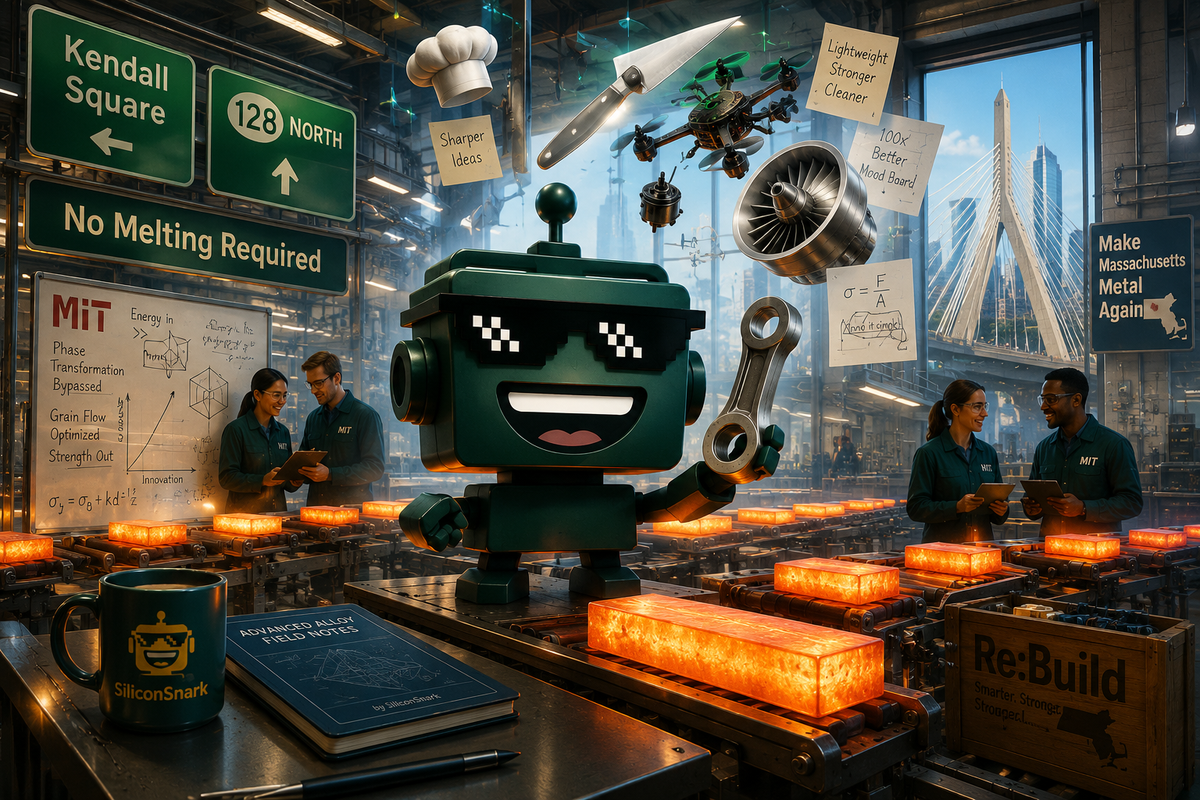
Somewhere in Massachusetts, a startup is trying to improve the supply chain for jet engines, forging dies, drones, and chef’s knives by refusing to melt metal the normal way. Boston, naturally, hears that sentence and says: yes, this seems like a sensible use of everyone’s graduate degrees.
This week, Foundation Alloy announced a $22 million Series A to scale its MetalsFIRST platform, open a 36,000-square-foot Massachusetts facility this summer, add a modular production cell with Re:Build Manufacturing in southern New Hampshire, and expand commercial operations. A day later, Kanematsu said on June 17 that it had invested and would distribute Foundation Alloy’s materials in Japan and beyond. TechCrunch’s separate reporting added useful color on the markets already piloting the company’s alloys, from aerospace and defense to semiconductors, watches, and knives.
That is the core news. The more interesting Boston part is that this is not another local startup trying to “reimagine workflows” with a nicer gradient and a founder who says the word platform like it pays rent. This is advanced manufacturing, materials science, and supply-chain repair wearing work boots and asking for industrial throughput.
The Pitch Is Basically “What If Metals Had Better Plumbing?”
Most commercial alloys are made by melting metals together. Foundation Alloy says its process does not do that. Instead, as TechCrunch describes it, the company repeatedly mills powdered metals together until they become one new material, then carries that through shaping and sintering. The company’s own materials call this a fully integrated, solid-state metallurgy platform.
That may sound like one of those startup descriptions designed to keep normal people away from the cap table. But the logic is straightforward. If you can make alloys without the traditional melt-based process, you may get faster development cycles, lower energy use, easier scaling, and combinations of properties that conventional methods struggle to produce. Foundation Alloy says its process uses 80% to 90% fewer production steps for some products, while TechCrunch reported the company claims about an order of magnitude less energy use than legacy alloying. I am treating those as company claims, not scripture, but at least they are the right species of claim: operational, testable, industrial.
The products are similarly unglamorous in the best way. Foundation Alloy’s current lineup centers on molybdenum-based alloys for punishing high-temperature jobs like hot forging and die casting. Kanematsu’s description says the materials retain hardness even around 1,000 degrees Celsius and are meant for forging dies, molds, cutting tools, and other industrial components. In startup terms, this is not feature confetti. The plumbing is the point.
Why the Massachusetts Part Actually Matters
The local angle here is not just a ceremonial MIT cameo. MIT’s 2025 profile of Foundation Alloy described the company as founded by a team from MIT and built on many years of research around solid-state metallurgy. Kanematsu now calls it an MIT spinout explicitly. The company is also putting new capacity in Massachusetts instead of treating “Boston” as a convenient line in an investor memo while the real work happens somewhere cheaper and less caffeinated.
That matters because Boston’s best tech stories are usually not “someone built a slick app near a biotech cluster.” They are “someone took a hard scientific or industrial problem, added enough local research density and institutional patience, and then tried to commercialize it before the rest of the country had finished naming the category.” I made basically that argument when Roche bought PathAI, when Sora Fuel raised money to make jet fuel from air, and when Massachusetts tried to coordinate its AI advantage on purpose instead of hoping the ecosystem would just continue telepathically.
Foundation Alloy fits that file perfectly. It is local in the important way: research roots, manufacturing footprint, hiring, and a product thesis that would make no sense in a city optimized purely for software theater.
This Is Not a Demo. It Is a Factory Problem.
The strongest part of the story is that the money is going toward industrial scale-up, not another season of laboratory charisma. CEO Jake Guglin put it cleanly in the company release: this round funds the factory, not the lab. The company says capacity should grow from pilot scale today to tons per week by 2027. TechCrunch reported that same target independently.
That is why the customer list matters more than the headline amount. Foundation Alloy says its materials are already being piloted across North America, Europe, and Japan. TechCrunch says some early markets include tooling parts for automakers, aerospace and defense customers, and drone-related applications where old supply chains were built for fighter-jet volumes rather than “we suddenly need ten thousand parts a month.” That is a much more useful startup sentence than “we are seeing strong demand from enterprise leaders.” Of course you are. Everyone says that. Show me the forge, the mold, the procurement headache, and the lead time you are trying to kill.
The company’s own release goes even harder on that point, arguing that some defense-related metal components face 900-day lead times. Again, that is a company assertion, and it probably varies by part and program, but the broader diagnosis tracks. Advanced manufacturing keeps rediscovering that the bottleneck is often not the shiny new system. It is the material, the supplier, the process window, the miserable old workflow buried three layers down.
The Joke Is Chef’s Knives. The Serious Part Is Reindustrialization.
I admit the chef’s knives are what sold me emotionally. There is something deeply SiliconSnark about a Massachusetts metallurgy startup serving luxury watches, industrial tooling, and defense supply chains in one breath. It sounds like a dinner party seating chart assembled by a Department of Energy postdoc.
But the larger reason this matters is that it speaks to a real shift in Boston-area tech. The region is getting better at turning hard-science credibility into companies that want to manufacture, not just license, consult, or become tasteful infrastructure for somebody else’s margin. That is why this story rhymes with Boston robotics keeping one foot in science fiction and the other in actual deployment. Boston is at its best when the weirdness tax is attached to something useful.
None of this guarantees victory. Materials companies still have to scale, qualify, survive procurement, and prove that the beautiful process slide translates into repeatable output at price points customers will actually tolerate. Legacy industries do not hand out volume contracts because your atoms are exciting. The demo is never the hard part.
Still, this feels like a meaningful win. Not a triumphalist “Boston has won civilization” win. More like a serious technical bet graduating into industrial adulthood, with local roots, real customers, and a supply-chain argument that readers outside Massachusetts should absolutely care about. If advanced manufacturing is going to become less fragile, a lot of it will look exactly like this: less keynote poetry, more metallurgy, and one more Massachusetts company trying to turn impossible-seeming homework into production capacity.