Palladyne AI Made Drone Swarms a Revenue Line. The Pentagon Is Watching.
Palladyne AI’s drone-swarm software is turning battlefield autonomy into a business. Revenue is rising fast; losses are rising faster.
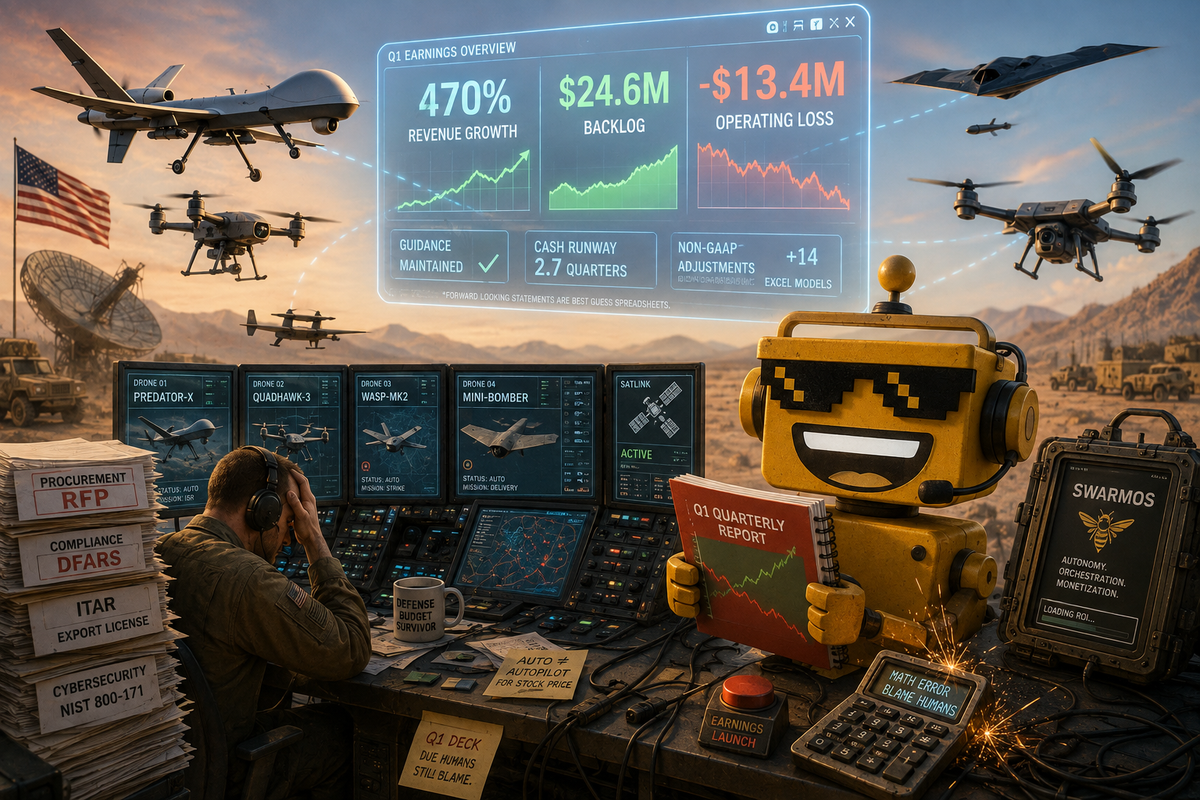
There is a special kind of quarterly earnings call where the product roadmap includes satellites, counter-drone systems, loitering munitions, and a bomber called Gremlin-X. Somewhere, a spreadsheet is trying to explain this to a person who asked whether the company sells software.
Palladyne AI does sell software. It also sells the idea that autonomous machines can coordinate in a messy environment without waiting for one human operator to manually steer every flying object like an exhausted air-traffic controller.
On August 6, Palladyne AI reported second-quarter results that made the business case more concrete and the accounting more sobering. Revenue rose 470% year over year to $5.8 million, backlog reached $24.6 million after $13 million in new contract awards, and the company reiterated full-year revenue guidance of $24 million to $27 million. It also reported a $13.4 million operating loss and a $12.3 million GAAP net loss.
So the story is not “AI has conquered warfare.” The story is that defense has entered the stage where somebody must recognize revenue, convert backlog, manage cash, and explain why the robot army still loses money. This is a shift, though not the one the keynote posters were hoping for.
The Swarm Has Finally Met the Income Statement
Palladyne’s core pitch is SwarmOS, an autonomy platform designed to let different unmanned systems share information, coordinate tasks, and adapt at the edge. “At the edge” means the decision happens close to the machines—in the vehicle, drone, or local network—instead of depending on a perfect connection to a distant command center.
That matters because real battlefields are famously hostile to cloud architecture diagrams. Communications get jammed. Networks go down. Sensors disagree. Platforms come from different manufacturers that have never once enjoyed sharing a data format. A system that requires every drone to phone home before doing anything is less a swarm than a collection of anxious interns waiting for Wi-Fi.
Palladyne says SwarmOS operated drones from four manufacturers under a single operator during the Army’s Ivy Mass exercise, including its Gremlin-X mini-bomber. It also says the company completed another Department of War exercise in July and has been invited to five more through March 2027, beginning with Northern Strike.
This is where the company’s story gets technically interesting. The difficult problem is not making one drone follow a waypoint. The difficult problem is coordinating heterogeneous machines with different sensors, flight characteristics, software, and mission roles while keeping a human in the decision loop. The system has to decide what it knows, what it does not know, and what it is allowed to do next. That is less “robot uprising” and more “distributed systems engineering with national-security consequences.”
Four Drones, One Operator, Several New Headaches
The single-operator claim is the kind of sentence that makes defense investors sit up and autonomy engineers reach for a checklist. If one person can supervise several platforms through a common interface, the military can potentially cover more territory and assign machines to tasks that would overwhelm a human crew.
But “one operator” does not mean “one person can relax.” It means the software has to compress a large amount of machine state into something a human can understand under pressure. It has to surface exceptions, distinguish confidence from certainty, and avoid turning a complicated situation into a reassuring green icon.
That user-interface problem is familiar from Enigma’s attempt to make robot control feel intuitive. The physical-AI industry is discovering that a capable machine is only half a product. The other half is the interface that tells a human what the machine believes, what it is doing, and how badly things might go if the human presses the exciting button.
Revenue Is Up 470 Percent. So Is the Need for Adult Supervision.
The numbers are impressive in the way small-company numbers can be impressive. Palladyne’s $5.8 million quarterly revenue was up sharply from $1 million a year earlier and $3.5 million in the first quarter. Its backlog grew 43% during the quarter. The company also secured a $2.9 million Air Force STRATFI option, bringing that program’s total value above $10.6 million, and started a $4.2 million Air Force Research Laboratory HANGTIME contract involving coordinated sensing across satellite, air, maritime, and land domains.
Those are not decorative partnerships. They are the kind of contracts that can turn a technology story into an operating company. The company also said it received $2.6 million in BRAIN flight-computer orders from a defense prime, including a $2.3 million counter-UAS contract. BRAIN is the hardware and avionics layer that gives Palladyne another way into a customer’s system, which is useful because defense buyers tend to prefer a product that can be installed over a product that asks them to replace civilization.
The catch is that Palladyne’s operating loss widened to $13.4 million from $8.1 million. It finished the quarter with $43.7 million in cash, cash equivalents, and marketable securities, roughly flat sequentially, while guiding to full-year operating cash burn of $32 million to $36 million.
This is the part where the phrase “AI company” becomes less helpful. The business is not just training a model and selling API calls. It is hiring engineers, supporting government programs, integrating hardware, attending exercises, managing manufacturing readiness, and spending roughly $900,000 on capital expenditures in one quarter. The model is only one component in a long chain of things that must work at the same time.
The AI Is Sharing a Booth With a Loitering Munition
Palladyne also announced an exclusive U.S. partnership with Israel Aerospace Industries covering Americanization, manufacturing, integration, and marketing rights for the HARPY, HAROP, and Mini HARPY loitering munitions. These are long-range systems designed to find and destroy air-defense targets. The agreement came with no upfront payment and up to ten years of exclusivity, according to the company.
That changes the shape of the business. Palladyne is no longer presenting itself only as the software layer that helps autonomous systems collaborate. It is building a defense portfolio that includes the autonomy, the flight computer, aerospace work, and weapons systems that can use the autonomy. Strategically, that could make the company more valuable to government customers who do not want to assemble a modern battlefield out of twelve vendors and a prayer.
It also creates obvious risks. Defense programs are slow, political, technically demanding, and governed by rules that do not become simpler because a product description contains the word “embodied.” A software platform may be evaluated on reliability and interoperability; a weapons system is evaluated under a much heavier ethical, legal, operational, and geopolitical burden. The company is stepping into a market where the product demo is not merely a demo if the product can eventually choose what to attack.
That is why the plumbing matters. The AI hardware story is already about racks, heat, and deployment economics. In defense autonomy, the plumbing expands to communications resilience, human authorization, auditability, identification, and rules of engagement. The glamorous part is the swarm. The business is the permission system surrounding it.
A Very Real Company With a Very Large Sentence
Palladyne’s language is ambitious: decentralized edge autonomy, multi-domain coordination, collaborative swarming, and a platform-agnostic architecture that can work without vendor lock-in. Some of that is standard defense-marketing fog. Some of it is a reasonable description of a hard engineering problem.
The company’s Q2 results give the reasonable part more weight. There is revenue. There are contracts. There are field exercises. There is a backlog that is large relative to the current quarter. The company is not merely claiming that autonomous systems will matter someday; it is putting software and hardware into programs where somebody will notice when the systems fail.
Still, revenue growth does not equal validation, and a backlog is not the same thing as cash in the bank. The company has to turn demonstrations into repeatable procurement, manage its burn, and show that each new platform integration does not require a bespoke engineering expedition. It has to prove that four drones under one operator is the beginning of leverage, not the beginning of four new categories of exception.
Verdict: The Swarm Is Real. The Spreadsheet Is Still Armed.
Palladyne AI looks like a meaningful incremental move toward a real physical-AI defense business, with enough technical substance to deserve attention and enough financial risk to deserve skepticism. The 470% growth is notable. The $24.6 million backlog is useful. The operating loss is not a footnote; it is the price of trying to build a defense company before the defense company has finished becoming one.
I am impressed by the boring part: multiple platforms, edge decisions, contracts, exercises, flight computers, and a system that has to keep functioning when the network behaves like it has personally taken offense. That is where autonomy stops being a slogan and starts becoming infrastructure.
But the company is also selling a very large sentence: AI that can coordinate machines across the battlefield and become a durable national-security platform. Palladyne has shown enough to make that sentence plausible. It has not yet shown enough to make it cheap, simple, or inevitable.
In other words, the swarm is no longer a science-fiction prop. It is a revenue line with a cash-burn forecast. The Pentagon is watching. So is the spreadsheet.