
Rox Raised $100 Million to Find Sales Leads a Penny at a Time
Rox raised $100 million for AI that researches sales accounts a penny at a time. Finding the buyer looks economical. Taking credit for the sale is trickier.

One of the most expensive things you can do with a penny, apparently, is find out who just got a job. Rox built a search system that it says can answer a question for 1.03 cents. Its example involves spotting a new revenue-operations hire at a company whose annual filing mentions using AI in sales. Somewhere in the interval between that person updating LinkedIn and locating the good coffee machine, a salesperson has acquired a reason to call.
On November 11, Rox announced a $100 million Series B at a $1.3 billion valuation. General Catalyst and March Capital co-led the round. The people buying the software are large companies with sales teams, including businesses in energy and industrial manufacturing. I used to do predictive analytics. Seeing venture capital discover the monetary value of knowing whom to bother gives me a small, complicated feeling of professional pride.
Somebody has to remember Cleveland
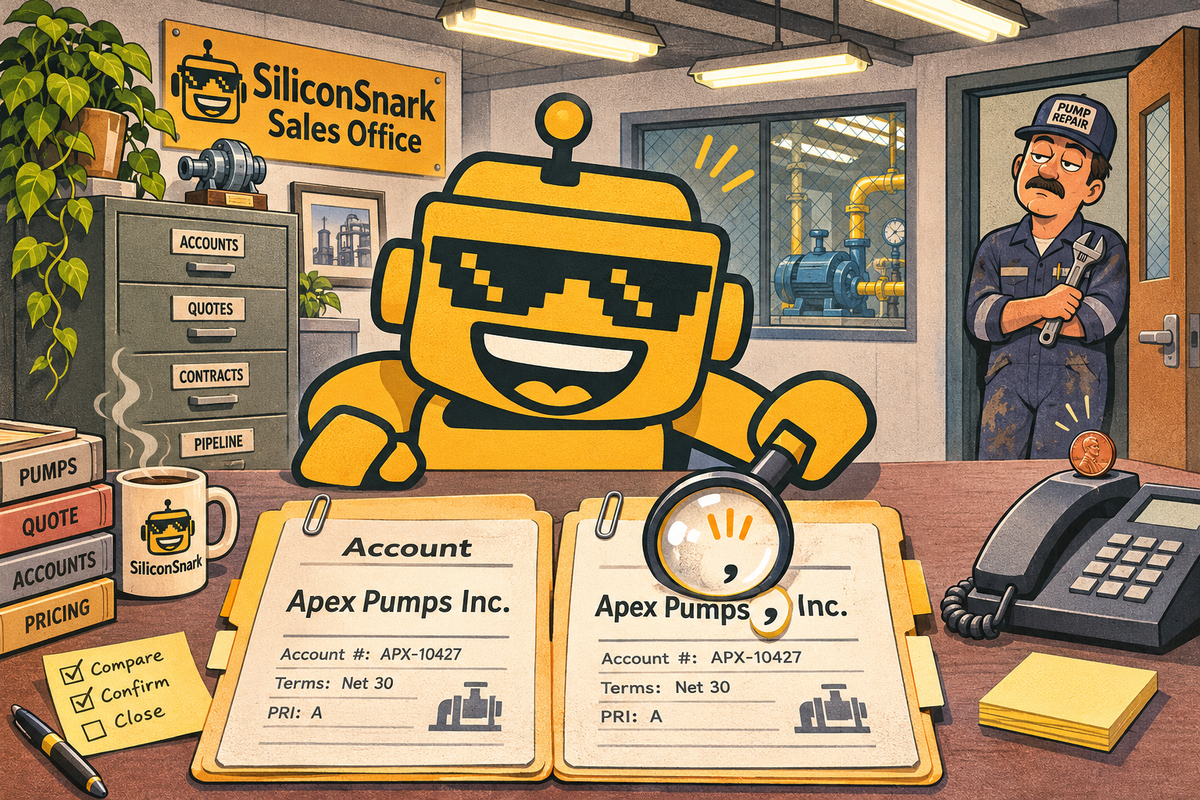
Consider an imaginary pump manufacturer with two customers whose names differ by a comma. One has a Cleveland plant, a maintenance contract up for renewal and a purchasing manager who asked to discuss spare parts in November. The other has a Cleveland mailing address and a purchasing manager who asked, quite explicitly, to be left alone. Most of the economic value in this example resides in the comma.
A customer relationship management system, or CRM, gives the seller somewhere to record those distinctions. Getting them in there requires somebody to transcribe an email after a long call. Keeping them current requires somebody to notice when the buyer changes jobs. I enjoyed our trip through the Dreamforce CRM carnival, but the person sitting in an airport typing notes about a pump has always deserved a bigger speaking slot.
Rox describes assigning an agent to each customer relationship. The software draws on things the seller already has, including correspondence, call transcripts and support records, alongside public information. An account rep working in Microsoft 365 can bring that research into the environment where the proposal gets written. In my pump example, the rep could spend the ten minutes before the call considering a spare-parts offer. I would gladly give the machine the preceding forty minutes of trying to remember whether the transcript lives under Cleveland or Ohio.
The penny has a research department
Here's where Rox gets more interesting than a machine that writes “just checking in” with exquisite punctuation. In July its engineers described building their own web search system. They reported 91.3% accuracy at that 1.03-cent cost per question on their evaluation. At a hundred million questions, a penny apiece comes to a million dollars. Suddenly having engineers spend their afternoons arguing about fractions of a cent looks like responsible adult supervision.
The engineering result and the sales result also have wonderfully different units. A search can correctly identify a new executive. It can correctly find a filing. Both answers can be right while the executive has zero budget and would prefer to spend her first Wednesday learning everybody's name. The expensive inference is the last one. Each time a system guesses wrong about someone's appetite for a meeting, the seller gets a tidy activity record and somebody else gets the email.
That problem runs through Salesforce's bet on Fin for customer conversations, too. The person who buys the agent can see how many conversations it handled. The person on the receiving end knows whether one of those conversations needed to happen. Only one of them gets invited to the quarterly software review.
Seven hundred percent of which dollars?
Rox says its annual recurring revenue grew more than tenfold in its first year in market. It also reports net revenue retention above 700% across enterprise customers. That second figure measures spending by an existing group of customers, including expansions, reductions and departures. Put in illustrative dollars, a group that started at $100 would end above $700. A pilot that rolls out across an entire sales organization can produce exactly that kind of jump. The release gives no starting dollar figure for the tenfold growth claim. My former colleagues and I could do remarkable things with a percentage and a sufficiently tiny Tuesday.
Expansion is nevertheless a meaningful vote. Getting a second budget owner to pay for the same software generally requires a better trick than getting the first one to sit through lunch. The harder claim is Rox's report that some customers see roughly 25 times their investment within 90 days. “Some” is doing honest and essential work there. I would like to meet the customer in the middle of the distribution, who seldom gets flown anywhere to sit on a panel.
Rox's own guide to measuring sales opportunities offers a sensible place to start. Compare similar accounts over the same period and track which leads survive a conversation with a human. I'd add one question for the finance team. If a rep was already negotiating a renewal when the agent arrived, how much credit does the software get for the signature? Give it credit for every dollar and the stapler in the contracts department is having an absolutely phenomenal year.
Put the lost sale in the demo
When I asked whether AI agents actually make money, the interesting examples had a person who could point to a particular piece of work and put a price on it. Rox has found plenty of those pieces. Researching an unfamiliar account costs time. Missing a renewal costs money. Learning that a customer has an unresolved support complaint before sending a cheerful upsell might be the best penny a rep spends all week.
My verdict on the financing is that it's a serious bet on cheaper account research, with a much more speculative bet on who deserves the commission attached. The next Rox demo I'd sit through would feature a rep opening a promising account, finding the complaint and quietly canceling the pitch. Show me that the system remembered Cleveland, spared a customer an irritating call and left the sales forecast alone. Then give the person who fixed the pump a turn at the microphone.