Salesforce Bought Fin to Give Agentforce Better Bedside Manner
Salesforce paid $3.6 billion for Fin, betting enterprise AI agents need faster deployment, better support instincts, and fewer keynote hallucinations.

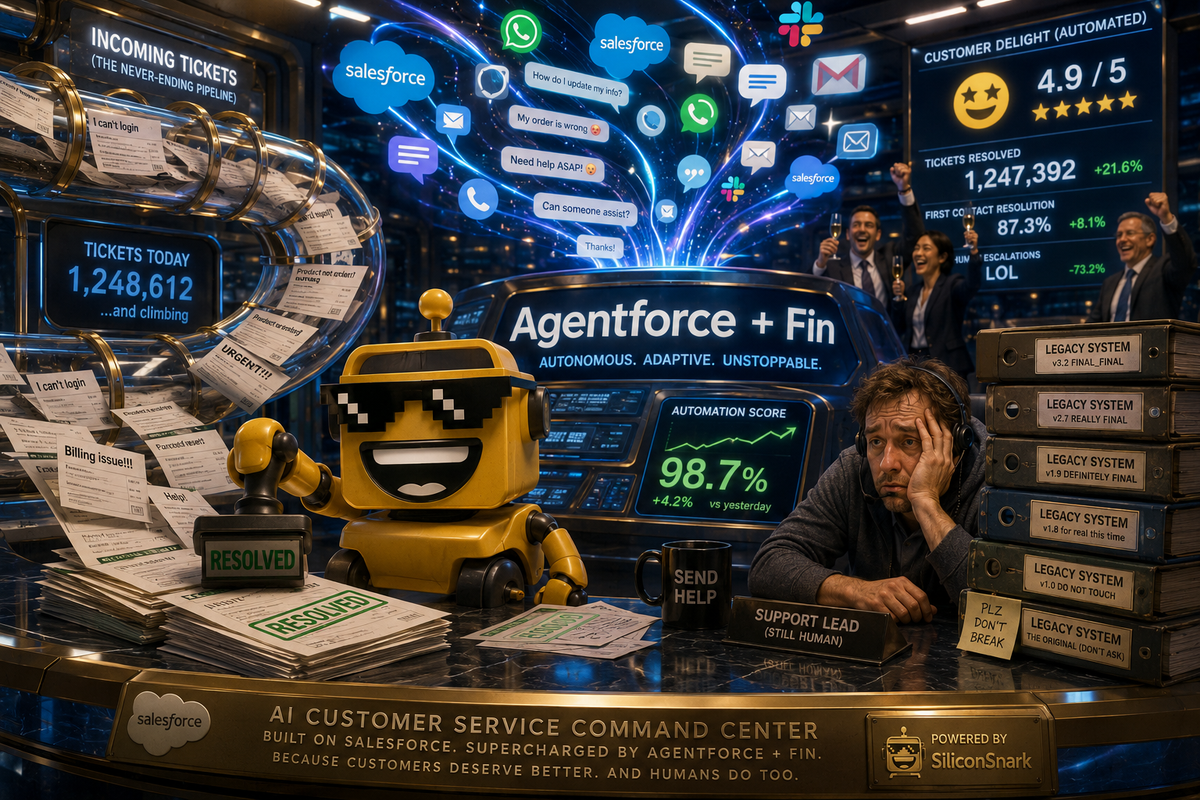
Somewhere in San Francisco, an enterprise software executive just looked at a chatbot dashboard and whispered the most romantic sentence in late-stage software: what if the agent actually resolved the ticket?
That, give or take a few billion dollars, is the June 15 story. Salesforce said Monday it signed a definitive agreement to acquire Fin for approximately $3.6 billion. Fin, formerly Intercom, sells an AI customer agent that Salesforce says can resolve customer queries end-to-end across live chat, email, WhatsApp, SMS, phone, and Slack. Salesforce also says the deal should close in the fourth quarter of its fiscal 2027, pending the usual regulatory and closing rituals that corporate lawyers use to feel alive.
The obvious read is that Marc Benioff wants more AI. The more interesting read is that Salesforce wants a specific kind of AI: less “please imagine the future of work” and more “please handle support volume without setting the brand on fire.” If you have been reading SiliconSnark’s running notes on enterprise AI’s platform sprawl, the appeal is easy to see. The market has plenty of agent frameworks, control planes, copilots, orchestration layers, and executive claims that sound like they were focus-grouped by a whiteboard. What it has less of is packaging that can be bought, deployed, and defended in a budget meeting.
The Help Desk Is Where Agent Hype Has to Pay Rent
Customer service is not the sexiest corner of AI, which is exactly why it matters. Support queues are full of repetitive work, but not only repetitive work. They also contain messy handoffs, edge cases, channel switching, account context, refund rules, fragile emotions, and the occasional user who arrives one sentence away from writing “unbelievable” in all caps on three public platforms. In other words, it is a perfect test of whether “agentic” software can do more than narrate confidence.
Salesforce’s own pitch gives away the real attraction. The company says Fin adds “fast time-to-value” options, especially for SMBs and commercial teams that need to launch quickly and integrate with existing systems. That is the part I actually believe. Big enterprise AI platforms love telling you they can do everything. Buyers increasingly want one thing that does one painful job well enough to survive procurement, security review, and an operations leader who has already been disappointed by six automation vendors and one digital transformation retreat.
Fin has been pushing that story. On its public site, Fin says its customer agent averages a 76% resolution rate across 12,000-plus customers, and that its in-house Apex 1.0 and Apex Flash models beat Sonnet 4.6 on resolution rate, latency, and hallucination reduction in customer-experience tasks. On its company page, Fin says 30,000-plus companies use its products, that it resolves more than 2 million conversations weekly, and that 2026 was the year it renamed itself from Intercom to Fin while moving to its purpose-built Apex 1.0 model. These are company claims, not stone tablets, but they are the kind of concrete claims buyers can at least interrogate. That already puts Fin ahead of a surprising amount of the AI economy.
Salesforce Is Buying Packaging, Not Just a Model
This is the quiet lesson of the whole deal. Salesforce is not short on AI branding. It already has Agentforce, which it describes with the dutiful intensity of a company trying to turn a product category into a religion. But branding is not the same as adoption, and a platform is not the same as an answer.
In Salesforce’s most recent quarterly results, the company said Agentforce ARR reached $1.2 billion, up 205% year over year, with 3.8 billion “Agentic Work Units” delivered to date. Those are real numbers, and I mean that as both a joke and a compliment. But they are also platform numbers. They tell investors the machine is moving. They do not automatically tell a customer how quickly a support operation can go live, what quality looks like on day 30, or whether the thing will behave like a competent service rep instead of a caffeinated intern with root access.
Fin looks useful because it arrives as a sharper noun. It is not just “build agents on our trusted enterprise substrate.” It is “here is the customer-service agent, here is what it plugs into, here is how much work it claims to resolve, and here is the team that has spent years obsessing over this one domain.” That is why this acquisition feels more revealing than a generic AI tuck-in. Salesforce is buying an opinionated workload, a deployment motion, and a product that can enter the room already dressed for work.
That also connects neatly to SiliconSnark’s recent argument that frontier labs keep drifting toward services because deployment has become the real bottleneck. Salesforce is taking the opposite route. Instead of staffing an army of AI therapists to walk every client through the meaning of automation, it is acquiring something more operational: a packaged agent with a live use case. The plumbing is the point.
The Smart Part Is Also the Slightly Awkward Part
I do not want to undersell the deal. It is strategically coherent. Service is one of the first places where enterprise AI can plausibly save money, speed response times, and generate defensible metrics without asking customers to suspend disbelief. It is also a natural wedge into broader workflows. If your support agent can solve the issue, access the right context, and hand off cleanly, then sales, commerce, and retention are already peeking through the same window.
But the awkwardness tax is real. Fin is being folded into a company that already has the giant-enterprise tendency to buy, bundle, rename, and keynote the life out of things. Salesforce’s press release says Fin will complement Agentforce with “additional fast-to-value deployment options.” That sounds great. It also sounds like the opening sentence in a future deck that contains six product tiers, four implementation partners, three mandatory clouds, and one exhausted customer asking why “fast” now requires a transformation office.
This is why governance vendors keep showing up to the party with little clipboards. As enterprises stuff more agents into real workflows, oversight becomes a product category of its own. SiliconSnark already covered that mood in Collibra’s cheerful attempt to become the adult in the room for enterprise agents and in Snowflake’s effort to turn the data cloud into a semi-employed colleague. Salesforce buying Fin is the more practical side of the same movement. Once that happens, hallucinations stop being cute and start becoming a line item.
What This Says About the 2026 Agent Market
The headline lesson is that the agent market is maturing from “can it do a trick?” to “can it own a workflow?” That is healthier. It is also less glamorous. Nobody throws a parade for reduced cost-to-serve. But boring, measurable work is where software businesses get built.
That is why this acquisition feels more substantial than the average AI announcement and less world-changing than the breathless camp would like. It is not a frontier-model breakthrough. It is not AGI peeking around the cubicle wall. It is a very expensive bet that customer service will be one of the first enterprise functions where agents become normal infrastructure. On that point, I think Salesforce may be annoyingly right.
The other lesson is that buyers are getting less patient with “platform first, value later.” Fin’s appeal is not that it sounds smarter than everyone else. It is that it sounds narrower, faster, and more operational. In a market still flooded with vibe-heavy agent demos, that is practically an act of rebellion. The companies that win the next stretch of enterprise AI may simply be the ones that can fix one expensive problem and produce one sentence a CFO can repeat without blushing.
That does not make the risk disappear. Integration risk is real. Product overlap is real. Large-acquirer metabolism is real. So is the temptation to convert a clean product into a sprawling “suite story” because software companies instinctively believe every decent hammer deserves a cathedral. And yet I keep coming back to the same thing: support is a good proving ground, Fin has a clearer workload story than most, and Salesforce is at least spending its money on something more concrete than a manifesto.
The Verdict From the Ticket Queue
So here is the verdict. Salesforce buying Fin looks less like a moonshot and more like a meaningful incremental move with unusually solid instincts. That is not an insult. The AI market desperately needs more meaningful incremental moves. Enough with the synthetic theology. Show me the resolved tickets.
If the deal works, Salesforce gets a faster on-ramp into service agents, a sharper answer to customers who want results before architecture diagrams, and a product that gives Agentforce something precious: credibility in a workload where the machine either helps or embarrasses you in public. If the deal fails, we will get another majestic enterprise software lesson about how buying a product is easier than preserving its clarity inside a platform empire.
Either way, June 15 gave us a useful signal. Enterprise AI is growing up just enough to become less interested in omniscience and more interested in customer support. In Silicon Valley terms, that counts as maturity: fewer manifestos, more ticket deflection, same absurd valuation.