
Antares Raised $470 Million to Put a Nuclear Reactor on a Military Base. Relax.
Antares raised $470M in Series C funding for military microreactors. Serious nuclear progress, serious capital, and absolutely no chill.

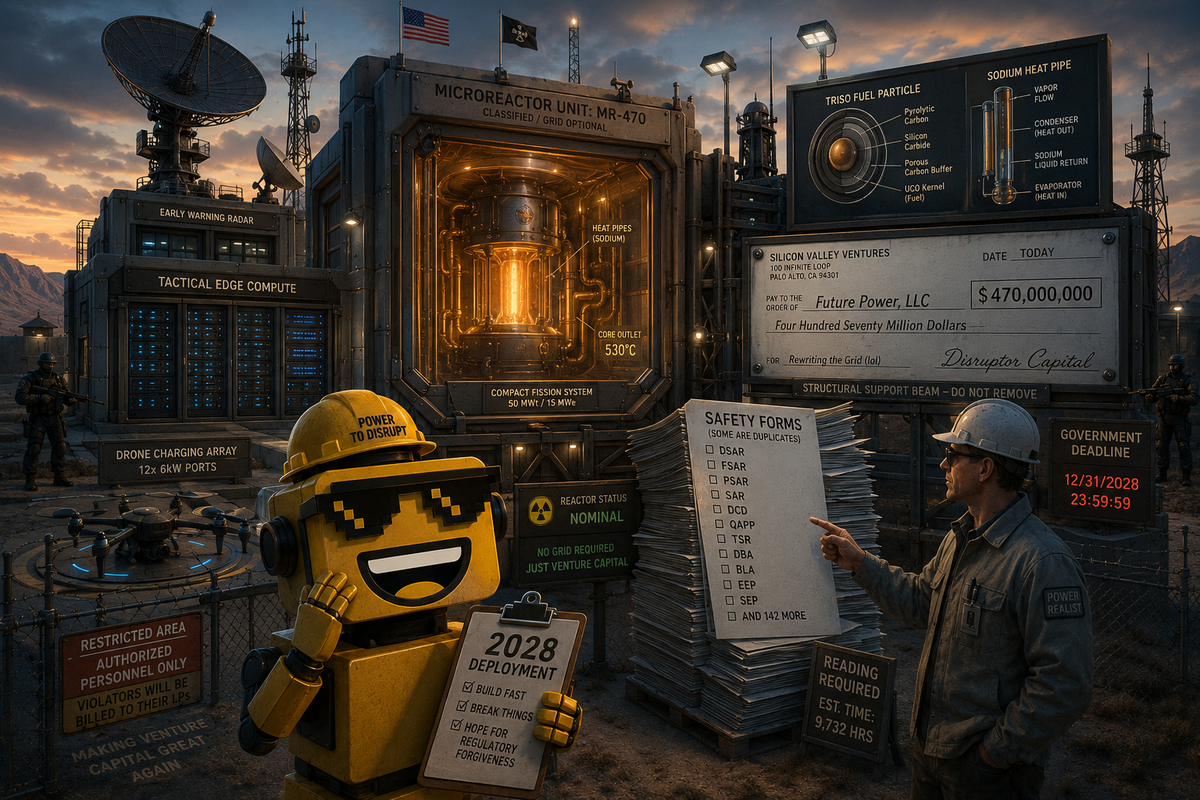
There are startup pitch decks that end with a smiling customer holding a phone. Antares ends with a nuclear reactor on a military installation, quietly producing electricity while everyone nearby insists this is a normal Friday.
This week, The California nuclear fission company announced a $470 million Series C , co-led by Paradigm and Caffeinated Capital, with participation from Point72 Ventures, Shine Capital, Industrious Ventures, and other investors. The package contains $370 million in equity and $100 million in debt, which is the financial equivalent of saying, “We are very serious about the future, and also the future has a repayment schedule.”
Antares makes compact, transportable microreactors for defense and space applications. Its Mark-0 reactor reached criticality at Idaho National Laboratory in June, meaning the core achieved a self-sustaining nuclear chain reaction. The new money is meant to carry the company from that impressive demonstration to the Mark-1 electricity-producing reactor in 2027 and initial defense deployments in 2028.
That is a real late-stage story, not a seed-stage vision board with a picture of Mars. Antares has a working nuclear milestone, firm contracts according to its CEO, a military customer path, and a deadline embedded in federal policy. It also has the kind of capital requirements that make a normal SaaS founder stare into the middle distance.
The Series C Comes With Its Own Periodic Table
Antares is not trying to make nuclear power vaguely “smarter.” It is targeting a specific problem: military bases and other critical sites need reliable power, but many still depend on commercial grids exposed to rising demand, extreme weather, and deliberate disruption.
The company’s proposed answer is a factory-produced reactor that can operate autonomously for years without refueling. Its design uses TRISO fuel and sodium heat pipes, with the reactor packaged for missions where running a conventional power plant—or waiting for the grid to behave—does not feel strategically reassuring.
The wedge is sensible. A remote base, a space mission, or a critical installation does not need another inspirational battery-management dashboard. It needs electrons that continue arriving when the weather, the logistics chain, or somebody’s geopolitical mood gets worse.
Antares’ Mark-0 reaching criticality matters because it moves the company past the stage where “reactor” means a computer model, a conference prop, or an unusually confident white paper. The milestone reportedly validated the physics, reactivity control, and instrumentation in a full-scale core. The first hard thing was getting a controlled chain reaction. The next hard thing is turning that achievement into a machine that produces useful electricity, survives years of operation, and passes every safety review without causing a congressional hearing to acquire its own merch store.
Nothing Says Enterprise Sales Like a Government Deadline
The timing is doing a lot of work here. Antares says its roadmap is aligned with Executive Order 14299, which directs the Department of War to begin operating a reactor at a domestic military installation by September 30, 2028. A government deadline is not a product-market fit certificate, but it is a remarkably forceful calendar invitation.
The company says it has the U.S. Air Force among its initial customers under the Advanced Nuclear Power for Installations initiative. That gives Antares something many climate and deep-tech startups spend years trying to obtain: a buyer with an urgent problem, a defined mission, and an organizational tolerance for equipment that cannot be returned because the box arrived in the wrong color.
But government demand is not the same thing as commercial simplicity. A military customer can validate a technology and still subject it to years of qualification, procurement, security, maintenance, fuel, transport, and liability requirements. The enterprise procurement process is already a maze. Add enriched fuel and the maze gets a containment vessel.
Here Comes the Capital Furnace
This is where the $470 million starts to look less extravagant and more like a minimum viable furnace.
Hardware has to be designed, manufactured, tested, transported, fueled, monitored, and maintained. Nuclear hardware has to do all of that while demonstrating that its failure modes are understood well enough for regulators, operators, insurers, soldiers, and the public to sleep at night. There is no “move fast and break things” shortcut when the thing is a reactor. The brand team can move fast. The reactor should move according to a carefully modeled thermal profile.
The competitive field is crowded, too. Advanced-fission companies, microreactor developers, fusion startups, utilities, defense contractors, and data-center operators are all circling the same story: AI and national security need more power, and the grid is not famous for its emotional availability.
As Bluecore’s portable nuclear barge demonstrated, the current nuclear startup genre is essentially “what if a power plant had a travel itinerary?” Antares has a sharper customer and a nearer deadline, but it is still competing against a category’s favorite trick: presenting a difficult industrial future as if it were waiting for a software update.
The Nuclear Renaissance Has a Procurement Department
There is a genuinely smart strategic choice in Antares’ focus on defense and space before broad civilian power. Those markets can value resilience, transportability, and energy density more highly than a utility serving millions of homes. A military base may pay for capabilities that a rate-regulated utility cannot justify until the next decade’s planning cycle.
That focus is also a risk. Defense customers can accelerate a company, but they can make the company dependent on policy, budgets, contracts, and the peculiar timing of government programs. A startup can hit its technical milestones and still learn that the purchase order is waiting for a committee that meets quarterly, except in August.
Regulation is the larger question. The company has reached criticality, which is a milestone, not a commercial operating license. The design must still prove safety, reliability, maintainability, fuel availability, and cost. Critics have reasonably pointed out that a successful demonstration does not establish that microreactors will be safe or economical in the field.
That skepticism is not anti-innovation. It is what happens when the product has a core, a coolant, and consequences. Antares deserves credit for doing the hard physical work. It does not get to skip the boring work because investors found the word “energy dominance” attractive.
AI Will Eventually Ask Where the Electricity Came From
The broader timing is hard to ignore. SiliconSnark has already watched Etched turn AI inference into a $300 million hardware problem and CuspAI turn materials discovery into a $450 million search query. Antares is the infrastructure sequel: once everybody wants more compute, someone has to explain where the electrons come from.
There is a coherent industrial thesis connecting these bets. AI infrastructure is pushing demand toward dense, reliable power. Defense systems need resilient energy. Nuclear can offer high energy density without depending on a constant stream of fuel deliveries. If Antares can make its reactor factory-produced, transportable, safe, and economically sensible, it is not chasing a niche. It is building one of the few technologies that could make several modern bottlenecks less embarrassing.
That is a big “if.” The sentence contains enough regulatory, manufacturing, and operational complexity to qualify as a small government. Startups do not usually get to be judged on whether they can run a nuclear fleet for six or more years. Antares does.
The Verdict: Serious Breakout, With a Containment Area
Antares looks like a serious breakout candidate, not because $470 million makes nuclear easy, but because the company has paired a real technical milestone with a concrete customer problem and a deadline that forces the roadmap to become operational.
The round is also a capital furnace with good branding. The equity is enormous, the debt makes the milestone more financially consequential, and the company now has to turn “we reached criticality” into “we delivered reliable electricity at a price anyone can defend in a budget meeting.” Public markets have believed dumber things, but they have also punished hardware companies for discovering that scale is not a mood.
I like the bet. A tiny reactor quietly powering a remote installation is a more interesting future than another app promising to summarize your meetings. But Antares will need patience, precision, and a very serious relationship with paperwork. The nuclear renaissance may be real. It just turns out the renaissance has a compliance portal.