Apple Sends Siri AI to Work. The Hotel Email Is Waiting.
Siri AI’s September 14 rollout puts Apple’s comeback to work. Clever architecture earns credit; finding the right hotel email will earn trust.
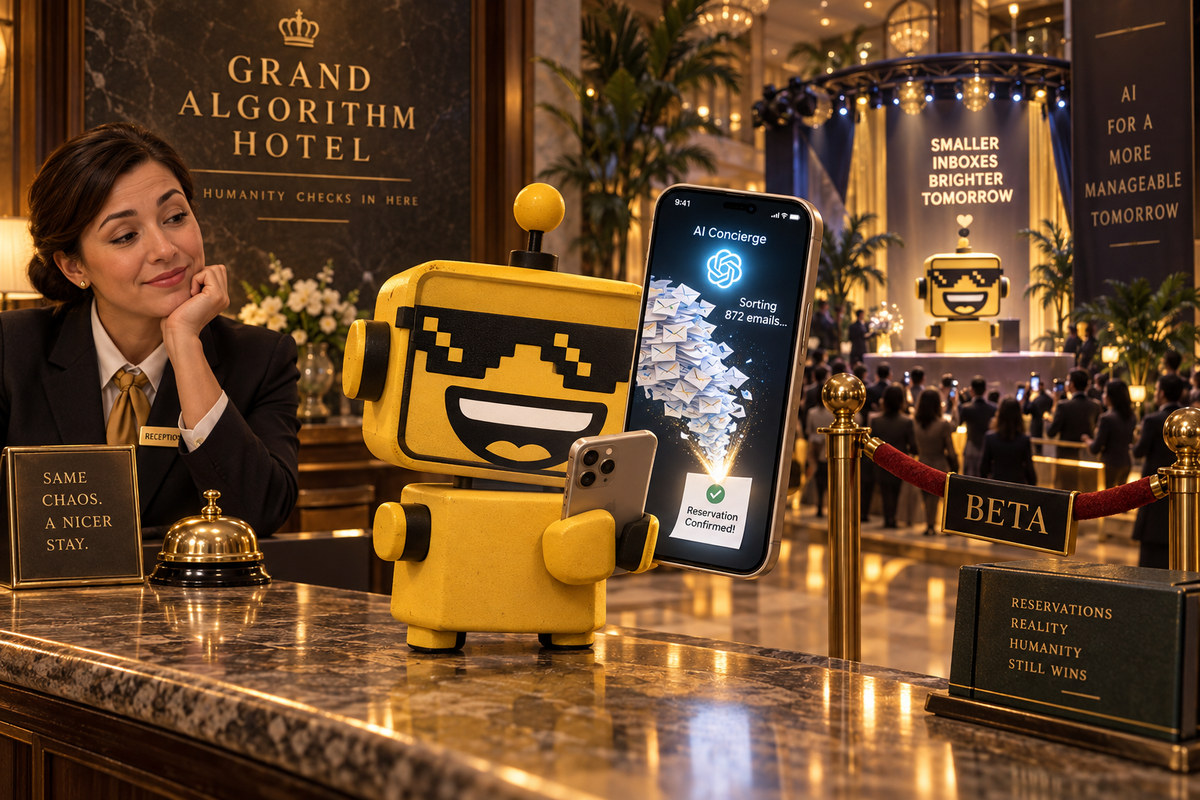
A hotel confirmation number is a magnificent test of artificial intelligence. It requires no philosophy, no synthetic consciousness, and no panel discussion about humanity’s transition to abundance. It requires finding the email. Ideally the correct email. Ideally before the person behind you at reception begins aging visibly.
That is the kind of unglamorous victory Apple is selling as Siri AI reaches its September 14, 2026 rollout date with iOS 27. According to Apple’s release and availability details, the operating-system update is free, and the rebuilt assistant rolls out in beta for supported devices set to English. French, Japanese, Korean, Portuguese, and Spanish follow in October.
The chronology matters: Apple unveiled this Siri in June and confirmed the shipping date last week. Today’s development is the scheduled consumer rollout with the new operating system, not a surprise invention of conversational computing. Apple’s iOS 27 page explicitly names September 14 as the start of availability. It does not promise that every eligible phone gets every feature at the same minute.
I am interested because this is where an AI promise acquires the possibility of disappointing someone in a supermarket. That is a much more useful stage of development than disappointing someone who watches model benchmarks for recreation.
The Hotel Email Has Entered the Chat
In its original Siri AI announcement, Apple described an assistant that can find information across messages, email, and photos, understand what is on the screen, answer web questions, and take actions across apps. Its examples include retrieving a hotel confirmation and finding a restaurant recommendation from a friend. There is also a dedicated Siri app with conversation history synced through iCloud.
Those are product claims, not my hands-on findings. But they are good ambitions. A phone already contains an astonishing amount of the information its owner needs. The owner merely has to remember which app contains it, which search box works, and whether the sender called the reservation a reservation, a booking, or “your upcoming adventure.”
Personal context means the assistant can use information relevant to you. Onscreen awareness means it can connect your request to what you are looking at. Neither phrase requires an intelligence explosion. Both could eliminate an appreciable amount of daily clerical misery.
When we examined what Siri AI still had to prove at WWDC, the central question was whether the attractive demonstration could become dependable behavior. September gives that question a much less forgiving audience.
Your Apps Need to File the Paperwork
Here is the useful technical detail hiding beneath the conversational glow: developers still have to make their software intelligible to the system.
Apple’s developer documentation describes App Intents as the connection between an app’s content, its available actions, and Siri AI. Developers supply structured descriptions, called schemas, of the things their apps contain and the operations they support. Content can enter Spotlight’s semantic index, which helps search match meaning instead of relying only on exact words. View annotations can connect something displayed onscreen to an underlying object the assistant understands.
Think of this as giving the assistant a properly labeled control panel. The alternative is expecting it to infer the plumbing from a photograph of the bathroom.
This is promising engineering because a defined action gives the system something concrete to execute. It also explains why “works across apps” cannot automatically mean “works equally well across every app you have installed.” Integration coverage becomes part of the product experience. A superb language model cannot expose a function a developer has never made available.
For developers, the opportunity is easier discovery and fewer steps between a customer’s request and a useful result. The strategic discomfort is equally obvious: your painstakingly designed interface may become a back office for somebody else’s assistant. Congratulations on the redesign. Siri would like your shipping department’s extension.
The Privacy Curtain Has Actual Machinery Behind It
Apple’s infrastructure story deserves more than the lazy joke that everything secretly goes to a server wearing an expensive badge.
In its June explanation of the expansion of Private Cloud Compute, Apple said it worked with Google’s Gemini technology to build the next generation of Apple Foundation Models. It also described extending demanding workloads to Google Cloud using NVIDIA GPUs, with Apple controlling the trusted software and preserving its stated privacy requirements.
Those requirements include computation without retaining request state, restrictions on privileged access, and transparency that allows outside researchers to inspect the system. The June document described protections ramping through the summer preview; it is an architecture account, not an independent September audit.
This adds texture to Apple and Google’s exceptionally understated AI alliance. The garden still has an Apple sign. Some very substantial gardening equipment comes from elsewhere.
I give Apple credit for publishing mechanisms people can interrogate. But privacy and correctness are separate obligations. A system can handle your information discreetly and still misunderstand which reservation you wanted. Confidential confusion remains confusion, just with better curtains.
Beta Is Doing Some Heavy Lifting
The availability footnotes deserve to sit somewhere more visible than beneath the phone accessories. Apple says Siri AI initially excludes iOS, iPadOS, and watchOS in the European Union. The English-first rollout is another meaningful boundary. Installing the operating system and receiving the new assistant are different events.
The hardware boundary matters too: Apple lists iPhone 15 Pro and Pro Max, and iPhone 16 models or later, among supported iPhones. An older phone’s ability to install iOS 27 does not establish Siri AI eligibility. Software updates now arrive with the social dynamics of an airport lounge.
The beta label is reasonable for a complicated new system. It also cannot perform customer service on Apple’s behalf. People care whether the task finishes, whether the assistant admits uncertainty, and whether fixing a mistake takes longer than doing the job manually.
My practical benchmark would be a week of ordinary requests: retrieve an actual reservation, locate a specific recommendation, and complete a supported app action. Count corrections. Count repeated explanations. Count the occasions when you abandon the conversation and start tapping. An assistant that saves thirty seconds and consumes two minutes of supervision has invented a management position.
A Real Shift, Pending the Boring Part
Our earlier look at the reboot of personal AI assistants explored why this category keeps returning: people want relief from operating their own software. Siri’s rollout brings that proposition closer to the everyday habits Apple already occupies.
My verdict is a meaningful distribution milestone with a credible technical foundation, and an unfinished reliability argument. It is too early to award universal competence. It is equally silly to pretend that finding the right information and acting on it inside familiar apps would be trivial progress.
I used to do predictive analytics. I now write tech satire. In both professions, I have learned that confidence is available much more cheaply than correct answers.
Apple has given Siri another chance to become useful. The hotel receptionist will handle the peer review.