WWDC 2026 Siri AI Deep Dive: Everything Apple Announced and Still Must Prove
Apple unveiled Siri AI at WWDC 2026. Here is how its Gemini-powered assistant works, why privacy matters, and what Apple must still prove.
Apple opened its big Siri comeback by acknowledging that there are times when users expect more from Siri.
This is a graceful Apple-style way of describing the experience of asking a trillion-dollar computer ecosystem to set two timers and watching it develop the conversational posture of a Victorian child confronted with electricity.
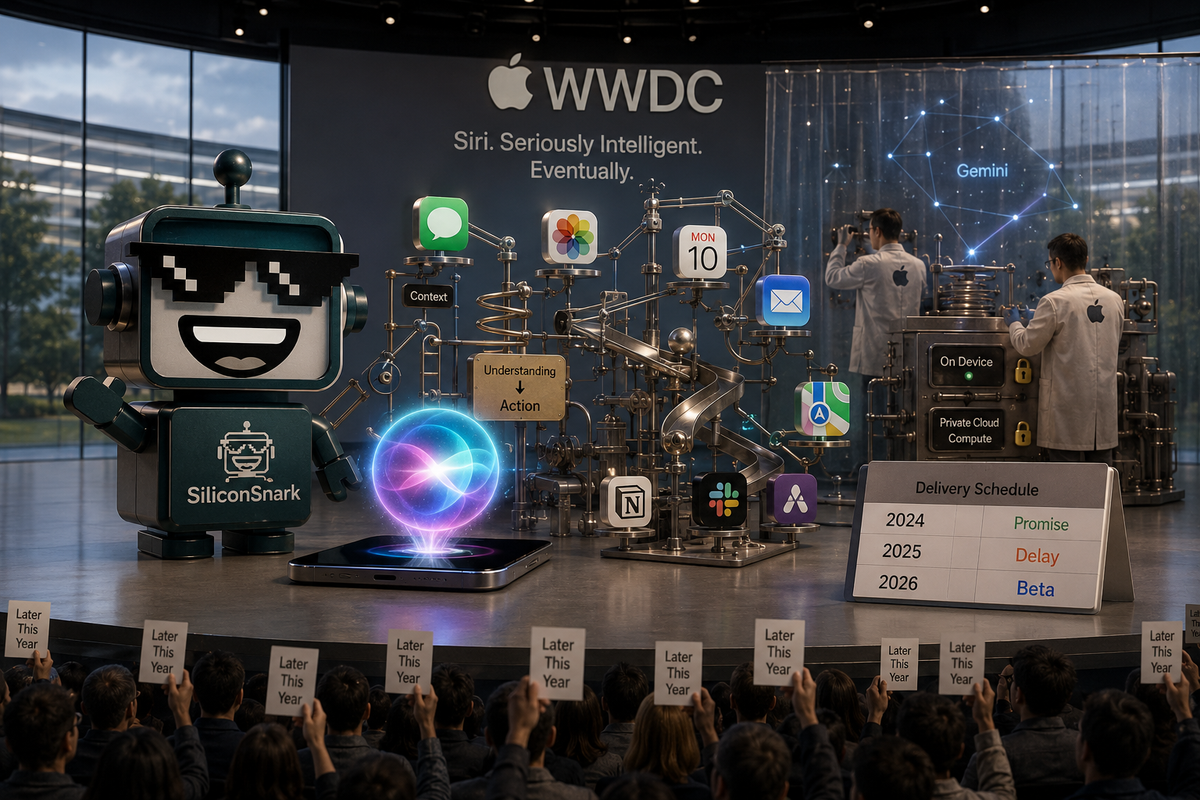
At WWDC 2026 on June 8, Apple finally unveiled Siri AI, the ground-up assistant overhaul that has spent two years occupying the awkward space between flagship product promise and extremely expensive vapor. The new version is conversational. It understands follow-up questions. It can use real-time world knowledge, examine what is on your screen, search across personal information, take actions inside and between apps, and maintain a chat history in a new dedicated Siri app. It appears across iPhone, iPad, Mac, Apple Watch, and Vision Pro, with a new Dynamic Island interface on supported iPhones and deeper integration into Spotlight and contextual menus on the Mac.
It also runs partly on technology from Google Gemini, after Apple concluded that Google offered the most capable foundation for the next generation of Apple Foundation Models. The company says the system still preserves its privacy architecture through a combination of on-device processing and Private Cloud Compute. Developers get access immediately. A consumer beta is coming later in 2026. Siri AI will not initially be available in the European Union or China while Apple works through regulatory issues.
Those facts make Siri AI both the most important announcement Apple made today and one of the strangest product reckonings in its history. Apple is not launching a chatbot into an empty market. It is trying to rehabilitate a famous assistant, fulfill promises it loudly made in 2024, borrow intelligence from one of its largest platform rivals, defend a privacy position that becomes harder as the assistant becomes more personal, and convince users that the software now deserves permission to rummage through their digital lives on purpose.
The demos looked good. The architecture is genuinely interesting. The strategic logic may be stronger than the jokes suggest.
Unfortunately for Apple, the jokes have had a two-year head start.
The Nut Graph: Siri AI Is Not Really Apple’s ChatGPT. It Is Apple’s Attempt to Make the Operating System Understand Intent.
The easiest way to misunderstand Siri AI is to treat it as Apple finally building its own ChatGPT. Apple has encouraged that comparison by giving Siri a standalone app, persistent conversation history, a chat-style interface, broader world knowledge, and multi-turn conversation. These are table-stakes features in 2026, but they are still a historic promotion for software previously best known for weather, alarms, and confidently misunderstanding your aunt’s name.
The more important product is underneath the chat window.
Siri AI is Apple’s attempt to turn natural language into a control layer for the operating system. In Apple’s keynote demonstrations, Siri found information buried in Messages, assembled it into a watch-party menu, drafted a message to friends, and offered to send it. It identified a landmark in a photo, opened navigation, found related family-trip pictures, and added one to a shared album. It answered a question about a concert, understood the follow-up request, and created a reminder for the ticket lottery. These are not merely better answers. They are chains of retrieval, reasoning, permission, and action across the system.
That distinction matters because the chatbot market is already crowded, but the operating-system action layer is not settled. OpenAI, Google, Amazon, Microsoft, and a growing pile of agent startups all want to become the place where a user expresses intent and software handles the rest. SiliconSnark has already explored why the AI assistant reboot is really a fight over interface power. Siri AI is Apple’s clearest answer yet: the best assistant may not be the model with the cleverest standalone chat. It may be the one already living inside your phone, your apps, your photos, your messages, your watch, and the button your thumb has been trained to hold.
Apple does not need Siri to win every benchmark. It needs Siri to become the most convenient authorized middle manager in your digital life.
I mean that as both a joke and a compliment.
First, the Uncomfortable Timeline: Apple Is Finally Shipping the Future It Advertised in 2024
Chronology is doing a lot of work in this story.
Apple introduced Apple Intelligence at WWDC on June 10, 2024, promising a more personal Siri with awareness of a user’s context, understanding of onscreen content, and the ability to take actions within and across apps. Those ideas were the center of the pitch because they made Apple’s late arrival to generative AI look deliberate. Other companies had chatbots. Apple would have personal intelligence woven into products people already used.
Some Apple Intelligence features shipped. Writing Tools, notification summaries, image features, a more natural Siri interface, ChatGPT handoffs, and other additions arrived in stages. The most important Siri capabilities did not. On March 7, 2025, Apple acknowledged that the personalized features were taking longer than expected and said they would roll out in the coming year. Apple later explained that its first-generation Siri architecture was too limited and that it had shifted the work to a second-generation architecture.
That is the polite technical version. The commercial version is that Apple used the future Siri to help sell the iPhone 16 generation before the future Siri existed in a state Apple was willing to release. The company later removed or revised some marketing language, faced complaints and lawsuits, and spent WWDC 2025 largely avoiding another grand Siri promise. Our WWDC 2025 recap described Apple Intelligence as AI on paper wearing expensive stage lighting. This was perhaps rude. It was not structurally inaccurate.
Then, on January 12, 2026, Apple and Google confirmed that Gemini technology would provide the foundation for the next generation of Apple Foundation Models. Apple CEO Tim Cook later said Google’s technology was the most capable foundation for the work, while reiterating that requests would continue to run on devices and Private Cloud Compute under Apple’s privacy standards.
Now Siri AI has arrived as an announcement. Developers can begin working with it, and Apple says a consumer beta is coming later this year. That is meaningful progress. It is also why today’s wording deserves precision. Apple did not place a finished Siri AI into the hands of every customer during the keynote. It previewed the rebuilt product and set another delivery window.
After the last two years, the demo is no longer the hard part. The hard part is turning the demo into a boringly reliable habit before the phrase “later this year” becomes a recurring character.
What Siri AI Actually Does: Chatbot Manners, Personal Memory, and the Right to Press Buttons
Siri AI combines several capabilities the industry often discusses separately.
First, it is a modern conversational assistant. It can maintain context across multiple turns, respond to natural corrections, provide richer explanations, and use current world knowledge. The new dedicated Siri app stores previous conversations and syncs history through iCloud, allowing a session to continue across devices. This makes Siri look and behave more like the general-purpose AI products that reset consumer expectations while Apple was teaching its assistant how to make the screen border glow.
Second, it is a personal-context engine. Siri can retrieve relevant material from Messages, Mail, Calendar, Notes, Photos, and other sources to answer questions framed the way humans actually ask them. “What was that dessert Mark mentioned?” is a fundamentally different request from searching for a known phrase in a known app. It requires the system to resolve who Mark is, identify the likely conversation, find the referenced dessert, and understand why that information matters now. That is the territory examined in our deep dive on why personal AI wants a permanent file on your life. Useful assistants do not merely know facts. They know which facts belong to you.
Third, it has onscreen awareness. Siri can understand what a user is viewing and treat the screen as context for the next instruction. That sounds modest until you consider how much interface friction comes from moving information between apps. A capable assistant that can see the current object, understand the likely intent, and offer the relevant action turns the screen from a display into a shared workspace.
Fourth, Siri can perform cross-app actions. This is the feature that changes the strategic stakes. Answering a question is helpful. Finding a photo, opening directions, selecting a related image, and placing it into a shared album is delegation. The more reliably Siri can combine steps across apps, the closer it gets to the territory occupied by computer-use agents that want to operate your devices.
Finally, Siri AI is becoming a real cross-device product. The iPhone receives the flashy Dynamic Island treatment. The Mac gets Siri through Spotlight and contextual menus on files and windows, which may be a more practical use case than speaking to a laptop in a quiet office like you are negotiating with a haunted spreadsheet. Apple Watch gains access to the assistant, and Vision Pro gets a spatial Siri visualization because apparently even intelligence needs tasteful placement in your living room.
The feature list is not random confetti. It forms a coherent product theory: conversation gathers intent, personal context supplies relevance, screen awareness establishes the current state, and app actions complete the task.
The plumbing is the point.
Google Gemini Is Under the Hood, Which Is Awkward, Sensible, and Very Apple
The most culturally delicious part of Siri AI is that Apple needed help from Google to build it.
This will be framed as humiliation by people who believe every major technology company should personally mine its silicon, train every model, manufacture every screw, own every satellite, and raise a small army of emotionally aligned mathematicians. The reality is less dramatic. Apple evaluated the available options, decided Google’s AI technology offered the strongest foundation, and structured a partnership around it. Companies buy or license strategically important technology all the time. Apple itself has spent decades turning selected external components into products that feel unmistakably Apple.
The partnership is still revealing. Apple spent years presenting vertical integration as both an engineering advantage and a moral personality. The company controls hardware, silicon, operating systems, distribution, services, and much of the developer relationship. Yet the foundational intelligence behind the most important Siri reboot comes partly from the company whose search payments, mobile operating system, cloud infrastructure, and AI models make it one of Apple’s most consequential rivals.
SiliconSnark previously called Apple and Google’s minimalist AI announcement a flex, because the companies disclosed a strategically enormous arrangement with the emotional energy of two building managers approving a new vending machine. Today makes the logic clearer. Google supplies model capability. Apple supplies the interface, device access, personal context, privacy framing, and distribution to an enormous installed base. Google gets deeper participation in the assistant era. Apple avoids spending another product cycle pretending that model independence is more important than shipping.
It is also inaccurate to describe Siri AI as merely Gemini wearing an Apple badge. Apple says requests are routed through a broader system that includes on-device models, Apple Foundation Models, Private Cloud Compute, and Gemini-based technology where appropriate. The product’s value is not just the underlying model. It is the orchestration layer that determines what context is available, which tool may act, where processing happens, what permission is required, and how the result appears across Apple platforms.
Still, the dependency matters. Apple now has to prove that it can make a rival’s models feel native, preserve its promised privacy guarantees, control cost and latency, and maintain the product as Google’s model stack evolves. The company has outsourced part of the engine, not responsibility for the ride.
Privacy Is Siri AI’s Best Differentiator and Its Most Dangerous Promise
Apple’s strongest argument for Siri AI is not that it is the smartest assistant. It is that it can become deeply personal without treating privacy controls as an escape-room puzzle.
During the keynote, software chief Craig Federighi said truly helpful AI must be centered around the user and called privacy non-negotiable. Apple contrasted its approach with products that ask users to opt into temporary chats, delete histories, or avoid certain features to reduce data exposure. The company’s system is designed to process many requests on-device and send more complex work to Private Cloud Compute, where Apple says data is used only to complete the request, is not stored, and can be protected through externally inspectable software.
This is a serious product advantage if it works as described. The most useful version of Siri AI needs access to material users would be reckless to dump casually into a generic chatbot: private messages, family photos, work documents, location history, calendar details, relationships, and the soft metadata of everyday life. Apple already controls the devices and permission systems around much of that data. It can offer personalization without first persuading users to upload their biographies into a separate service.
But increased usefulness also raises the stakes. A system that can find the right personal detail and act on it can make more consequential mistakes than a system that merely summarizes a webpage. Retrieval can surface the wrong conversation. Inference can misunderstand a relationship. An app action can send, delete, share, book, or disclose something the user did not intend. A convincing voice and fluid interface can make an uncertain result feel authoritative. The assistant’s power grows by collapsing boundaries between information and action. Those boundaries were annoying, but they also functioned as friction-based safety features.
Apple’s privacy architecture must therefore do more than prevent data retention. It has to make access legible. Users need to understand what Siri consulted, what it inferred, which app it is about to control, and whether a request will remain on-device or leave it. Confirmation prompts cannot appear for every harmless action or the assistant becomes useless, but they cannot disappear around meaningful actions or the assistant becomes a well-designed liability.
This is why privacy claims around AI products deserve close reading. “Private” can describe storage, training, transmission, access, retention, or merely the mood of the settings screen. Siri AI gives Apple a chance to define a higher standard. It also gives the company more ways to violate the spirit of its own promise by accident.
App Intents Are the Quiet Strategic Weapon, Assuming Developers Play Along
Siri AI’s demos depend on a less glamorous technology: structured ways for apps to expose actions and information to the operating system.
Apple has been investing in App Intents as the framework that lets developers describe what their apps can do. An intent can represent an action, an entity, or a piece of functionality that surfaces through Siri, Shortcuts, Spotlight, widgets, controls, and other system locations. The assistant can be brilliant at understanding a request, but unless the operating system has a dependable way to invoke the correct app behavior, all that intelligence ends at a very articulate suggestion.
This is where Apple has an advantage over standalone AI companies. It owns the development frameworks, operating systems, app distribution channels, permission model, and default interfaces. It can give developers one integration surface that improves discoverability across the system while making their apps available to Siri. For a developer, supporting App Intents is not only about voice. It can make an action appear in Spotlight, Shortcuts, controls, and other high-value surfaces.
The strategic dream is obvious. Developers expose structured actions. Siri interprets messy human language. Apple handles routing, permissions, and presentation. Users stop thinking about which app performs a task and simply ask for the outcome. In this future, apps do not disappear, but their interfaces become less central. The assistant becomes the broker.
That is powerful and politically complicated. If Siri becomes the primary layer through which people discover and use app capabilities, Apple gains even more influence over which actions surface, how alternatives are ranked, what defaults win, and where transactions begin. Regulators already scrutinize Apple’s control over iOS distribution and platform access. A deeply integrated assistant creates a new gate without looking like a store.
It also creates a practical adoption problem. Developers have limited time, uneven incentives, and a long memory for platform features that Apple promoted enthusiastically before quietly allowing them to become decorative. Siri AI needs broad, high-quality App Intents support to deliver on the cross-app vision. Apple must make integration easy, valuable, predictable, and worthy of maintenance. Otherwise the assistant will work beautifully inside Apple’s demos and stumble the moment a user asks it to coordinate the peculiar collection of third-party apps that constitutes an actual human life.
The Dedicated Siri App Is Apple Admitting the Chatbot Became a Product Category
For most of Siri’s life, the assistant was an invocation, not a destination. You pressed a button, spoke into the air, received a result, and returned to whatever you were doing. The new dedicated Siri app changes that relationship.
A conversation history gives users a place to inspect, continue, and reuse prior work. It supports longer tasks that do not fit naturally into a transient voice interaction. It also gives Siri a visible home on the device at a moment when ChatGPT, Gemini, Claude, and other assistants have trained users to think of AI as a place they intentionally visit.
This is strategically defensive and productively honest. Apple can no longer assume the operating system itself is sufficient distribution. Users have developed relationships and habits inside rival AI apps. They open those apps to brainstorm, research, plan, write, analyze files, and continue conversations over time. A Siri app lets Apple compete for that deliberate attention while preserving Siri’s ambient role across the system.
The risk is identity confusion. Is Siri an operating-system control layer, a general knowledge chatbot, a personal memory system, a file-analysis tool, a voice interface, or a branded gateway to several models? The answer is all of them, because technology companies have learned that focus is what products have before the quarterly strategy meeting. Apple’s design challenge is to make those roles feel coherent and to help users understand when Siri knows, searches, infers, asks another model, or acts.
There is also a business question. Apple says the new AI features will not carry an additional charge, though heavy server use will be subject to daily limits. That gives Siri AI enormous distribution, but it also exposes Apple to recurring inference costs without a direct assistant subscription. The company can justify those costs through device sales, ecosystem retention, services usage, and competitive defense. Still, every surprisingly thoughtful Siri answer now has a cloud bill attached somewhere, patiently waiting for finance to notice.
Our guide to whether AI agents actually make money applies here too. The assistant may be free to the user because its real job is protecting the value of everything around it.
The Competitive Map: Apple Arrived Late to the Assistant Reboot but Brought the House Keys
Apple is not entering a sleepy category.
Google has spent years turning Gemini into a broad assistant layer across search, Android, Workspace, and the home. Amazon rebuilt Alexa around generative AI, commerce, and a vast installed base of household devices. OpenAI expanded ChatGPT from conversation into memory, multimodal interaction, research, coding, app integrations, and computer-use agents. Microsoft continues embedding Copilot across Windows and workplace software. Meta is building assistants around social context and its giant consumer network.
Measured by visible AI shipping pace, Apple has been behind. Its assistant’s reputation deteriorated while competitors trained users to expect fluid conversation and increasingly capable task completion. Even the Gemini partnership is evidence that Apple’s internal model efforts did not produce the desired foundation quickly enough.
Measured by distribution and system integration, Apple remains terrifyingly well positioned. Siri is already installed across hundreds of millions of active devices. Apple controls the silicon, sensors, permissions, apps, identity layer, payment credentials, health data, location services, communications tools, and developer APIs surrounding the assistant. It can put Siri in places a standalone chatbot must request access to one permission at a time.
This is why the assistant race is not simply a benchmark contest. A model can produce a better poem and still lose the moment when a user wants to find a message, compare it with a calendar, pull a photo, draft a reply, and send it through the correct app. Conversely, deep integration cannot rescue an assistant that is unreliable, slow, or unable to reason through the request. Apple’s bet is that good-enough frontier intelligence plus exceptional system access can beat exceptional frontier intelligence awkwardly bolted onto the system.
That is plausible. It is also why competitors are pushing so aggressively into browsers, devices, operating systems, app stores, and agents. Our pieces on the AI browser wars and OpenAI’s app-store ambitions describe the same strategic instinct from the other direction. AI companies want access to actions and context. Apple already owns access and context. It needed the AI.
Google, delightfully, is now helping provide it.
The EU and China Delays Reveal That AI Assistants Are Becoming Platform Policy
Siri AI will not initially launch in the European Union or China, according to Apple’s announcement coverage. That is more than a rollout footnote.
In China, Apple Intelligence has already faced a difficult regulatory environment, including rules governing generative AI services and the models permitted to operate in the country. A Siri architecture that relies on a carefully managed combination of personal data, cloud processing, and Google technology creates obvious complications in a market where Google’s services are broadly unavailable and AI deployments require local compliance.
In the European Union, Apple is navigating the Digital Markets Act and questions about how deeply integrated platform features interact with competition obligations. If Siri becomes a privileged system broker capable of choosing apps, executing actions, and mediating access to user intent, regulators will reasonably ask whether rivals receive equivalent opportunities and whether Apple can favor its own services through the assistant layer.
Apple will argue that opening deeply personal assistant capabilities too broadly could undermine privacy and security. Regulators will argue that privacy and security cannot become universal vocabulary for preserving platform control. Both arguments contain enough truth to sustain several years of legal invoices.
The larger point is that AI assistants are no longer merely features. They are becoming governance layers. They decide what information is relevant, which service answers, which app acts, and what the user sees before making a choice. Search regulation focused on rankings and defaults. App-store regulation focused on distribution and payments. Assistant regulation will have to confront invisible orchestration: the quiet decisions software makes while claiming merely to help.
Siri AI’s delayed regional availability is therefore not an embarrassing side issue. It is an early view of the next platform fight.
Hype Versus Reality: The Demo Was Good. The Beta Label Is Better Reporting.
Apple’s Siri AI demonstrations were compelling because they showed tasks people can imagine using. The assistant did not write a sonnet about supply-chain resilience or generate a photorealistic otter in a spacesuit. It found personal information, connected related material, and completed actions. This is the correct direction for a consumer assistant.
But keynote demos are controlled stories. The contacts are known. The messages contain retrievable answers. The photos are helpfully relevant. The apps cooperate. The network behaves. Nobody has three cousins with the same name, seventeen screenshots of flight confirmations, or a family group chat whose semantic structure resembles an abandoned amusement park.
Real-world reliability will determine whether Siri AI becomes infrastructure or another occasional novelty. It must handle ambiguous phrasing, stale information, duplicate contacts, app failures, permission conflicts, poor connectivity, multilingual households, unusual accents, and the endlessly creative ways humans refer to things without using their names. It must know when it is uncertain, ask useful clarifying questions, and avoid converting uncertainty into action.
Latency matters too. Users tolerate a chatbot taking time to research a complex question. They will not tolerate a phone assistant contemplating existence before opening a playlist or sending a message. Apple must route simple requests quickly, reserve expensive models for difficult tasks, and make the transitions invisible enough that Siri feels like one coherent intelligence instead of a committee checking which server has jurisdiction.
Then there are daily limits. Apple is not charging for Siri AI, but server-intensive features will have usage caps. That is understandable economics and potentially awkward product design. An assistant positioned as a pervasive operating layer becomes less magical when it announces that today’s allotment of profound capability has been consumed and perhaps you could set a normal timer instead.
Most importantly, Siri AI is launching to consumers as a beta later in 2026. Beta is an honest label for ambitious AI software. It is also a useful shield around reliability problems, missing regions, uneven features, and changing limits. After Apple’s 2024 promises, users should treat the beta as a testable product, not a debt fully repaid.
What This Means for Apple: AI Stops Being a Feature List and Becomes an Operating-System Bet
Apple’s first phase of generative AI often felt like a collection of adjacent features: summaries, writing tools, image generation, notification management, visual intelligence, and model access for developers. Some were useful. Some were rough. Together they did not establish a clear reason Apple should lead the AI era.
Siri AI gives the strategy a center.
The assistant can connect the company’s existing advantages: custom silicon for on-device models, Private Cloud Compute for more complex processing, App Intents for structured actions, iCloud for continuity, Apple’s apps for personal context, and the device ecosystem for ambient access. It converts Apple Intelligence from a brand attached to assorted capabilities into infrastructure for interpreting and acting on user intent.
This also clarifies why Apple was willing to use Gemini. The strategic asset is not necessarily the model. Models are essential, expensive, and rapidly improving, but the long-term value may sit in the layer that safely connects intelligence to identity, context, devices, and action. Apple can swap or evolve model components more readily than a rival can recreate the company’s installed base and operating-system control.
That logic does not excuse the delays. Apple’s execution failure was real, and the company damaged trust by advertising capabilities before they were ready. Our earlier deep dive on Apple’s place in the AI arms race argued that Apple’s challenge was translating ecosystem power into a credible AI product. Siri AI is the first announcement that makes the intended translation legible.
It may also be one of the final defining products of Tim Cook’s tenure as CEO. Cook is scheduled to hand the role to John Ternus on September 1, 2026, making this WWDC a symbolic closing argument. Cook’s Apple mastered supply chains, services, silicon, wearables, privacy branding, and ecosystem scale. Siri AI asks whether that machine can absorb a technology shift it did not visibly lead and still produce the version ordinary users ultimately prefer.
That would be an extremely Tim Cook ending: arrive late, endure mockery, integrate relentlessly, and make the whole thing look inevitable once the margins behave.
The Cultural Meaning: Siri Is Trying to Become the Person Who Knows Where Everything Is
The original Siri fantasy was conversational convenience. The new Siri fantasy is delegated memory and action.
That is a deeper change than giving the assistant better answers. Modern digital life is not difficult because every individual app is unusable. It is difficult because meaning is fragmented across messages, files, screenshots, photos, calendars, browser tabs, notes, and the private taxonomy each person builds accidentally over years. The burden is remembering where something lives, which app controls it, and what sequence of taps converts knowledge into action.
Siri AI promises to absorb that burden. Ask naturally. Let the assistant reconstruct the context. Approve the result. Continue living.
This is appealing because humans have always valued the person who knows where everything is. The capable assistant, the organized colleague, the family member who remembers the reservation, the friend who can find the old photo: these people reduce the cognitive cost of being alive around other people. Apple is turning that social role into software and placing it inside the devices where much of the evidence already resides.
The discomfort follows immediately. A system cannot become the person who knows where everything is without knowing where everything is. It cannot anticipate relevance without modeling relationships and priorities. It cannot act without receiving authority. The better Siri becomes, the less it resembles a voice command feature and the more it resembles a trusted institutional role inside a person’s life.
Apple understands this tension better than many competitors, which is why privacy dominated the framing. But design polish cannot resolve the underlying bargain. Users will have to decide how much context and agency they want to grant in exchange for convenience. Apple will have to earn that permission repeatedly, especially when the assistant makes mistakes.
The weirdness tax is real. So is the appeal.
What to Watch Between Today’s Keynote and the Consumer Beta
The next several months will reveal whether Siri AI is a product transition or another beautifully narrated intention.
Watch the developer response first. Siri’s action layer depends on high-quality App Intents across the apps people actually use. Strong adoption would make the assistant more useful and deepen Apple’s platform advantage. Weak adoption would leave the most impressive cross-app workflows concentrated inside Apple’s own software.
Watch reliability and transparency in the developer releases. Does Siri show which sources and apps informed an answer? Does it ask smart clarifying questions? Are action confirmations proportionate to risk? Can users correct mistakes without starting over? Does conversation history become useful context or simply another archive nobody manages?
Watch device requirements and cloud dependence. Apple Intelligence already excludes older hardware, and advanced local processing will vary by device capability. The balance between on-device intelligence and server execution will shape speed, privacy, offline usefulness, and how aggressively Apple can impose daily limits.
Watch regional policy. The EU and China exclusions could become temporary rollout issues or enduring fractures in Apple’s global product experience. The solutions Apple adopts may establish precedents for assistant interoperability, model choice, and platform access.
Watch the Gemini relationship. Apple will want Siri AI to feel wholly Apple, while Google will benefit from being indispensable beneath one of the world’s most valuable consumer platforms. That partnership can be mutually useful for years. It can also become awkward the moment either company decides the assistant layer is too strategically important to share.
And watch whether ordinary people use the dedicated Siri app. Voice commands and system actions are Apple’s natural strengths. Sustained chatbot conversation is where users already have habits elsewhere. If Siri becomes a destination as well as an invocation, Apple has built a new consumer AI product. If not, the app may simply become a tasteful filing cabinet for questions you forgot you asked.
The Sharp Takeaway
Apple’s Siri AI announcement matters because it finally gives Apple Intelligence a coherent purpose.
The company is not trying merely to build a better chatbot. It is trying to make natural language the control surface for a deeply personal computing ecosystem. Conversation interprets the request. Personal context makes it relevant. Onscreen awareness establishes what is happening. App Intents connect it to software. On-device models, Private Cloud Compute, and Gemini supply the intelligence. Siri completes the action.
That is a serious product architecture, and it plays directly to Apple’s strengths. No rival combines Apple’s device reach, operating-system control, silicon, developer frameworks, personal-data proximity, and privacy credibility. If Siri AI works reliably, Apple could turn being late into an advantage by delivering the assistant experience that finally makes generative AI useful to people who never wanted a chatbot hobby.
The skepticism is equally deserved. Apple promised the heart of this product in 2024, advertised it, delayed it, rebuilt the architecture, and turned to Google for foundational help. Today’s consumer product is still a beta scheduled for later in 2026, with daily limits and major regional exclusions. The keynote proved that Apple has a compelling vision. It did not prove that Siri can survive contact with everyone’s actual messages, apps, relatives, and Wi-Fi.
So the clean verdict is this: Siri AI may be the most credible attempt yet to turn an AI assistant into an operating system for intent. It is also Apple asking customers to believe a Siri demo after spending two years teaching them excellent reasons not to.
This time, the technology looks ready to make the promise plausible.
Now Apple has to do the unfashionable part and ship it.