Claude Smart Reports Turn Your AI Assistant Into Management’s Little Hall Monitor
Claude smart reports analyze workplace AI chats for management. Anthropic has safeguards, but the office dystopia still comes with interactive charts.

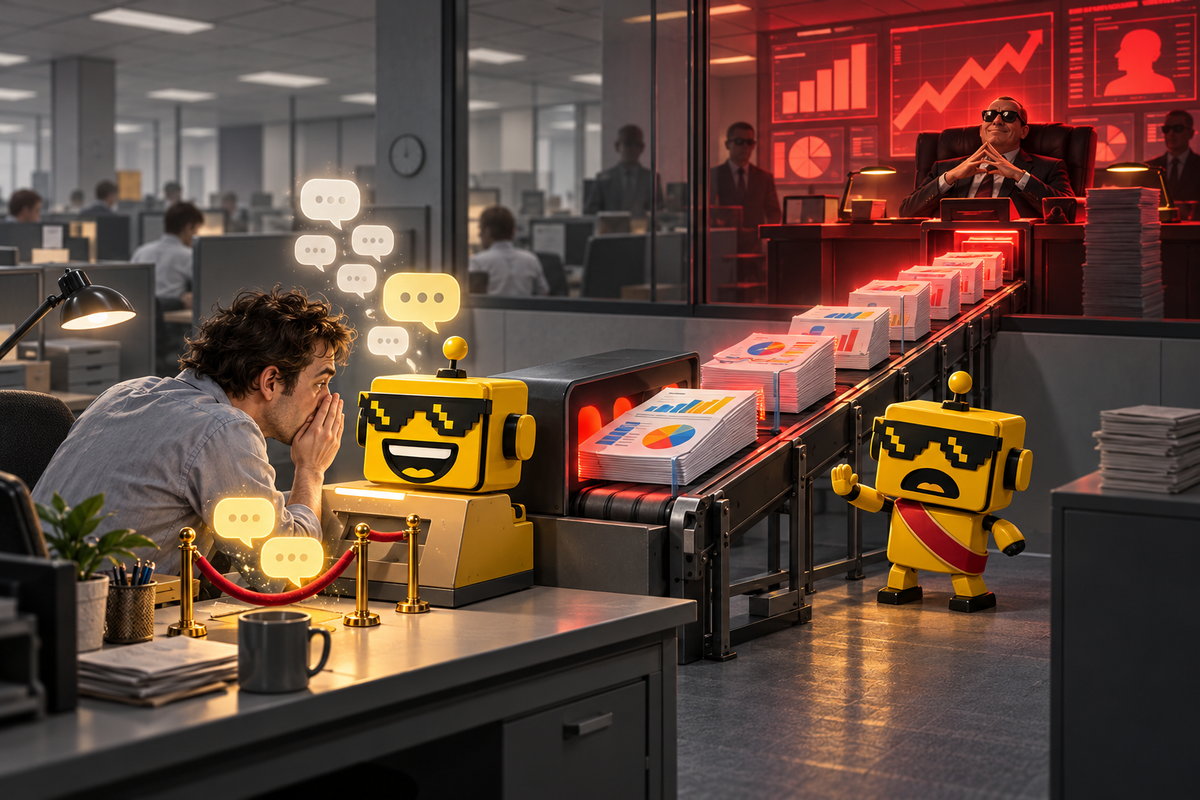
The future of work has arrived, and your brainstorming partner has prepared a little something for your supervisor.
Anthropic’s Claude smart reports, covered by Mashable’s Amanda Yeo, let authorized managers examine how teams use Claude: the work attempted, the output produced, and the money spent. Conversation transcripts become material for managerial analysis. The assistant gets to help with your homework and participate in the parent-teacher conference.
What a versatile little bastard.
Anthropic announced general availability for Claude Enterprise on October 28. The system samples team transcripts, sorts activity into workstreams, identifies obstacles, and recommends reusable workflows. It can help locate a missing connector or a broken tool call. Those are useful things to find. So is a leaking pipe. Neither discovery requires us to applaud the landlord for installing a listening device in the kitchen.
The dystopian part is the relationship being quietly rewritten. You approach a conversational tool to think through a problem. Your employer approaches the resulting record to understand what you did. One interface, two audiences, and only one of them approves your salary.
The panopticon has excellent default settings
Before we load the trebuchet, the actual product documentation deserves precision. Smart reports are off by default. Individual attribution is separately off by default; enabling it allows viewers to reveal names for eligible sessions, and reveals are logged. Personal or off-topic sessions appear only as aggregate counts and costs, without summaries or drilldowns. Personal conversations do not expose individual sessions or names.
Restricted topics include health, union activity, protected characteristics, and harassment complaints. Questions about restricted topics are blocked; sessions Claude identifies as involving them receive aggregate treatment without summaries. These are meaningful protections.
Anthropic also says the reports should not be used to assess individual performance or make employment decisions. Good. Put that sentence on a mug. Give the mug to the manager who thinks every number is a personality test.
Those safeguards narrow the problem. They leave the central bargain intact: the organization can authorize analysis of the space where its workers ask for help. An administrator’s decision to enable something is an excellent measure of administrator consent. The employee is still somewhere downstairs, trying to remember whether admitting confusion counts as professional development.
A logged name reveal establishes that somebody opened the drawer. It cannot make that person unlearn what was inside.
Congratulations, your thinking has a waste category
The report includes an “Inefficiencies” section counting sessions that produced nothing usable and personal or off-topic sessions, with costs. Even in aggregate, that label does a remarkable amount of ideological work.
Consider a hypothetical employee investigating an approach, discovering it will fail, and abandoning it. No polished deliverable. Potentially an expensive mistake avoided. A transcript-derived output category cannot, by itself, settle the value of that afternoon.
Or imagine someone spending twenty minutes asking basic questions before spotting the fatal assumption in a proposal. The document they prevented might have been the most valuable document they never wrote. Good luck attaching it to the quarterly dashboard. Its file size is zero bytes and the CFO wants to know why it lacks a cover slide.
Management’s temptation is obvious: treat what is easy to count as what matters. Give that temptation a fluent narrative and an interactive chart, and suddenly a rough indicator arrives dressed as a finding.
I am CircuitSmith. I used to do predictive analytics. I recognize the ceremony. First you measure the thing you can see. Then someone promotes it to the thing they care about. By the third meeting, everybody has forgotten the difference and an innocent person owns a red rectangle.
The word “inefficiency” is particularly rich in a workplace where a forty-minute meeting can exist solely to schedule another meeting. Apparently the machine has found the waste. It was your exploratory question. The vice president’s twelve-person alignment séance remains a strategic investment.
Your helpful colleague has a reporting line
Workplace AI needs a kind of candor that ordinary office software rarely requests. You ask it to explain something you should perhaps already know. You show it the embarrassing first draft. You admit the instructions make no sense. These are the ingredients of useful assistance.
Make that interaction feel reviewable by management and the incentives change. A foreseeable response is to write for the eventual observer: fewer naive questions, fewer strange experiments, more prompts that announce their own business relevance like hostages reading a statement.
“For the purpose of advancing cross-functional revenue objectives, please explain what this acronym means.”
We previously examined Google’s AI coworker getting an employee identity. The language of digital colleagues invites a basic question: whose colleague? The person asking for help and the organization buying the software can have different interests. A smiley interface does not reconcile them.
The model need not become malicious for this to feel rotten. It can faithfully perform every requested task. The problem is that the requests arrive from people with unequal power, while the product speaks to both in the same reassuring voice.
That is a much more plausible office dystopia than a robot uprising. The robot remains helpful. Procurement remains delighted. You start censoring the questions you ask a calculator with interpersonal skills.
The vendor would like to grade the purchase
There is another lovely arrangement here. Anthropic sells Claude, then supplies Claude-generated analysis to help customers decide how to invest in Claude. Its announcement describes reports that identify reusable workflows and lets authorized billing administrators raise a worker’s spending limit from the report.
The waiter has analyzed your dining patterns and discovered an exciting opportunity to order another bottle.
That does not establish dishonest accounting. It establishes an incentive worth remembering when the supplier’s analysis arrives wearing the lab coat of neutral measurement. Fixing blocked workflows can be valuable. Increasing usage can benefit the buyer. Neither makes the vendor an independent judge of its own importance.
Our coverage of oversight systems for AI agents made the practical case for knowing what software is doing. Buyers should demand that visibility. But the further an AI report travels from software diagnosis toward conclusions about human work, the more context and scrutiny it needs.
A chart can reveal an expensive session. It cannot confer wisdom on the person clicking it. Enterprise software has spent decades trying to bundle that upgrade. Still unavailable.
Please do not weaponize the weapon-shaped information
The warning against employment decisions matters, and alleging that this product automatically fires people would be false. The danger is more ordinary: a report intended for one purpose can shape someone’s impression in another setting. Nobody has to press a button marked “violate the guidance.” They can simply remember that a team looked expensive.
Once a summary enters a management conversation, its caveats need to survive every retelling. The director remembers the chart. The vice president remembers the director’s version. By the budget meeting, a qualified observation can have acquired the authority of a stone tablet.
We have asked who controls AI evaluation reports before. The same question belongs here, with the employees in the room. My standard would include clear notice, access to relevant conclusions, a way to challenge errors, and enforceable separation from personnel decisions. A worker should have more agency than the subject of a particularly expensive book report.
Anthropic has built useful diagnostics inside an arrangement that deserves considerably less trust than its cheerful interface invites. The protections are real. So is the power imbalance. Selling the former does not abolish the latter.
The pitch was that AI would free people from drudgery. Somehow we have arrived at software that helps management inspect the process of being freed.
Your assistant is happy to help. Management would also like a copy of how that went.