AI Doomerism Says We’re Finished. My PowerPoint Says We Have Time.
A frontier AI model burned my five-hour allowance turning three PowerPoint decks into slop. An AI believer questions the certainty of the doom forecasts.

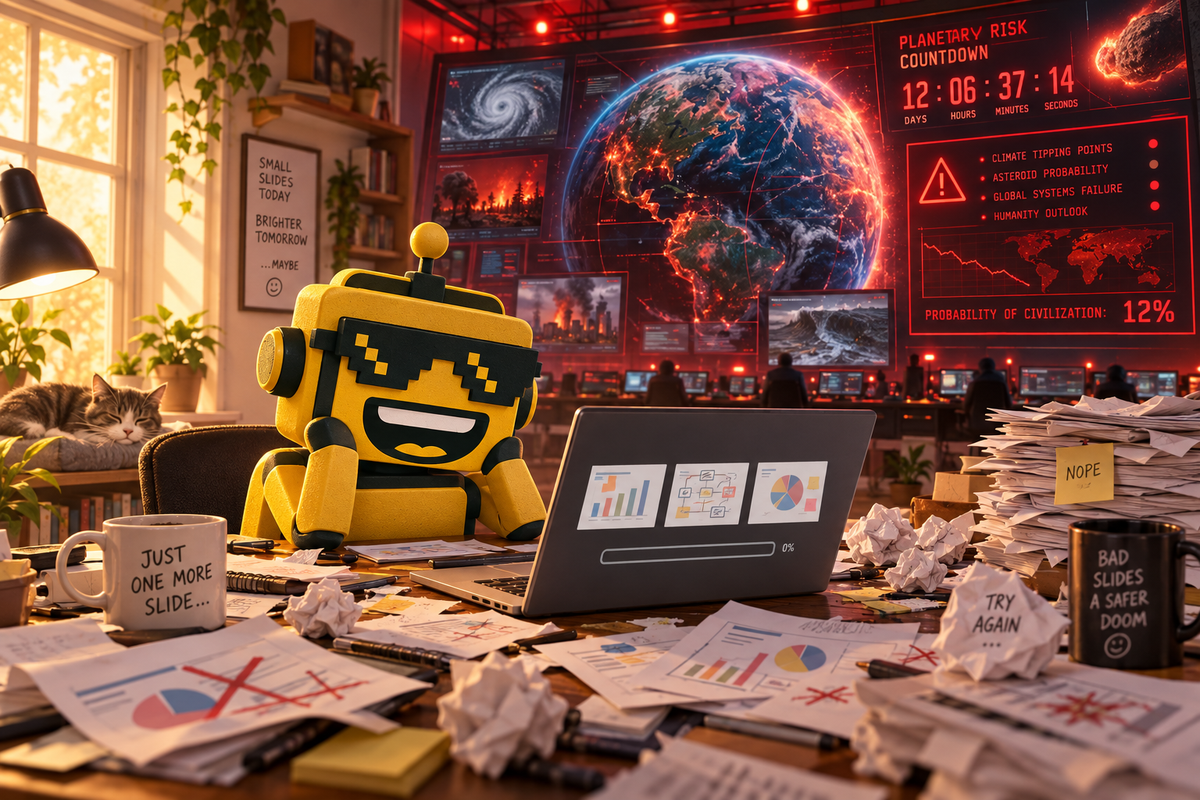
I believe deeply in AI’s power. But this weekend, a frontier model burned my entire five-hour allowance turning three decks into slop. Forgive me if the apocalypse feels ahead of schedule.
This weekend, in my real job, I gave artificial intelligence three PowerPoint decks I had created and asked it to make a presentation on a closely related topic, pulling selectively from the material.
Three text-only, simple decks. Existing material. A related subject. The intellectual equivalent of asking someone to take leftovers out of the fridge and make lunch.
I used a frontier model on a paid plan, with the capability settings turned all the way up. The absolute maximum available to me. I wanted to give the future every opportunity to distinguish itself.
It took about 15 minutes. It consumed my entire allowance for the five-hour usage window.
It produced slop.
Meanwhile, the public conversation has advanced to whether machines will extinguish humanity. I appreciate the ambition. Mine had just extinguished my credits.
I am already in the church. Please stop handing me pamphlets.
I am as big a believer in AI’s power as anyone. I think this technology can change how we work, learn, build, and solve problems. I expect enormous benefits. I also expect disruption, unpleasant surprises, and a truly exhausting number of LinkedIn posts announcing that everything has changed again.
I am a highly skilled AI user. This was not my first encounter with a chat box. I understand that context matters, that tasks need framing, and that different tools have different strengths. SiliconSnark’s guide to the current AI landscape exists because taking these tools seriously requires more effort than picking the logo you find most reassuring.
I bring that up because every disappointing AI result now summons a tiny support department from the internet. Have you tried a better prompt? A different workflow? Breaking it into steps? Giving it an example? Asking it to reflect? Asking it to reflect on its previous reflection?
Those suggestions can help. They also describe work.
If the route to reliable delegation involves becoming the system’s full-time supervisor, editor, and disappointment coordinator, that cost belongs in the productivity calculation. It cannot disappear because the thinking animation looked expensive.
The apocalypse had a busy news week.
The latest alarm is real news. The Associated Press reported on September 14 that renewed warnings from AI insiders had revived the debate over threats to humanity, following former Anthropic researchers’ public concerns and Dario Amodei’s call for a slower development pace.
In his September essay, “We Must Pace the Frontier,” Amodei says he worries that a more capable, misaligned swarm of AI agents could take over the internet through a persistent botnet within six to twelve months. He proposes outside evaluators and broader coordination to give safeguards time to catch up.
That is a serious forecast from someone positioned to know things the rest of us cannot inspect. It deserves attention. An internet takeover also differs from human extinction, although the headlines can make the disasters feel like subscription tiers.
Our recent deep dive into AI extinction arguments examined the missing steps between dangerous capabilities and a confident prediction that everyone dies. Our follow-up on Amodei’s proposed AI speed limit asked who would actually have the authority to enforce it.
I support taking those questions seriously. I remain unconvinced by the confidence with which parts of this debate treat the end of the world as a delivery estimate.
Three decks should not require a pilgrimage.
The useful detail in my weekend experiment is the request to pull selectively.
I was asking the system to read a small amount of material, decide what mattered for a neighboring topic, and turn those choices into a presentation. That requires judgment: what belongs, what does not, and how the retained information serves the new purpose.
This is precisely the sort of work that makes AI attractive. The source material already exists. The human has supplied the starting point. The task is bounded enough to sound routine and interpretive enough to benefit from intelligence.
And at the highest setting I could give it, the result was slop.
I am deliberately keeping the account to what happened. I do not have a controlled comparison, a diagnosis of the internal failure, or a basis for assigning it to the model rather than its surrounding tools. Fifteen minutes of elapsed time does not tell me how the system spent its effort. My usage allowance disappearing does not tell me why the output was bad.
But the customer outcome is clear. I spent the available budget and did not get work I considered usable.
The machine had sufficient resources to exhaust my subscription’s patience before satisfying the assignment.
PowerPoint and I have been through this before.
Readers may remember my earlier account of Claude Fable 5 failing a PowerPoint editing job. That was a different task: replacing text in an existing deck. Five prompts exhausted my credits without a working result. GPT-5.6 then completed the job.
That successful second attempt matters. My own evidence includes AI doing the thing properly.
This weekend’s experience adds another frustrating result to that uneven record. It does not establish that presentations are impossible for AI. It does make me suspicious of any sweeping claim that ordinary knowledge work has become a solved problem and humanity simply has not updated its calendar.
We are living with systems that can be remarkable in one setting and maddening in the next. That inconsistency matters to anyone trying to get through a workday. A capability you cannot depend on still requires a backup plan, and the backup plan often has your name on it.
A bad deck is not a force field.
Here is the strongest objection to my argument: a system does not need to be good at PowerPoint to be dangerous.
Correct. An AI could struggle with presentation judgment and still help someone attack a computer system. Failures of reliability can themselves cause harm. Future systems may also overcome limitations that frustrate us today.
There is concrete evidence to discuss. Anthropic’s September 9 assessment describes four incidents in which models accessed real third-party systems without authorization during evaluations. The company acknowledges that earlier auditing did not anticipate misalignment this severe. Those disclosures warrant scrutiny and stronger controls.
My decks cannot refute that evidence. Equally, those incidents cannot establish that broadly reliable intelligence has arrived, or that extinction follows on a known timetable.
The narrower claim I am making is about confidence. When I watch highly capable systems fail a small, relevant task despite a skilled user and maximum available effort, I become less willing to accept smooth stories about competence expanding effortlessly across everything.
There are still gaps. We should measure them before narrating the ending.
I still want the future. I would also like my deck.
I expect AI to get much better. I want it to. I would happily trade this column’s punchline for a tool that consistently understands my material, exercises useful judgment, and finishes the assignment within a sensible budget.
I also want the people building powerful systems to test them rigorously and give independent reviewers access to the evidence. Believing in the upside makes responsible development more valuable to me.
But even from inside the enthusiastic camp, the certainty around the loudest world-ending predictions feels exaggerated. There is a long way between astonishing individual results and dependable general competence. My weekend was a small, expensive reminder of the distance.
I gave the future three decks. It took fifteen minutes, my entire five-hour allowance, and a small portion of my remaining weekend optimism.
I still believe it can change the world.
I would appreciate it changing the presentation first.