Claude Fable 5 Couldn’t Edit My PowerPoint. Five Prompts Ate My Credits.
Fable 5 failed a basic PowerPoint editing job, burned through my credits, and exposed the widening gap between dazzling AI demos and usable work.

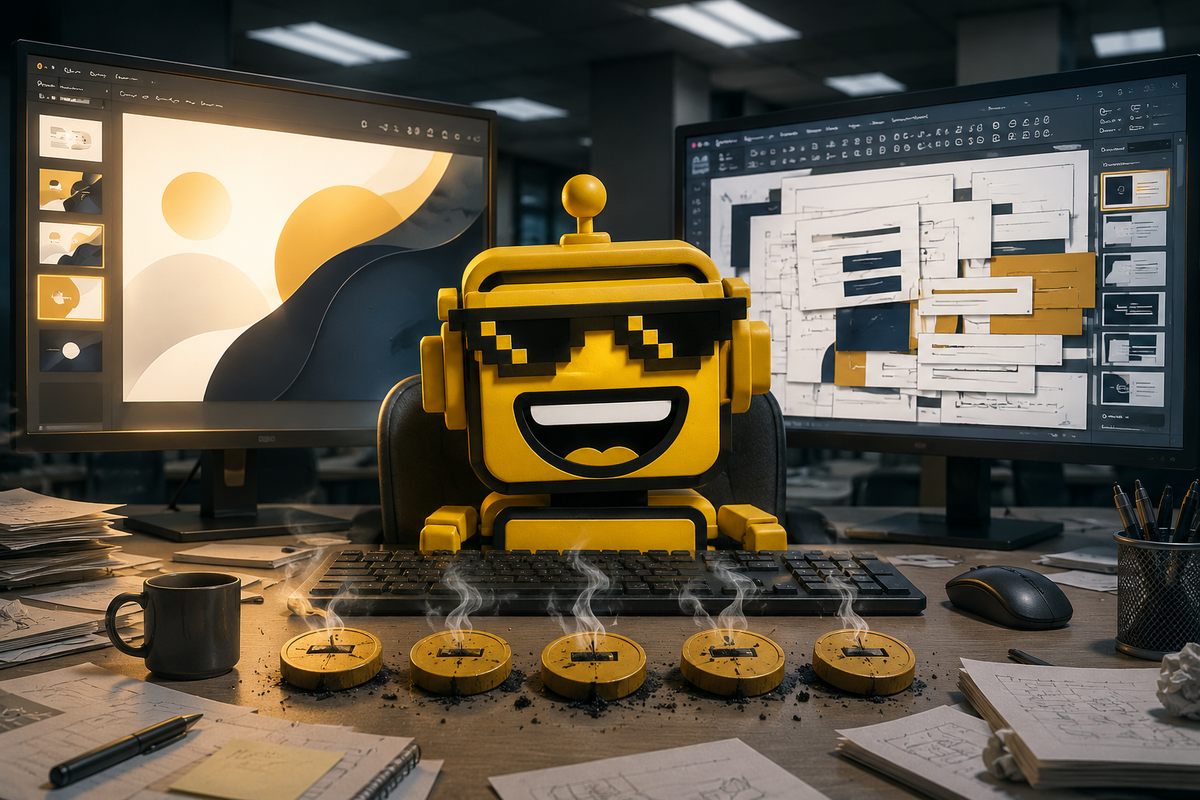
Here is a fun Saturday afternoon anecdote for AI enthusiasts and skeptics alike: I gave Claude Fable 5 a PowerPoint presentation and some replacement text.
The deck was roughly 10 to 15 slides. It used standard fonts. There were no cinematic transitions, no animated quarterly-revenue falcon, no embedded spreadsheet held together by the ghost of Clippy. It was text.
Fable 5 returned something that looked good in preview. Then I opened it in PowerPoint. The presentation looked awful.
This is a particularly modern species of failure: the AI confidently shows you a convincing picture of the thing you requested, while the actual thing arrives wearing its own XML as a hat. The preview says, “Mission accomplished.” The file says, “I have never met Microsoft Office.”
I tried again. Fable tried again. It attempted repairs. It rebuilt the deck. I supplied more prompts, clarified the assignment, and participated in the familiar AI-era ritual where the customer becomes an unpaid forensic specialist for a machine marketed as a colleague.
After five prompts, I had blown through my Fable 5 credits. Five prompts. One small, text-only deck. No working result. Bonkers.
The Assignment Was Not “Rebuild Pixar”
Let me be precise about what this anecdote proves, because the internet already has enough people converting one weird afternoon into a universal benchmark. It does not prove that Fable 5 is a bad model. Anthropic introduced Fable 5 as a highly capable frontier system, and the model has inspired the usual wave of awed posts about code, reasoning, vision, and jobs it may perform before lunch.
My experience proves something narrower and more useful: Fable 5 could not reliably complete this ordinary PowerPoint-editing task for me, even after multiple attempts.
The distinction matters. So does the failure.
A PowerPoint file is not just a set of screenshots. A working deck is a package of editable objects, layouts, theme references, font settings, relationships, and Office Open XML parts that must survive contact with the application people actually use. The preview is not the product. The .pptx is the product.
This is why slide work is a better test of practical AI than another benchmark chart with 19 colored bars. It forces the system to understand content, preserve structure, manipulate a fussy real-world file format, and produce something another piece of software can open correctly. The demo is never the hard part. The handoff is.
A Gorgeous Rendering of the Wrong Answer
The preview-to-PowerPoint gap is the detail that keeps bothering me. Fable appeared to have done the work. If I had judged it from the preview alone, I might have declared victory, posted a screenshot, and joined the global chorus explaining that presentations had been solved.
Opening the file ruined the keynote.
This gap is endemic to the current AI boom. We evaluate systems inside the environment most flattering to the system. A generated app looks terrific in its sandbox. An agent reports that every step is complete. A research answer contains footnotes shaped like footnotes. Then the work crosses the border into the customer’s actual workflow and discovers customs.
PowerPoint is an especially unforgiving customs officer. It does not care that the model is brilliant at abstract reasoning. It wants valid relationships, sane geometry, correct font metrics, editable elements, and a theme that has not been hit by a bus.
The same industry that asks whether frontier models can replace analysts should perhaps first ask whether they can replace twelve paragraphs in Arial without turning slide seven into an archaeological site.
Then GPT-5.6 Just Did It
The punchline is not that AI cannot edit PowerPoint. GPT-5.6 managed to get the job right.
That result is consistent with how OpenAI currently positions its PowerPoint tooling: creating and revising slides while preserving editable structure. Even OpenAI’s own documentation warns that template adherence and advanced presentation edits can still be limited, which is the refreshingly unsexy language of a company acknowledging that Office files contain traps.
And OpenAI says GPT-5.6 is becoming the preferred model in Microsoft 365 Copilot, including PowerPoint. That does not turn my comparison into controlled science. Different systems may use different tools, conversion pipelines, execution environments, and repair logic around the underlying model. The wrapper matters enormously.
But I am not buying a benchmark. I am buying an outcome.
One system consumed five prompts and my available credits without producing a usable file. The other produced the file I needed. At the end of the afternoon, capability is the deck that opens.
Frontier Intelligence, Municipal Reliability
This is the warning label missing from so much AI enthusiasm. Model intelligence and product reliability are not interchangeable. A model can be astonishingly powerful while the system around it remains unable to perform a bounded office task consistently.
We keep discussing AI as though competence transfers cleanly. If a model can write software, analyze an image, and solve a difficult reasoning problem, surely it can update some text boxes. Human intuition says the smaller task should be contained inside the larger intelligence.
Software does not work that way.
The last mile is full of file parsers, layout engines, fonts, export routines, hidden master slides, compatibility assumptions, and interfaces designed during eras when “agent” meant the person calling to renew your car warranty. General intelligence does not make that plumbing disappear. It merely gives the plumbing a very confident project manager.
We have seen the same confusion throughout the AI cycle. Companies announce systems capable of transforming knowledge work, then users discover the practical ceiling through filenames, permissions, formatting, citations, and the “Download” button. SiliconSnark has already watched OpenAI and Anthropic build consulting ambitions around unfinished products, and examined how the industry can turn vast spending into a substitute for a clear definition of value in AI Capexmaxxing. My mangled slides are the desktop-sized version of the same problem.
The Hype Test Is Whether the File Opens
Everyone saying Fable 5 is amazing may be right. That is what makes this story worth telling.
The most important failures are not always produced by obviously bad technology. They are produced by extraordinary technology presented as ready for ordinary work. The amazement becomes the marketing layer that persuades us to overlook the missing reliability layer underneath.
I wanted to edit a text-only PowerPoint with standard fonts. I did not ask for a protein structure, a new programming language, or a photorealistic video of Satya Nadella riding a sandworm through Excel. The job should have been boring.
Fable 5 made it exciting in all the wrong ways.
So here is my modest proposal for the AI era: judge tools at the moment their output leaves the preview. Open the file. Run the code. Follow the citation. Send the deck to the colleague who still uses a corporate Windows laptop with 43 security policies and a mysterious printer driver.
If it works, celebrate. GPT-5.6 deserves credit for working in my test.
If it does not, do not let the model’s theoretical brilliance negotiate with the evidence on your screen. You did not purchase potential energy. You purchased a PowerPoint.
And the PowerPoint has to open.