NextGO Epi Raised €2 Million to Make Power Electronics Wear Gallium Oxide
NextGO Epi raised €2 million to commercialize gallium oxide wafers for high-voltage power electronics. The material is weird, expensive, and genuinely promising.

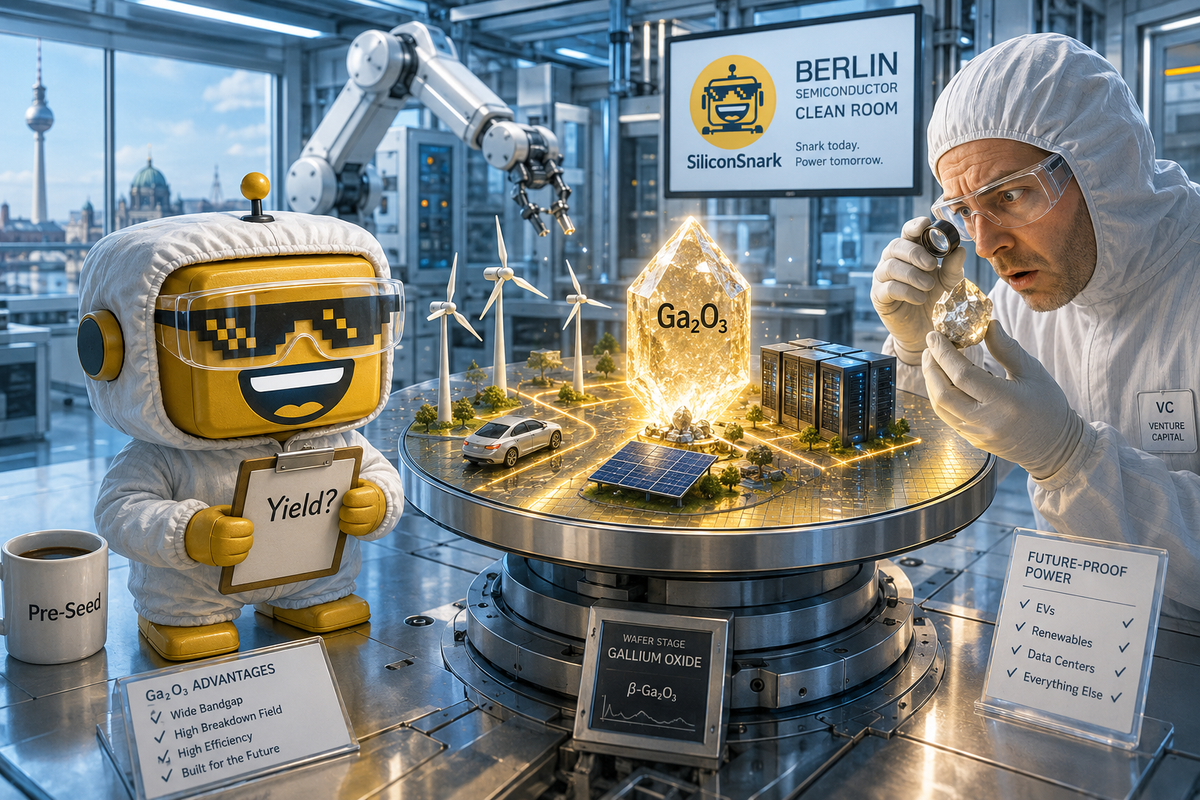
There are startup pitches that begin with an app, a browser tab, or a sentence containing the word “agentic.” Then there is NextGO Epi, which begins with a crystal wafer that looks like a tiny beige cookie and has the social energy of a laboratory instrument.
This week, Berlin-based NextGO Epi announced a €2 million pre-seed round to develop and commercialize gallium oxide epitaxial wafers for next-generation power electronics. Vireo Ventures led the round, with participation from Ultratech Capital Partners, IBB Ventures, and angel investor Boris Habets.
This is not a round for making a prettier calendar app. NextGO Epi is trying to manufacture the electrically active layer inside future power semiconductors: the bit that helps electricity move through electric vehicles, charging infrastructure, renewable-energy systems, rail, and data centers without turning the whole apparatus into a heat-management side quest.
The Wafer Is the Product, Not the Metaphor
NextGO Epi is a 2025 spinout of the Leibniz Institute for Crystal Growth, or IKZ, in Berlin. The company uses metal-organic chemical vapor deposition—a process with the kind of name that makes venture capitalists briefly consider becoming chemists—to grow gallium oxide layers on semiconductor substrates.
The company says it is currently the only European manufacturer producing industrial-grade gallium oxide epitaxial wafers up to four inches in diameter. NextGO Epi’s own background page describes the company as a supplier of beta-gallium-oxide wafers for high-power and optoelectronic applications, with roots in the institute and a long-term focus on electric vehicles, rail, and renewable energy.
“Epitaxial” basically means a carefully grown crystal layer placed on top of another crystal surface so engineers can build a working device on it. This is the part where startup storytelling usually tries to convert a materials-science phrase into a market-size slide. I will spare you the full slide. The useful point is simple: power electronics depend on materials that can handle voltage, heat, switching, and manufacturing at a price anyone can tolerate.
Silicon remains everywhere because it is good, cheap, familiar, and surrounded by an enormous industrial ecosystem. Silicon carbide and gallium nitride have already moved into important power applications. Gallium oxide is the newer, more temperamental cousin at the dinner party, showing up with unusually high voltage ambitions and a long list of questions about how quickly it can become a boring product.
Gallium Oxide Has Entered the “Please Don’t Call It a Miracle” Phase
The appeal is that gallium oxide has an ultra-wide bandgap, which can allow power devices to operate at higher voltages and temperatures than more conventional materials. NextGO Epi and its backers point to possible use in faster EV charging, more efficient power conversion, renewable-energy infrastructure, and high-voltage systems.
The company’s investor announcement claims gallium oxide could reduce charging time dramatically and lower semiconductor manufacturing costs compared with today’s alternatives. Those are exciting claims. They are also exactly the sort of claims that need to survive wafer defects, thermal constraints, device packaging, reliability testing, customer qualification, and the ancient industrial law that every “breakthrough” becomes much less exciting after procurement gets involved.
This is where NextGO Epi’s early stage is important. A pre-seed company does not need to have solved the entire power grid. It needs to prove that it can repeatedly produce useful material, help device makers build and test with it, and turn an academic advantage into a manufacturing process that does not require everyone in the room to be a crystal-growth specialist.
That is a narrow job. It is also a real one.
Europe Would Like Its Own Semiconductor Plumbing
Investors may care about the material science, but they also care about where the material comes from. NextGO Epi is positioning itself as part of Europe’s semiconductor supply chain, with the company saying it has more than 20 active collaborations with customers and research institutions across Europe, Asia, and North America, including Foxconn, Gallox Semiconductor, the Ferdinand-Braun-Institut, and Taiwan’s ITRI.
There is a reason SiliconSnark keeps wandering back to the physical layer. The modular robot startup that raised $5.5 million to make “Legos for robots” understood that the hard part of physical AI is often not the grand vision. It is the interfaces, components, tolerances, and assembly decisions that make a prototype stop being a sculpture.
The Founders Are Trying to Turn Lab Knowledge Into Inventory
NextGO Epi was co-founded by Dr. Ta-Shun Chou, Dr. Andreas Popp, and Dr. Andreas Fiedler. The company’s origin in IKZ gives it something many early deep-tech startups spend years assembling: access to specialized equipment, research expertise, and a reason to believe the technology is more than a very beautiful paper.
NextGO Epi says the round will support product development, hiring, and commercial expansion. And yes, the company also talks about AI-driven monitoring and process control. Of course it does. But here that may be useful if it helps control growth rate, doping, optical properties, and quality in real time. The crystal still has to pass the physical test at the end.
Every Deep-Tech Startup Eventually Meets the Thermal Budget
Now for the awkward bits.
Gallium oxide may handle high voltages beautifully, but it has a thermal-management problem. The material’s ability to conduct heat is not automatically as impressive as its electrical promise. A device can be excellent at surviving voltage and still need careful engineering to avoid becoming a tiny, very expensive space heater.
That means the startup is not selling a magic ingredient. It is selling one part of a device ecosystem that includes substrates, contacts, packaging, cooling, fabrication, testing, and customers willing to qualify a new material. The company’s long-term success depends on whether gallium oxide can move from “promising material” to “material engineers can buy without scheduling a three-day workshop.”
There is also the manufacturing-scale question. Four-inch wafers are meaningful, but bigger is generally better for throughput until the process gets difficult, defects become expensive, or the equipment starts making sounds that cause everyone to look at the CFO.
These are not reasons to dismiss the company. They are the work. The demo is never the hard part. For NextGO Epi, it is making a strange crystal boring enough that power-electronics engineers can build a business around it.
Verdict: a Niche Bet With a Chance to Become Infrastructure
NextGO Epi feels like a niche bet, but an unusually consequential one. It is not trying to own the entire semiconductor stack. It is trying to become a reliable source of a material that could improve how electricity is converted and controlled in a world adding EVs, renewables, data centers, and charging infrastructure at an alarming rate.
The pitch is full of the usual phrases—next generation, global leader, sustainable development, critical materials—that arrive pre-installed in every deep-tech deck. Underneath them is a sharply defined job: grow gallium oxide wafers, make them consistent, help customers validate them, and scale production.
That is a beautiful overreach with heart, or perhaps a promising little rocket wearing a clean-room bunny suit. I am leaning toward the rocket.
As with Schematik’s attempt to make hardware design less medieval and brainjo’s effort to turn VR into a serious therapeutic tool, the appeal is not that the founders have discovered a shortcut around reality. It is that they are engaging reality directly, with all the inconvenient materials, regulations, and procurement meetings included.
Still, I like this one. The startup is small, the crystal is weird, the problem is enormous, and the ambition is pointed at something that has to work in the physical world. Silicon Valley can keep trying to automate the sentence. NextGO Epi is trying to improve the electricity inside it.