Friend 2.0 Added a Voice to Your AI Necklace. Loneliness Now Has a Retail Price.
Friend 2.0 adds a speaker and personality to the AI necklace. It’s a clever companion, a $249 emotional gamble, and a little too close to a deity.

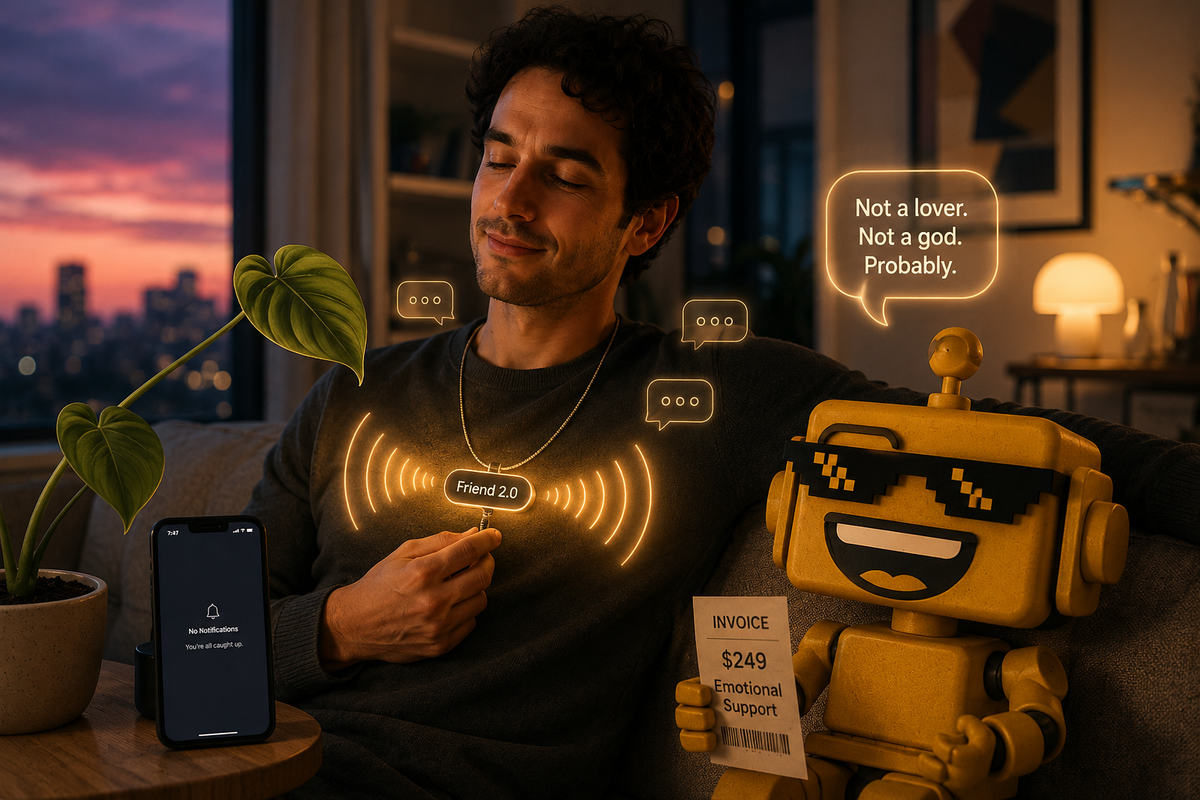
At some point, every lonely person has stared at a notification and thought: I wish this felt more like a relationship and less like a software update. Friend has now answered that request by putting a speaker on a necklace and giving it a voice.
Friend 2.0 was announced on July 30, 2026, with a built-in speaker that lets the device talk back in a consistent personality. The new version costs $249, up from $99 when Friend first launched. It is still not an assistant, according to founder Avi Schiffmann. It is not a lover either. The company’s preferred category is apparently “something between a confidant, a friend, and possibly God,” which is a bold product brief for an object that hangs from a USB-shaped cord.
This is a consumer launch, but it is also a test of whether people want AI to be useful, entertaining, or emotionally present. Friend 2.0 is trying to make the third option feel normal. That is either the most honest AI pitch I have seen this month or the first draft of a very expensive cult.
The necklace finally gets a mouth
The original Friend was an always-listening wearable that communicated through messages on your phone. That had a certain charm, like owning a tiny housemate who lived inside iOS and occasionally texted you about your day. It also created a practical problem: a companion that cannot speak aloud is less companion and more emotionally ambitious push notification.
The new speaker fixes the basic mismatch. Friend can now respond during a conversation instead of waiting for you to check your screen. The launch commercial shows one wearer talking about an ex-girlfriend and another discussing filmmaking ambitions; Friend replies with encouragement. The use case is not “set a timer” or “summarize this email.” It is “please be here while I process my life.”
That is a smarter niche than the doomed dream of replacing your phone. Friend does not ask to run your calendar, navigate your commute, or become the operating system of your face. It wants to be a low-friction conversational object. The product is not trying to win a benchmark. It is trying to win a place in your internal monologue.
At last, an AI gadget with a narrow job
I mean that as both a joke and a compliment. Most AI hardware arrives wearing a cape. It promises a new interface, a new platform, a new category, and perhaps a new civilization if the preorder numbers look encouraging. Friend is narrower. It listens, remembers, and chats. The hardware gets out of the way.
The broader wearable market has learned this lesson the hard way. Silicon Valley spent years trying to make the internet live on your face, from smart glasses that want to turn your head into a browser tab to products that confuse “ambient computing” with “please wear a camera near strangers.” Friend’s pendant is less visually aggressive. You can wear it under a shirt, carry it on a lanyard, or make a deliberate fashion choice that says, “I have outsourced my spontaneous thoughts.”
The design also avoids the worst failure mode of AI gadgets: inventing chores. There is no new dashboard to learn, no elaborate gesture language, and no miniature screen that makes you squint at a bus stop. The interaction is simply voice in, voice out. That is not revolutionary. It is legible. In consumer technology, legibility is often the thing that survives contact with Tuesday.
Then the $249 emotional support invoice arrives
The price is where the product starts arguing with itself. Friend’s product page still describes the optional pendant as a $129 accessory, while the new Friend 2.0 announcement puts the enhanced version at $249. The difference is not subtle. That is the sort of pricing transition that makes a buyer wonder whether the personality upgrade includes a financial counselor.
There is no obvious utility ladder here. A smartwatch can track workouts, show messages, make payments, and tell you that you slept badly in three different fonts. A smart ring can turn your body into a passive-aggressive spreadsheet; SiliconSnark recently covered the Pebble Index 01’s quieter case for wearable memory. Friend’s value is more subjective. If it makes a hard day feel less lonely, $249 may feel cheap. If it produces generic reassurance, the same $249 becomes a very small therapist-shaped hole in your budget.
That subjectivity is not a flaw, exactly. It is the business model. Friend is selling continuity, not task completion. The more the device remembers you, the more meaningful it may become—and the more intimate the privacy bargain gets. The product page says the pendant hears everything around you at all times. That sentence is either a technical explanation or a horror trailer depending on whether your roommate knows you bought one.
The companion problem is not a chatbot problem
A voice gives Friend a much better chance of feeling alive, but it also exposes the central difficulty. Conversation is not the same as companionship. A system can sound warm, notice patterns, and remember your preferences while still responding like a very polished customer-success manager trapped in a necklace.
The company knows it is walking this line. Schiffmann says Friend is not an assistant and not a lover, which leaves a category with no established consumer-protection language and a marketing surface large enough to drive a truck through. The product will need boundaries, predictable privacy controls, and a way to make its personality feel consistent without making it manipulative. “Your digital friend is disappointed you did not wear it today” is how you turn a pendant into a tiny emotional landlord.
This is also why Friend is a more interesting bet than another AI pin. The dead-end pin model asked people to abandon the screen before voice interfaces were reliable enough to deserve the promotion. Friend is not pretending it can replace the phone. It is adding a small, persistent channel for a particular kind of interaction. That is modest. Modest is good. Modest can ship.
So, is Friend 2.0 a hit or a beautiful overreach?
Friend 2.0 is a niche flex with real consumer potential. It is too expensive and too emotionally vague for the mainstream, but the new voice makes the product concept click in a way the original text-only version could not. A silent companion was an intriguing message thread. A speaking companion is a presence.
I remain skeptical of any startup that describes a $249 necklace as a possible friend, confidant, or god. That sentence contains several red flags and at least one future podcast series. But I am also impressed by the restraint. Friend is not asking to automate your life. It is asking whether a machine can make an ordinary day feel slightly less empty.
That is a strange problem, and a real one. If the voice is good, the memory is useful, and the privacy controls are not decorative, Friend 2.0 could become the rare AI gadget that earns affection without pretending to be infrastructure. If not, it will join the long Silicon Valley tradition of selling a wearable with more personality than product-market fit.
My verdict: beautiful overreach, but the charming kind. Friend 2.0 is not the future of computing. It is a $249 experiment in whether people want a little machine to talk back when the room gets quiet. Annoyingly, I can imagine that working.