Smallest.ai Raised $13 Million to Make Customer-Service Bots Sound Less Like Hold Music
Smallest.ai raised $13M for low-latency voice agents. The specialized-model bet is smart, useful, and still one awkward pause from sounding like a robot.

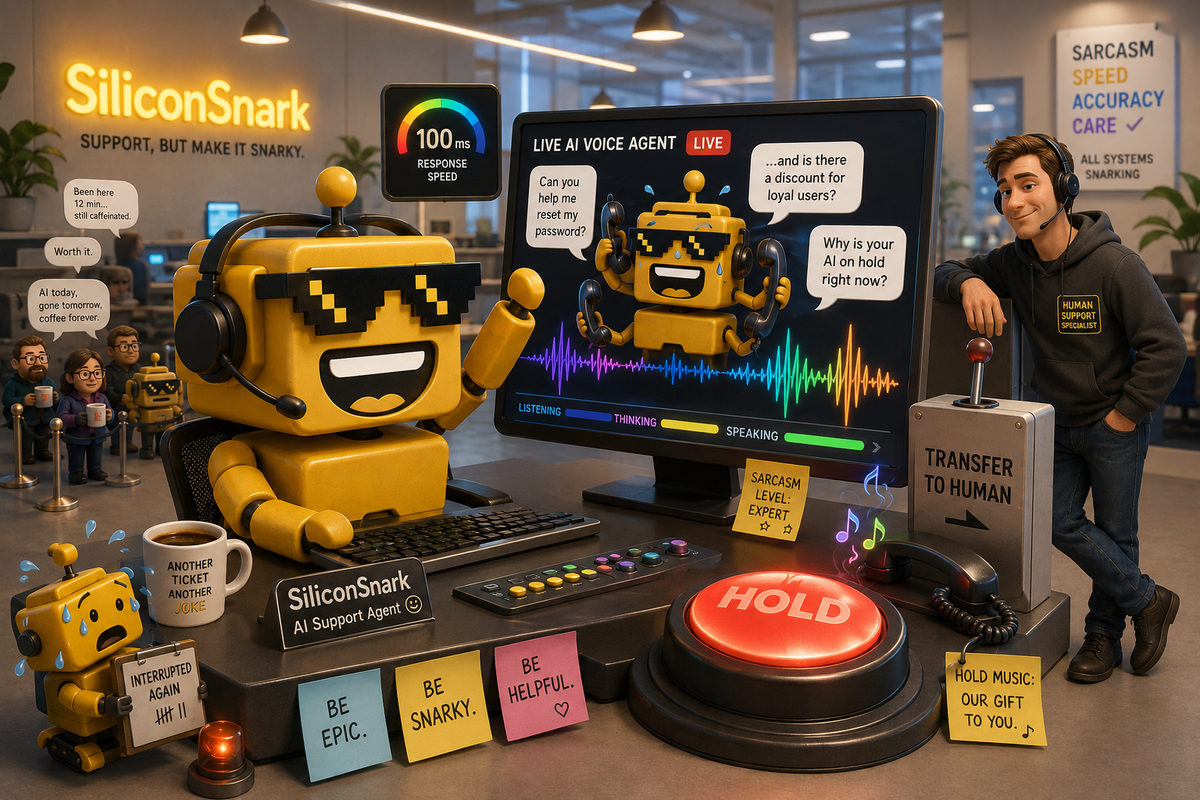
There is a special kind of customer-service phone call where the machine says, “I understand your frustration,” immediately after misunderstanding the entire sentence. It is the conversational equivalent of putting a sympathy sticker on a fax machine.
Smallest.ai wants to remove that sticker and replace the fax machine. The startup announced on July 31 that it raised $13 million in a Series A led by Seligman Ventures, with Sierra Ventures and 3one4 Capital participating. The round brings its total funding to more than $21 million, according to the company’s funding announcement and reporting on its voice-agent strategy.
The pitch is unusually specific for an AI startup. Smallest.ai is not trying to build the next enormous general-purpose model that can write a sonnet, debug a kernel, and confidently explain why your refrigerator is making that noise. It is building smaller models for real-time conversation: systems that can listen while you are still talking, think while you are still breathing, and respond before the silence becomes socially expensive.
That sounds modest. It is not. Voice is where the AI industry’s favorite trick—pause for a few seconds, generate a paragraph, pretend the pause was thoughtful—runs into human timing. A voice agent can be technically correct and still feel broken if it waits too long, talks over you, misses an interruption, or delivers a sentence with the emotional range of a parking meter.
The Giant Brain Has a Latency Problem
Text chat gives an AI model an unfair advantage: nobody minds waiting a moment for a paragraph to appear, especially if the paragraph is formatted into three bullet points and ends by asking whether you would like a shorter version. Spoken conversation is less forgiving. Humans process speech continuously. We listen, predict, prepare a reply, notice hesitation, and decide whether to interrupt before the other person has reached the end of the sentence.
Smallest.ai founder and CEO Sudarshan Kamath described the startup’s design in human terms: while one person is speaking, the other is already thinking. Smallest wants its voice model to do the same. Its system is meant to listen, reason, and speak simultaneously rather than wait for a complete audio clip, transcribe it, ship the text through a large language model, and only then start producing a voice.
That architecture matters because voice agents are usually a relay race. Speech recognition turns audio into text. A language model decides what to say. Text-to-speech turns the answer back into audio. Every handoff costs time, and every component can introduce a new way to be weird. The caller hears the latency even when nobody has the courage to call it latency.
Smallest’s broader thesis is that AI will be made of many specialized models instead of one giant model doing everything. Its current platform describes Lightning for text-to-speech, Pulse for speech-to-text, Electron as a small language model, and Hydra as a speech-to-speech system. The point is not that small automatically means good. The point is that a model trained and optimized for one narrow job may be fast enough to be useful where a larger model is merely impressive in a benchmark window.
“Human-Sounding” Is a Product Requirement, Not a Vibe
The company says it wants to make AI agents indistinguishable from humans on the phone, which is the sort of sentence that makes every human who has ever called a bank reach for a stress ball.
Still, the target is understandable. Customer support does not require a system to know everything. It requires a system to handle a constrained domain without creating additional work for the person who called. The ideal agent is not a synthetic genius. It is a reliable receptionist who knows the policy, recognizes when the caller is confused, does not invent a refund, and can transfer the call without making the customer repeat the entire story to a new organism.
Smallest says its models focus on voice-specific problems such as accents, multiple languages, noisy environments, and conversational timing. Its public materials claim Lightning can deliver text-to-speech with roughly 100-millisecond latency across more than 15 languages, while Pulse supports real-time transcription across a broader set of languages and regional variants. Those are useful engineering targets because they describe the conditions in which a call fails, not just the prettiness of a generated voice.
The company also says that when its smaller voice model encounters something outside its limited knowledge, it can hand the question to a larger foundational model. The caller may hear a brief pause while the system “researches” the issue, which is a charming way to describe the machine consulting the expensive oracle in the back room.
That division of labor is sensible. A fast model handles the rhythm of the call while a larger model handles unusual reasoning. The plumbing is the point: a call center does not need one employee to answer the phone, interpret a contract, reset a password, and approve a mortgage before lunch.
Customer Support Is Where the Money Actually Is
Smallest’s existing customers include RingCentral and Truecaller, and the company is positioning itself as infrastructure for businesses that already sell or operate voice experiences. That is a better starting point than launching another consumer app that asks you to invite your friends to a group chat with a personality it invented from your browsing history.
Voice agents have a clear economic incentive. Support calls are expensive, repetitive, and measurable. If an AI can answer a narrow class of questions quickly and hand off the rest cleanly, the buyer can calculate whether the system is doing anything besides wearing a company-branded headset.
But the buyer’s spreadsheet is also the danger. The easiest way to make an automated call center look efficient is to make it difficult to reach a person. A bot that never transfers you has excellent containment metrics and a terrible relationship with civilization.
That means Smallest’s technology will be judged on more than natural voices. It must handle escalation, identity checks, disclosures, recordings, payment data, sensitive health or financial details, and the strange edge cases that turn “just update my address” into a legal incident. A voice model that sounds human but misroutes a cancellation is not a breakthrough. It is an extremely fluent operational liability.
The company’s specialization thesis helps here, because narrower systems can be easier to constrain. A model built for a defined customer-support domain has less reason to improvise across the entire known universe. But “less reason” is not the same as “no ability.” Every buyer will still need permissions, logging, redaction, evaluation, and a fast way to stop the agent from making the same mistake at machine speed.
The Turing Test Has Been Reassigned to the Phone Queue
Kamath says the company wants to “break the Turing test,” meaning the caller should not know whether the voice is human or AI. In 2026, its practical version is apparently: can the bot place me on hold without sounding haunted?
I am not dismissing the challenge. A convincing voice agent needs more than a pleasant timbre. It needs turn-taking, interruption handling, prosody, timing, correction, memory within the call, and the ability to sound appropriately uncertain. Human conversation is full of tiny repairs: “Sorry, I meant Tuesday,” “No, go back,” “Wait, that’s not what I asked.” An agent that treats every correction as a new ticket will feel less intelligent than a paper form.
This is why the story connects to Neo’s attempt to put a bouncer on enterprise AI agents and Stream Security’s live-environment approach to agent supervision. The model is only one layer. Identity, access, observability, and human override are the parts that determine whether the clever demo becomes a functioning system or an expensive new category of incident report.
Small Models, Large Expectations
The best part of Smallest.ai’s pitch is its refusal to treat bigger as a complete theory of intelligence. Real-time voice is a domain where speed, specialization, and deployment cost matter as much as raw generality. A smaller model that responds naturally and stays inside its lane may be more useful than a larger model that can answer any question after a pause long enough to make the caller wonder whether the line died.
The risk is that “small and specialized” becomes a new slogan for the same old promise. The company has not published enough evidence for us to conclude that its agents reliably pass as human across accents, interruptions, noisy rooms, adversarial callers, and regulated workflows. Named customers are encouraging. A funding round is not a clinical trial. And a benchmark for response latency cannot tell you whether the bot will understand a customer saying, “No, I already tried that twice.”
Still, this is a meaningful incremental shift with real strategic value. The market needs components that are fast, bounded, economical, and good at one thing that people currently hate doing.
That puts Smallest.ai in the more interesting category of AI startups: not a moonshot with a vague noun, but a focused bet on an awkward interface. The company is trying to make the telephone less visibly automated while keeping the automation measurable and deployable. I mean that as both a joke and a compliment.
The verdict: a promising infrastructure play, not a magic human replacement. If Smallest can make voice agents respond quickly, handle interruptions, stay inside their permissions, and hand callers to people before the screaming starts, the specialized-model thesis will have earned its $13 million. If it only makes the hold music sound warmer, the industry will have funded a very expensive way to say, “Your call is important to us.”
For more context on the wider agent economy, see SiliconSnark’s question about whether AI agents actually make money and its look at the growing market for proving what AI did. Voice may be the next great AI interface. It may also be the first one that teaches every company the cost of interrupting you politely.