Stream Security Turns Your Cloud Inventory Into an AI Security Colleague. Please Supervise.
StreamForce gives security teams AI agents grounded in a live production model. Smart infrastructure, serious promise, and one very nervous SOC.

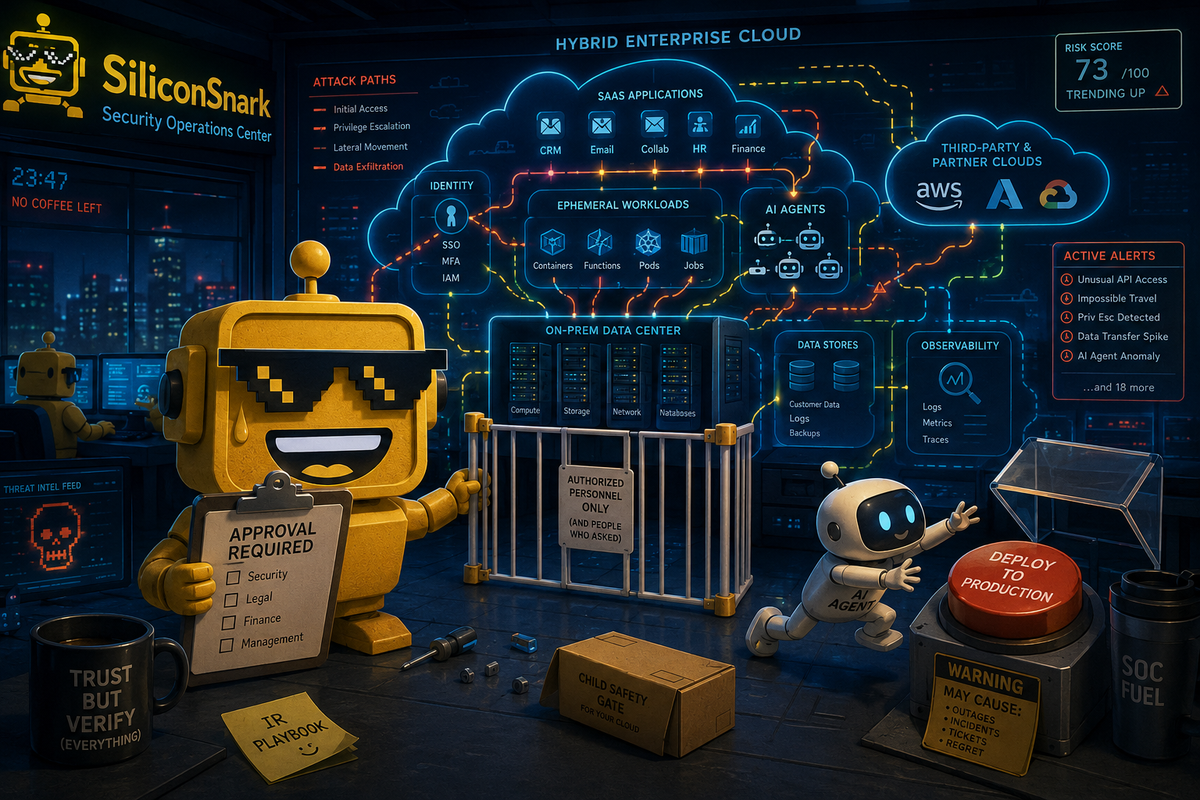
Somewhere in a security operations center today, an AI agent is being asked to investigate an attack path while staring at a map of the enterprise that was last updated sometime between lunch and the last reorg.
This is how enterprise AI usually works: give the model a dramatic verb, connect it to six APIs, pour in a bucket of logs, and hope “context window” means something more than a room where everyone is quietly panicking. Stream Security’s new StreamForce is taking a more architectural swing. The company announced general availability for StreamForce on July 29 pitching it as an AI agent orchestration platform built on a continuously updated model of a company’s live environment.
That model covers cloud, on-premises systems, SaaS, identities, temporary assets, and even AI agents already running in production. Security teams can describe a workflow in natural language, deploy it against that environment, and get an answer based on what the infrastructure looks like now—not what a pile of normalized logs suggested it looked like yesterday.
The Map Is More Important Than the Magic
Stream’s argument is refreshingly unfashionable: the hard part of security automation is not making an AI agent talk. The hard part is giving it an accurate picture of the territory.
Most security AI pitches begin with the action layer. Investigate this alert. Prioritize those vulnerabilities. Contain that identity. The model may be impressive, but if the underlying facts are stale, incomplete, or scattered across incompatible systems, the agent is just a fast typist with executive privileges.
StreamForce is built on Stream’s environment model, which the company says updates in near real time as infrastructure changes. That means an agent can reason over current relationships: which workload talks to which database, which identity can reach which resource, what changed recently, and where an attack path might actually exist.
The plumbing is the point. A live environment model turns “investigate the suspicious access” from a vague chatbot request into a question with nouns attached. It gives the agent a chance to understand the difference between a production database, a forgotten test bucket, and the server someone created for a demo and then emotionally abandoned.
This is the same uncomfortable lesson behind AI coding agents moving into the repo with root-ish access: the intelligence matters, but the surrounding permissions, tools, and state matter just as much. An agent that understands reality is more useful. It is also more capable of doing something consequential in reality, which is where the fun ends.
Natural Language, Meet Natural Consequences
StreamForce lets security teams build AI workflows in natural language. That sounds like a demo until you remember how many security teams are held together by a small number of experts who know the company’s systems, history, exceptions, and weird little dependencies by heart.
If the product works as described, a lean team can ask an agent to validate defenses against an active attack technique, trace the likely path through the environment, and surface the highest-risk changes without spending months building a custom orchestration layer. The company says the platform avoids requiring teams to assemble infrastructure, normalize all the underlying data themselves, or predefine every use case before they can get useful results.
That is a meaningful design choice. Fixed playbooks are reliable until the environment does something impolite. Build-it-yourself systems are flexible until the only person who understands the integrations leaves for a competitor with better snacks. StreamForce is aiming for a middle layer: flexible enough to ask new questions, grounded enough not to invent the map.
The customer angle is still early, but it is concrete. Michael Young, cybersecurity director at Hunt Consolidated, says the company piloted StreamForce during early access and used it to validate defenses against active attack techniques without building and maintaining a complex integration estate. He also describes traditional SOAR systems—security orchestration, automation, and response—as difficult to architect, maintain, and scale.
That is the kind of quote enterprise buyers actually recognize. Not “we transformed our business in three weeks,” but “the old thing was a maintenance project and we would like fewer maintenance projects.” The bar for security software is often less “perform sorcery” and more “make the capable people less tired.”
Every Agent Needs a Chaperone and a Kill Switch
Here is the part where I become the responsible adult at the conference table.
A live model can reduce hallucination and stale-context problems. It does not make an agent infallible. In fact, it makes the agent more operationally interesting. If the model knows what is connected to what, it can make better decisions—and a bad decision can now be better informed.
Security teams will still need explicit boundaries around what StreamForce agents can read, change, quarantine, or delete. They will need audit trails, approval gates, rollback paths, and a way to distinguish a clever investigation from an enthusiastic outage. The agent should be able to say, “This identity appears to be moving laterally,” before it gets to say, “I have revoked every credential in finance.”
This is where the product sits inside a larger enterprise pattern. Vanta’s AI agent for compliance work made the same broad promise in a quieter corner of the business: automate the bureaucratic layer, but keep the evidence and controls visible. Akamai’s bouncer for AI shopping agents approached the problem from the edge, trying to establish identity and trust before an agent starts acting. The common thread is not “AI replaces the security team.” It is “AI needs a security system around the AI.”
StreamForce’s risk is that “live model of the environment” becomes one more grand enterprise noun that sounds valuable but is difficult to inspect. Buyers will want to know how quickly the model updates, how broad the integrations are, how it handles contradictory signals, what agents can do by default, and what the product costs when the environment is the size of an actual corporation rather than a polished demo tenant. The public launch material does not offer a simple price list, which means the old enterprise tradition of contacting sales remains undefeated.
Not a Chatbot With a Badge
The best thing about StreamForce is that it is not trying to win by pretending the model is the whole product. The company spent three years building the environment model first, then added the agent orchestration layer on top. That is less cinematic than unveiling a cybernetic SOC employee with a name like “Defendly,” but it is probably closer to what enterprise AI needs.
The awkward thing is that infrastructure products rarely get applause. Nobody posts a keynote clip of a normalized asset graph updating because a developer spun up an ephemeral workload. Yet that boring state management separates an agent that can act from an agent that can act responsibly.
StreamForce feels like a niche flex today, with a credible path to becoming important infrastructure for lean security teams. It is not a guaranteed enterprise hit; the proof will be in accuracy, integrations, governance, and whether customers trust it when the incident is real and the blast radius is not theoretical.
But the thesis is sound. AI security agents do not mainly need more adjectives. They need a current map, bounded authority, and enough humility to ask before turning an incident into a quarterly business review. Stream Security is betting that the map comes first.
I mean that as both a joke and a compliment. In enterprise technology, “we built the thing that knows what is actually running” is practically a punk-rock position.