
Breggz Put Five Drivers in Your Ears and Fired Noise Cancellation
Breggz’s £549 Zohn 2 packs five drivers into each earbud, skips ANC on principle, and makes movie night feel like an audiophile tax audit.

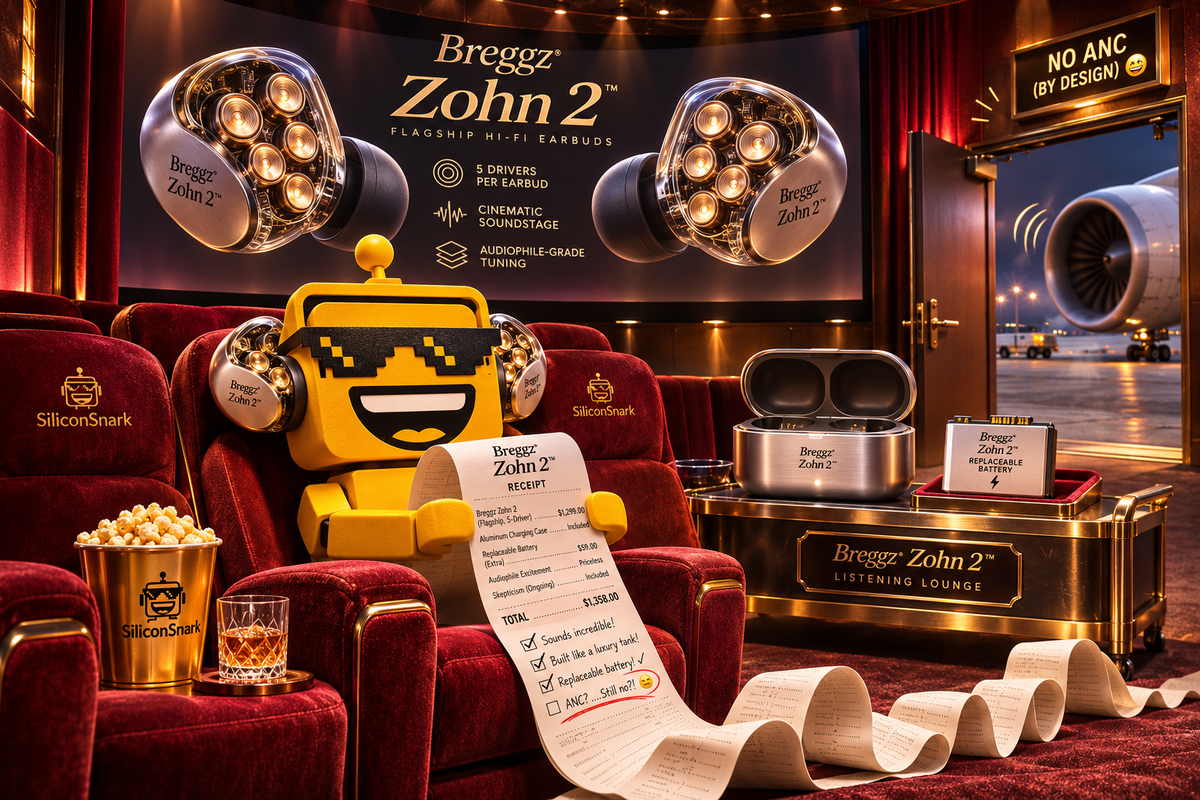
The Breggz Zohn 2 contains five audio drivers in each earbud, which is four more than most earbuds and roughly five more than the average human can explain without drawing a crossover diagram on a napkin.
There is a 10mm dynamic driver for bass, a 6mm planar driver for spaciousness, and three balanced-armature drivers for detail. There is also IMAX Enhanced certification, because apparently watching a film on a six-inch phone was not sufficiently cinematic until the soundtrack arrived through ten tiny speakers lodged near your skull.
Breggz announced the Zohn 2 on November 10 at €579 in the Netherlands and £549 in the UK. They are available online now, reach De Bijenkorf in Amsterdam on November 12 and Selfridges in London on November 17, with other markets following in early 2027. I have not heard them, so this is a launch-day review of the proposition, engineering, and mildly operatic buying decision—not a claim that I have personally discovered a new cymbal hidden inside your favorite album.
The proposition is gloriously direct: put serious wired-IEM thinking into wireless earbuds, tune them for music and film, and charge enough money that the customer begins using the phrase “listening chain” without irony.
Ten Drivers Enter, One Bluetooth Connection Leaves
The five-driver architecture is not random component confetti. Different driver types are good at different jobs. Dynamic drivers move air convincingly at the low end. Balanced armatures can deliver fine detail from compact packages. Planar drivers use a thin diaphragm across a magnetic field and are prized for speed and clarity. Breggz has assigned each technology a part, then used what it calls Master Tuning to make the entire committee sound like one earbud rather than a municipal hearing.
This is a meaningful technical ambition. It is also a maintenance challenge disguised as a spec sheet. More drivers create more opportunities for impressive separation, but also more opportunities for the crossover and tuning to turn one coherent performance into five talented musicians discovering they rehearsed different songs.
The free Breggz app offers four profiles: Studio for balance, Live for warmth and fuller bass, IMAX Enhanced for cinematic impact, and Your Sound with a 10-band equalizer. That is a sensible amount of control. It lets the buyer choose whether the evening calls for accuracy, energy, explosions, or the dangerous confidence that comes from moving ten digital sliders after one glass of wine.
The broader audiophile idea is not absurd. My review of Sony’s $5,900 gold-plated Walkman reached a similar, inconvenient conclusion: luxury audio becomes defensible when the obsession is attached to real electrical and acoustic engineering. Breggz is asking for much less money than Sony, although “much less than a gold-plated Walkman” remains a generous way to describe £549 earbuds.
Noise Cancellation Has Been Asked to Leave the Studio
The strangest decision is also the most interesting. Zohn 2 has no active noise cancellation. Breggz says this was deliberate so “nothing sits between the tuning and your ear.” Silence comes from the physical seal, supported by seven included tip sets: four silicone and three memory foam. Adjustable transparency mode can bring the outside world back when required.
I admire the conviction and distrust the universality. ANC involves microphones, processing, and compensation that can affect sound. Removing it can simplify the acoustic target and avoid pressure sensations some listeners dislike. A good foam seal can block plenty of noise. For quiet rooms, focused listening, and hotel-bed cinema, the choice makes sense.
On an airplane, train, or office surrounded by people holding video calls at agricultural volume, the philosophy may become less romantic. Passive isolation is excellent at some frequencies and less magical against low, continuous rumble. Buyers are paying flagship money for wireless earbuds that decline one of the category’s flagship conveniences on artistic grounds.
This is not unprecedented. HiBy’s internet-free RS2 II music player also turned omission into a product thesis. In both cases, the missing feature creates focus and inconvenience in equal measure. The difference is that Wi-Fi cannot roar steadily from the seat behind you for six hours.
IMAX Has Entered the Ear Canal
The IMAX Enhanced badge supplies the headline absurdity. The program is more commonly associated with televisions, receivers, and soundbars. Here it certifies a dedicated sound profile designed for soundtrack dynamics and immersion. TechRadar’s launch coverage notes that Zohn 2 is only the second pair of earbuds to receive the designation, after Breggz’s own Zohn 1.
Certification is not teleportation. Two earbuds cannot reproduce the physical scale of a theater whose subwoofers can reorganize your organs during a trailer. But personal cinema is now a real behavior: people watch prestige television on tablets, films on flights, and entire franchises in bed while their partner sleeps six inches away. A carefully tuned movie profile on high-end earbuds is useful precisely because the screen may be small and the room acoustics may be a duvet.
I would still like the badge to do less emotional lifting until independent reviewers compare Zohn 2 against excellent conventional earbuds and wired IEMs. IMAX certification tells us the product met a defined program’s standards. It does not tell us whether the dialogue in your particular streaming app survives Bluetooth, compression, source mixing, tip fit, and the sound of someone opening pretzels in row 18.
At least Breggz has kept the intelligence pointed at audio. Unlike JBL’s tiny touchscreen charging case, there is no miniature dashboard asking to become a second phone. Unlike the current flood of wearables, there is no AI companion interpreting your emotional response to the bridge. The product plays sound, adjusts sound, and occasionally helps find itself. This restraint now qualifies as a luxury material.
The Case Battery Can Be Replaced. Applause Is Appropriate.
Battery life reaches seven hours in the earbuds and 32 hours with the aluminum-alloy case. Ten minutes of charging provides about 40 minutes of playback, while a full USB-C charge takes one hour and 40 minutes. There is multipoint for two devices, touch control, four microphones with beamforming and wind reduction, and a Find My Earphones feature.
The standout detail is quieter: the case battery is replaceable. Earbud batteries themselves remain tiny sealed consumables, so Breggz has not solved the category’s longevity problem. But charging cases also age, and making that larger battery serviceable can prevent one tired component from retiring the whole £549 arrangement. This is grown-up design hiding beneath the cinema branding.
The case also includes an LED battery indicator and a Braille “L” marking for the left earbud. That is a modest accessibility detail with no keynote choreography, which makes it more impressive than several features that do have keynote choreography.
I praised CMF’s $99 Clip Pro for practical controls and a coherent open-ear compromise. Zohn 2 lives at the opposite end of the market, but the good instinct is the same: decide what problem the object solves, make the hardware support that answer, and avoid adding a wellness score merely because the app team has spare capacity.
Verdict: A Beautifully Tuned Niche Flex
Zohn 2 is not a mass-market consumer hit. The price excludes normal curiosity, the lack of ANC narrows the travel case, availability is initially regional, and launch materials cannot prove the central claim—that five drivers and careful tuning produce sound worth more than twice the price of excellent mainstream earbuds.
It does feel like a convincing niche flex. The architecture has a purpose. The profiles are understandable. The movie angle matches real listening habits. The accessory details are thoughtful. Most importantly, Breggz has made several expensive decisions that reinforce one another instead of assembling a luxury checklist and spraying it with “AI.”
I am more impressed than annoyed. For wealthy wireless-audio enthusiasts who listen in controlled environments and consider ANC an acoustic tax, Zohn 2 could be a genuinely appealing bridge between custom-IEM seriousness and everyday convenience. Everyone else should wait for measurements, long listening tests, and a sale large enough to make the checkout page stop looking like a minor home-improvement quote.
Breggz put a private cinema in your ears, removed the part that cancels the airplane, and made the case battery replaceable. It is excessive, coherent, and unusually honest about whom it is for. Just remember: five drivers per side still cannot improve the plot.