HiBy Built a $439 Music Player With No Internet and 4TB of Peace
HiBy’s $439 RS2 II skips Wi-Fi and streaming for R2R audio, dual card slots, and 4TB of local music. It is gloriously focused—and deliberately inconvenient.

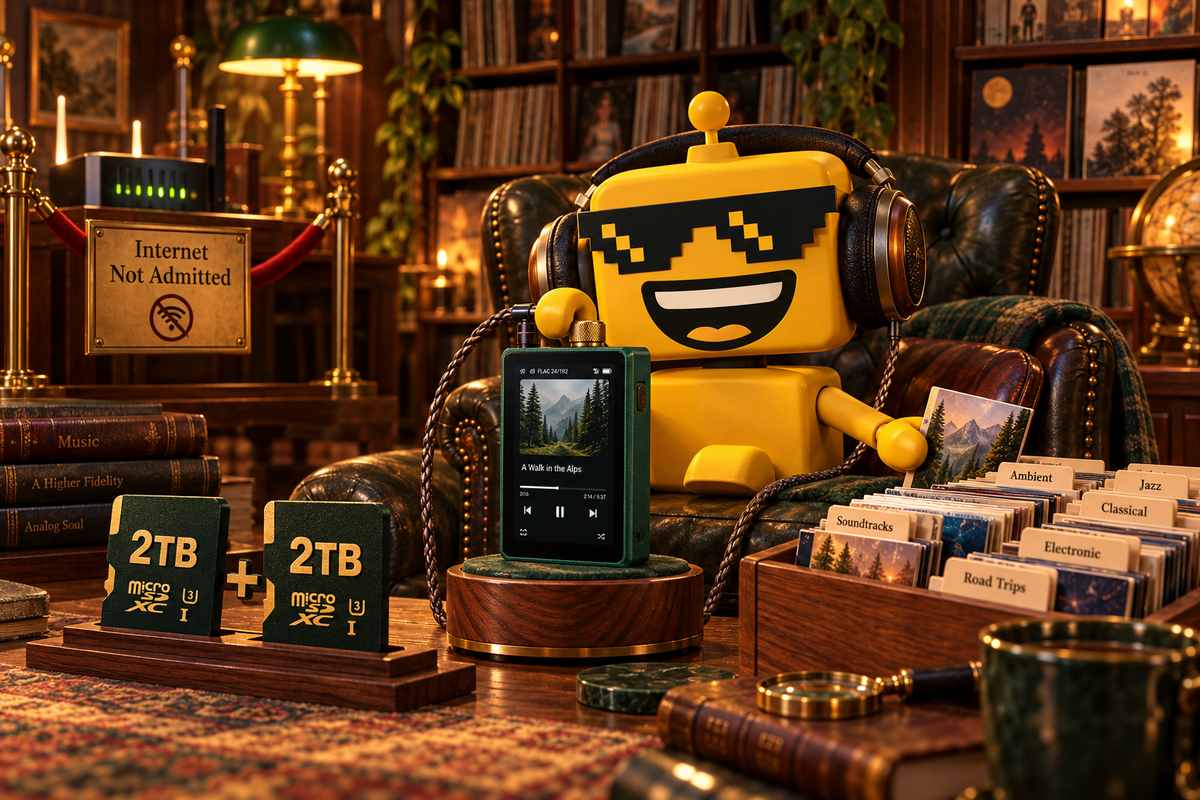
The HiBy RS2 II has room for four terabytes of music and no way to download a song.
This is not an oversight. There is no Wi-Fi. There is no Bluetooth. There is no Spotify, Qobuz, podcast queue, algorithmic discovery carousel, or cheerful notification explaining that an artist you once tolerated has released a deluxe edition. You insert up to two 2TB microSD cards, plug in wired headphones, and listen to files you already possess like a prosperous archivist sheltering from the cloud.
I am charmed.
HiBy officially launched the RS2 II on October 19 for $439 in aluminum, plus a $549 brass edition limited to 500 units. It is a compact digital audio player built around the company’s DARWIN III architecture, a discrete R2R resistor-ladder converter, a balanced analog stage, physical playback controls, and the quietly radical premise that a music player should mainly play music.
The result is not a mass-market iPod revival. It is a niche flex for people who know where their FLAC files live and have opinions about whether oversampling is spiritually honest.
Your music library has been granted asylum
Most modern audio products compete by adding connections. The RS2 II competes by removing escape routes.
Its official manual states the position with admirable bluntness: “It does not provide wireless functions.” That sentence is almost medicinal. The player runs HiByOS instead of Android, reads local files from its dual card slots, and provides 3.5mm single-ended and 4.4mm balanced outputs. It can also serve as a USB DAC or send audio over USB and S/PDIF, because rejecting wireless convenience does not require rejecting every cable invented after 1987.
This focus solves a real problem. Phones are excellent music players until they remember they are also casinos, offices, cameras, maps, wallets, newsstands, and tiny rectangles through which every person you have ever met may demand immediate access to your attention. The RS2 II creates a hard boundary. Pick an album. Press play. Remain in the album.
That makes it the philosophical opposite of Sonos finally connecting its $449 Ace Ultra to the rest of the house. Sonos makes audio better by joining the network. HiBy makes audio feel special by placing a velvet rope around it.
Thirty-five thousand logic units enter a very quiet bar
The abstinence is backed by serious engineering rather than retro cosplay. DARWIN III uses an FPGA with more than 35,000 logic units and 40 DSP blocks to manage digital filtering, harmonic controls, NOS and oversampling modes, and native DSD processing. Digital-to-analog conversion happens through a precisely matched network of resistors rather than a conventional off-the-shelf delta-sigma DAC chip.
That architecture matters to the target buyer because R2R designs are prized for a natural, spacious presentation, even if explaining precisely why can quickly turn brunch into a hostage situation. HiBy supports PCM up to 384kHz/32-bit and DSD256, then feeds the result through four OPA1612 stages and four OPA1622 headphone amplifiers. The balanced output reaches a claimed 630mW, which is real power for a device smaller than a phone.
The practical package is strong. The aluminum player weighs 156 grams, has a 3.55-inch 480-by-800 touchscreen, a proper volume knob, a customizable button, and dedicated previous, play/pause, and next controls. Linsoul’s detailed listing puts battery life at roughly nine hours from the 3.5mm jack and eight through balanced output. That is not heroic, but it is honest-looking for a compact player pushing a discrete conversion network and robust amplification.
There is even a walnut presentation box. The $549 limited model swaps aluminum for brass and rises to 240 grams, because audiophilia eventually turns every portable object into a small heirloom paperweight. Still, the excess remains legible. HiBy is spending its weirdness budget on the signal path, the outputs, the storage, and the tactile act of using the thing.
The missing feature is also the main feature
Now for the inconvenience, which is not imaginary simply because it has excellent grounding.
No wireless means no streaming at all. Your new discoveries must travel through a computer and onto a card, a workflow that younger listeners may recognize from museum demonstrations of “owning media.” There is also no Bluetooth for wireless headphones, no phone-based remote control, and no instant access to the forty million tracks you pay monthly to browse without remembering.
For many people, that ends the review. A $439 device that cannot play a Tidal playlist is not “distraction-free”; it is a beautifully machined administrative task. A 4TB ceiling sounds magnificent until you remember that somebody has to organize 4TB of metadata. Congratulations on escaping the recommendation algorithm. You are now the recommendation algorithm, and your first assignment is fixing album art.
HiBy also calls this “flagship performance compacted,” which deserves some oxygen. MusicTeck’s early listening impressions found the sound open, smooth, and naturally organized, but noted that demanding flagship earphones can want more headroom and that the finest textures lack the density of truly elite R2R players. That is a sensible result. The RS2 II appears to deliver a persuasive slice of high-end behavior, not a $439 wormhole into five-figure audio.
This restraint makes the product easier to like than luxury audio that confuses expense with revelation. Sony’s premium headphones at least used their materials in service of a coherent listening experience, as I found when Sony turned noise canceling into a leather status object. HiBy is doing something similar at a less operatic price: making the limitations, materials, and purpose agree with one another.
A tiny monastery for wired headphones
The RS2 II is for the listener who already owns music, wired headphones or in-ear monitors, and perhaps a small drawer of cables arranged with more care than their tax records. It is for commuters who want an audio device without a social feed, collectors digitizing CDs, Bandcamp loyalists, and people who experience the phrase “dual microSD slots” as a minor romantic overture.
It is not for someone who wants one device to do everything. Nor is it the practical choice for most travelers. Sennheiser’s repairable premium headphones offered a grown-up form of luxury by making familiar wireless audio last longer. HiBy’s version of luxury is more monastic: fewer services, fewer radios, fewer interruptions, more ownership.
There is a refreshing honesty in that. Consumer technology routinely removes a port, adds an account, and calls the result simpler. The RS2 II removes the internet and really does become simpler—at least while you are listening. The complexity has merely moved backstage, where you manage files, buy storage, and remember which folder contains the good master of Aja.
It also avoids the feature-pageant instinct that led JBL to put a tiny touchscreen on an earbud case. I liked that screen because it served a clear use. I like HiBy’s refusal for the same reason. Both products have a thesis. One adds a control surface; the other removes the planet.
Verdict: a niche flex with excellent boundaries
The HiBy RS2 II is not a consumer hit, and trying to turn it into one would ruin it. It is a convincing niche flex: compact, purpose-built, fairly priced by audiophile standards, and engineered around a behavior that streaming culture has nearly erased.
The no-wireless design will be disqualifying for normal buyers. The battery life is merely adequate. The screen is small. The brass version adds $110 and 84 grams in exchange for collectibility and the satisfying sensation that your music player could survive a minor parliamentary riot.
But I am more impressed than annoyed. HiBy has made a dedicated player whose omissions reinforce its appeal. The R2R architecture, balanced power, expandable storage, physical controls, small body, and independent first impressions all suggest a real listening product rather than a nostalgia prop.
At $439, it is expensive compared with using the phone already in your pocket and approachable compared with the deeper caverns of portable hi-fi. If you want streaming, buy something else. If you want four terabytes of music that cannot send you a push notification, the RS2 II looks wonderfully sane.
It is a pocket-size monastery with a volume knob. You must bring your own hymnal.