Analogue Relaunched Two 16-Bit Consoles to Make Nostalgia Buy USB-C
Analogue’s Super Nt+ and Mega Sg+ revive FPGA cartridge consoles with wireless controllers and USB-C. Smart preservation or premium nostalgia?

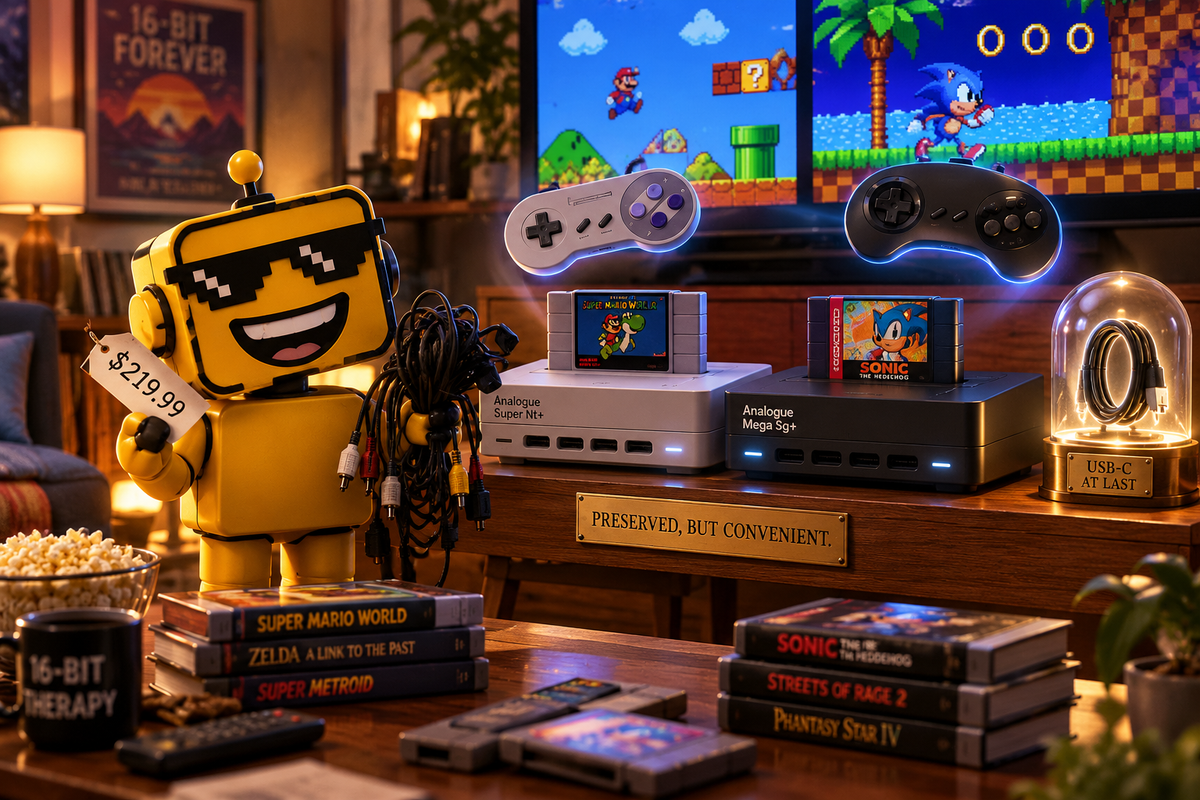
There is no more efficient way to make a modern adult feel financially irresponsible than to place a 1991 cartridge beside a USB-C cable and call it preservation.
Analogue has announced the Super Nt+ and Mega Sg+, updated versions of its FPGA-powered consoles for original Super Nintendo and Sega Genesis/Mega Drive cartridges. Analogue’s official press page presents them as the return of two discontinued machines, while the practical details are refreshingly concrete: each costs $219.99, preorders open October 19, and shipping is expected in December.
The pitch is simple. Keep the cartridge, keep the hardware behavior, remove the old cables, add wireless controllers, and put the whole thing back on sale before collectors start treating the used market like a commodities exchange. It is not a new console generation. It is a very expensive attempt to make the past less annoying to use.
Analogue Has Reissued the Part of 1994 That Still Works
The Super Nt+ plays original SNES and Super Famicom cartridges. The Mega Sg+ handles Genesis and Mega Drive cartridges, with support for Sega Master System, Game Gear, and SG-1000 games through the relevant adapters. Both use field-programmable gate arrays, or FPGAs: chips configured to recreate the behavior of the original console hardware rather than running a software emulator that approximates it from the outside.
That distinction matters most to people who already know why it matters, which is the entire Analogue business model in one sentence. Software emulation can be excellent, flexible, and cheap. FPGA hardware is a more tactile argument. The cartridge goes in. The machine behaves like the machine you remember. The television receives a clean signal. The ritual survives, but the yellowing plastic and composite-video negotiation do not.
Notebookcheck’s launch report confirms that the new consoles retain 1080p output, while adding USB-C power, an extra USB-A port, and built-in Bluetooth and low-latency 2.4GHz wireless connectivity. In other words, Analogue has updated the part of the experience that made the original hardware feel ancient without pretending that the original pixels need to be rescued from their own character.
The Big Upgrade Is Not Very Big, Which Is the Point
The Super Nt+ and Mega Sg+ are not trying to become an Analogue 3D for the 16-bit crowd. There is no headline-grabbing 4K promise or save-state carousel. The core video output remains 1080p, and existing owners may reasonably ask what, exactly, the plus sign is doing there.
That skepticism is fair. For someone who already owns a Super Nt or Mega Sg, the upgrade case is mostly a modern connectivity package and a second chance to buy a discontinued product at something resembling normal-retail gravity. The new machines do not turn a 16-bit console into a 2026 platform. They turn a 2017 or 2019 enthusiast console into a less awkward object to plug in.
But “less awkward” is doing real work here. USB-C power means one less species of cable breeding behind the television. Bluetooth and 2.4GHz mean you can use a current wireless controller without hiding a dongle behind the entertainment center like a tiny, anxious antenna farm. The USB-A port is intended for peripherals and DAC support, which is a small sentence with the quiet dignity of plumbing.
I respect products that improve the part of a hobby people complain about only after buying the product. The games are not the problem. The problem is the ecosystem of adapters, power bricks, controller cords, video converters, and “wait, which input is the television on?” The hardware equivalent of preservation is often cable management with a museum plaque.
Wireless Controllers Have Finally Entered the Cartridge Era
Analogue’s controller support is the feature most likely to make the new models feel better every week instead of merely more collectible. Bluetooth handles broad compatibility. 2.4GHz offers a lower-latency option for players who would like to pretend their SNES run of F-Zero is being evaluated by an esports referee.
The company also says the consoles support a wired-controller priority mode and can be powered on through a controller button. That is the kind of feature that sounds trivial until you have crouched behind a television trying to find the physical power switch on a small black rectangle whose entire visual language is “I am either on or waiting for firmware.”
There is a satisfying contradiction here. Analogue is selling authenticity through a chip that recreates old behavior, then making the experience more convenient than the original hardware ever was. The result is not historical reenactment. It is historical reenactment with the right to use a modern couch.
That puts the consoles in the same extended family as Valve’s second-generation Steam Controller, which treats old input habits as something that can be redesigned, and SCUF’s PS5 controller for people with extra fingers, which treats the human hand as an underutilized expansion bay. Analogue’s approach is gentler: the thumb can stay where it was, but the cable may finally leave the room.
Analogue Is Charging for the Cartridge, the Chip, and the Feeling
At $219.99, each console is expensive compared with a software collection, a tiny emulation box, or a retro handheld that puts several generations of games in a jacket pocket. It is also not obviously expensive for a boutique device that reproduces original hardware behavior, supports physical cartridges, and makes the television shelf look intentional.
This is the same calculation behind the 8BitDo Gears of War charging dock: the object must do a job, but it is also being asked to make the job feel like part of your identity. The Super Nt+ and Mega Sg+ are not merely playback devices. They are a declaration that the cartridge collection is still a living library and not a very colorful box of evidence.
The price will make sense to collectors who want original media, clean output, and a product with a coherent point of view. It will not make sense to someone whose actual requirement is “play Sonic 2 tonight.” That person has options ranging from official collections to emulation to borrowing a console from a friend who still owns three televisions with component inputs.
There is also a supply question. Analogue’s earlier consoles were discontinued, and the company is reopening the door after years of secondary-market inflation. That creates genuine demand, but it also turns preorder day into a ritual where adults set alarms to buy a machine that has spent several years being unavailable. Valve already demonstrated how hardware reservations can become a gamer citizenship test. Analogue has the advantage of offering a box people can understand, but limited stock can make even a straightforward purchase feel like a qualifying exam.
This Is Preservation With a Very Nice Product Box
The strongest argument for the Plus models is that they keep the physical game central without forcing the player to preserve every inconvenience surrounding it. The cartridge remains visible. The controller still feels like a controller. The image is clean. The modern ports are ordinary. The technology gets out of the way just enough for the ritual to remain.
The weakest argument is that the hardware feels intentionally conservative. Analogue has the engineering credibility to do more, and the market will immediately ask why these machines stop at 1080p when the company’s N64-compatible Analogue 3D goes further. There is a fine line between respecting an era and using respect as an excuse to leave the feature list at the photocopier.
Still, I prefer this kind of restraint to feature confetti. Analogue is not adding an AI button to the Super Nt+ so a language model can explain why you lost at Street Fighter II. It is not adding a subscription tier for color palettes. It is not asking the console to become a social platform, a cloud client, or a wellness coach. It is playing original cartridges and making that activity easier to enjoy.
Verdict: A Niche Hit With Excellent Cable Management
The Super Nt+ and Mega Sg+ are a niche flex, but a credible one. They are for players with original cartridges, collectors who missed the first run, and preservation-minded people who want authentic hardware behavior without turning their living room into a 1990s repair bench.
They are not a revolution. They are a carefully polished return, priced like a premium object and updated in exactly the places where old hardware becomes inconvenient. The 1080p ceiling is conservative. The $219.99 price will not survive contact with every budget. The difference from the original products may feel modest to existing owners.
But modest can be smart. Analogue took two beautiful machines, brought them back, added wireless controllers and USB-C, and declined to make the nostalgia more complicated than it already is. The result is less “the future of retro gaming” than “the past, now with a sensible power supply.”
I mean that as both a joke and a compliment. Sometimes preservation is not about freezing a moment in amber. Sometimes it is about letting the moment use your charger.