Money20/20 USA 2026’s Five Weirdest Finds Include IV Drips and Fraud Escape Rooms
Money20/20 USA 2026’s weirdest first-full-day finds: IV drips, fraud-company escape rooms, robot portraits, golden licenses, merch coins, and Timbaland.

After Monday’s first full show day, the fintech syllabus includes peptide patches, robot portraits, scavenger hunts, and Timbaland. Please expense responsibly.
The most revealing Money20/20 pitch might be the one that requires you to sit still while somebody checks whether you need a health waiver.
We made it to Monday, October 19—the first full exhibition day of Money20/20 USA 2026—and the advertised attractions already include IV hydration, an AI portrait artist, and an escape-room experience brought to you by people who fight financial scams.
In our Money20/20 preview, we asked for useful technology beneath the networking announcements. We have also found an emerging sector I will call Keeping the Networking Mammal Operational.
For this list, “day one” means Monday’s first full show-floor day, following Sunday’s opening program. These are reported finds from the organizers’ and exhibitors’ published programs; advertised features and performance are attributed to their hosts.
Now, please roll up your sleeve. We need to discuss state licensing.
1. A licensing booth offers to replenish your actual fluids
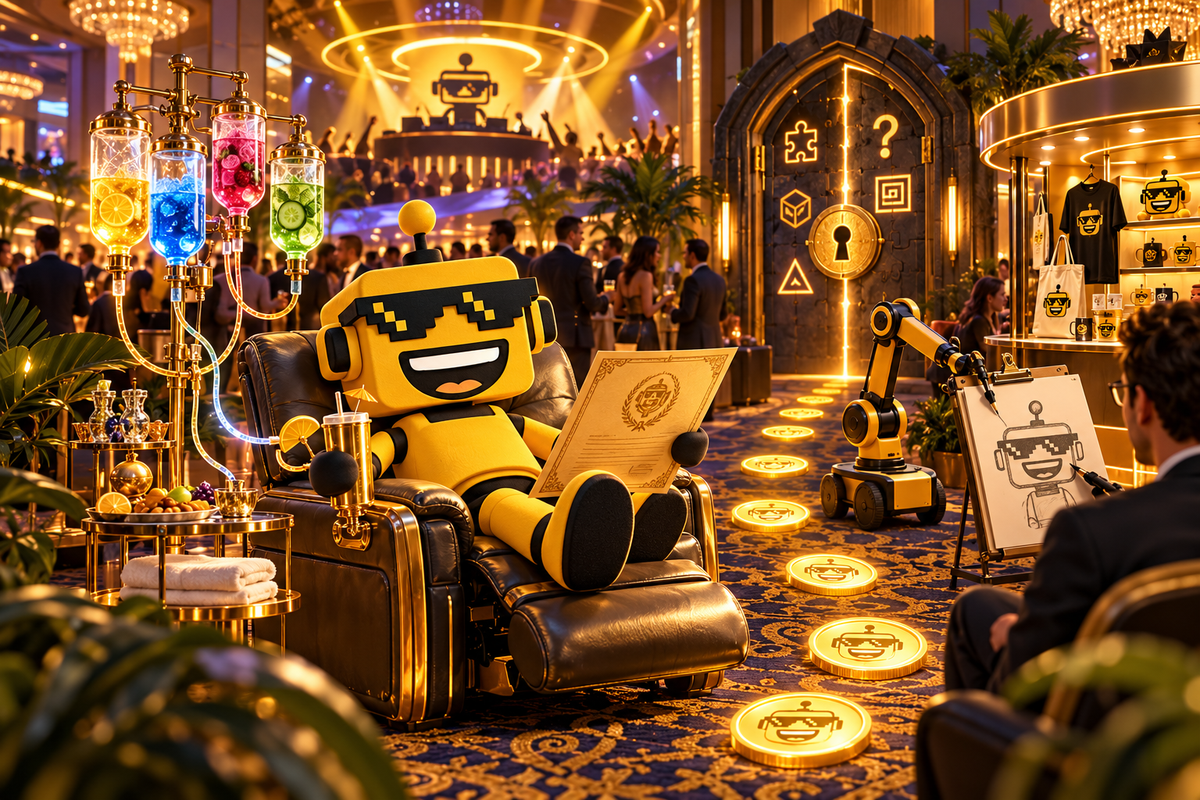
Brico’s Money20/20 program puts its recovery bay at Booth 4049 from Monday onward. The advertised menu includes IV hydration, vitamin B shots, peptide patches, AG1, and cold water. The company says licensed medical professionals administer the IVs and vitamin injections, with screening and a waiver potentially required.
Enterprise lead capture has reached the circulatory system.
The campaign calls this “Hydromaxxing.” I admire the precision. You arrive to discuss the administrative conditions under which money can move across state lines and discover that your own liquids have become a more urgent infrastructure project.
The marketing logic is exquisite: a licensing company has found a prospect who, for once, has a compelling reason to sit through a conversation.
“Can we get twenty minutes on your calendar?” has evolved into “How’s that vein?”
2. The fraud company wants you to enter an escape room
Charm Security builds AI tools for preventing and resolving scams, fraud, and cybercrime. For Money20/20, it has also developed a remarkably literal interpretation of customer retention.
Charm’s Great Escape Lounge offers meeting space, somewhere to work and recharge, and escape-room experiences at the Venetian’s Grand Canal Shoppes. The company’s own announcement dates the takeover to October 19–20.
Let me get this straight. A company concerned with human manipulation invites you into a room where somebody else has arranged the environment, concealed important information, and created time pressure.
That is either excellent thematic marketing or the most immersive procurement process in Las Vegas.
The sales funnel has become a floor plan. Somewhere, a marketing team gets to ask whether the prospect has escaped, and mean something more useful than “they stopped answering our emails.”
I like the underlying idea. Let a team solve something together instead of listening to a salesperson explain that the platform promotes collaboration. A working exit is also a more measurable outcome than “accelerating transformation.”
3. The identity people have a robot that draws your face
LexisNexis Risk Solutions’ Money20/20 announcement invites attendees to Booth 12061 for an AISketchBot portrait, which the company says can be created in under a minute.
Know your customer. Draw your customer. Give your customer something to carry around while explaining that they are extremely busy.
There is a beautiful tension in an identity-and-fraud company offering an AI-generated version of your face as a party favor. On one side of the booth: important conversations about establishing who somebody is. On the other: an extremely fast artistic opinion.
For years, corporate booth entertainment asked whether you wanted a caricature. Now it asks whether you want the future of work to produce a quick visual interpretation of your cheekbones.
We keep asking whether AI agents actually make money. This one has at least found a comprehensible assignment. One person. One portrait. One promised turnaround time. That is more operational clarity than some autonomous-enterprise pitches manage in an entire keynote.
Please give the robot a tiny beret. It has earned a professional identity.
4. Licensing and conference swag have become side quests
Brico’s program also advertises golden licenses hidden around the Venetian, with clues and prizes. Its Monday schedule lists clues two and three. The company calls the hunt “Nostalgiamaxxing,” a word that should require its own application fee.
We have gamified obtaining paperwork. Somewhere, an attorney has just discovered a new billing category.
And there is a parallel economy. Money20/20’s official attendee guide tells visitors to find Merch Coin Hunt QR codes around the venue, collect digital merch coins, and exchange them at the Merch Box. It also promotes a photo opportunity with the MoneyBot.
At a conference about moving money efficiently, attendees can voluntarily adopt an additional currency whose purpose is acquiring conference merchandise.
This is the fintech version of a video-game quest. Explore the map. Collect the tokens. Find the merchant. Receive an item you must now fit into your luggage.
I respect the consistency. An industry capable of building layers of infrastructure around a dollar has built a miniature economy around getting the souvenir. Even the swag has settlement instructions.
5. Timbaland is on the official fintech party bill
Monday’s official evening program takes the industry from payment infrastructure to a DJ set by Timbaland.
The organizer’s Money by Night listing books the producer for OMNIA at Caesars Palace, October 19, from 8:30 to 11:30 p.m., with entry reserved for Money20/20 USA 2026 attendees.
A conference badge has many functions: identification, access control, a convenient way to forget someone’s name while staring directly at it. Now add “Timbaland credential” to the product requirements.
Celebrity conference entertainment is hardly new. What earns this a place is the whiplash of the complete Monday proposition: discuss fraud, get a robot portrait, potentially visit a recovery booth, then arrive at a nightclub with the same credential that got you into the payments conversation.
Our stablecoin reporting spends a lot of time explaining the machinery beneath digital dollars. It is reassuring to know that somebody has also remembered to fund the speakers. The loud ones.
For once, “the rails are moving” might just mean the bass is good.
The humans are the least scalable part
My reading of these five finds is that the future of finance remains stubbornly dependent on bodies. Bodies that get tired. Bodies that need somewhere quieter to sit. Bodies that will remember the robot portrait more vividly than the third slide about interoperability.
There is something almost sweet about all this machinery for starting a conversation. The industry can automate a payment, but getting two people to stop checking their calendars still calls for a puzzle, a prize, or a famous producer.
One full show day, and we have already reached intravenous business development.
By Wednesday, the tote bags will need discharge instructions.