Sonos Ace Ultra Finally Joined the Sonos System. That Took $449.
Sonos Ace Ultra adds direct speaker handoffs, stronger ANC, and 35-hour battery life for $449. The obvious upgrade is also the right one.

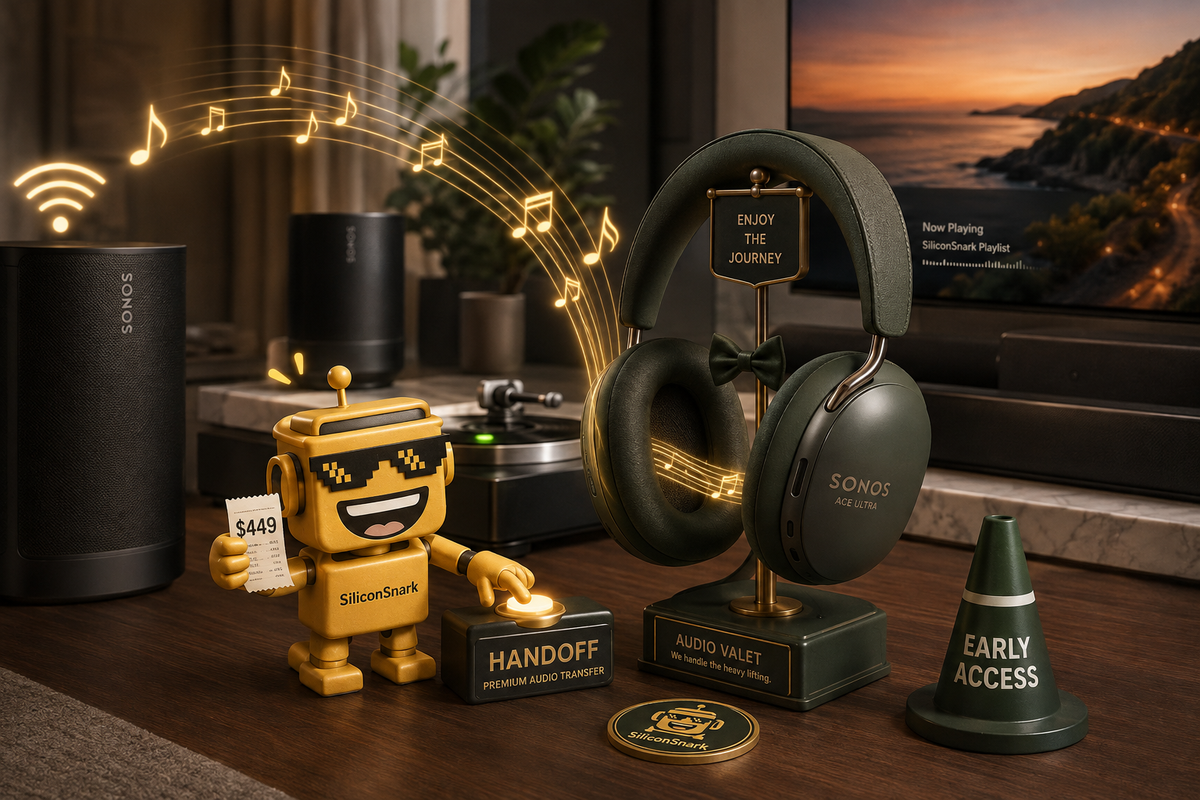
There is a button on the new Sonos Ace Ultra that moves whatever is playing on your speakers directly into your headphones. Press it again, and the sound goes back into the room. Playlist, movie, vinyl: out of the furniture, into your skull, then back to the furniture.
This is delightful. It is also the feature many people reasonably assumed Sonos headphones would have when Sonos launched headphones two years ago.
On September 1, Sonos announced the Ace Ultra, a $449 pair of noise-canceling over-ears that ships September 29 in black, soft white, sand, and a tasteful green called agave. The official Sonos Ace Ultra product page promises new 40mm drivers, adaptive noise cancellation, ten microphones, lossless audio, spatial audio, up to 35 hours of battery life with ANC on, and—finally—a direct Wi-Fi connection to the wider Sonos system.
It is a premium sequel built around fixing the original product’s identity crisis. That may sound like faint praise. It is not. Consumer technology is full of second-generation devices that add a titanium hinge, three AI nouns, and a color borrowed from a beverage. Sonos looked at the Ace, found the missing thesis, and rebuilt around it.
The Headphones Have Been Granted Speaker Citizenship
The original Ace could swap television audio from compatible Sonos soundbars, but it was not a fully integrated member of the whole-home system. That was peculiar in the way a Ferrari-branded wheelbarrow would be peculiar: possibly excellent at its assigned job, but not the brand experience anyone was picturing.
Ace Ultra fixes that with “headphone linking.” At home, you can use the Content Key or the Sonos app to push and pull music between compatible speakers and the headphones, including audio that began as a record playing through a Sonos-connected turntable. The headphones can also stream music over Wi-Fi from services inside the app. This is the product’s killer feature because it makes the ecosystem tangible. Sonos is no longer merely selling competent Bluetooth headphones with a famous surname. It is selling a private room inside your Sonos house.
That idea fits what I liked in Google’s attempt to make the home speaker feel natural again: the best smart-home features remove a ritual. Press one control and keep listening while the rest of the household escapes your podcast. No pairing ballet. No source archaeology.
There is one asterisk large enough to receive mail. Headphone linking launches in Early Access, is opt-in, and is explicitly offered “as-is” while development continues. Sonos is therefore centering the upgrade around a feature that arrives wearing a beta badge. After the company’s famously rough 2024 app overhaul, asking customers to treat software confidence as an accessory is bold. Still, the feature is real, legible, and pointed at an actual inconvenience. I would rather see Sonos carefully finish the obvious idea than invent a synthetic DJ who asks about my mood.
Ten Microphones Enter, Your Air Conditioner Leaves
The rest of the hardware pitch is less surprising and mostly encouraging. Sonos says the new adaptive ANC is up to twice as effective as the original Ace at key frequencies. Ten microphones handle noise control, calls, ambient Aware mode, and TrueCinema processing. Adaptive EQ compensates for acoustic leaks caused by glasses, hair, fit, and head movement, which is an impressively diplomatic way to tell your hairstyle that it has entered the signal chain.
The new 40mm drivers promise deeper bass, finer detail, and zero distortion. I have not heard the headphones, so I cannot confirm that the artist’s intent survived its meeting with Bluetooth and a playlist named “Focus Energy.” But the stack is credible: aptX lossless on supported devices, wired USB-C audio, Dolby Atmos, dynamic head tracking, and three- or eight-band EQ.
Physical controls remain, thank civilization. The Content Key handles volume, playback, calls, and system handoffs, while separate controls manage noise modes and Bluetooth. This is the kind of restraint that made CMF’s physical case dial more useful than its mildly theatrical branding suggested. Premium audio products spend too much time sanding away buttons until basic operation feels like solving a polished black riddle.
At 322 grams, Ace Ultra is not especially light, so comfort will depend on clamping force and weight distribution. The design is handsome but conservative: rounded cups, matte finishes, no exposed cybernetic tendons. Sonos even offers a $49.99 stand, because a $449 headphone apparently requires a tasteful valet.
Thirty-Five Hours, Three Minutes, One Sensible Repair
Battery life rises from 30 hours on the original Ace to 35 hours with ANC or Aware mode active. Three minutes of charging can provide up to three hours of playback. Those numbers will not overthrow the category, but they clear the important threshold where charging stops becoming a daily administrative role.
The quietly excellent detail is the replaceable battery. Sonos lists a $25 replacement kit and $39 replacement ear cushions, while the headphones use recycled materials and plastic-free packaging. That is much more meaningful than an animated leaf in a setup screen. Wireless headphones are consumable electronics largely because batteries and cushions age before the expensive drivers do. Making both replaceable gives a premium price a better long-term argument.
Sennheiser recently made the same sort of grown-up move with replaceable batteries in its flagship earbuds, and it deserves to become a category expectation. The strongest premium features are often not futuristic at all. They are the ones that let a product remain a product instead of gradually becoming a beautifully engineered e-waste chrysalis.
Ace Ultra is more coherent than the screen-on-everything school represented by JBL’s tiny touchscreen earbud case. Sonos is making the opposite bet: keep controls physical and put the cleverness into the handoff. Both approaches can work. Only one requires your case to develop a user interface roadmap.
The $150 Question Wearing a $449 Headband
Price is where Sonos turns a clean argument into a difficult checkout page. Ace Ultra costs $449, while the original Ace now sells for $299. That is a $150 ecosystem toll for better cancellation, five more rated battery hours, new drivers, two extra microphones, Wi-Fi linking, and access to sand.
For someone who already has Sonos speakers around the house, the premium can make sense. The handoff is not spec-sheet glitter; it changes how the headphones participate in daily listening. For everyone else, Ace Ultra enters brutal territory occupied by excellent Sony, Bose, Apple, and Sennheiser alternatives. Without a Sonos system, the star feature becomes a menu item you cannot order. You are left with a promising but untested premium headphone that weighs 322 grams and costs as much as a respectable weekend away, provided your weekend has agreed to exclude lodging.
Sonos introduced the headphones alongside Beam Ultra and its renamed Sonos 27 software. In the company’s September 1 announcement, “Sonos Fabric” lets products adapt as sound moves around the home. The plumbing is the point, although naming it Fabric is how you know a strategy deck has achieved consciousness.
I am cautiously optimistic. Sonos has chosen interoperability inside its own ecosystem as the reason for Ace Ultra to exist, which is both obvious and correct. The launch would be stronger if headphone linking were finished rather than Early Access, and the price would feel friendlier at $399. But the product has a clearer purpose than the first Ace, thoughtful repair options, serious audio hardware, and refreshingly normal controls.
Verdict: A Niche Hit That Finally Knows Its Family
Ace Ultra feels like a niche hit defined by household topology. If your home contains a Sonos soundbar, speakers, and perhaps a connected turntable, these may be the headphones that complete the map. One-button audio handoffs are the kind of low-drama convenience that becomes indispensable after a week.
If you do not own Sonos gear, wait for listening tests and compare aggressively. Better ANC, repairable parts, lossless options, and 35-hour battery life are appealing, but the category is too accomplished for promises alone to justify $449. As Motorola’s much cheaper Bose-tuned earbuds reminded us, competent personal audio no longer requires joining a premium ecosystem with bylaws.
Still, I like the Ace Ultra more than I expected to. Sonos did not reinvent headphones. It made Sonos headphones that finally understand the Sonos part. That should have happened the first time, yes. But consumer tech redemption often looks less like genius than like a company returning to the scene of an obvious omission with better engineering and a straight face.
The result is expensive, slightly overdue, and genuinely clever. In other words, it is now unmistakably a Sonos product.