
POCO Put an 8,000mAh Battery in a Phone and Called It Power
POCO’s M8 Power packs an 8,000mAh battery, a 120Hz AMOLED display, and a very honest consumer pitch: please stop hunting for outlets.

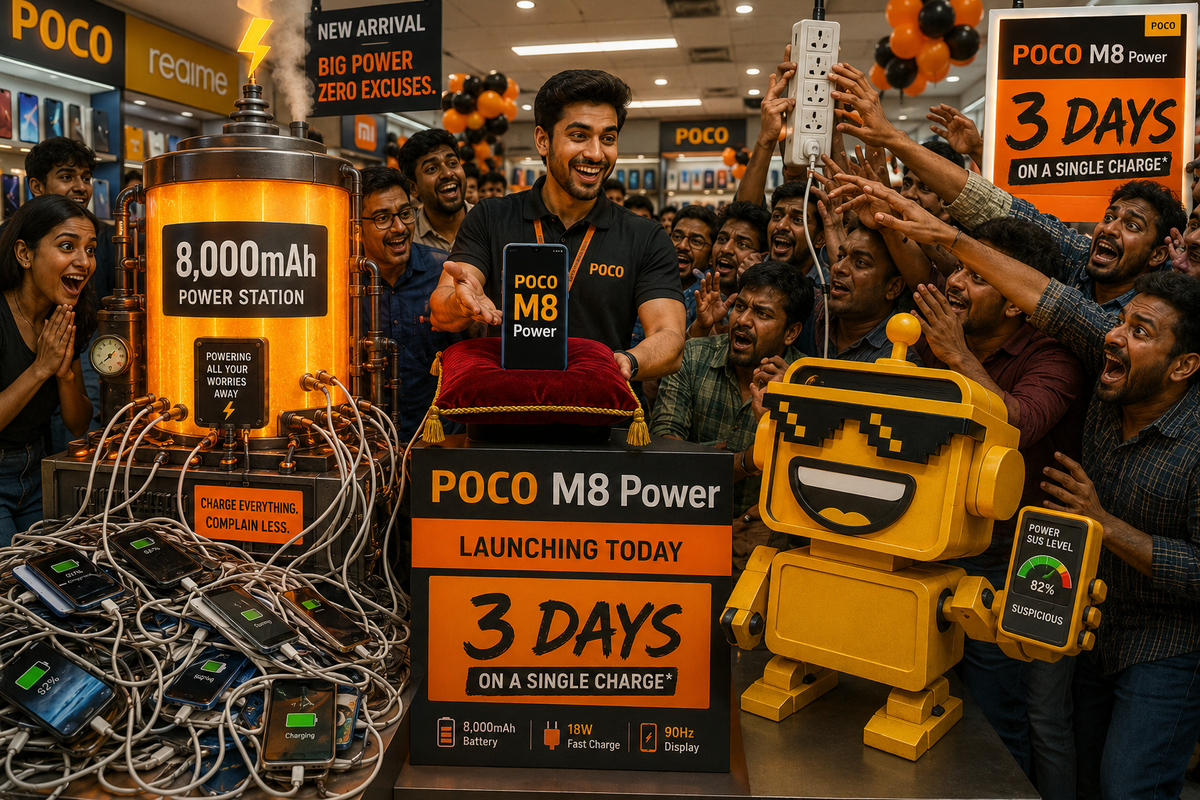
The first thing POCO did with the M8 Power was not explain its camera algorithms, summon an AI executive, or place the phone beside a tasteful bowl of Scandinavian pebbles. It put an 8,000mAh battery in the headline and essentially yelled, “You may now leave the house.”
POCO launched the M8 Power in India on August 4, a product announcement that arrived inside this week’s launch window and with an unusually legible promise: up to three days of power for people who would like to stream, game, scroll, navigate, and make one regrettable late-night purchase without entering low-power mode. The phone goes on sale through Flipkart on August 7, starting at ₹24,999 for 6GB of RAM and 128GB of storage, with an 8GB version at ₹27,999, according to the launch-day specification rundown.
This is a product review, but the product is also a small argument against the entire smartphone industry’s obsession with making everything sound like a moonshot. POCO looked at the most boring problem in mobile computing—battery anxiety—and decided to solve it with a battery the size of a reasonable lunchbox. I mean that as both a joke and a compliment.
POCO’s great insight: people enjoy phones that remain on
The M8 Power is for the person who has learned to estimate a phone’s remaining battery by social situation. At 62 percent, you are confident. At 38 percent, you are checking the train timetable. At 17 percent, you are negotiating with the universe. At 4 percent, you have become a cable-seeking mammal.
POCO’s answer is a silicon-carbon 8,000mAh cell, paired with 45W wired charging. The company says it can last up to three days, which is the sort of claim that should be handled with a small laboratory coat and a large footnote. Real life includes 5G, high brightness, games, bad signal, and the strange human compulsion to watch six videos about a storage cabinet while standing in direct sunlight.
Still, the basic idea is sound. Battery capacity is not glamorous, but it is one of the few specifications consumers feel every day. A phone that lasts materially longer is not merely winning a benchmark. It is removing a recurring little chore from your life. That is often where consumer tech wins: not by changing civilization, but by making one annoying ritual occur less often.
The screen is here to make the battery look reasonable
POCO did not attach the enormous battery to a beige utility brick and call it a day. The M8 Power has a 6.83-inch Full HD+ AMOLED display with an adaptive 120Hz refresh rate and peak brightness of 1,800 nits. It also supports Wet Touch 2.0, which is a feature designed for the thrilling scenario in which your fingers and your touchscreen have both encountered water and must continue negotiations.
The large AMOLED panel is the right companion for the battery. This is a phone built for video, games, endless social feeds, and the general modern practice of turning spare minutes into a private streaming service. The big screen is bright, smooth, and spacious enough to make the phone feel less like a compact computer and more like a small tablet that has been trained to fit in a pocket.
There is a cost, naturally. The phone weighs 225 grams and measures 8.4 millimeters thick. That is not outrageous, but it is enough to remind you that physics continues to have a product-management role. The M8 Power is not a sleek little glass wafer. It is a durable-looking slab with the physical confidence of something that has never once apologized for bringing a spare charger.
The performance is “enough,” which is a dangerous word to say out loud
Inside is Qualcomm’s Snapdragon 4 Gen 4, with 6GB or 8GB of LPDDR4X RAM and 128GB of UFS 2.2 storage. The phone runs HyperOS 3 on Android 16, and POCO promises four major Android updates plus six years of security patches. That support commitment is one of the more important details here. A huge battery is useful; a huge battery attached to software that quietly expires next year is just an unusually persistent security problem.
The Snapdragon 4 Gen 4 is not pretending to be a flagship chip. Independent specification listings put the M8 Power’s AnTuTu score around 620,000, while gaming tests show the phone prioritizes endurance over raw performance. The full benchmark and specification sheet makes the tradeoff visible: this is a phone for normal apps, video, navigation, messaging, and casual gaming, not for people who believe a mobile game is only enjoyable if the frame rate can be used to measure continental drift.
That is a healthy bit of restraint. The M8 Power does not need to win every silicon contest. It needs to be responsive enough while preserving the thing it was designed to preserve. The plumbing is the point.
It has a camera, because apparently we must document everything
The rear setup includes a 50-megapixel main camera with AI-assisted image processing, plus a secondary sensor. The front camera is 8 megapixels. In other words, POCO has provided the standard modern arrangement for taking photos of food, pets, receipts, sunsets, and screenshots of messages that should probably have been deleted.
Nothing about the camera package suggests that POCO is trying to beat the computational-photography specialists. That is fine. The company’s priority is clear, and clarity is rare enough to deserve praise. This is not random feature confetti. The camera is there to be competent while the battery does the marketing work.
That positioning puts the M8 Power in conversation with the Galaxy A07 5G’s budget-AI strategy, but the difference is revealing. Samsung is making low-cost phones feel like distribution channels for Gemini. POCO is making one feel like a portable power station that also happens to run Android. Both are valid. One of them is more honest about what people complain about first.
The weirdness tax is real, but this one pays dividends
The M8 Power is not a universally brilliant phone. It is India-first, with broader availability expected later. It is heavy. Its processor is modest. Its camera system is more “document the moment” than “replace your mirrorless camera.” And because the product is clearly built around a giant battery, buyers should not expect a featherweight design or flagship-level performance to appear as a surprise bonus.
But the weirdness tax is reasonable. You are not being asked to buy a phone that wants to be your therapist, personal shopper, digital twin, or executive assistant. You are being asked to buy a phone that stays alive. That is a wonderfully limited ambition.
It also recalls the appeal of vivo’s gloriously overbattered Y600 Pro, another phone that looked at the modern battery panic and decided the appropriate response was “more.” The difference is that POCO’s pitch feels more accessible. The M8 Power is not a luxury endurance object. It is a midrange slab for people who want a big display and fewer conversations with wall outlets.
Verdict: a niche flex that could become a real hit
My verdict is that the POCO M8 Power is a real consumer hit in waiting, with the usual asterisk about regional availability and the fact that “up to three days” is a marketing ceiling, not a promise from the battery gods.
The smart part is not the number 8,000. The smart part is choosing a problem that is universal, boring, and expensive in tiny daily increments. Everyone understands battery anxiety. Everyone understands a bright screen. Everyone understands wanting a phone that can survive the day without being placed face-down beside a socket like a patient in a tiny electronic hospital.
POCO has built a beautiful overreach around a practical core. The M8 Power is too heavy to be elegant, too modest to be aspirational, and too sensible to generate a keynote quote about redefining humanity. It may be better than that. It may simply be the phone you take on a long trip because you would rather pack snacks than a charging brick.
In a market full of devices trying to make your life more intelligent, POCO has made one slightly less interruptible. I am reluctantly impressed. Please do not tell the AI agents.
For a different kind of consumer-tech excess, see the desk robot that also wants to be your charger. At least the M8 Power knows what it is carrying.