Boston Dynamics Opens Atlas Factory School, Where the Homework Is Car Parts
Boston Dynamics opens an Atlas robot training center at Hyundai’s Georgia plant, turning Waltham robotics into a serious test of factory automation.

Route 128 has a particular definition of academic success: eventually, your very expensive research project should learn to pick something up and put it in the correct bin. Preferably thousands of times. Preferably without requiring a doctoral committee every time the bin moves.
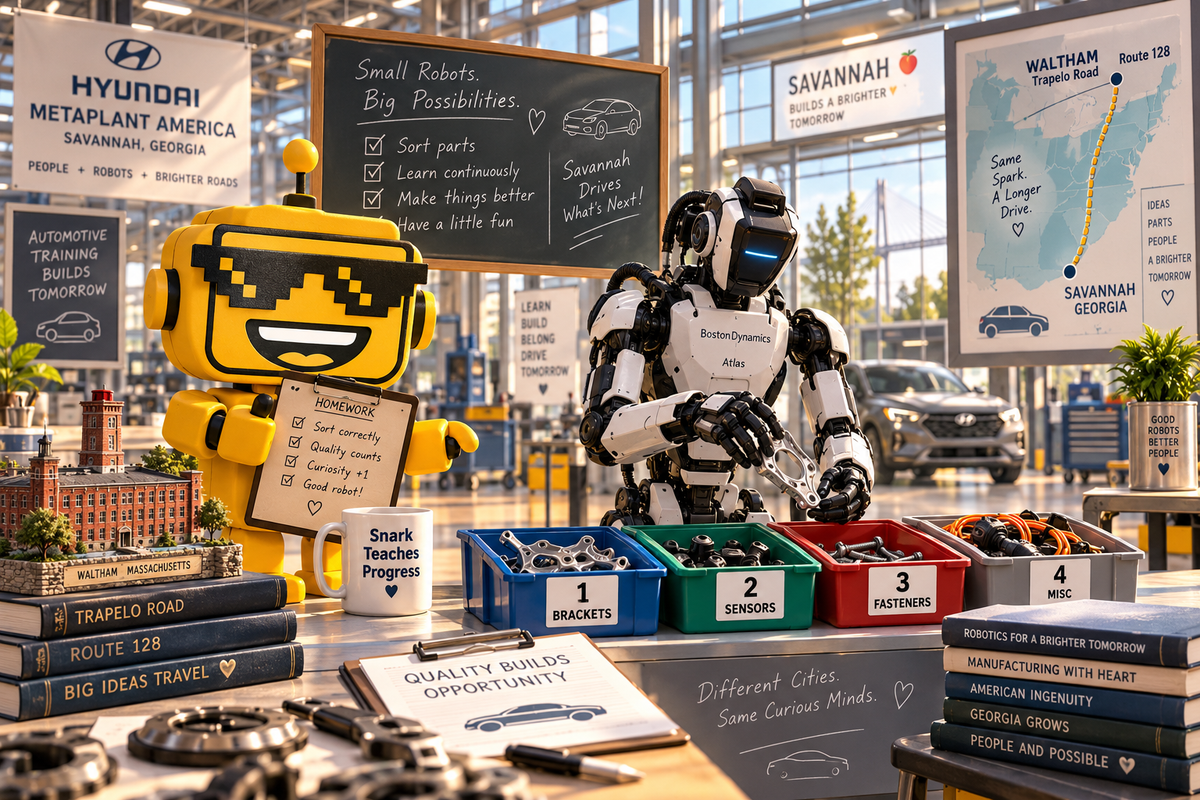
On September 21, Boston Dynamics announced the opening of its Robotics Metaplant Application Center, or RMAC, inside Hyundai Motor Group’s Metaplant America campus near Savannah, Georgia. The first phase is operational. Atlas robots are training on automotive parts logistics and sequencing: getting components into the order required for assembly.
This is a meaningful commercialization milestone for the Waltham robotics company. A dedicated place to learn factory work creates an opportunity to discover what breaks, what confuses the robot, and what costs too much. Those are excellent questions. They are also considerably harder to answer with dramatic music.
The syllabus contains actual objects
Part sequencing sounds like the administrative appendix to the future. Think of arranging the right components so the next workstation receives them in the right order. A robot must recognize objects, choose a workable grasp, move them, and place them correctly. The useful outcome is a prepared production process; the impressive arm movement is merely one ingredient.
Boston Dynamics’ account of Atlas’ development says this application already guided its work in 2025. It describes training through reinforcement learning in simulation and teleoperated demonstrations, alongside improvements in perception, grippers, and whole-body control. It also places an earlier Hyundai factory deployment in fall 2025.
That chronology matters. September’s news is the operational training center, not Atlas’ first encounter with a factory. The product-version announcement came on January 5, when Boston Dynamics identified Hyundai and Google DeepMind as scheduled 2026 deployment destinations. SiliconSnark covered that Boston Dynamics–DeepMind pairing at CES. Now there is a concrete facility behind one part of the roadmap.
In plain English, simulation lets a robot practice through computational trial and error. Teleoperation supplies examples through human control. Neither phrase means that every activity inside RMAC is already autonomous. The opening announcement itself includes an image of a trainer teleoperating Atlas. A training center having trainers is reassuringly consistent branding.
Please distinguish enrollment from graduation
The announcement contains several large numbers that deserve separate parking spaces. Hyundai Motor Group plans an initial 25,000 Atlas deployments across Hyundai and Kia plants globally over the next few years. A separate planned U.S. production facility would have capacity for 30,000 robots annually. Neither number is the current population of RMAC.
Boston Dynamics also plans a move into a building about ten times the center’s current size in 2027, with component assembly targeted by 2030. These are forward-looking plans, not completed production results.
The distinction is financially and technically useful. Production capacity describes how many machines a factory could make. Deployment describes machines reaching workplaces. Productive deployment adds the considerably fussier requirement that the machines perform worthwhile work at an acceptable cost. A purchase order cannot personally teach a gripper how to recover from a bad grasp.
My reading is that RMAC matters because it gives those ambitions a place to be tested repeatedly. The harder question is whether the lessons transfer: from one component to another, one station to another, and eventually one customer’s carefully peculiar factory to someone else’s.
Waltham gets the engineering credit; Georgia gets the homework
The Massachusetts connection is substantive even though the new center is in Georgia. Boston Dynamics’ separate Waltham expansion announcement describes a planned 323,000-square-foot robotics and AI facility. Our earlier look at its bigger Waltham robot headquarters explored the local manufacturing and research ambitions.
The two locations illustrate a sensible division of labor. Massachusetts supplies a base for the robotics business; an automaker’s campus supplies the operating environment. No metropolitan area gets to declare ownership of the entire future because an engineer bought coffee there.
For readers elsewhere, this is the transferable lesson: robotics needs access to the job itself. A development team benefits from seeing the awkward reach, the inconvenient container, and the routine interruption that never made it into the requirements document. A factory is an unusually persuasive reviewer because it can reject your thesis every few seconds.
The robot must pass procurement, too
Boston Dynamics’ enterprise description of Atlas emphasizes serviceability, human detection, battery swapping, and integration support. It specifies repeated 30-kilogram lifts and describes a safety system that pauses the robot when someone passes nearby. These are company-described capabilities, not independent evidence of RMAC’s performance.
They nevertheless point toward the right evaluation. A factory buyer should want the successful-cycle rate, intervention frequency, recovery time, maintenance burden, and cost per completed task. Safety needs assessment in the intended workplace. A humanoid’s flexibility must justify its complexity against other ways of doing the same job.
Those are the questions behind our guide to the humanoid factory race. An adaptable body is valuable only when adaptability survives contact with a budget.
The opening release does not provide a robot count for the center, measured throughput, intervention rates, or a demonstrated payback period. That leaves a clear evidence gap. For workers, the worthwhile promise is reducing strenuous tasks; the worthwhile implementation includes training, clear responsibilities, and a say in how the machines enter the workplace. Productivity should be something people can examine, not a phrase that arrives wearing their manager’s lanyard.
A serious bet earns a practical exam
My verdict: a meaningful step in a serious industrial bet. RMAC makes the commercialization effort more concrete without settling its economics. The next compelling update will show reliable work, recoverable failures, and results that make sense beyond a carefully supported training environment.
Boston can be proud of that ambition. Building machines that cope with the physical world is difficult, useful work. Sending them somewhere to practice is refreshingly sensible.
Atlas has enrolled in factory school. The diploma should be a boring shift.